

Episode 34
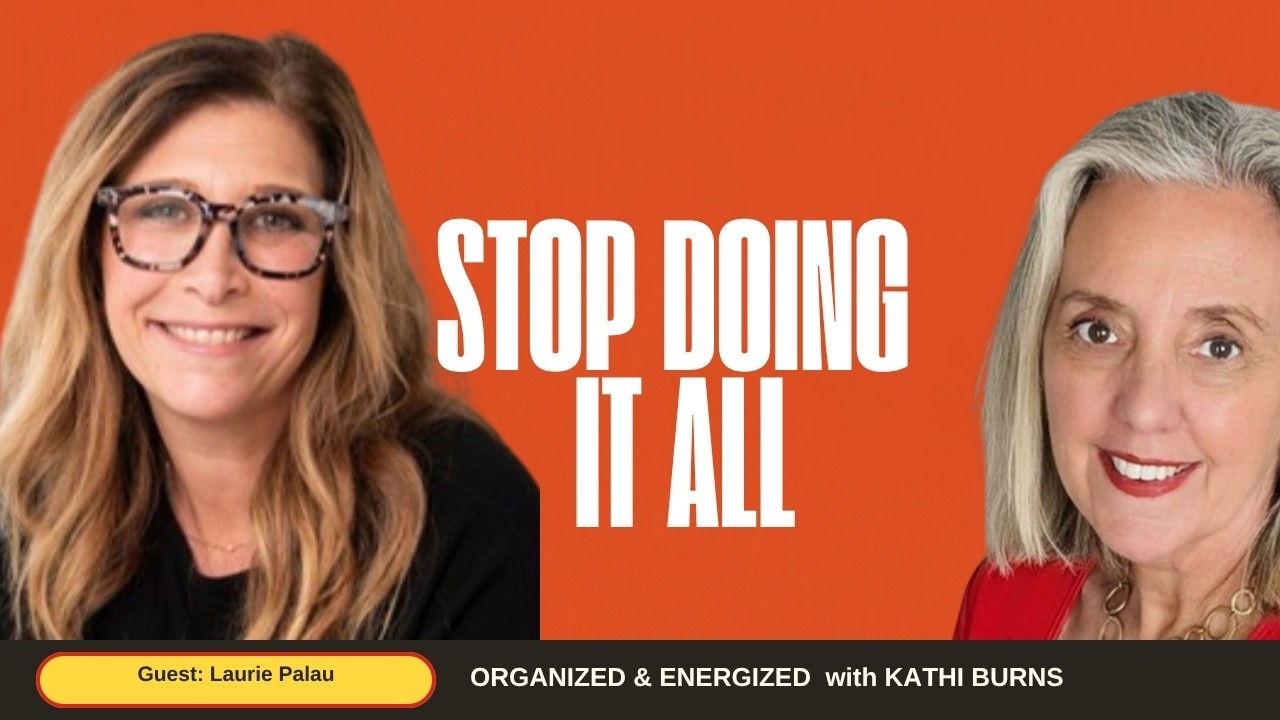
with Laurie Palau, professional organizer, founder of Simply B Organized and host of This ORGANIZED Life podcast · June 29, 2022 · 30 min
Laurie Palau spent 15 years as an executive recruiter before starting Simply B Organized in 2009.
She tells busy moms to run their household like a CEO runs a business: delegate, outsource, swap favors with a friend or ask a spouse for real help instead of doing every job alone.
Laurie says it is fine to tell people "not in this season of my life," and Kathi Burns suggests asking for a day to check your schedule before saying yes.
When she works from home, Laurie blocks her work time, keeps a hard stop and does not answer email before or after set hours.
Laurie uses Evernote with a notebook for each client, because she says organization is about how fast you can find something, not the act of putting it away.
Published · Updated
What is this episode about?
Organizing for busy moms starts with admitting you can't do it all. Kathi Burns, CPO®, Business FLOW Strategist, talks with Laurie Palau, founder of Simply B Organized and host of This ORGANIZED Life podcast. Laurie spent 15 years as an executive recruiter, then built her organizing business in 2009 after years of running a busy household mostly on her own. She explains why moms should see themselves as the CEO of their home and delegate, how to turn down requests by saying "not in this season of my life," and why every organizing project needs a maintenance plan. She also shares how she sets work and email hours when working from home, how she uses Evernote to keep client notes in one place, and why she tells young people to find something they're good at that they can make money doing.
Organization is about the ease of retrieval. It's not about the act of putting it away.Laurie Palau
Jump to links and resources · Part of How do I organize my home and closet? · All episodes · Every guest
What are the key takeaways?
- Laurie Palau compares a household to a business: no company has one person doing every job, so moms should delegate and outsource instead of wearing all the hats.
- Delegating can mean hiring help, doing a co-op swap with a friend or asking your spouse for actual help.
- Laurie says turning something down with "not in this season of my life" doesn't make you a bad person or a bad community member.
- Laurie builds a maintenance plan into her organizing projects because seasons change, kids grow and routines shift, and needing a tune-up doesn't mean the system failed.
- When working from home, Laurie works in set blocks with a hard stop and doesn't answer email before or after certain times.
- Laurie uses Evernote with a notebook for each client and warns against shiny object syndrome: pick one tool that works and stick with it.
- Her advice to young people is to find something you're good at that you can make money doing, then take small, deliberate steps and see how it evolves.
This episode is brought to you by the Business Logjam Session
A private 75-minute online session with Kathi Burns to find the one thing holding your business back and leave with your next steps. It is the same F.L.O.W. process Kathi uses with her own clients: Focus on your goals, Locate your logjams, Outline your solutions, Walk away knowing your next steps.
Find What's Holding Me BackInterested in sponsoring the show? Get in touch.How did Laurie Palau go from executive recruiter to professional organizer?
Laurie Palau spent 15 years as an executive recruiter, then started Simply B Organized in 2009, during the recession. She sees close parallels between finding out what motivated people to change jobs and what motivates them to streamline, declutter and organize, whether that is more freedom or more space. She jokes that starting a luxury service while people were losing their jobs was perfect timing.
How did Laurie Palau start organizing for busy moms?
Laurie started organizing for busy moms by helping friends with the routines she had built for herself. When her kids were babies, she ran most of the shopping, laundry, bills and childcare and relied on checklists, to-do lists, routines and habits to keep things from falling through the cracks. Years later she saw fellow moms struggling, some together at work but a hot mess at home, and a friend who is an interior designer told her to make it a business.
What does it mean to be the CEO of your home?
Being the CEO of your home means running your household the way a business runs: one person doesn't do every job. Laurie Palau saw moms handling every department themselves and not delegating. She says to step back and hire help if you can, swap favors with a friend, or ask your spouse for actual help.
What is the kindest way to say no when you're too busy?
Laurie Palau says you're allowed to tell people "not now, this is not in this season of my life." Saying you can't volunteer or help right now doesn't make you a bad person or a bad community member; it's a boundary. Kathi Burns adds a softer option: thank the person and ask if you can get back to them tomorrow after you check your schedule, which gives you time to think before you say yes.
Why does an organizing project need a maintenance plan?
An organizing project needs a maintenance plan because life keeps changing. Laurie Palau builds one into every project: swapping a garage from summer to winter, cycling out clothes as kids grow, or reworking spaces when the pandemic sent everyone home to work and school. She compares it to a seasonal fall or spring cleanup for your yard and says coming back for a tune-up doesn't mean the system or the organizer failed.
How do you use time blocking when working from home?
Laurie Palau works in a set block of time with a hard stop and doesn't fill it with laundry or dinner. As a recruiter with young kids, she dropped them at school, worked until her stop time, then switched to mom mode. She doesn't answer email outside set hours, which models healthy boundaries.
What is the best app for organizing client notes?
For Laurie Palau it's Evernote, though she says any tool that works for you is fine. She keeps a notebook for each client, adds notes after every call or visit, and searches it on any device to find details on the spot. She warns against shiny object syndrome: choose one tool and stick with it.
What is good career advice for young people who don't know what to do?
Laurie Palau tells young people to find something they're good at that they can make money doing, and see how it evolves. She stumbled into recruiting and then into organizing, and never pictured herself writing books, mentoring organizers or hosting a podcast in 2009. She credits a series of deliberate, small, actionable steps, and closes by urging women entrepreneurs to find a community that builds them up.
Where does each part of the conversation start?
- 0:00 Meet Laurie Palau
- 0:27 From executive recruiter to organizer
- 2:35 How motherhood made her organized
- 5:36 Be the CEO of your home
- 7:39 You don't have to do it all
- 8:54 Her first paying client: a playroom
- 11:32 Why organizing needs a maintenance plan
- 15:35 Working from home: time blocking
- 17:24 Set hours for email
- 19:20 Evernote: the tool that cut her stress
- 22:57 Avoid shiny object syndrome
- 24:00 Best advice: find what you're good at
- 27:33 Community over competition
- 29:17 Wrap-up
What resources were mentioned?
- Simply B Organized resources page
- Evernote
- Trello
- Asana
- Pomodoro method
- Clean Sweep (TV show)
- Hot Mess: A Practical Guide to Getting Organized by Laurie Palau
These episodes continue the same thread as this one: Donna Zalter, Amy Stone, Adele Bernard, Kitti Andrews also answer the question "How do I organize my home and closet?", and the rest are the most recent conversations on the show.




See every episode on the podcast archive or filter by topic on the How do I organize my home and closet? hub.
How can I support the show?
- Subscribe on Apple Podcasts, Spotify or YouTube, or add the RSS feed to any app.
- Rate and review. A rating on Apple Podcasts helps new listeners find the show, and Kathi reads every review.
- Share the episode with one business owner who needs it; the share buttons are at the top of the page.
- Grab a free eBook: 6 Steps to Organize & Energize Your Home, 6 Steps to Organize Your Home Office or 6 Steps to Organize & Energize Your Life.
- Work with Kathi. The Business Logjam Session is a private 75-minute session to find what is holding your business back.
- Be a guest. Apply here if you have a story about clearing the obstacles in your business.
What did they say, word for word?
The transcript below is edited for readability: filler words and false starts are removed and speaker names are added. Nothing was added or summarized.
Read the full transcript +
Kathi: Hey, I'm back and I am with Laurie Palau. She is a fellow organizer, and I just want to talk to her about her hacks, her tips, her tricks to keep her clients organized and keep herself organized, because guess what? We're all in this together. We're all women entrepreneurs who are just cruising along and making things happen. So, welcome to the show, Laurie.
Laurie: Thank you so much, Kathi. I am very excited to be here.
Kathi: Well, I know you're a veteran organizer, as myself. Tell me what you did prior to that. What's your backstory?
Laurie: So, my backstory is I spent 15 years as an executive recruiter. So, I've always enjoyed working with people, and I think it's funny because I look back now over the decade and a half that I've been doing this, and I see so many parallels in the strategies that I used to work with people to find out what motivated them for job change and what motivates people to streamline, declutter and organize their lives. Whether it's more freedom, whether it's more space, whatever the fill in the blank is, it really comes from an understanding and being able to communicate that. And so that's what I did. And like we were talking offline, in 2009, in this crazy world that we were in at that time with the recession, people losing their jobs, I was like, let me start a luxury business where people can hire me to help them declutter and organize their stuff.
Kathi: Perfect timing.
Laurie: Perfect timing. And here we are.
Kathi: It's interesting because you were working with people in transition back then, and what I find is a majority of our clients, and you're going to say the same thing, are in transition of some sort whenever they're ready to get organized.
Laurie: Totally.
Kathi: So that's interesting. It's a similar transitional time. So it makes total sense. Now, why organizing? You could have done anything. Had you been organized all your life, or not? How'd that work?
Laurie: Yeah. You've worked with other professional organizers. You spoke to them, and I feel like sometimes we can all sound like we have a similar elevator pitch to a degree, right? Everyone's got their story. But yes, I guess intuitively I was naturally organized. I was always pretty good with the physical stuff in terms of not liking physical clutter, but I was also really good with time management and just juggling all that life has to throw at us. And I guess my thought process, looking back at when I really started putting these practices into place, was when my kids were babies. And I always tell the story: my husband traveled a ton. Great guy, super helpful at home, but just wasn't around a lot. And so I was like a single mom with a paycheck. I was wearing all the hats, and I was trying to work first, and then I wound up taking time off, and I was a stay-at-home mom for a while. But either way, I had to run the whole household, from shopping, laundry, paying bills, taking care of the kids. Anything that needed to get done, for the most part, fell on my shoulders because I was the one in the trenches on the day-to-day. And so I had to, for survival purposes, develop simple strategies in order to get everything done. Otherwise, it would fall through the cracks, whether that was checklists, to-do lists, routines, habits. So, I was just instituting these things for my own self. Never back then, in the early 2000s, was I thinking I'm laying the groundwork or the foundation for a business. But then fast forward close to a decade, and I saw so many of my friends, other fellow moms, that were struggling. Sometimes they were professionals and they were struggling with, why am I together at work and I'm a hot mess at home? Or they were stay-at-home moms and they were just struggling with physical overwhelm or just not having the right routines in place. And so I just started helping my friends, like, "Why don't you do this?" or "Have you thought about doing this?" And a girlfriend of mine who's an interior designer said, "Hey, you should do this for a business." And that's how it all came to be.
Kathi: That's fantastic. I was egged on by a friend as well that I just helped innately get organized, and she goes, "You should be a professional organizer." I'm like, "What is that?" In 2003, what is that? Fortunately, Clean Sweep had come out.
Laurie: Yes, I was obsessed with the show. I look back, I was obsessed with the show Clean Sweep.
Kathi: Peter's awesome. So, yeah, that's really good. I think that organizing is a gift. And what I really love about what you said, Laurie, is that for all you women out there listening, I know that husbands don't understand how overwhelmed you can get, and they don't understand all the intricate moving parts of running a household. And add that on top if you're a full-time mom, a full-time worker, and a full-time mom with an absent husband for whatever reason. He could be a great guy, but he's just not there. There's a lot on your plate. Don't you find that sometimes the men just don't understand how much women have to do around the house to run it?
Laurie: Absolutely. And I even think, and this isn't exclusive just by gender, when you think about all of the moving parts… I wrote this one article years ago, very early on in my professional career, when I was blogging back in the day, when blogging was super big, in 2010 or whatever. I wrote this article for a magazine and it was called "Being the CEO of Your Home." It was really about understanding how in business, because I had worked in corporate America and worked with a lot of corporations, in any business you rarely have one person that wears all the hats. You've got your CFO, you've got your COO, you've got your marketing people, your admin people, your tech department, sales, all the different departments that help run this well-oiled machine. And what I was finding was that moms in particular, because that was my core demographic, were doing all of the facets of running this household business, this entity, but they weren't looking at themselves as the CEO. So, they weren't delegating. They weren't outsourcing. They were trying to wear all the hats. And I'm like, no business runs efficiently when you're paying the bills, mopping the floors, coming up with the business strategy and presenting to the world. You can't do it all. It's just impossible. And so something's got to give. Whether you're in a position that you can hire somebody to mow your lawn or clean your house, or you have to enlist a friend and do a co-op swap where you watch my kids while I run errands, or you have a come-to-Jesus moment with your spouse and go, I need actual help. But to be able to take a step back, because we just innately, somewhere ingrained in ourselves, think that we have to do all the things. And as somebody who took time off from my recruiting to be a stay-at-home mom, I drank that Kool-Aid myself for a little while, where I felt like, okay, now this is my job, so I have to do all the things.
No business runs efficiently when you're paying the bills, mopping the floors, coming up with the business strategy and presenting to the world.
Kathi: Good point. Good point. And we are both here to tell you ladies out there that you don't have to do it all. And actually, you shouldn't do it all, because you won't have enough of yourself to give at the end of the day to be your true self and to feel fulfilled. So, we give you permission to delegate.
Laurie: Yes. Or delete. Just say, I'm not doing this. Don't say yes to everything. Trust me, there are things that I'd like to say no to that you can't. But there are things where we are allowed to say, not now, this is not in this season of my life. I can't volunteer in this season of my life. I can't help you do this right now. It doesn't mean you're a bad person. It doesn't mean that you're not a good community member. It doesn't mean that you don't want to help. But sometimes you have to put these boundaries in place, and it's a hard thing for a lot of us women to admit and to really put into practice.
Kathi: Yeah, it's easier to say yes than say no sometimes. I used to have a magic wand and say, I grant you all permission to say no. Or, bare minimum: thank you so much for this opportunity, can I get back with you tomorrow after I check my schedule? That gives you time to ruminate and not say yes right away.
Laurie: For sure. I love it.
Kathi: So, when you got your first client… your first client was maybe your girlfriend that you helped. What happened when you got your first paying client? What kind of gig was that? And how'd that feel?
Laurie: Oh, gosh, it was great. So, my first paying client was somebody that I knew locally, because, again, I started this business very grassroots. I didn't want to invest a ton of money because I didn't know if it was going to take off. And so it was very much, who do you know, and whatnot. So it was somebody local in my community, and it was a playroom, and I loved it. It was funny, actually. I had spent so much time as a recruiter on the phone all day, whether it was with hiring managers or candidates, and I would just talk, talk, talk all day. And I like that. I'm an outgoing, extroverted person. But I was working in this playroom, and I was working with the client for a short time, and once we went through the editing process, I said, "Well, you can go and do what you need to do, and now I can organize and create some systems." And it was so nice because I was able to actually work and be productive, and I could listen to music. I remember that being the first thing that I thought of. I was like, "Oh my gosh, I can do this and not have to be 'on'," and I'm air quoting for anybody that's listening. I was like, "This is great." And I remember bringing her up for a reveal, I guess, afterwards. And it wasn't anything major. We didn't bring in a ton of products. It wasn't like an HGTV show reveal, but we had worked through her stuff, gone through the editing process, rezoned everything so that we had like with like. We wanted things to be age appropriate and accessible, because she had three kids, and I just showed her how to repurpose what she had. I wasn't even bringing in new product at that time. It was really super simple. And just seeing this light bulb in her eye, like, oh my gosh, this was great, and seeing how that gave her the freedom to breathe. And I said, "Wow." And then she paid me, and I was like, "This is awesome. I can go into my Zen space and I can do what I love and not be bothered and make money."
Kathi: Yeah. Well, and create an impact. I love the impact on clients' lives. Do you find that the majority of your clients need follow-up sessions, or do they get it? The busy moms, I know it's a lot about training the kids. How does that work with you and your clients?
Laurie: Yeah. That's a really great question. And just for clarity purposes, I don't really see a ton of clients anymore. My business has evolved over time. So, I see a few cornerstone clients. Now, like you, I also work with other women entrepreneurs, and I focus a lot on teaching through podcasts and books and resources. But what I do, I try to always incorporate a maintenance plan into any of the organizing… I will call them packages, for lack of a better word. Projects, let's call them projects. Any projects that I do, I always try to incorporate a maintenance plan into, because life happens. Life is fluid. We go through seasons. The seasons change. Whether it's literally the season, like we're going to help you flip out your garage from summer to winter for somebody in the Northeast like myself, not like someone like you in San Diego who doesn't have to worry about snow, or my kids have grown and so we need to cycle out clothes. A lot of the people that I work with… and I think this is a really important distinction, knowing your lane within the organizing space. For me, my core demographic was always the busy mom. Not exclusively, but that's the core bulk of my business: the people that listen to my show, the people that read my books. That's my biggest area.
Kathi: And so you're not talking about your extreme hoarders or your extreme minimalists. You're talking about busy people that just have maybe a volume of stuff and don't have the right system strategies or time to make them happen and keep up.
Laurie: Yeah. And so being there, like you would have your landscaper say, "Hey, it's time for your fall cleanup," or summer cleanup or spring cleanup, or your exterminator say, "Okay, it's time for your checkup." It's not a one-and-done. And that's the thing about organizing. And so I always say, whether it's tweaking the existing system, or maybe something worked for a while and now it's not… and the pandemic is a prime example of that. We had systems that we put in place for people when everyone was going to work and going to school and life was one way, and then all of a sudden everyone's world switched, and we had to repurpose spaces, and we had to incorporate new things into different places and get really creative about how we were going to keep our spaces functional and organized. So there's always that need. And so I always encourage people, it's not a bad thing if you're like, "Oh, I need to come back." It doesn't mean that you failed as an organizer. You want to be somebody that is developing a relationship. For me, and I shouldn't say everybody because it depends on the scope of your business, but for me, I was always a very relational business, and I wanted to be a part of these people's lives as they go through life.
It's not a one-and-done. And that's the thing about organizing.
Kathi: And organizing is not a one-off at all. There's nothing wrong with saying, "Oh, I need to see my organizer again in a few months," or whatever, when life changes. We were talking about that off mic, that when people are in transition is when they need us. And we're in transition all the time, and major transitions are really the impetus to, okay, you have to shift it, just like you said, during the pandemic, when everybody now worked from home, including the kids.
Laurie: Yeah, for sure.
Kathi: What a difference.
Laurie: Yeah, absolutely. Absolutely.
Kathi: So, what's your best piece of advice for women entrepreneurs who are working from home? Do you have a hack that you help them with to create more freedom?
Laurie: So, for me, I think it's really important to be able to separate. I worked from home for years before the pandemic, and I was somebody who was always very internally motivated. That was just how I was wired. It wasn't hard for me. I would be able to come in my office. Even when I was a recruiter, back when my kids were little, I would drop them at daycare or at school, come back, work for my block of time till I had to do my hard stop, go pick them up, and then put my mom hat on. And I was very diligent about not flipping the laundry or making dinner and doing these things, because I think we have this tendency where we want to multitask, where we want to maximize these things. And I'm not saying I never flipped a load of laundry or took a break. I think you can do these things. But one of the things where I see a lot of people struggle is there's a very big gray area when you work from home, if you're not disciplined with your time and how you're spending it, whether you're using time blocking strategies or the Pomodoro method or whatever you want that's going to work for you. I think that's really important because it sets those boundaries. By the same token, it's also really hard to turn it off when you are working from home, and when it's your own business, because you're invested in it. So, I think it's equally as important as staying focused to know when it's time to step away for the day. And so I have put specific things into practice. I don't answer emails before a certain time. I don't answer emails after a certain time. I'm not a brain surgeon. No one's going to die on the table if I wait until the morning to respond. And I think setting those healthy boundaries is not only good for me, but it's good behavior to model for my family. And it's good to train your clients that you're not on call 24 hours a day.
Setting those healthy boundaries is not only good for me, but it's good behavior to model for my family. And it's good to train your clients that you're not on call 24 hours a day.
Kathi: Absolutely. And I think that's one thing: turn off your emails, stop responding. Time blocking is critical. I'm like you. I'm very driven, and I can really focus, and I can just walk away from the office and leave. But a lot of people can't do that when they work from home. I think right now a lot of people are adjusting to that, and whatever it takes. If it just takes shutting the door to your office, simple things like that, to say, "Okay, I'm off work." Closing the computer. Don't take the computer with you when you leave.
Laurie: Yeah. Absolutely. And that's where I think knowing your own natural strengths and weaknesses really comes into play. As opposed to shaming yourself for struggling in a certain area, just know, okay, I need a little bit more boundaries. I'm not somebody that's self-disciplined, and I am going to check my email. So, you know what? Like you said, I'm not even going to bring my computer downstairs, or I'm going to leave my phone in the other room, or whatever you have to do so that you can put that distance between it.
Kathi: And we're all different. And that's the beauty of getting organized: there's no one way to do it, and there's no perfect ultimate way to do it. It's all about you and how you think and how you use your space and how you use your mind for your time blocking. But time blocking is super duper important. I'm with you on that. We all have a tendency to multitask, but just don't go there if you can stop yourself.
Laurie: Yes, absolutely. Absolutely.
Kathi: So, tell me about a time when you were stressed, when you were growing your business, that you found a powerful tool to help you curb back the stress level of growing your business. What did you find that helped you?
Laurie: Like, aside from an electric wine opener? Is that what we're talking about?
Kathi: We can do the wine openers. I know. We need to have some wine and be BFFs.
Laurie: I think for me, I'm a big app person, like digital products, because I don't like paper clutter. And I teach this to my clients: organization is about the ease of retrieval. It's not about the act of putting it away. It's how quickly can you find it when you need it. And so for me as a business owner, I wanted to create systems in my business so that I could easily retrieve information when I needed it. So, for example, if a client called me, I needed to know what we talked about on our last call, so I knew what I was talking about when I went for a consultation, and I wanted to remember all the details that I took down during our time together, whatever it was. And so for me, and this will just be a shameless plug for Evernote, but you can use whatever program or app or solution you want, for me it happened to be Evernote. And I loved it because it synced wirelessly. I could use it with any of my devices, and it allowed me to essentially have this digital notebook where I could just punch in keywords and retrieve information on a dime. I don't just use it in business. I use it in my personal life, too. But specifically from a business perspective, it was great, because in those early days I would just create a new notebook for each client. Every time we would talk, either on the phone or in person, I could take notes in there, and if I needed product, everything was there. So, instead of going, I'm at the store, oh, darn, what did I need? I left it on a piece of paper or a Post-it note or whatever. I always had it with me on my phone. And to this day, I use Evernote.
Organization is about the ease of retrieval. It's not about the act of putting it away.
Kathi: Well, I love Evernote, and I think we could talk a little bit more about it for those of you who are not familiar with it. I use Evernote a lot too. What I like about it is not only keeping notes, but you don't really have to organize things necessarily within it. Although I tend to over-organize my Evernote, it doesn't really require organization, because it finds words. But I like that you can shoot pictures of other pieces of paper. So it incorporates everything. And I remember way back in the day just flipping out when they had the PDF recognition. I was like, I've been waiting for that forever. So, yeah, Evernote is brilliant, and I think you should all check it out. There's free versions. You can do it without even having to buy anything. When you get really consumed with it, obviously you'll start paying.
Laurie: Yeah. But for me, it's worth it, because again, it comes back to what is your time worth. It saves me time, and not just time, but it saves me stress and anxiety and all of those other things. So, for me, again, I'm an Evernote user, but I know other people use other modalities, and that's fine too. The other thing I just want to say, because it's easy to get shiny object syndrome and I have to watch myself, is there's so many different products on the market. You have to find what works for you. You might be like, I love Trello, I love Asana, I love this, I love that, and they're all great, but you have to figure out what works for you. And I think we as entrepreneurs, and specifically women entrepreneurs, and add on to it an organizing entrepreneur, it is so easy to try to find the next greatest, latest way that is going to just revolutionize your world. And sometimes just keep it simple, and if you've got something that's working for you, go with it.
Kathi: So choose your weapon, choose it wisely and stick to it.
Laurie: Yes. I love that.
Kathi: Stop bouncing all over the place. But yeah, Evernote is tried and true. So, yeah, we can shameless plug it. I don't mind plugging Evernote at all because it's brilliant.
Laurie: Exactly.
Kathi: So, let's talk about the best piece of advice you've ever received. It could be about business or life. Do you have something that just sticks in your mind that someone told you, that you go back to?
Laurie: Oh, gosh. I don't know. I guess somebody told me this, because I now tell it to other people, especially young people. Again, the season of life I'm in is I've got kids that are in college, entering into young adulthood, and there's all the stress of, what am I going to do with my life, and all of that. And the advice that I give to them, which I know somebody gave to me, is find something that you're good at that you can make money doing. You don't have to know exactly what your future is going to look like, but just do that thing now and see how it evolves. And that's what I've done with my business, I would say. I stumbled into being a recruiter, and I stumbled into starting my own organizing business. And if you would have asked me in 2009, would I be writing books and mentoring other organizers and hosting a podcast and doing all these things, I would be like, no. I wouldn't even have thought of that. But it was a series of deliberate, small, actionable steps that led to other doors opening. So, I'm all about planning for the future and thinking big and all of that. I think that's great, but the devil's in the details. And so really just rolling up your sleeves and doing the hard work. And if you can find something that comes naturally to you, intuitively to you, that you like, chances are somebody else, just like that woman with the playroom, the first person that paid me… that was something that was so valuable to her that she was not able to do on her own. And I'm glad to be able to provide a service that helps people. So, whatever that is for you, whether it's organizing or whatever your passion is.
Kathi: Yeah, I think that's great advice, because whatever you're good at is typically what I would consider a God gift. And it could be that it's not really the passion and the purpose, but it will lead you down that path towards that. I really believe that. I think that's really good advice. Okay, so you have a valuable free resource, hopefully, for the people here that are listening. What do you want to offer them?
Laurie: Oh my gosh, I've got a whole bunch of free resources on my page. Jeepers, I'm just trying to think. There's so many. I have a bunch of different templates and whatnot. Can we just link up the resources page and let people choose their own adventure?
Kathi: Absolutely. I'll just put the resources page down in the show notes. You guys can click and have fun gallivanting through the clutter.
Laurie: Yeah. I don't want to limit it, because some person might need one thing, some person might need another. So we'll let you guys figure out what's going to be the greatest value for you.

Kathi: I love it. Okay, is there anything that we should have discussed that we haven't touched on? I mean, we could talk forever. Actually, we could talk for the day. But what do you want to say that we haven't talked about so far? Anything you want to add?
Laurie: I just want to say to anybody that's out there who is a woman entrepreneur, or is thinking about dipping your toe into this entrepreneurial space, whether it's a side hustle or a mompreneur, whatever you want to call it: there's so many people out there that are cheering you on. People like Kathi, people like myself. There are so many. For anybody that's watching, I happen to be coincidentally wearing my hat that says "community over competition," which is our motto at Simply B Organized. And it's all about trying to help inspire and empower other women to follow their passions and not feel like they have to be constantly comparing themselves, or that other people are going to be comparing them. And it's just a matter of finding your people. Find your community of people, whether that's an in-real-life community, a podcasting community or an online community, people that are going to help build you up, give you resources and insight and mentor you in whatever area you're looking to grow, because I think that's what we all need.
Kathi: Yeah. It's what we all need, and it's what we all give.
Laurie: Yes.
Kathi: So realize that you're not alone out there. There's so many women that are breaking out and creating their own new identity, actually creating their own new life, because it's limitless out there, what you can do, and we are here to support you.
Laurie: Absolutely.
Kathi: So that's what it's all about. That's a good way to end. And Laurie, I so appreciate you and I appreciate your time, and I will sign off for now.
Where can I find the links and resources from this episode?
Connect with Laurie
Organizations and companies
Inspired? Here Are Your Action Steps:
- List every job you do to run your home, the way a business lists its departments.
- Pick one task to hand off: hire help, set up a co-op swap with a friend, or ask your spouse.
- Practise saying "not in this season of my life" to a request you don't have room for.
- Ask for a day to check your schedule before you say yes to anything new.
- Schedule a maintenance check for your organizing systems when the seasons change or your kids grow.
- Block your work hours with a hard stop and keep laundry and dinner out of that block.
- Set times before and after which you don't answer email.
- Keep notes for each client in one searchable app that syncs to your phone.
- Choose one productivity tool and stick with it instead of trying every new one.
Frequently asked questions
What does it mean to be the CEO of your home?
+
No business has one person doing every job, and Laurie Palau says a household shouldn't either. She saw moms running every department of their home themselves without delegating. Her answer is to step back and hire help if you can, swap favors with a friend, or ask your spouse for real help.
What is the kindest way to say "no"?
+
Laurie Palau says it's fine to tell people "not in this season of my life," and that doing so doesn't make you a bad person. Kathi Burns suggests thanking the person and asking to check your schedule and get back to them tomorrow, which gives you time to think before you say yes.
Can you give me an example of a time blocking schedule?
+
Laurie Palau describes her own: drop the kids at daycare or school, come back and work a set block until a hard stop, then pick them up and switch to mom mode. During that block she avoids switching to laundry or dinner. She also keeps set hours for email and doesn't answer before or after them.
Does time blocking actually work?
+
Laurie Palau says it works for her because it sets boundaries in the gray area that comes with working from home. She mentions time blocking and the Pomodoro method as options and says to use whatever works for you. Kathi Burns calls time blocking critical and adds simple cues like shutting the office door or closing the computer at the end of the day.
Why should an organizing plan include maintenance?
+
Seasons change, kids grow and routines shift, as they did when everyone started working and schooling from home during the pandemic. Laurie Palau builds a maintenance plan into her projects so systems can be tweaked as life changes. She says needing a tune-up doesn't mean the system failed.
What tool helped Laurie Palau manage a growing business?
+
Laurie uses Evernote, with a notebook for each client, so she can search her notes and product lists on any device. Her bigger point is to pick one tool that works for you and stick with it instead of chasing the next shiny app.
Who is talking in this episode?

About the Host, Kathi Burns
Kathi Burns, CPO®, is a Business FLOW Strategist based in San Diego. For the last 20+ years, Kathi has helped clients create systems they can stick to. She is the author of How to Master Your Muck, Organizing With Tetris and Home Organization, The Smart Guide, and co-author of four more titles; all are in Kathi's shop. Kathi's business has been featured on Good Morning America, and her advice has been featured in Oprah Magazine, Martha Stewart Living, Better Homes and Gardens and Entrepreneur Magazine.
More about Kathi · Shop Kathi's books · Business Logjam Session · Apply to be a guest

About Laurie Palau
Laurie Palau is the founder of Simply B Organized and the host of This ORGANIZED Life podcast. She spent 15 years as an executive recruiter before starting her organizing business in 2009, and she sees close parallels between finding out what motivates people to change jobs and what motivates them to declutter. Her core audience has always been busy moms. Today she sees a few cornerstone clients, mentors other organizers, and teaches through her podcast, books and resources. She is the author of Hot Mess: A Practical Guide to Getting Organized, and her site describes her as a speaker and certified Enneagram coach. The motto at Simply B Organized is community over competition.
Want help putting this into practice?
Book a Business Logjam Session with Kathi
A private 75-minute online session to find the one thing holding your business back and leave with your next steps, using the same F.L.O.W. process Kathi uses with her own clients: Focus on your goals, Locate your logjams, Outline your solutions, Walk away knowing your next steps.
Prefer to start small? Download Kathi's free eBook 6 Steps to Organize & Energize Your Home.
Published · Updated
This episode page is for general information. Guests speak for themselves, and their opinions, statistics and examples are their own. Nothing here is legal, financial, medical or mental-health advice; talk to a qualified professional about your own situation. Some links go to the guest's own products or free offers; addSpace does not earn a commission from them unless stated.