


Episode 114
with Erik Johnson, podcast talent coach, on-air personality and radio program director · March 13, 2025 · 42 min
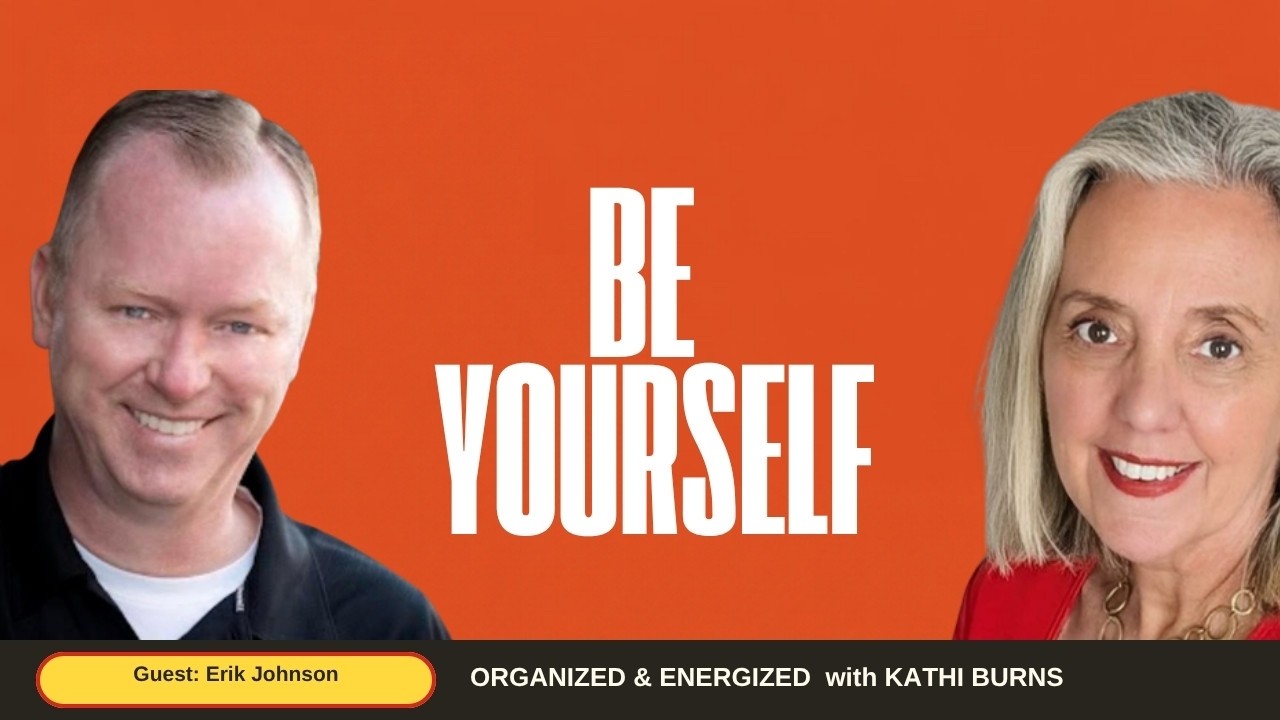
Podcast Talent Coach Erik Johnson tells Kathi Burns, CPO®, Business FLOW Strategist, that a podcast builds know, like and trust, the rapport that starts the sales process.
Erik says broadcasting is a mile wide and an inch deep, while a podcast is an inch wide and a mile deep.
He steers most clients away from sponsors because they are hard to land and cap revenue, and suggests using airtime to grow their own business instead.
Erik says building rapport and qualifying a prospect are about 70 percent of the sales process, and a podcast does both before the first call.
His test for whether to start a show: list 50 topic ideas in about 10 minutes; if you struggle to reach 25, it may be the wrong topic.
Published · Updated
What is this episode about?
Podcasting for business works best when listeners get to know the host, says Erik Johnson, the Podcast Talent Coach. Kathi Burns, CPO®, Business FLOW Strategist, talks with Erik, who studied architecture, fell in love with radio after his brother got him a job at a station, and spent about 35 years in radio learning to move an audience he can't see. He started coaching podcasters around 2012. You'll hear why a podcast is an inch wide and a mile deep, why Erik steers clients away from sponsors, how a show handles about 70 percent of the sales process, and why nobody needs your six steps to success. Erik also tells the story of a client whose show got downloads but no clients until he started talking about himself, shares the spreadsheet he plans every episode in, and gives a ten-minute test for whether you should start a podcast at all.
The content brings people to your show, but who you're being brings people back.Erik Johnson
Jump to links and resources · Part of How do I become known as an expert? · All episodes · Every guest
What are the key takeaways?
- Erik says a podcast builds know, like and trust, which he calls the first step in the sales process.
- Interviewing current clients, peers and mentors on your show builds relationships with each group; mentors who won't meet for coffee will often give you an hour as a guest.
- Erik steers clients away from sponsors because they take a long time to land and cap revenue; he suggests marketing your own business or an affiliate instead.
- According to Erik, building rapport and qualifying a prospect make up about 70 percent of the sales process, and a podcast does both.
- Your story, opinions and take on the world are what separate you from anyone else teaching the same steps.
- Erik repurposes each interview: record on video for YouTube and socials, use the audio as the podcast, and turn the transcript into show notes and a blog post.
- He plans episodes, tracks clients and manages follow-up in spreadsheets, and suggests listing 50 topic ideas in about 10 minutes to test whether a podcast topic is right for you.

This episode is brought to you by the Business Logjam Session
A private 75-minute online session with Kathi Burns to find the one thing holding your business back and leave with your next steps. It is the same F.L.O.W. process Kathi uses with her own clients: Focus on your goals, Locate your logjams, Outline your solutions, Walk away knowing your next steps.
Find What's Holding Me BackInterested in sponsoring the show? Get in touch.How does podcasting for business build know, like and trust?
Podcasting for business builds know, like and trust because listeners get to know you as a person, week after week. Erik Johnson coaches podcasters to use their show as a marketing vehicle by building relationships with their audience. He calls that rapport the first step in the sales process, and a podcast does it when used the right way.
What is the difference between podcasting and broadcasting?
Broadcasting is a mile wide and an inch deep, while a podcast is an inch wide and a mile deep. Only a fraction of Super Bowl ads apply to any one viewer, Erik explains. A podcast has fewer listeners, but each one subscribed to hear you talk about their pains and passions, so a well-chosen sponsor fits everyone.
Should you get sponsors for your podcast?
Erik steers most of his clients away from sponsors. Advertisers are hard to convince, a sponsor takes a long time to land, and you can only fit so many on a show, which caps your revenue. He says to use your airtime to market your own business instead, or an affiliate who pays you every time something sells.
Why do people listen to podcasts?
Erik says people listen to podcasts because they don't want to be alone while they work out, ride a bike, drive or mow the yard, so the host is their companion. Your content gets people to the show, but who you're being brings them back, so be someone they want to spend a half hour with every week.
How does a podcast help with the sales process?
A podcast covers about 70 percent of the sales process before you ever get on a call. Erik breaks sales into four steps: building rapport (about 40 percent), qualifying the prospect (about 30 percent), educating them on your solution (20 percent) and closing (10 percent). Telling stories and interviewing clients on your show does the first two, so listeners arrive already wanting to learn more.
Why isn't my podcast getting me clients?
Often it's because listeners learn about your guests but nothing about you. Erik had a client, a listening coach with the show Deep Listening: Impact Beyond Words, who was 36 episodes in with downloads but no clients. They relaunched as season two with a co-host who interviewed him, so he could share his own stories. Erik says the show was later named a top 10 podcast by Apple Podcasts in Australia and the coach is now a sought-after keynote speaker. With another client, an accountant, Erik's advice was to share the why and his backstory, not the steps.
How do you plan podcast episodes?
Erik plans his episodes in a spreadsheet. Based on Ryan Deiss's 60-second blog planner, it lists each episode's date, number, topic, guest and call to action, so he can see which of his roughly seven topics he hasn't covered lately. Every two months or so he brainstorms topic ideas into the sheet without judging them, then assigns them to upcoming episodes. He tracks clients and follow-up in spreadsheets too.
Should everyone start a podcast?
No. Erik says you should have a podcast only if you love talking about your subject, not because you think your audience wants it. His test: list 50 topic ideas in about 10 minutes; if you struggle to reach 25, it may not be the right topic. He says podcasts fade for three reasons: more work than expected, slower growth, and slower money when people chase sponsors.
Where does each part of the conversation start?
- 0:00 Meet Erik Johnson
- 0:40 From architecture to 35 years in radio
- 2:56 Why he started coaching podcasters
- 5:33 Interview your mentors
- 6:57 Podcasting isn't broadcasting
- 10:46 Why he steers clients away from sponsors
- 12:09 Launching a podcast is the easy part
- 12:45 Be your listener's companion
- 14:15 The four steps of the sales process
- 16:15 What to offer your listeners
- 17:22 Nobody needs your six steps
- 19:02 A client who started talking about himself
- 23:06 Share the why, not just the how
- 24:43 Show listeners what's possible
- 26:33 Repurpose every episode
- 27:39 His spreadsheet system
- 31:42 Should everyone have a podcast?
- 32:44 The 50-topic test
- 33:28 Why podcasts fade away
- 35:41 Curiosity makes a great host
- 37:51 Turn everyday life into episodes
- 38:50 Wrap-up
What resources were mentioned?
- Erik's free Authority Assessment (21 yes-or-no questions)
- Erik's lead magnet: 17 Most Powerful Interview Questions Ever
- The Eventual Millionaire podcast with Jaime Masters
- Deep Listening: Impact Beyond Words (podcast and book by one of Erik's clients)
- Ryan Deiss's 60-second blog planner
- Google Sheets, Excel and OpenOffice
These episodes continue the same thread as this one: Dr. Julie Marty-Pearson, Vince Warnock, Anne Bartolucci, Ally Machate also answer the question "How do I become known as an expert?", and the rest are the most recent conversations on the show.
 PodcastingEpisode 146
How to Grow Your Confidence Through Storytelling & Podcasting with Julie Marty-Pearson


See every episode on the podcast archive or filter by topic on the How do I become known as an expert? hub.
How can I support the show?
- Subscribe on Apple Podcasts, Spotify or YouTube, or add the RSS feed to any app.
- Rate and review. A rating on Apple Podcasts helps new listeners find the show, and Kathi reads every review.
- Share the episode with one business owner who needs it; the share buttons are at the top of the page.
- Grab a free eBook: 6 Steps to Organize & Energize Your Home, 6 Steps to Organize Your Home Office or 6 Steps to Organize & Energize Your Life.
- Work with Kathi. The Business Logjam Session is a private 75-minute session to find what is holding your business back.
- Be a guest. Apply here if you have a story about clearing the obstacles in your business.
What did they say, word for word?
The transcript below is edited for readability: filler words and false starts are removed and speaker names are added. Nothing was added or summarized.
Read the full transcript +
Kathi: Hi everyone, welcome back to Organized and Energized! The Podcast. I am here with my friend Erik Johnson, and we're going to talk about podcasting. We're going to talk about how to make you the authority in your niche, as we all want to be. So thanks for coming on, Erik. It's good to see you again.
Erik: It is great to see you. It's been so long. Thanks for having me on.
Kathi: Absolutely. I love chit-chatting with you about podcasting and all things visibility. I know a lot about you, but perhaps people listening don't know that much about Erik Johnson. Let people know a little bit about you.
Erik: So I've spent the last 35 years in radio after getting my degree in architecture. I was going to architecture school, had my heart set on owning my own architecture firm and living the life of an architect, and as I was going through college, I started falling out of love with architecture and started falling in love with radio. Got into radio by accident. My brother worked at a radio station and got me a job, and that turned into being the music director at our campus radio station, which I absolutely loved. It was fascinating. A lot of people say, "Well, architecture and radio? That seems completely opposite." And it's really not, because in both of them you have to be analytical and creative at the same time. And so this was just another way for me to show my creativity in front of an audience that I couldn't see, which was pretty interesting. And so over the last 35 years, I've developed the super skill of being able to attract an audience that I can't see, entertain them when I'm not getting any feedback from them, and be able to motivate that audience to take action, to activate them to a cause or a purpose or into a client's location, and really be able to build powerful relationships with that audience so that when I ask them to take action, they do so.
Kathi: It's so fascinating, and you're right. Podcasting, you're speaking to people that you can't really see and getting them to take action. I didn't realize we have this similar background. I studied communications, and I ran a radio show that was broadcast live every Thursday night called Uptown Thursday Night. So I would stream it out from the radio station. We have these similar backgrounds.
Erik: Yeah. And I've been helping podcasters for the last 10 or 12 years now. I got into coaching podcasting in about 2012, I think, was my first client. I was listening to podcasts and I loved it. I thought, man, this is like the wild west. This is like the old-time radio where you could do whatever you wanted, talk about whatever you want. It's your show. You make the rules, right? It's like radio used to be. Well, now radio has become so corporate and homogenized, and they've really sucked the creativity out of it. It's lowest-common-denominator entertainment. It just became so frustrating, and I discovered podcasting, and it lured me in like radio did in those early days. But as I listened to these shows, I thought, if they just used some of the strategies and tactics that we used in radio, their shows could be so much stronger, and their call to action could be so much more effective, and they could actually become influential authorities in their niche just by doing a few things that they don't realize they're not doing, because they don't know what they don't know. And so I stepped in and started coaching podcasters on how to use their podcast as a powerful marketing vehicle for their business by building those powerful relationships with their audience. We talk so much about know, like and trust. A podcast gives you that ability to build that know, like and trust. That's a relationship. It's a rapport. It's the first step in the sales process. And your podcast allows you to do that if you use it in the right way.
Kathi: Yeah, I totally agree, and it gives you instant authority to say that you are a podcaster. And I love the fact that it also allows you to connect with people that you want to connect with that you might not otherwise have been able to connect with, because the podcast is the new book, right? Before, it used to be, "Oh, you have a book? Oh, wow." Now it's like, "Oh, you have a podcast?" It's the thing.
Erik: The podcast is fantastic when it comes to building relationships, not only with your potential clients and your listeners, but you can also build relationships with your current clients by bringing them on your show and interviewing them about the struggles they were going through, how you helped them, what you've helped them do. It sells yourself again to your client, because they're like, "Oh yeah, I remember all those struggles I was going through and how you helped me out of that." It shows your audience how you help your clients move through. So it builds your relationships with clients. And then, as you were saying, you connect with your peers that maybe you haven't talked with in a long time, and you have a stage now that you can put them on and highlight them. But one thing that many people overlook is the opportunity to connect with their mentors, because a lot of mentors don't have time for a cup of coffee or to let you pick their brain. They hate it when you say, "Hey, do you have 10 minutes so I can pick your brain?" They're like, "No, I don't." But if you call them and say, "Hey, would you be a guest on my podcast?" now they'll give you an hour to have a conversation on your podcast, because you're giving them some exposure, and now you're getting free coaching from them, which is fantastic. Jaime Masters has a podcast called The Eventual Millionaire. She was starting in the online space, and she thought, "Man, I want to be a millionaire. I want to get into this online space and become a millionaire, but I don't know how to do it. What I need to do is talk to a whole bunch of millionaires, but the millionaires won't let me pick their brain." So she launched a podcast called The Eventual Millionaire, and on every episode she interviews another millionaire on how they became a millionaire, and now she gets to talk to a millionaire every week. How great is that?
Kathi: Crazy. I love that, and I agree that it is the wild, wild west. I mean, it's getting more refined, but really any topic is fair game. Any topic that you're inspired to speak on, even if it's not your niche but you want to be in the niche, just like you said with the last example. She wants to be a millionaire. Let's interview some millionaires. Why not?
Erik: Yeah. And a lot of people want to equate podcasting to broadcasting, which is one of the reasons I really, really dislike advertising and sponsorships on your podcast, because most of the ad agencies want to treat podcasting like broadcasting, and it's just simply not the same, because broadcasting is broad. It's a mile wide and an inch deep. If you're watching the Super Bowl, a fraction of the commercials on the Super Bowl will pertain to you. If it's an automobile insurance ad, it might pertain to you, but I've had my same auto insurance for 30 years. I'm probably not changing to Geico. If there are retirement investments on there, that may not pertain to you. If it's something about having a baby, it may not pertain to any of us. It's a fraction. And so they're just throwing a bunch of money and hoping they hit a small pool of their target listener. With podcasting, instead of being a mile wide and an inch deep, it's an inch wide and a mile deep. So you have fewer listeners, but you're going really deep with them, because you're talking about their pains and their passions, and you're making that connection with them. And everything you talk about, they love, because they subscribed to hear you talk about it. So now if your sponsors are right for the show, everybody in the audience is right for that sponsor. If you're an entrepreneurial podcast and QuickBooks is your sponsor, QuickBooks is relevant to all of your audience. But marketing agencies want to treat a viewer of the Super Bowl equal to the listener of a podcast, and it's just not the same. They're not equal in value, because you have such a close, powerful relationship with your audience.
With podcasting, instead of being a mile wide and an inch deep, it's an inch wide and a mile deep.
Erik: You had someone join you. He's so enraptured by your talk.
Kathi: I really agree, because I've had sponsors try to sponsor my podcast, and it's just that no one who has pitched to me has been a good fit for my audience. Strange things that they want me to promote. I'm like, "It doesn't really make a lot of sense to me for my database."
Erik: Yeah, and they want to value a spot on your show just like they would a spot on the radio, and the value just doesn't equal. Or even a spot on your show compared to a commercial on a generic show. Let's say it's a show like Brendon Burchard's, who has a wide audience because he's all about life coaching and motivation. Or a Tony Robbins, right? The audience is so broad that it may not be right. So a listener to that show doesn't equal a listener to your show, because everybody that listens to your show is right in the pocket for what you're doing when you select the right sponsor. So even though your show has a smaller audience than a Tony Robbins, the commercial on your show is much more valuable than a commercial on a Tony Robbins show, because everybody in your audience is perfect for the advertiser when you select it right.
Kathi: Yeah, it's very interesting. So whenever you work with people, do you actually help them find sponsors, or do you say, "Let's not do sponsors"? Because I'm in the boat of, I don't think I'm going to do sponsors for my show.
Erik: Yeah, I try to veer people away from sponsorships on their show, because it's very difficult to convince advertisers that your show is different and more valuable. It takes a very long time to land a sponsor. I mean, it's a lot of work to land a sponsor. It limits the amount of revenue you can generate, because you can only have so many sponsors on your show. Instead, spend your time and energy finding more clients. Use your podcast to build your authority and your influence so you can grow your business. Your business isn't advertising and marketing. Your business is what you do. And so use the time on your show to market yourself. If you're going to market somebody, at least market an affiliate or somebody like that where you're getting paid every time something sells. If you're just getting paid for the commercial, you're wasting your time.
Kathi: I'm with you on that. Amen to that. It's just a cat. He's just doing his own cat stuff in the door. But maybe it'll add some visual impact.
Erik: You never know. Everybody loves cats.
Kathi: Hey, so let's talk about someone who might want to become a podcaster, and then let's talk about the podcasters that are there already. So if you want to be a podcaster, Erik, what would you tell people right away?
Erik: Launching a podcast is super easy. Launching the podcast isn't the challenge. A lot of people launch the podcast and think it's all about their content, and they have to tell everybody how they do it and how brilliant they are. It has nothing to do with your content. It has everything to do with who you're being while you're on the podcast. People want to be attracted to you. You want to be somebody that people want to hang out with. You're their companion. The only reason people listen to a podcast is because they don't want to be alone. They don't want to do whatever it is they're doing by themselves. I'm working out. I don't want to work out by myself, so I put my earbuds in and I'm listening to a podcast. I'm out on a bike ride. I don't want to bike ride by myself, so I listen to a podcast. I'm driving in the car by myself. I don't want to be alone, so I have my podcast on. You're their companion. You're their buddy. So can you be that person they want to spend a half hour with every week while they're exercising or riding their bike or mowing the yard? You're their companion. It doesn't have anything to do with your content. The content is just the ante into the game. It's just the admission into the party. The content brings people to your show, but who you're being brings people back. And that's what a lot of people forget.
The content brings people to your show, but who you're being brings people back.
Kathi: The authenticity, exactly. Be yourself. Here I am with this cat. He just shows up. And for those of you who are listening, yes, my kitty cat is here with me, so you might want to tune into the video portion of this on my YouTube channel.
Erik: Yeah, he's awesome. So launching a podcast isn't really that difficult. I teach people how to launch a podcast in four weeks. Getting the show up and running is great. Then how do we turn you into that authentic, influential go-to expert in your niche, so when they have a problem, they think of you? There are four steps to the sales process: building rapport, qualifying your prospect, educating them on your solution, and then closing the deal. So, the four steps, but they're not all equal. Building rapport is about 40 percent of the sales process. And then qualifying your prospect is about another 30. Qualifying your prospect means you're making sure the prospect is right for you, and they're making sure you're right for them. We qualify each other. Are you the one that can lead me to the promised land? That's about 30 percent of the process. So building rapport and qualifying is 70 percent of the process. You do both of those with your podcast, because you're telling stories, you're revealing things about yourself. You're sharing yourself and your journey with your audience. They're deciding whether or not they like you and want to hang out with you every week. When you interview your clients or your peers or your prospective clients on your show, you're showing how you coach and how you help people get where they want to go. And then your listeners are thinking, "Man, I need me some of that." So by the time you get on the phone with them, they're 70 percent of the way through the sales process. You've already built the relationship with them. "I've heard you talk about this. I want to learn more about it." Now, the next 20 percent is educating them on your solutions. And then the last 10 percent is, which card do you want to use? Let's get you signed up. And so the podcast helps you build that authority, but it doesn't have anything to do with your content. It has to do with who you're being on the show.
Kathi: That's so interesting. Authenticity is where it's at right now, being who we are. We're individuations. We're all completely different, and I'm with you on that. So let's get into the offer. For your podcast, or for anybody who wants to make some type of an offer, how do you position that on your podcast site? Is it a free download, book a chat? What do you recommend when people say, "Well, I don't have anything to offer. What should I offer?"
Erik: I first try to get them on the list. I have maybe three dozen different lead magnets that I offer. One of my most popular is my 17 most powerful interview questions ever, which you can use to shape your podcast interviews and get your guests to tell stories. But I have a variety of lead magnets to get them on the email list. And then I'll invite people to have a coaching call with me and just experience what coaching looks like, and how I can help you become that influential authority in your niche, and how I can help you craft your podcast to make you the go-to expert that keeps you top of mind. So when people think of their problem, they think of you as the solution. And so that's really what I help with: I help turn information into entertainment. Because so many people think the show is about teaching people the six steps to success. Nobody's looking for your six steps to success. AI could probably craft your six steps to success faster than you can, right? I don't need you to give me the six steps to success. The only thing that's going to separate you from anybody else teaching the six steps to success is you. Your story, your journey, your opinion, your take on the world. When you infuse you into the content, that's what makes it different. And that's what I help people do: uncover who they are authentically. Authenticity seems to get overused a lot, but I truly believe everybody can be authentic when they live into their true selves and share that with the world. You have a message to share. A lot of people come to me and they say, "Well, Erik, I'm not really a big personality. I'm not Oprah. I'm not Howard Stern." I say, "Well, you don't need to be Gary Vaynerchuk to have a big podcast. You just need to be yourself." As a matter of fact, you shouldn't try to be anybody else, because you're the only thing other people can't copy. They haven't lived your life, they haven't followed your journey, they don't have your stories. They aren't you.
You're the only thing other people can't copy.
Kathi: Yeah, absolutely. I like to call it individuation. So, speaking of storytelling, tell us a story about one of your clients, either one that was a podcaster or one who wanted to be a podcaster. Spin us a yarn, Erik. You're such a great voice.
Erik: One of my favorite clients has a book and a podcast called Deep Listening: Impact Beyond Words. He is a listening coach. He teaches CEOs and top type A personalities how to be better listeners. He goes into these companies and works with leadership on how to be less authoritative and more listening. And so he had a podcast. He still does. It's called Deep Listening: Impact Beyond Words. He was about 36 episodes into it, and he reached out and said, "Erik, I love doing the podcast. I'm talking to some great people, but it's not getting me any clients. It's not doing anything to grow my business. What am I doing wrong? I'm struggling. It's getting downloads, but it's not helping the business. Can you help me?" And I said, "Well, let me listen to it." So I took a listen to a few of his shows, and halfway through the first show I'm like, "Oh, I figured this one out." So I get on the call with him and I said, "I have good news and bad news. The good news is you are a great listener. You are fantastic." Which makes him a great interviewer, right? Because he would ask great questions. "So the bad news is I know everything about your guests, but I don't know anything about you. You are a great interviewer, but I don't even know what you do in your business, because we don't talk about it anywhere on the show." And so we revamped his show and relaunched it as season two. And in episode two, we brought on a co-host who interviewed him. The co-host would ask him questions, and he would share himself and his stories on the podcast, so people got to know him. And then he would use bits of the interviews that he did in the past to support what he was teaching, and show examples of it and case studies of it. His podcast was named one of the top 10 podcasts by Apple Podcasts in Australia. He's a well-known keynote speaker in Australia now, hired by big companies to come in and work with their leadership teams, and his business is thriving, and his podcast is doing well, and he just put out his second book. So it's been fantastic. But a lot of times you're so close to the content, you can't see the struggles and the challenges, which is why it helps to have an outside set of ears give a listen to it and figure out exactly what we need to tweak to make you that go-to authority in your space.
Kathi: I think that's so relevant, too. I always say masters hire masters, and we can't see what we're doing wrong, good, bad or ugly, oftentimes. However, I can tell immediately what's going on with a client when it comes to organizing their systems. I can see it real quick, right? Because as outside objective observers, we're not stuck in the muck of our stuff, so to speak. I was working with my coach the other day, and he was telling me exactly what I teach. And I'm like, "I teach this." And he goes, "I know. That's why you're not doing it." And I'm like, "All right. Fine. I'll go do it."
Erik: Yeah, we teach what we most need to learn, don't we?
Kathi: Seriously. Yes. And people come to me and they're like, "What's the worst case you've ever seen?" It's like, no, there's not even judgment. It's just, can you see this? You can't see this for yourself. I can see it so easily. Same with you. You can see it so easily. And what I loved about the story of your client is he was already an authority. He was already a leader in his field, but then he got podcast of the year, and now he's keynoting. And so he has so many more opportunities just from the little niggly bits that he could not see. I can't see what I'm doing wrong. You might not be able to see. It takes that outside opinion.
Erik: I'm working with a client right now who is an accountant. And being an accountant, he's very organized and very methodical. And on his show, he teaches a lot of the what to do. Here are the five steps to create your budget, or here are the eight steps to get out of debt. And I said, "Nobody cares about the steps. They care about the why. Why should we take these steps?" We need to lean in, and he's got a great backstory. He's been doing math, like accounting, since he was eight. He's helping his mom do the household budget. By the age of 12, he's in a car dealership helping his mom negotiate car deals. And I said, "We need to share those stories on your podcast. If we shared that, that is what will attract people to you, and that's what will endear people to you. Not the fact that you know how to run a spreadsheet. Nobody cares about the how. They've got to care about the why. And so let's talk a lot about the why on your show, and share your backstory, and share your principles and the foundational beliefs that you have, so people fall in love with you. And then they can go get the how when they give you a call or work with you or grab your lead magnet."
Nobody cares about the how. They've got to care about the why.
Kathi: Absolutely. And don't you think also, there's the why and then the how, but also the outcome? You want to let them know what the outcome's going to be. I don't care if I know how to add two plus two. I want to know what that's going to do for me as well.
Erik: Yeah, we talk about the outcome. So here's what's possible, and here's why you want what's possible. Here's why we can get there. Now, what happens in the middle, how we get there, that's a different conversation. We'll get into the nuts and bolts later. But here, look at what's possible for you, and why you should do that, and why you want that. And here are the challenges that you're facing. I understand the challenges. I understand that little voice inside your head is saying, "Who would listen to me? Why would anybody want to talk to me? Why would anybody want to be on my podcast? I only have three episodes." I get all that, and I help you get through it, because you have a message to share with the world. You have impact to make, and you will be surprised at the connections and the relationships you can build when you launch a podcast that you're not even considering, because you don't know what you don't know. But if you love to talk about your niche and your topic and your content, people will love to talk about it with you. And when you start sharing yourself, that's when you start creating real engagement.
Kathi: Absolutely. I so respect what you do, Erik. You're such an authority in this, and that's why I really wanted to have you on the show, just to help people who are already doing podcasts or maybe even thinking about it. It is easy to launch, but I agree, you have to keep yourself in it. And I try to do that all the time. It's easier said than done sometimes, which is why we call on people like you to help us with that. So, okay.
Erik: Well, and one more thing with that. A lot of people think, I don't have more time in my schedule to do a podcast. I don't have more room. You can repurpose your content a lot, like you do, Kathi. Record the interview on video so you can post it on YouTube and you can use it on your socials, and then just take the audio from that video and use that as the podcast, and then transcribe it or run it through some AI to create some show notes, and now you have a blog post for your website. And now it's one piece of content spread across multiple platforms in a variety of media, because some people like to consume video, some people like to consume audio, some people like to read. And so when you can use all of it and repurpose it, it magnifies your visibility in a way that just can't be measured in any other platform, and saves you a boatload of time creating content. And it's better content, I think.
Kathi: It's better content because it's more diverse. We have different experts talking about different topics. But that leads right into my next question, Erik. You're very organized. Talk to me about your favorite organizing hack. We have to cover this part.

Erik: I love spreadsheets. I keep everything in a spreadsheet. All of my podcast episodes, I document in a spreadsheet. I actually stole this from Ryan Deiss. He used to own Digital Marketer until he divested from it, but he has what he called a 60-second blog planner. It has the date of the blog post, the topic of the blog post, the headline of the blog post. And so I repurposed that for my podcast. I have the date, the episode number, the topic of it, if I'm interviewing anybody, and the call to action, like the lead magnet or the offer that I'm making in that particular episode. And so I have them all laid out, so I can go back and see which topics I haven't hit recently. Have I talked about interviewing? Have I talked about growing your business? Have I talked about content flow, content creation? I have probably seven different topics I like to rotate through, and so I can go back and look at my spreadsheet. And then about every two months or so, I'll sit down and just brainstorm topic ideas. I don't hash them out. I don't come up with the headline. I just ask, what could I talk about, or who could I interview about a particular topic? And I just brainstorm and put it all down on the spreadsheet. And then when I go to record episodes, I look at that brainstorm and I go, okay, I'm going to make this one episode 512. I'm going to make this one episode 513. I'm going to make this one episode 514. So it creates that content flow and the diversity of content throughout my episodes. Spreadsheets are my friend. That's my go-to hack for everything I do. I track all of my clients in spreadsheets, all of my follow-up. So many people don't follow up with clients, right? They make a call and the prospect is like, yeah, I'm not sure right now, let's talk again in a month, and then they never talk to them again, because there's no follow-up. I track all that and keep track of all my follow-up in a spreadsheet. I'm a spreadsheet guru.
Kathi: Do you love spreadsheets? Do you use Excel? Do you use Google Sheets?
Erik: I use Google Sheets mostly, because I'm on a Mac. I love Excel, though. When I work on a PC, I know a lot of the hacks in Excel, and in Google Sheets the formulas are a little different, so I'm still learning my way around Google Sheets because of my Mac. But I use OpenOffice. I'll create it in Excel, and then I'll open it in OpenOffice on my Mac and crunch it there.
Kathi: That's funny. I like doing that as well, because I like putting the links to the articles and the links to the images all within that same topic. Which is really nice, because then you go click, click: what was that image? Oh yeah, here's the image, and so on and so forth.
Erik: I share a lot of resources when I follow up. So I'll say, "Hey Kathi, it's been a minute since we talked. I saw this article and I thought you might be interested in it." And that's all in the spreadsheet. I have a bank of articles and a bank of resources, and I just copy and put it into the email and shoot it off to somebody as I'm following up with them.
Kathi: Very nice. Giving and giving, win-win. That's what it's all about.
Erik: Absolutely.
Kathi: Okay, so is there anything that we didn't really talk about? I mean, we went off script, and I really don't care. I always go off script. It doesn't matter to me. Is there anything that we should have covered that you think people really need to know?
Erik: Anybody can do it, but should everybody do it? I get that question a lot. Should everybody have a podcast? And I don't think everybody should have a podcast. You should have a podcast if you love talking about your subject. If you go out to dinner with your friends, does the conversation always lean back toward this particular subject? When you get together with your buddies in your niche, do you always get magnetized toward that particular subject? If so, then you should probably have a podcast about it, because you love to talk about it. But you should not have a podcast if you think, "I need to talk about this because that's what my audience wants me to talk about." That's the worst kind of show you could have. If you try to force it because you think that's what the audience wants to hear, nobody will listen, because, back to the authenticity, they'll know you're faking it. So make sure it's a subject that you love to talk about. And here's a quick test you could do to make sure that it's right. Whatever your topic is, brainstorm 50 different topic ideas you could talk about under that topic. So with podcasting, what could I talk about? I could talk about equipment, how to interview, how to edit, how to find guests, how to get on other shows. Just list them all. If you can come up with 50 topics in about 10 minutes, you're on the right path. If it's hard to come up with 25 in 10 minutes, then you're probably not ripe for that particular podcast. If you're hesitant to share yourself and your story with others, you probably shouldn't have a podcast, because it's not going to grow as fast as you want it to. Podcasts tend to fade away. Podcasters give up. There are about 4 million podcasts available. Only about 2 million publish on a regular basis. The rest of them have gone on their way. And podcasts fade away for three reasons. The first one is it's more work than they thought it was going to be, because they don't have a system in place to methodically produce an episode every week. They don't have it scheduled. They haven't refined their editing process, and it eats up their whole week, and they're like, "This is too much work. I'm out." Because they just haven't done it right. The second reason is it doesn't grow as fast as they thought it would, because they don't have a strategy in place to get out and get in front of people who don't know them and invite them back to the show. They don't have a podcast growth strategy in place, so they get frustrated that it's not growing, and they throw in the towel. And the third reason it fades away is because it doesn't monetize as fast as they thought it would, because they're doing it the wrong way. They're going out and trying to get ads and sponsors, like we talked about, which is very difficult, and it's a big struggle, and it requires a very large audience. Instead, have a business strategy in place where you're using the podcast to grow your business through interviewing those four types of guests I talked about, and be realistic about what your growth looks like, and use your podcast as a marketing tool. You will have much more success, and you'll be much more satisfied with the results when you do it that way. And that's what I help podcasters do: be realistic about your goals, and let's create systems and strategies and put those in place to reach those goals methodically over a set period of time.
Kathi: You know I love hearing about those systems, Erik.
Erik: Yes. Yes, indeed.
Kathi: Yes, I do. I love it, and I love what you do, and you provide such a valuable resource. Which, speaking of, there is a valuable resource that we're going to offer everyone who's listening to this podcast. Let's talk about that a little bit.
Erik: Yeah, it goes back to, should I do a podcast? Are you ready to be the influential authority in your niche? Do you have what it takes? Because there are characteristics that go into being that influential authority. One of the big characteristics is curiosity. In order to be a great podcast host, you need to have a high level of curiosity. It makes you a great interviewer. It makes you a great content creator, because you say to yourself, "I wonder why that happens. I wonder why people do this. I wonder what that's all about." And when you have that high sense of curiosity, it makes you a great host. Well, there are many characteristics that go into a great host and that create an influential authority. And so I put together an authority assessment. It's 21 yes-or-no questions. You go through and answer yes or no, and it will help you determine if you have what it takes to be an influential authority in your niche. It's a super quick, easy assessment. You can grade it right there. You don't have to go through some big computer program to grade it. You just count up the yeses, and then you match it to the framework, and it'll tell you where you sit on the authority assessment. It's super easy. You can get that at podcasttalentcoach.com/authority. If you download it right there, it's super easy to go through, and it will help you determine if you should have a podcast, if you have what it takes to be that go-to expert in your niche.
Kathi: Yeah, and you'll hear the real deal, whether you should or not. I love the fact that it's yes-and-no questions, so there's no, is it a yes or is it a no? Let's not have a diatribe about a long-form answer when we can figure out anyhow what the answer would be. So that's fantastic. Easy. Once again, a systematized approach to figuring out whether or not you have what it takes to be a podcaster, or whether you should even go there. I also like what you said about coming up with 50 different angles for your topic. I think that's a really solid tip to give. If you're having a really hard time trying to figure out what all these different topics around your topic could be, then you might want to consider shifting just a little bit and coming up with something that's more broad, right?
Erik: Yeah. I teach hosts how to create content out of everyday life. And so I'll show them how to take a blog article, an article out of the newspaper, an article out of any magazine, and turn it into content for your show. So what I will do is take an article out of USA Hockey Magazine. How can I turn this article into an episode of Podcast Talent Coach? And we'll go through it, and I'll pull out pieces and I'll say, "How does that relate to podcasting? How do I start? How do I get involved? How can I coach? How can I help others? How do I meet others in my niche?" Things like that. It's just a way to brainstorm. And once you start letting the creative juices flow and do a true brainstorm, don't judge and evaluate your topic ideas. Just write them down, and you'll be surprised how many you can come up with.
Kathi: Yeah, don't edit them out. Just write them down, baby. Then later you can go back.
Erik: Yeah, right.
Kathi: Well, thank you so much. Everybody, make sure to grab that download. Even if you are a podcaster, I'm going to look at it and just see what's up. Am I yes-ing or no-ing myself, or what am I doing? So grab the download and connect with Erik. If you're serious about wanting to grow the podcast you already have, or you don't know whether you should start a podcast, this is the guy to talk to. So, Erik, thank you. It's so good to connect with you. That is part of the joy of doing my podcast: I get to connect and reconnect with friends and make new friends from people that I don't really know. So that's one more asset, one more thing that you get from being a podcaster. So, Erik, thank you.
Erik: Kathi, it was a pleasure. Thank you for having me. It was great seeing you again.
Kathi: Absolutely. And you know, you're such an easy guest, of course, because you're a pro. So thanks for being on the show, and hopefully we will reconnect sooner rather than later this next time.
Erik: Absolutely. See you soon.
Kathi: Yeah, thanks, Erik.
Where can I find the links and resources from this episode?
Connect with Erik
Organizations and companies
Inspired? Here Are Your Action Steps:
- List 50 topic ideas for your podcast in 10 minutes to test whether you love the subject enough.
- Invite a current client on your show to talk about the struggles they had and how you helped.
- Ask a mentor to be a guest instead of asking to pick their brain over coffee.
- Skip chasing sponsors and use your airtime to promote your own offer or an affiliate.
- Share your own stories, opinions and the why behind your work, not just the steps.
- Record interviews on video and repurpose them as a YouTube video, podcast audio and a blog post.
- Keep a spreadsheet of every episode's date, number, topic, guest and call to action.
- Brainstorm episode ideas every couple of months without judging them, then assign them to episodes.
- Track your prospects and follow-up in one place so no conversation gets dropped.
- Take Erik's 21-question Authority Assessment at podcasttalentcoach.com/authority.
Frequently asked questions
How can I start a podcast for my business?
+
Erik Johnson says launching a podcast is the easy part; he teaches people to launch in four weeks. First make sure you love the topic by listing 50 episode ideas in about 10 minutes. Record interviews on video so one recording becomes a YouTube video, the podcast audio and a blog post, and plan episodes in a spreadsheet so you rotate through your topics.
What does it mean to be an industry expert?
+
In this episode, Erik describes the go-to expert as the person people think of first when they have a problem. He says a podcast builds that position by letting listeners get to know your story, opinions and take on the world, which nobody else can copy. Curiosity is one of the traits he looks for in an influential authority.
How is podcasting different from broadcasting?
+
Erik says broadcasting is a mile wide and an inch deep, while a podcast is an inch wide and a mile deep. You have fewer listeners, but every one of them chose to hear you talk about their pains and passions.
Should you take sponsors on your podcast?
+
Erik steers most clients away from it. Sponsors are hard to land and limit what you can earn. He suggests using your airtime to grow your own business instead, or to promote an affiliate who pays you when something sells.
How can you tell if you should start a podcast?
+
Try to list 50 topic ideas in about ten minutes. If you can, you love the subject enough. If you struggle to reach 25, it may not be the right topic. Erik also offers a free 21-question yes-or-no authority assessment at podcasttalentcoach.com/authority.
Who is talking in this episode?

About the Host, Kathi Burns
Kathi Burns, CPO®, is a Business FLOW Strategist based in San Diego. For the last 20+ years, Kathi has helped clients create systems they can stick to. She is the author of How to Master Your Muck, Organizing With Tetris and Home Organization, The Smart Guide, and co-author of four more titles; all are in Kathi's shop. Kathi's business has been featured on Good Morning America, and her advice has been featured in Oprah Magazine, Martha Stewart Living, Better Homes and Gardens and Entrepreneur Magazine.
More about Kathi · Shop Kathi's books · Business Logjam Session · Apply to be a guest

About Erik Johnson
Erik Johnson is the Podcast Talent Coach. He went to college for architecture but fell in love with radio after his brother got him a job at a station, and he became music director of his campus radio station. He has spent about 35 years in radio; his site describes him as a nationally recognized talent coach, on-air personality and radio program director whose shows ranked at or near the top in Omaha. Erik started coaching podcasters around 2012. He helps business owners launch a show in four weeks and use it to build relationships with listeners and become the go-to expert in their niche.
Want help putting this into practice?
Book a Business Logjam Session with Kathi
A private 75-minute online session to find the one thing holding your business back and leave with your next steps, using the same F.L.O.W. process Kathi uses with her own clients: Focus on your goals, Locate your logjams, Outline your solutions, Walk away knowing your next steps.
Prefer to start small? Download Kathi's free eBook 6 Steps to Organize Your Home Office.
Published · Updated
This episode page is for general information. Guests speak for themselves, and their opinions, statistics and examples are their own. Nothing here is legal, financial, medical or mental-health advice; talk to a qualified professional about your own situation. Some links go to the guest's own products or free offers; addSpace does not earn a commission from them unless stated.