
TL;DR
Say no when a request does not move you toward your long-term goals or when you do not truly have the time and energy for it. To say no gracefully, Kathi thanks the person for their confidence in you and asks for a day or two to think it over. If they cannot wait, she treats that as a sign to decline.
Learning how to say NO graciously is all about shifting your mind. As a busy person on the go, I’ll bet that most of the time you operate in “reaction mode”, living life doing what others want and expect you to do. I’ll even bet that you are frequently asked to volunteer on committees and perhaps even put together a special project.
While there is nothing wrong with being a “you can count on me type” sometimes there just aren’t enough hours in the day to do what you already have on your schedule.
Most importantly you need to have enough hours each day to take care of yourself in the way that you deserve.

Why is it so important to say no sometimes?
If you live your life serving others and under a constant barrage of other people’s obligations and expectations, you will begin to lose yourself.
You can lose your identity. When you lose yourself, your spirit dwindles and your happiness factor diminishes. You become disempowered, cranky, and possibly even bitter.
This state of mind does not help you and definitely does not help those around you. So the bottom line is this: it pays to become a bit selfish and say no to things not in alignment with your long term goals and dreams.
The better you feel about yourself and your success helps the whole world because you are adding your unique gifts to the world in your own special way!

How does planning ahead give you more time?
Time is a finite resource. We cannot make more hours in the day, we can only manage the 24 hours that we have in each day.
There is one sure-fire way to have more time throughout the day and this is to plan ahead.
Planning ahead serves two purposes with the first being that every hour you plan you will save 3 hours of effort. Abe Lincoln was known to say 1 hour of planning saved him 8 hours of perspiration and this concept, while not the exact 8/1 payoff, is still true today.
Keeping your focus on your long term goals will help you create a plan to optimize the hours you spend each day working toward that goal.

When you know what you want to accomplish this year, you will have a lighted pathway to get to where you want to go. It will also help you to determine all of the steps you need to accomplish in order to get there. Also, and most importantly, you will be better able to forecast how long it will take to get there. It will also help you say no to opportunities that are not in alignment with your goals. Kathi shares more on this in Organize and Prioritize.
Learning how to say no without offending the person, charity, or board that is asking for our time is an invaluable skill to add to your professional toolkit.
Our lives are so full and with everything in flux, virtual schools, working from home, cooking and cleaning, it is easy to simply go into action mode before thinking about what we should be doing.
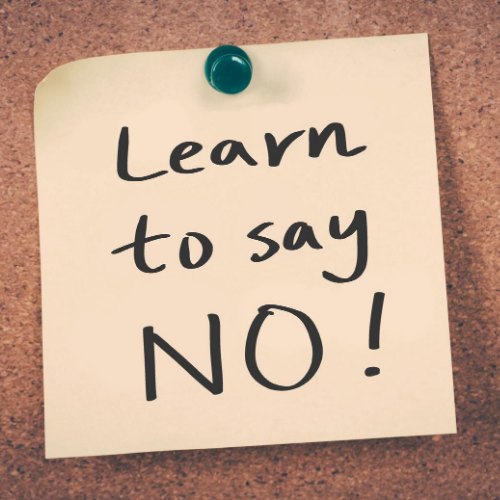
How do you say no without offending anyone?
So back to the topic at hand: how to say no. When you have your big goal set in your mind’s eye (and hopefully on paper) it will be easier to eliminate the small distractions and also to give yourself guilt-free permission to say no to tasks, committees, and outside projects that don’t move you towards that goal.
Another tactic you can use to bow out of obligations that you don’t have time for is to show gratitude for their confidence that you can do the job and then say you need a bit of time to think about it for a day or two. This way you can take a step back to determine if you really have the time they need from you to tackle their project.
What if they need an answer right away?
By the way, if they cannot wait a few days for your commitment, this is a good indicator that the project is probably one you do not want to get entangled with. The urgency indicates that the project is probably someone else’s fire that they did not tend to until it sparked!
Take a moment to determine whether you are being asked to tackle this project because someone else has dropped the ball. Are they in reaction mode, reaching to anyone who might save them? In this instance, it will absolutely pay to step away and reply with a firm NO.

What should you check before you say yes?
If you are considering saying YES to a request, make sure you really have the time and energy to commit and pay the attention that it needs.
When we commit before we determine if we have the actual amount of time involved to give the project to completion, we might take on too much responsibility.
When this happens, it is a lose-lose scenario for all parties involved. Things might fall through the cracks and you might miss deadlines. The result will be that you appear unprofessional and let the people down who were counting on you.

Those close to you and even your health might suffer because you become uneasy and unhappy with the weight of the obligation you took on. All of this simply adds up to too much stress!
One very important element of getting organized and putting processes into place is to have the ability to let go of whatever does not serve your business.
I am not suggesting that you should never volunteer or take on outside projects. Sometimes committees and outside projects are what is needed to expand your life.
Letting go, saying no, and moving forward toward your personal and business goals are skill-sets that will help every entrepreneur thrive. For more ways to free up your schedule, see Seven Tactics To Create More Time For Fun.
What are the quick rules for saying no?
- Don’t volunteer until you take a moment to determine whether you have the time to fulfill the expected commitment.
- Give yourself permission to reconsider commitments and bow out of the ones you are currently involved in.
- Delete unnecessary tasks from your schedule that detract from your BIG picture goals.
- Don’t automatically respond to another person’s problem/fire before you determine whether it is going to enhance or disrupt your agenda.
Keep reading
- Organize and PrioritizeHow to decide what deserves your time first.
- Seven Tactics To Create More Time For FunWays to clear room in your schedule for the things you enjoy.
- Want to Become More Productive and Create More Hours in Your Day?Practical ideas for getting more out of each day.
Frequently asked questions
How do you say no politely when someone asks for your time?
+
Kathi suggests thanking the person for their confidence that you can do the job, then asking for a day or two to think about it. That pause gives you room to check whether you really have the time the project needs, so you can decline calmly instead of agreeing on the spot.
When should I say no to a request?
+
Say no when the request does not line up with your long-term goals and dreams, or when you do not have the time and energy to give it proper attention. Kathi also suggests a firm no when you are being asked only because someone else dropped the ball and needs rescuing.
What does it mean if someone cannot wait for my answer?
+
In Kathi’s experience, if a person cannot wait a few days for your commitment, the project is probably one you do not want to get tangled up in. That kind of urgency often means it is someone else’s fire that they did not tend to until it sparked, and now they want you to put it out.
What happens if I say yes to too much?
+
When you commit before checking whether you have the time, things can fall through the cracks and deadlines can slip. Kathi calls it a lose-lose situation, because you may appear unprofessional and let down the people counting on you, while the weight of the obligation adds stress to your life.
How does knowing my goals help me say no?
+
When your big goal is clear in your mind and ideally written down, Kathi says it becomes easier to drop small distractions. It gives you guilt-free permission to say no to tasks, committees and outside projects that do not move you closer to that goal, and helps you forecast how long things take.
Is it wrong to volunteer or join committees?
+
No. Kathi is not suggesting you should never volunteer or take on outside projects, and sometimes they are exactly what is needed to expand your life. Her advice is to pause before volunteering, make sure you can fulfill the commitment, and give yourself permission to step back from ones that no longer fit.
Originally published on Organized and Energized on August 12, 2020. Moved to addSpace and updated November 7, 2026.