

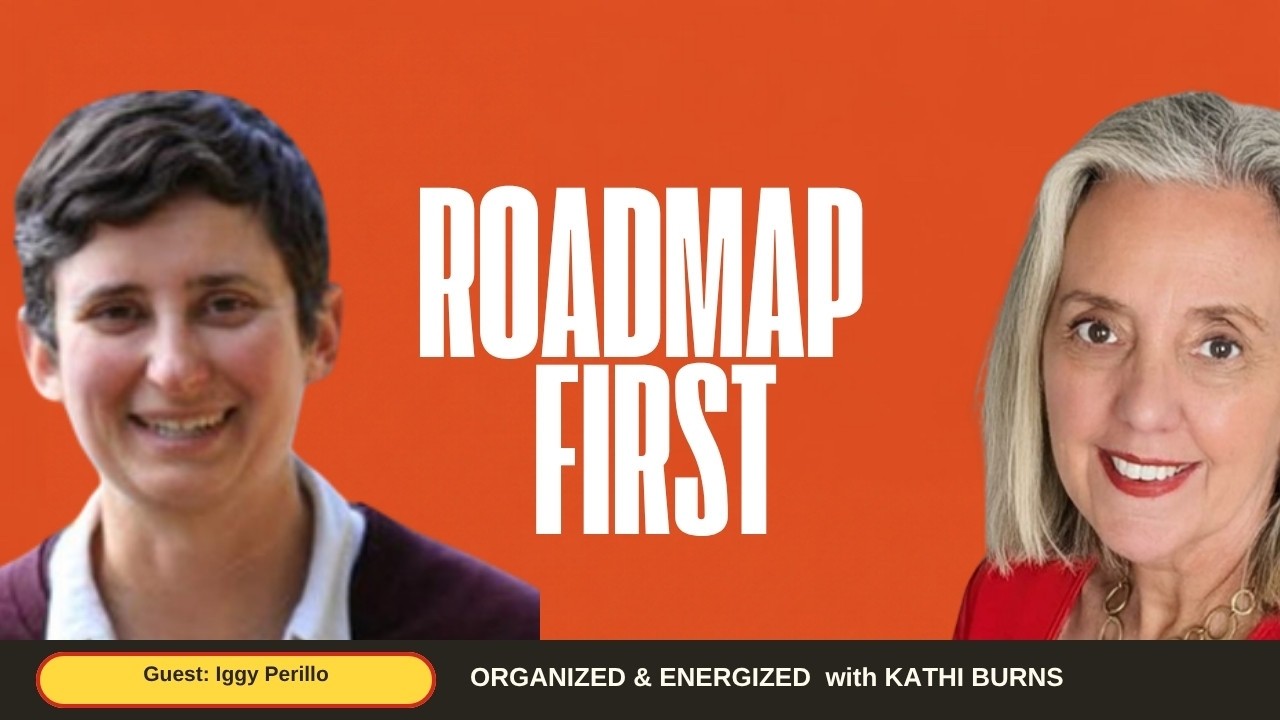
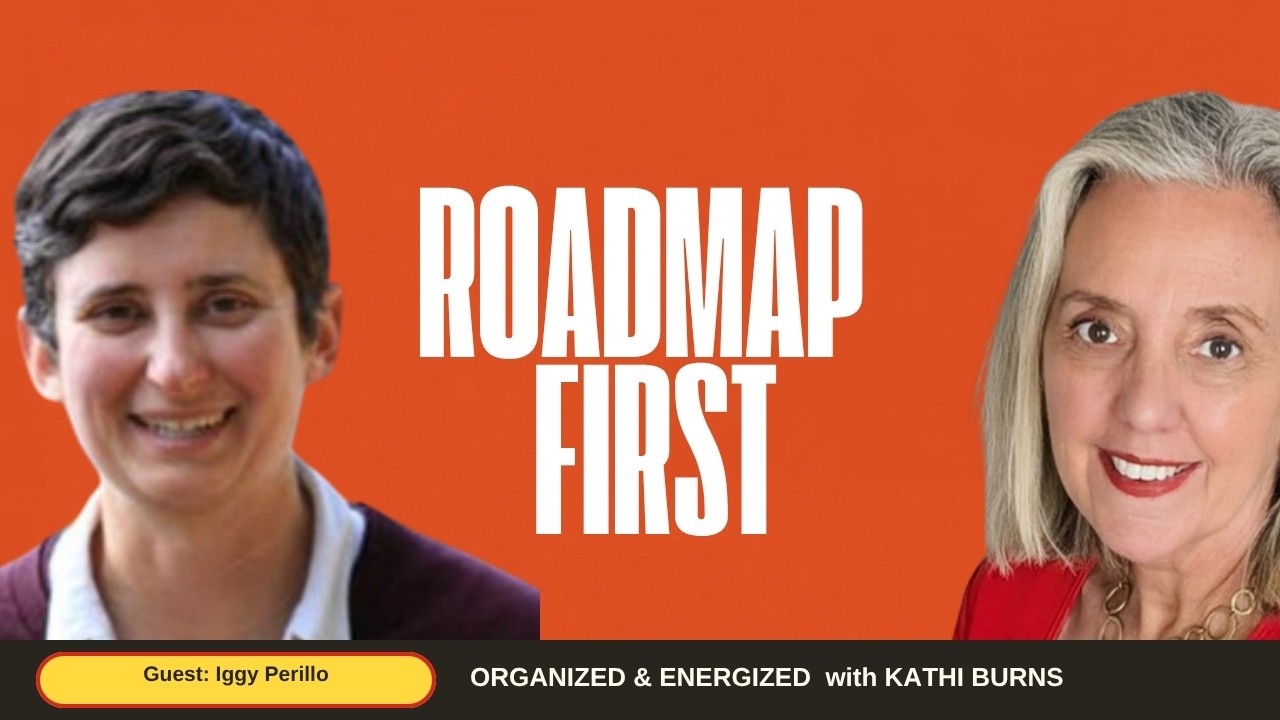
Episode 51
with Iggy Perillo, founder of WSL Leadership, leadership coach and teaching coach for course creators · October 26, 2022 · 37 min
Iggy Perillo, founder of WSL Leadership, spent years leading canoe, dog sled and ski expeditions for Outward Bound before turning her teaching skills into leadership coaching.
She says many experts with real knowledge struggle as educators because they don't set learners up to learn, and those skills can be learned.
Iggy ends every lesson with transference, the one thing learners will do next time they are in the situation, and recommends up to three action steps per talk or lesson.
Her roadmap statement is one or two sentences at the start of a lesson that give learners the goal plus the process, so they know where they are going and how they will get there.
Published · Updated
What is this episode about?
If you want to create an online course that people actually use, the subject knowledge is only half of it. Kathi Burns, CPO®, Business FLOW Strategist, talks with Iggy Perillo, founder of WSL Leadership, who spent years leading canoe, dog sled and ski expeditions for Outward Bound and holds a master's degree in experiential education. After watching skilled speakers deliver webinars and courses that didn't quite land, Iggy started helping experts bridge the gap from wisdom to teaching. You'll hear how she chose her next career by looking at where her 10,000 hours had gone, how a missed volunteer fair led to her first client, how she time-blocks deep work in Google Calendar, why every lesson needs transference and no more than three action steps, and how a one-sentence roadmap statement keeps learners oriented.
Being an educator isn't necessarily everyone's area of expertise. And you can learn those skills.Iggy Perillo
Jump to links and resources · Part of How do I become known as an expert? · All episodes · Every guest
What are the key takeaways?
- Iggy says experts often have the knowledge and wisdom but not the educator skills to set people up to learn, and those skills can be learned.
- To choose her next step after Outward Bound, she looked at where she had received training, feedback and coaching, and found it was leadership development.
- She recommends asking for feedback at the end of every session, leaving a few minutes and letting people talk.
- Her first client came from contacting her local roller derby league after missing its volunteer fair; within a week she was helping at a junior team retreat.
- Transference is the final part of her curriculum plan: the specific thing learners will apply the next time they are in the situation.
- She suggests up to three action steps per talk or lesson; in a long course they can build on each other, and a checklist of completed steps helps learners see their progress.
- A roadmap statement gives learners the goal plus the process at the start, so they can attach new knowledge to a framework instead of wondering what they are doing.

This episode is brought to you by the Business Logjam Session
A private 75-minute online session with Kathi Burns to find the one thing holding your business back and leave with your next steps. It is the same F.L.O.W. process Kathi uses with her own clients: Focus on your goals, Locate your logjams, Outline your solutions, Walk away knowing your next steps.
Find What's Holding Me BackInterested in sponsoring the show? Get in touch.What's the difference between an expert and an educator?
An expert has knowledge, wisdom and skill in their field; an educator also knows how to set people up so they can absorb and use it. Iggy Perillo noticed this while attending webinars and online courses during the pandemic: great presenters with plenty of knowledge would miss the setup or not craft a section well. She says being an educator isn't everyone's area of expertise, but the skills can be learned, and she helps people bridge that gap.
How do you decide what to do next in your career?
Iggy looked at where her 10,000 hours of deliberate practice had gone, then asked who she wanted to work with. After about seven years of back-to-back Outward Bound seasons, the work felt stale and she had lost the energy for it. Drawing on Anders Ericsson's research, she asked where she had been trained, given feedback and coached, and the answer was leadership development. She moved from remote northern Minnesota to Portland, Oregon to work with leaders. Kathi adds that knowing your skills and who you enjoy helping brings joy to your work.
How do you get your first coaching client?
Iggy got hers by offering her skills to a group she already cared about. She emailed her local roller derby league after missing its volunteer fair, and the volunteer coordinator asked what she could do. Within seven days she was helping at a retreat for the junior team, which was struggling with infighting. The league later hired her for work with the adult travel team, leadership coaching for its managers, and a leadership course for junior skaters, coaches and parents.
How do you time block deep work in Google Calendar?
Iggy blocks focused work time in Google Calendar and lets an app place project hours for her. A fan of Cal Newport's book Deep Work, she schedules work blocks, keeps her phone ringer off and puts days off on the calendar so she doesn't overschedule. She uses reclaim.ai: she tells it a project needs, say, 15 hours by a deadline in blocks of one to two hours, and it fits those blocks into her week. If her mind is on a different project, she can swap the hours, because the time is already protected.
What is transference in teaching?
Transference is the one thing learners will actually do the next time they are in the situation you are teaching about. Iggy plans every lesson with a beginning, an activity and then transference. For a 20-minute talk to roller derby coaches, the goal might be that coaches remember they need to lead both the parents and the skaters.
How many action steps should a lesson have?
Up to three. Iggy says more than three is too many situations to be prepared for. In a longer course, two or three takeaways per lesson add up, and each step can build on the last, so learners keep using earlier skills in more nuanced ways. Giving people too much overwhelms them and they drop off.
How do you create an online course that learners can follow?
Tell learners the goal and the process at the start, so they know where they're going and how they'll get there. Iggy calls this one-sentence setup a roadmap statement. Without it, learners waste energy figuring out what is happening. Experts skip this step because the order feels obvious to them after years of practice.
How do you avoid overscheduling your calendar?
Iggy follows her dad's advice: use a calendar with small boxes, because if a day's plans don't fit in the box, you've scheduled too much. In Google Calendar she uses a three-week view, and if a day shows more than about six items, she knows she is overscheduled. She keeps fewer things per day, because switching between tasks costs energy. Kathi adds that it can take 17 and a half minutes to get back into a project after switching, and suggests giving each day a theme, such as a phone call day and a project day.
Where does each part of the conversation start?
- 0:00 Meet Iggy Perillo
- 0:43 From summer camp to Outward Bound
- 3:06 What WSL stands for
- 4:56 When the work started to feel stale
- 6:31 Where her 10,000 hours went
- 7:23 Choose who you want to work with
- 9:42 Always ask for feedback
- 10:20 Her first client: a roller derby league
- 13:01 Time blocking with Google Calendar
- 15:03 Letting an app schedule deep work
- 17:13 A simple curriculum planning guide
- 17:42 Transference: what they do next
- 20:52 Up to three action steps
- 22:40 Show learners their progress
- 23:56 Set learners up before you start
- 26:18 The roadmap statement: goal plus process
- 29:40 A calendar with small boxes
- 31:47 Fewer things per day
- 32:54 The cost of switching tasks
- 33:52 Kathi's big takeaway
- 35:07 Wrap-up
What resources were mentioned?
- Roadmap Statement Quick Guide (free download from WSL Leadership)
- Reclaim.ai (calendar scheduling app for Google Calendar)
- Google Calendar
- Deep Work by Cal Newport
- Drive by Daniel H. Pink
- Anders Ericsson's research on deliberate practice, as summarized by Malcolm Gladwell
These episodes continue the same thread as this one: Dr. Julie Marty-Pearson, Vince Warnock, Anne Bartolucci, Ally Machate also answer the question "How do I become known as an expert?", and the rest are the most recent conversations on the show.
 PodcastingEpisode 146
How to Grow Your Confidence Through Storytelling & Podcasting with Julie Marty-Pearson


See every episode on the podcast archive or filter by topic on the How do I become known as an expert? hub.
How can I support the show?
- Subscribe on Apple Podcasts, Spotify or YouTube, or add the RSS feed to any app.
- Rate and review. A rating on Apple Podcasts helps new listeners find the show, and Kathi reads every review.
- Share the episode with one business owner who needs it; the share buttons are at the top of the page.
- Grab a free eBook: 6 Steps to Organize & Energize Your Home, 6 Steps to Organize Your Home Office or 6 Steps to Organize & Energize Your Life.
- Work with Kathi. The Business Logjam Session is a private 75-minute session to find what is holding your business back.
- Be a guest. Apply here if you have a story about clearing the obstacles in your business.
What did they say, word for word?
The transcript below is edited for readability: filler words and false starts are removed and speaker names are added. Nothing was added or summarized.
Read the full transcript +
Kathi: Hi guys, I'm back and I'm with Iggy Perillo, and I am here to talk with Iggy about course creation mastery. How to become the most masterful course creator and get the people to actually take your information and run with it and use it. Iggy is an expert in this field and I want to welcome Iggy to the show. Welcome, Iggy. Thanks for being here.
Iggy: Thanks, Kathi. I'm happy to be here with you.
Kathi: Yeah, I'm so excited to talk about this, being a course creator myself. But let's get into a little bit of backstory on why you're doing what you're doing. So, what's up? Where did you come from? Where have you been? All that good. Give us some backstory here.
Iggy: Sure. I basically come from the world that was summer camp at one time as a young person, summer camp counselor, and then took this leap to being an Outward Bound instructor. So, playing outside for fun to changing lives through challenge and adventure. And then along the way, I got a teaching license. And along the way, I got a master's degree in experiential education. So, not just like we're playing outside and hey, you might learn something, but we're going to sculpt experiences so that you can learn and change and grow and actually transform in really human, personal, deep levels. So, I was doing that work for, I'm actually still doing that work off and on. And so, through that work, I got more and more into leadership development, because leaders operate in this very dynamic, very changing, very experiential space.
Iggy: And then from there, moving into seeing the world through the pandemic, mainly a lot of folks, a lot of creators like us, a lot of people with expertise and a lot of wisdom to offer the world, were like, oh, I need to offer a course. I need to do it online. I need to offer a course. I need to do these things. And looking at and seeing them and going to webinars, learning. I love learning, so I'm always attending, going to different things and seeing people deliver things. I'm like, oh, you have so much skill. You have so much knowledge. You're a great presenter, you're a great speaker, but you're just not quite there as an educator. Like, oh, you missed it here a little bit. Oh, you should have set us up a little better over here. Oh, you could have crafted that a little bit better. Because people don't have those skills. They have knowledge. They have wisdom. They have expertise in their area. Being an educator isn't necessarily everyone's area of expertise. And you can learn those skills. You can have those too. And then whatever you deliver, whatever you have to say, the wisdom you have to offer gets into the minds of the people, which you articulated beautifully in the intro. And then people can use it and absorb it and take your wisdom and integrate it and transform their lives with it. And so I help people bridge that little gap from their wisdom to being expert educators.
Being an educator isn't necessarily everyone's area of expertise. And you can learn those skills.
Kathi: I think that's fantastic. So you started with summer camp, which, I love summer camps.
Iggy: Yeah. Who doesn't?
Kathi: Outward Bound. So you still bounce back to Outward Bound every once in a while?
Iggy: Yeah, I was actually there last month helping some folks lead canoeing and backpacking and mountaineering expeditions in northern Washington, in the North Cascades. So I was not in the field necessarily, but helping basically educate the instructors who were going out into the field and preparing them to be excellent educators in that type of very experiential, very personal, very expansive and exciting environment.
Kathi: That's so exciting. That's so cool that you do that. You've been doing that for years and now you're educating the educators. So talk to me about WSL Leadership. What's it stand for, actually? What's the W and the S and the L?
Iggy: Yeah, that stands for Work, Sport, Life Leadership. So I help people in all those different areas. I love working with people in the world of work, as leaders often are in work environments. I also love working with athletes. I have a close connection with my local roller derby league and also the roller derby leagues around the world. Somehow I've gotten connected to this community. I don't skate, but I'm a huge fan and love working with those athletes and other athletes. I've worked with other sports teams. And then life: we are human. We can communicate better. A lot of the same lessons apply whether you're leading a corporate environment or working as an athlete on a sport team, or just trying to communicate well within your life, with your neighbors, with your friends, with your family, or resolve conflict. These same topics come up in all these different areas, and being a good educator, you could educate folks in any of those environments too. So it all intermingles.
Kathi: And I think we all are experts in our own right, and knowing how to transfer our knowledge and get people to take action is what it's really about whenever we're creating the online courses. I love the fact that you're in the roller skating league. I had a client who did that and it's such a blast.
Iggy: Oh, it's so fun. It's like the best sport. If you can ever catch a bout anywhere, they're actually all over the US. Almost every town has a league or a league nearby. I would just say go watch a roller derby bout. You will be excited. It'll be interesting. It's super athletic. It's super fun. It's such a great sport. I love it.
Kathi: And I love the outfits.
Iggy: Oh, yeah. And there's outfits, and there's just enough silliness and some very punny names. It's really great all around.
Kathi: Yeah. It's really, really fun. So it sounds like your career has gone really well in alignment with where you are now. But talk to me about a time where you just felt a little bit lost or you weren't quite sure what you were supposed to be doing next. What's the next step for Iggy?
Iggy: Yeah, I'd been working full-time, year round, for Outward Bound for many years. So that meant summer seasons leading canoeing and backpacking expeditions in northern Minnesota, and then the winters leading dog sled and ski expeditions in the same course area, in the same space. So I'd been doing that for maybe seven or so years. And so basically my off season was April and November. And so I had these two months off a year, and the rest of the time I was working, working, working. And I got to this point where, I had worked up into management type of positions, or middle management, and I was supervising interns and I was training other staff and I was doing these different things. And eventually at a certain point I'm like, ah, this is feeling a little stale. It's feeling a little rote. I've done this, and new stuff is happening. It's a really dynamic environment, so it's not like things got boring, but I think I felt like I lost the energy for that. So I'm like, well, what am I going to do? I don't quite have the energy for this work.
Iggy: And then there's this part of my brain that's like, well, what has this trained me for? I'd been doing that work for maybe 12 or 15 years by then, and specifically at least seven years, summers and winters at Outward Bound, back to back to back. And I was like, what can I do with all this knowledge? I know how to schedule people a little bit. I know how to train people to back up trailers. I know how to tie canoes on a trailer. I have all these different skills. I guess I've been training staff. I've been doing all this stuff. And I went through this process of thinking about where my 10,000 hours have been spent. So Malcolm Gladwell does a fine, okay job summarizing Anders Ericsson, who was the guy who did the original research about peak performance and how we can become experts in our field by 10,000 hours of deliberate practice. Not just 10,000 hours of willy-nilly doing something. I could do a lot of things. We probably have all driven for 10,000 hours, yet we are nowhere near being professional drivers. We just willy-nilly do these things. So I was thinking about where I had focused my energy, where I had had training and gotten feedback, been coached, and it really was around leadership development.
I went through this process of thinking about where my 10,000 hours have been spent.
Iggy: So I'm like, oh, I like working with leaders. I like helping leaders lead. And I think in that space, leaders were leading groups, but also educating groups at the same time. The instructors were leaders. So there's this great intermingling of being educators and being leaders at the same time. And so I took a step back and was like, well, I don't want to be in the field or be in this remote space. What do I want to do? Where do I want to be doing it? And mainly, who do I want to be working with? And that's, I think, how I focused in on working with leaders, and from there adding back in leaders who are also educators. So I had this moment of transition from northern Minnesota, the remote edge. I think we were about 10 miles from the Canadian border, remote northern Minnesota, mostly water between us and Canada. We could paddle there. To living in Portland, Oregon, where I am now, a much more obviously urban environment, and working with people who are leaders in dynamic and interesting environments. And they encounter the same problems. How do we make decisions? How do we get things done? How do we get from here to there? Maybe not physically with our dogs over these lakes, but how do we get from here to there to produce our thing, to make our mark on the world, to do our thing? So yeah, there was definitely a lot of wrestling through that time of what do I want to be doing, who do I want to be doing it with? And then I ended up here. So here we are.
Kathi: Yeah. And I think a lot of people right now are going through that same thing. And I think it's so brilliant to think about, okay, what are my skills? And then most importantly, who do I want to work with to use those skills with? I think that's super important. I know as a professional organizer, we always started as generalists, and then we fine-tune down who we want to work with, what clients bring us joy when we work with them. And if you can really figure out, first off, your skill set and then who you like to hang out with and who you like to help, then you have joy in your career. And I think that this is great advice for anybody who's looking to switch, to jump out of maybe corporate, or to jump out of an Outward Bound situation like you, which is a very rare scenario. Although I do have a very close girlfriend that has taught rappelling and that kind of thing.
Iggy: Oh yeah, absolutely. It's super fun. But I think you're right, though, with who do you want to work with? Who are you excited to work with, even if it's hard for you? Being excited to work with them helps you and them both see progress. I think that's a great place to start. Those people, that characteristic, that workplace, whatever it is. Great first step.
Kathi: And they are going to be a challenge, and that's the whole beauty of it. Because the people that you really want to work with are the people who are going to help you grow as well. So think about that when you're first launching, gang.
Iggy: Oh yeah. And always ask for feedback. Anyone you work with, ask them for feedback every single time. What can I do better? What did you like about this? Whatever formulation of asking for feedback works for you, you're going to grow so much faster, so much better, and serve people so much better down the road by really, at the end of every session you have, leaving a minute, two minutes, five minutes, and being like, "What feedback do you have?" And just let them talk. It's going to sculpt the arc of your trajectory in amazing ways.
Anyone you work with, ask them for feedback every single time.
Kathi: I love feedback. I tell people that all the time. It's good, bad, ugly, I don't care. Just let me know how you really feel about it. And you have to be open and receptive to that. So talk to me about, because you made the jump, your first client that you landed that was not in the old world. What was your first leadership client and what happened with that?
Iggy: Well, actually it was the roller derby league, to be honest, which is really funny. They had had a volunteer fair, and I was like, oh, I should go to this volunteer fair. I've been watching. I'm a fan. I have all these skills working with youth and adults in leadership, in team environments. I could probably help them out. It's a nonprofit volunteer organization. So I'm like, oh, I could help. And I called them up or emailed or whatever, and the volunteer coordinator got back to me and was like, "Oh, you missed the volunteer fair." I missed the date or whatever. "But what skills do you have? What can you do?" I'm like, "Well, in the world of Outward Bound, I've been helping teens and youth develop their leadership, primarily, and young adults." That's what I'd been doing at that exact moment. And then adding training adults to be leaders, too. And they're like, "Hey, next weekend we have a retreat for our junior team. They're infighting and getting cranky with each other and just struggling a little bit. Can you help out at this retreat next weekend?" So I'm like, "Sure." So basically within seven days, I was volunteering at this retreat.
Iggy: And then from there I basically became a league sponsor, got hired by the league to do other work. So I think they were my first client in this really interesting, multifaceted way. So I started with the juniors, then I worked with the adults, and the adult team happens to be the reigning world champions right now. So I've been working with them for several years, the travel team, and then got into working with the league management. It's a really big league; not every league has so many different teams in different programs. So then I did some leadership coaching for, not the board exactly, but the leadership team of the league. They have a couple different managers running different programs. And now they recently hired me to do a leadership development course for their junior team skaters and then their junior team coaches and their junior team parents, because those are some complex relationships, and how they act and interact could be smooth, could be not so smooth. So I'm going to help make that communication flow a little more easily for all of them.
Kathi: Wow, that's pretty intensive. I can't even imagine doing a course that would handle all the aspects of all those different types of people.
Iggy: It's going to be a big project. Yeah, it's a big, big project.
Kathi: A big project. That's fantastic. So whenever we think about creating our own online course for this one set of people with this one specific message, it seems like it's rudimentary to you as far as basics. Get back to the basics.
Iggy: Yeah, for sure. And I think it'll be super helpful for other leagues. I think the hope is to make this for my local league and then to be able to also offer it to other folks in other places, too.
Kathi: Yeah. What a great backstory. So as you're creating these courses, how do you keep all that information organized? What's your method? I know you use Google Calendar. We can talk about that. I love Google Calendar. So let's first start with that, and then talk to me about the way that you might organize the information that you're going to put into a course.
Iggy: For sure. Yeah, I definitely had to start with Google Calendar because I'm very much a scheduler and a time blocker. I'm a fan of Deep Work, Cal Newport's book. He wrote this book called Deep Work, which is about giving yourself time without interruption to really focus on something. And I find that that's where I do a lot of my really good work, is to be able to block out interruptions, block out phone calls, turn off alerts and alarms and focus. And so I can get that on my calendar by basically scheduling workdays, scheduling work blocks sometimes. But I have all the integrations into my calendar. It's like, oh, you're going to schedule something with me? Boop, the Zoom link just shows up in my calendar. We need to have a meeting about this or that? Here, let me send you my scheduler. It's going to get on my calendar. If it's not scheduled on my calendar, it's pretty rare it'll happen. I don't have my phone ringer turned on, so if I need to schedule a phone call, I need to tell my calendar to tell me to turn on my ringer. It really helps me stay focused on the things I need to be doing and also gives me the time to do the things. Put my days off on there: actually, I'm not taking meetings this day. I'm actually going to have a weekend. What is that? These different pieces that I did not always do well, to be honest. I had to get myself into a process of using my Google Calendar better to not overschedule myself. I think that's the danger.
Kathi: Yeah, I love that. And I love the fact that you can have Google say turn on your phone. I actually need to do that myself, because I have my phone off at all times. And so whenever you create a little chunk of time for a project, I'm just very curious, how long do you designate for a deep dive project? What do you block? How many hours?
Iggy: Yeah, it depends. By now I have a rough estimate of how much time I need to do something or to develop something. Another app I use is reclaim.ai, and that is this beautiful integration with Google Calendar where you can tell it, hey, I have this project. It's going to take me 15 hours to do. Here's my deadline. Here's when I want to start. And make me times that are at least an hour long, but not more than two hours long, between now and then. And then it'll fit those into your calendar and block off those days and times in your calendar for you. So it's super handy. I'm a big fan of that one, just to help me. I have a training coming up next week where I'm actually working with the derby league and another organization. So I have these two projects competing in my mind a little bit this week. And so I know I need to spend maybe six or eight hours on one and maybe about 12 hours on the other, which is almost a full week. That's 20 hours of work I need to fit in.
Iggy: And so I end up trying to, there's a way, it's hard to explain exactly, because one way to do it is to be like, "Okay, here's my hour to work on the derby thing. I'm not going to do anything else." And then if I get there, I'm like, "Oh, but my brain's really on this other project. Maybe I need to work on that other project," and trade the hours back and forth. It gets messy. It's a whole train wreck. But I know my calendar is not going to have four other phone calls pop up and two other podcasts, because I have that time already blocked out for these two projects during the week.
Kathi: Oh, that's pretty amazing. I haven't heard of reclaim.ai, so I'm going to definitely check that out. I made a little note about it. And I'm a big proponent that if you know what you're supposed to do, you know what you didn't do. So like you say, you get into that block of time and you're like, I was supposed to be working for the derby, but wait, I'm not really there. So you can just swap it. But if it wasn't in the schedule to begin with, you couldn't swap it with anything. So that's the beauty of the Google Calendar. Now, when it comes to organizing the course curriculum, what do you use for that? Because I know everybody has different methods, and I want everybody out there to hear what everybody uses, because then you can choose your own. Because, gang, I feel like there's no one way to do anything. So take whatever you hear within these podcasts and choose the one that works for you. So let's hear about yours, Iggy.
Iggy: Yeah, I have a little curriculum planning guide that I start with: the goal of the thing. My goal for this weekend is a 20-minute talk about how coaches, skaters and parents interact. That's the goal for my next little presentation. That's what it needs to be. And then I walk through the beginning part of it: how am I going to introduce it, set it up. The middle part: what am I going to have people do to practice or engage with this? And then the final part: what am I going to give them that they're going to take away? And then there's this little piece at the very end that is called transference. So we have the beginning, some activity, and then transference is what's the thing that they're going to apply next time. So they've had this experience; what are they applying? Not just a goal. Yeah, they had a talk, they learned about some stuff, but what are they going to do? And that needs to be super succinct in a 20-minute talk. Maybe two or three things, or maybe one thing for each group. I guess I have to think about it that way. What is the one thing they need to take away and use and do after this talk?
Iggy: Like, oh, I need to know as a coach that I need to lead the parents and lead the skaters, both. If that's all the coaches remember, and here's two ways I can do that, great. They're set up to do that next time. Oh wait, I need to lead some parents right now. Wait, I need to lead some skaters right now. So that transference piece is crucial for how the impact that I want to deliver lands and gets enacted and happens. So not just the goal, not just the steps to get there, but what is that thing that they're actively going to do next time they're in the situation that I'm setting them up for?
Not just the goal, not just the steps to get there, but what is that thing that they're actively going to do next time?
Kathi: Yeah, what is the action step they are to take? And I think oftentimes I even forget that. That's one of my big mantras, but I forget it at the end. It just goes thud, and then, oh, I didn't really tell them what I wanted them to do next, or I wasn't very clear about that. So being succinct. And I think if you can make it some kind of a cool little phrase, that helps too, but I'm not that good at that kind of thing.
Iggy: It's tough. It's tough, and it changes all the time for different groups or different organizations. But I think you're right. We forget transference. We're like, "Yeah, I gave you all that information. See you. Good luck."
Kathi: And they're like, "My head is swimming. I have too much information. I don't even know what I was supposed to do next."
Iggy: Yeah. Absolutely. Absolutely. And so just making it super clear: when this happens, here's what I want you to do, or here's your next two steps from there, or here's the framework that I want you to employ when this situation comes up again. Because that situation will happen. The coaches are going to coach, the skaters are going to skate, the parents are going to parent. Those things are going to happen. And so I can just set them up with one next step in such a short talk. And then luckily, for this group, I have much more training I get to do down the road, but this has to be the intro and get them rolling along a little bit with that. But yeah, I still want them to do something. I don't want to just be like, "Wow, good job. Thanks for talking and making it vaguely entertaining." Yep, I'm going to be vaguely entertaining, and you have to do your part, too.
Kathi: Absolutely. Do you find that one thing is the goal for yourself, for your talks, having them take away one thing that they can take action on?
Iggy: It depends. It really depends a little bit. I have a training later that's just with the skaters, to be leaders in their league, leaders in their team. So they're going to have a lot more things to do, because it's going to be really focused. But having three different groups I'm talking to in one talk that are very distinct audiences, I think if they each have one to two things, that's going to be a lot of things, right? Because everyone else is going to be sitting there being like, "Okay, this isn't about me," taking a nap. And so I want to keep them engaged throughout and understand how they interact with these different pieces. So most likely for this, it's three different things, but it's just one thing per group.
Kathi: And if you're focusing in on one group, how many action steps would you recommend that we tell our people to do at the end of each talk?
Iggy: Up to three. I think more than three, that's just a lot of situations to be prepared for. And if you obviously have a longer training, if you're doing a whole course, great, each lesson can have two or three takeaways. Perfect. Then at the end of a course of 20 lessons, suddenly they've done 80 different things. It's amazing. You can compound those and add those up and make them progressive and make them scaffold onto each other. It's really powerful. And so you give them the easy thing first, and then the slightly harder thing that builds on the easy thing, and the slightly harder thing. So they are still using those earlier steps and those earlier skills, but they're applying them in more nuanced and more interesting ways the whole time. So then they really get good at them over time.
Iggy: And that's the beauty, I think, of a lot of online courses people create: they can be really long, but also they need to be really engaging and really thoughtful, or else you lose people early on, and people are out to lunch. We see this. We see people drop off. They pay for it, they don't show up. We host a session, you have a hundred signups and 25 people click into the call or whatever. And people watch videos, people take things in different ways. But I think with that level of engagement, we don't want to lose people by just giving them too much and overwhelming them. And so making it really simple, step by step, is really helpful. And that ties into not giving them 45 things to do. Giving them maybe three things to do for an hour or 45-minute talk is usually plenty of things.
Kathi: Yeah. I just had an aha moment when you were saying that. I always have three action steps at the end of each chapter or the end of each module. But what I thought is, what if I had that compiled into one sheet, and they could see all the check marks and all the stuff that they've done? They can actually physically, visibly see the progress that they've made throughout the course. I think that'd be like icing on the cake, right?
Iggy: Oh, absolutely. People are so motivated by seeing mastery develop. And that was Daniel Pink's book, Drive. He talks about how when we see that we're mastering things, we're making progress, we feel a ton of confidence. Like, oh yeah, when we try to think back to remember when you didn't know that thing and it was super hard and terrible, and now it's not so hard and terrible, and in the future it could be really easy. We're like, oh my gosh, I am on my way. I can do it. And so I think, exactly like you're saying, a checklist of here's what you've done already, here's where you are now, and hey, there's a little bit more to do, but also remember how this was kind of terrible, and now you're getting better at it. Showing people that they're growing and learning is really powerful for sure.
Kathi: And maybe to unveil each step as you get to each step. Because I'm again thinking of the Google Doc with the check marks, right? I'll unveil the next curriculum, you'll see the next steps, but they aren't unveiled till you get there, so you don't get overwhelmed. But you just gave me great insight.
Iggy: Well, yeah. And I think it helps at the beginning of the chapter. And this is the thing that you actually probably just saw in my download that I have for folks: to set people up to learn. Because I think sometimes we jump in. We're like, "Hey, we're going to do this really cool thing. Let's go." And people are like, "Wait, what are we doing? What's happening? How are we getting there?" And our learners are just trying to figure out what we're doing a little bit, in a way that wastes energy when they could be focused on doing what we're doing together. And I think my analogy is, we jump into connecting the dots when the learner is like, "Wait, we're not doing a crossword right now? I didn't get it. Hold on." They just aren't quite on the same page. So setting people up for knowing, hey, in this session we're going to cover these three things, and at the end I want you to be able to do this thing. Then you can go back to the beginning and be like, oh, okay, great. Now I know what's happening. We're going to do these things, and at the end I'm going to be able to do this thing. Great, I got it. Check. My brain can flow along with your flow. And there's different ways to be really nuanced about how that flow works or how it goes, if it's chronological or schematic or just different things. But I think that helps learners. I think so many educators skip that step, and the learners are just a little bit swimming around, like, what's happening next? Which is fine, to have some anticipation, but if it's like, wait, what's happening at all? That's not so great for our learners.
Kathi: Yeah. Connect the dots versus hangman or whatever.
Iggy: Yeah. What's even happening? They don't know. And it's obvious for us, because we're the educators. We have all this expertise, we have all this knowledge, and we have it in our brain. We're like, oh yeah, obviously we're going to go chronologically through these things. Meanwhile, your learner is like, wait, there's an order to this stuff? Our learners don't always know what we know. It's hard. That's the really difficult part of being an educator: putting ourselves in the place of that person who just doesn't know, when we've absorbed the knowledge and it's intrinsic to us. It's so easy. Like when you ask me how I organize things, I'm like, I don't know, I just organize, because it's intrinsic. I just do it, and it's become a habit for me. And so to break myself out of my habits and explain it takes more effort, because it's just become a rote habit. And we teach like that too. We teach like, oh yeah, this is a habit for me. It's known. I'm an expert. But we're teaching learners who are not experts and who are very much beginners. And I think we don't always appreciate how hard it is for them to learn and to put themselves in that learning role. Nor do we always set them up well to be really effective learners. And so that's the beautiful download I have for you all.
We're teaching learners who are not experts and who are very much beginners.
Kathi: Yes. Yes. Because with 18 years or 20 years or whatever of experience, trying to drip feed it, or trying to see how did I actually get here, I think is the hardest thing to do when you're creating something for people to integrate into their life. So let's talk about that download. What do you have? You should download this, because I just did it and it's really, really good.
Iggy: Yes. It's at wslleadership.com/educator, and it is a guide to help people build what's called the roadmap statement. It's called the Roadmap Statement Guide. And the roadmap statement is one sentence, basically, or two little pieces that you add at the beginning of your lesson, your session, your course to orient your learners, so your learners know, oh, I get what our goal is. It has two parts: a goal, and the process a little bit. So you want to tell your learners, here's our goal for today: I'm going to teach you how to post on Instagram today. And here's our process: I'm going to go through it step by step, one click at a time. People are like, "Great, great. I know where we're going. I know how we're going to get there. Great. I can follow along." Or, "Hey, I'm going to teach you how to be a confident speaker. We're going to go through starting with your fears, and then talking about how to use those fears to launch you into more and better speaking roles." Whatever it is for your expertise: the goal plus the process.
Iggy: And we talk about the goal pretty much. People sign up for the goal. They're signing up for, oh, I want to be a better speaker. I want to post on Instagram all the time. I want to blah, blah, blah. But we skip over the process, and that process is how our learners know what to expect and how they build a framework in their mind. And then they can attach all the pieces of knowledge that you're giving them to this framework. And from the learner's point of view, this makes it so much easier, versus: I have this apple over here, I have a couple oranges, 16 bananas and a watermelon. Am I making a fruit salad? What am I doing here? What's going on? And so it makes it really easy: hey, we're making fruit salad. I'm going to give you five different fruits. You're like, got it. Hand me the fruits. I'm ready for them. And so our learners are ready and oriented to do the thing that we want them to do and to get to that transference at the end. It just smooths the way a lot. So the Roadmap Statement Guide that you can download is a really fast, really short process for how to create that statement in a way that your learners are oriented, so they can learn and grow and transform a lot more easily. So you're not fighting their mental energy with, not curiosity, but confusion in their minds.
Kathi: Yeah. And I love the roadmap because, again, it is succinct and it's easy. I know exactly what you're trying to have me do, Iggy. I know how I'm going to do it now, and I feel that I can do it.
Iggy: One sentence. You can do it. It's fast. It's easy.
Kathi: But we skip that step of, okay, and I'm going to show you how to do it: one, two, three. This is the one, two, three step, or ABC, or however it is that we're going to give them the information. So yeah, everybody download this. It's really quick. It's really easy. And it really got my brain stirring on possibly parts that I've missed within courses that I've created. It's like, oh yeah, I should have probably done that.
Iggy: Well, and you can go back and add it in, or add it on the front page or the title slide, whatever it is. Be like, hey, let me just edit this little thing in. Here's where we're going today. Okay, great, now we're going to get going. It's simple. It's easy to add in later if you forgot. And it really helps your learners so much. You would not believe how much your learners' anxiety level just decreases, because they're like, "Okay, I get it. I get where we're going."
Kathi: Yeah. And then they actually take action, which, as influencers, educators, we want people to be able to take in our information and actually use it, because that's why we're entrepreneurs. We're here to help people shift into something new and grow and blossom. That's why we're all entrepreneurs, probably.
Iggy: Yeah, absolutely. We have something to offer, and I just want you people to offer it more easily, in a way that people can learn and use better.
Kathi: Yeah, I love it. Okay, so one piece of advice that you've received, because you've given me a lot of really good advice today. What's one piece of advice that you've received in your life that still sticks in your mind? The thing that sticks.
Iggy: I mean, it goes back to the calendar, which is a little weird because I'm attached to my Google Calendar, but I still follow it. My dad said to get a calendar with really small boxes for every day. This is back in the paper calendar world, the little calendar, so you couldn't write very much in every day, and that's what time management is. I was like, that's true. And so on my Google Calendar now, on my view, if there's more things, where it has to say "and more," I'm like, that's too much stuff on my day. I need to be able to see everything in the box. I don't have a day view. I think I have a three-week view, so each box can hold maybe six things. If I have more than that, I'm like, I'm overscheduled. I already know it. So I need to be able to visually see it. That's my limiting factor to not overschedule myself and to time manage myself: to make sure I don't put too much in each day on my calendar, based on my dad's advice.
Kathi: That's really, really good advice. I remember my father always had the paper calendar that he stuck in his shirt, and he wrote very small. And that is such good advice. If you can't fit it in the square, then you probably are overreaching, and you will set yourself up for being very disappointed, or "I didn't get anything done," and scattered. Or using the Ivy system, where you only have three to five things each day and that's it. You do the first three, and if the other two didn't happen, they become the first three for the next day. So it keeps it very, very simple, and again, it allows us to have our roadmap of what we've actually done. When you do 15 different little bitsy things, it feels like you haven't done anything.
Iggy: Oh yeah, our brain can't process. We switch so much. We spend so much energy switching between things. We're actually not multitaskers. That's this myth of multitasking. We're just switching between things in a way that we don't pay close attention, which doesn't help us do great work, because we spend so much time switching between things. So yeah, fewer things. I'm all about fewer things per day. And that includes phone calls, scheduled meetings, whatever, all the things that you have in your life and times. Unless it's a habit like brushing your teeth, great, I don't need to put that on my calendar. But if it's going for a run, yeah, I'm going to block off time. I'm going to put things on my calendar that are meetings, schedule my deep work, my planning time, all these different things. And for me, not too many per day, for sure.
Kathi: Yeah. And chunking them together into different types of buckets. I call it umbrellaing each intention for each day. Having it say, okay, this is my phone call day. This is when I'm going to be chatty. But Wednesday is my project day. I'm not going to chat.
Iggy: Yeah, absolutely. And this is my weekend, where I'm not going to do any of those things, right? It's okay to schedule yourself to not do the work things, because I think this is the other challenge of being an entrepreneur. We always have ideas. We're always creating things. And I do take notes. If on the weekend I get a great idea, I'm going to write it down, but I'm not going to go sit and pursue writing or outlining a whole article that day. I'll get enough notes to get back to that later. You need your diffuse mode brain to have some time to just do other things, or not be focus, focus, focused.
Kathi: Yeah, I totally agree. And between switching tasks, I think they figured out it's 17 and a half minutes to swap a task.
Iggy: Oh, okay.
Kathi: Yeah. 17 and a half minutes it takes to get back to where you were when you jumped off the boat and went on to something else. Even just answering a phone call. You answer a phone call, you have a chitchat: 17 and a half minutes before you can get back into the project you were thinking about to begin with, because you're still thinking about the conversation.
Iggy: I felt that. I felt that 100%. I believe it. I have definitely felt like, okay, wait, where was I? What was I doing? I had that great idea. I'm sure, obviously, I had so many great ideas. Where did they go? Every time.
Kathi: Where did they go? Where did those ideas go? I say that to myself all the time. It was there. Well, this has been fantastic. Is there anything that we should have talked about that we haven't covered yet? I just want to say that at the end in case I forgot something that was super important that you wanted to tell the gang.
Iggy: I don't think I have anything super important, but I would be curious to hear what you're taking away from today. What's the top thing that you're taking away from today?
Kathi: So I always tell them what I'm going to tell them, but actually putting it into: how am I going to show you this? What's the avenue that I'm going to use for this? Is it going to be, you're going to watch these videos? You're going to do this check sheet? What is it? How are you going to take the information that I give to you into your body or into your brain? So I think that's very important in anything that I'm teaching. So that's my big takeaway: the steps, or the procedure, or the process. The process, because I'm good at saying what I'm going to say. Tell them what you're going to tell them and then tell it to them again. So now it's tell them what you're going to tell them, and then tell them how you're going to have them use it and how it's going to flow, so that they have that anticipation. And I think that will increase the learning. So that's my big takeaway. I love it, and I love the roadmap. So everybody that's listening, go ahead and click the download. And on top of that, you'll get some more good tips from Iggy as she progresses in her world and comes up with more things that she's learned and taught about leadership. So I really appreciate your time, Iggy, and I wish you much success. And now I've got to go find my client and watch one of her derbies, because it's a blast.
Iggy: Oh, yeah. It's so great. Go find it. Go find it. If you can't find it locally, it's definitely on Twitch or on YouTube. It's out there.
Kathi: Yeah, it's a blast. So check out that, too. But thanks so much for your time. And everybody, go ahead: if you're thinking about creating a course, even if you're just doing a talk, even if you're just teaching a client, use these processes. I think it's going to be brilliant. I can actually think of another application: at the beginning of a client session. What are we going to talk about today, and this is the way that I'm going to show you how to implement it. These will be the steps that you learn today. I think that's going to be huge.
Iggy: Yeah. Or with client work: we're going to start with you as a person, then talk about your closest relationships and further relationships. There are just lots of ways to structure that so people's brains follow along. Great. I'm so excited for you to use that. I'm so happy for you.
Kathi: Thank you so much, Iggy. I really appreciate your time. And gang, we'll see you next week, and make sure to download the roadmap. Thanks, Iggy.
Iggy: Thanks. Bye.
Kathi: Bye.
Where can I find the links and resources from this episode?
Connect with Iggy
Organizations and companies
Books and resources
- Deep Work by Cal Newport
- Drive by Daniel H. Pink
- How to Master Your Muck by Kathi Burns
- Organizing With Tetris by Kathi Burns
- Home Organization, The Smart Guide by Kathi Burns
- Simple Family Organizing by Kathi Burns
- All of Kathi's books in her shop
Inspired? Here Are Your Action Steps:
- List where you have spent your hours of training, feedback and coaching to find your real expertise.
- Decide who you most want to work with before choosing your next offer.
- Leave a few minutes at the end of every session to ask for feedback, and let people talk.
- Plan each lesson with a beginning, an activity and a transference step: the one thing learners will do next time.
- Limit each talk or lesson to three action steps or fewer.
- Give learners a checklist of the steps they've completed so they can see their progress.
- Write a one-sentence roadmap statement with the goal and the process, and add it to the start of each lesson.
- Block deep work time on your calendar and turn off your phone ringer during it.
- If a day's plans don't fit in its calendar box, move something to another day.
Frequently asked questions
What's the gap between an expert and an educator?
+
Iggy Perillo watched talented speakers deliver webinars and courses that didn't quite land. They had knowledge and wisdom, but not the skills to set people up to learn. Iggy says those skills can be learned, and they are what turn expertise into change in someone's life.
What is a roadmap statement?
+
It is one or two sentences at the start of a lesson that give the goal and the process. People sign up for the goal, but the process tells them what to expect, so they can hang each new piece of knowledge on a framework instead of wondering whether they're doing a crossword or connecting the dots. Iggy offers a free Roadmap Statement Quick Guide at wslleadership.com/educator.
How many action steps should a talk or lesson have?
+
Up to three, according to Iggy. More than that overwhelms people. In a longer course, two or three per lesson add up, and each one can build on the last. Showing learners a list of what they've already done helps them see their own progress.
How did Iggy Perillo land her first coaching client?
+
She contacted her local roller derby league after missing its volunteer fair. Within a week she was helping at a retreat for the junior team, and the league went on to hire her for coaching, leadership work and a course for junior skaters, coaches and parents.
How does Iggy Perillo stay organized?
+
She time-blocks everything in Google Calendar, protects time for deep work, and uses reclaim.ai to fit project hours into her week automatically. Her dad's advice still guides her: use a calendar with small boxes, because if a day's plans don't fit, you've scheduled too much.
Who is talking in this episode?

About the Host, Kathi Burns
Kathi Burns, CPO®, is a Business FLOW Strategist based in San Diego. For the last 20+ years, Kathi has helped clients create systems they can stick to. She is the author of How to Master Your Muck, Organizing With Tetris and Home Organization, The Smart Guide, and co-author of four more titles; all are in Kathi's shop. Kathi's business has been featured on Good Morning America, and her advice has been featured in Oprah Magazine, Martha Stewart Living, Better Homes and Gardens and Entrepreneur Magazine.
More about Kathi · Shop Kathi's books · Business Logjam Session · Apply to be a guest

About Iggy Perillo
Iggy Perillo is the founder of WSL Leadership, which stands for Work, Sport, Life. She started as a summer camp counselor, became an Outward Bound instructor, and spent about seven years of back-to-back seasons leading canoe and backpacking expeditions in summer and dog sled and ski expeditions in winter in remote northern Minnesota. Along the way she earned a teaching license and a master's degree in experiential education. When she asked herself where her 10,000 hours of deliberate practice had gone, the answer was leadership development. Now based in Portland, Oregon, she helps leaders, athletes and course creators communicate and teach better, and she still helps train Outward Bound instructors.
Want help putting this into practice?
Book a Business Logjam Session with Kathi
A private 75-minute online session to find the one thing holding your business back and leave with your next steps, using the same F.L.O.W. process Kathi uses with her own clients: Focus on your goals, Locate your logjams, Outline your solutions, Walk away knowing your next steps.
Prefer to start small? Download Kathi's free eBook 6 Steps to Organize Your Home Office.
Published · Updated
This episode page is for general information. Guests speak for themselves, and their opinions, statistics and examples are their own. Nothing here is legal, financial, medical or mental-health advice; talk to a qualified professional about your own situation. Some links go to the guest's own products or free offers; addSpace does not earn a commission from them unless stated.