
Episode 11
with Dana K. White, decluttering expert, author of Decluttering at the Speed of Life and creator of A Slob Comes Clean · January 16, 2022 · 19 min
Dana K. White, author of Decluttering at the Speed of Life and creator of A Slob Comes Clean, started a secret blog in 2009 because she was overwhelmed by her own home.
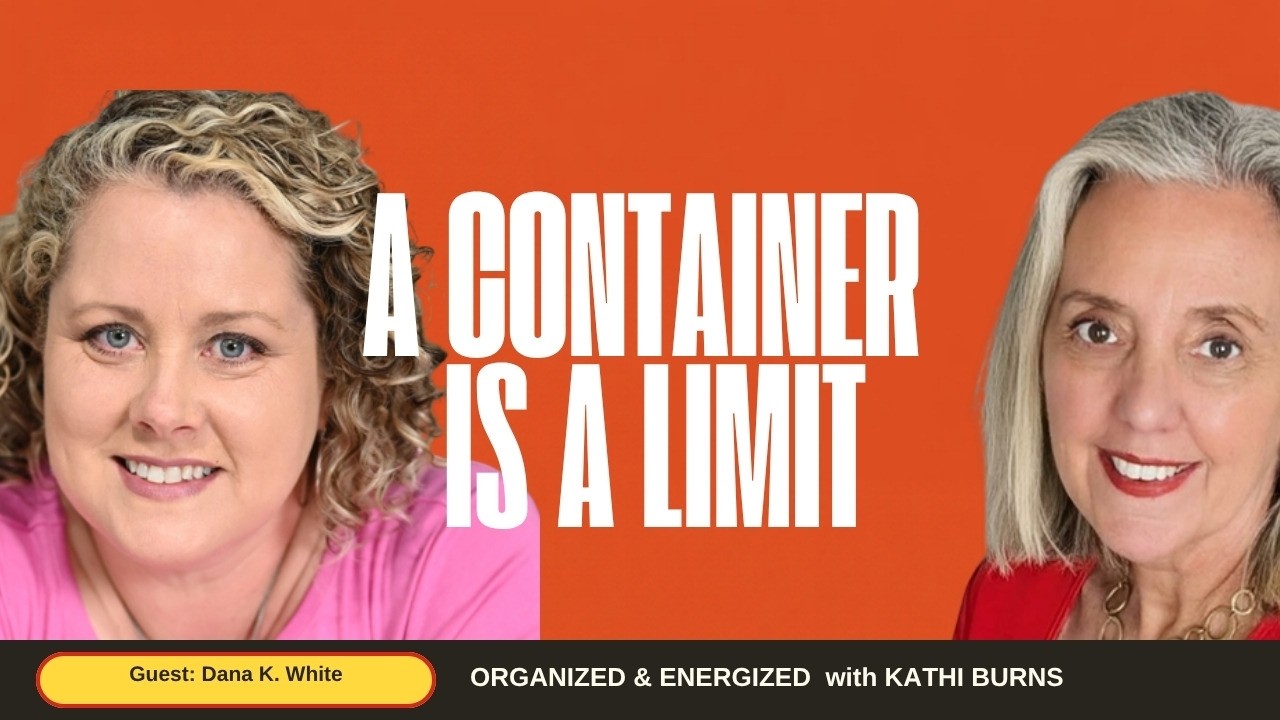
Her container concept says a container is a limit: put your favorite things in first, and when it is full, let the rest go.
Dana defines a clutter threshold as the point at which you have more stuff than you personally can manage, and for her the answer was having less.
Her No Mess Decluttering Method deals with each item as she comes across it, so a distraction leaves only progress behind.
Dana tells entrepreneurs to collaborate instead of compete, and that a weakness you have worked through is a superpower for helping others.
Published · Updated
What is this episode about?
Kathi Burns, CPO®, Business FLOW Strategist, talks with Dana K. White, author of Decluttering at the Speed of Life and creator of the No Mess Decluttering Method, about decluttering when overwhelmed. In 2009 Dana had tried everything she could think of to get her home under control, and nothing stuck. She started a secret blog under a made-up name about what she was and wasn't doing at home, and learned she wasn't alone and had to work out what suited her own brain. You'll hear why a container is a limit, why buying more containers only adds clutter, what a clutter threshold is, and how dealing with one item at a time means you never leave a bigger mess. Dana also explains why entrepreneurs go further by collaborating, why your weakness is your superpower, and how her fully online work reaches thousands of people.
A container is meant to contain. It's meant to serve as a limit.Dana K. White
Jump to links and resources · Part of How do I organize my home and closet? · All episodes · Every guest
What are the key takeaways?
- Dana K. White didn't know decluttering and organizing were two separate things, or that she couldn't get organized while she had as much stuff as she did.
- A container is a limit, so Dana puts her favorite items in first and lets go of the rest once it is full, instead of judging the value of every item.
- Buying more containers without a limit on your stuff only creates more clutter, and the containers are often the wrong size anyway.
- A clutter threshold is how much stuff you personally can manage; Dana's is far lower than her mother's, so she keeps less.
- Making do without something is a valid option, and Dana finds it a better use of her creative energy than collecting things.
- The No Mess Decluttering Method has you deal with each item as you find it: trash bag, donate box or its home, right away.
- Dana sees no competition in her field, because nobody gets all their information from one source, and she says collaborating has helped her soul and her business.
This episode is brought to you by the Business Logjam Session
A private 75-minute online session with Kathi Burns to find the one thing holding your business back and leave with your next steps. It is the same F.L.O.W. process Kathi uses with her own clients: Focus on your goals, Locate your logjams, Outline your solutions, Walk away knowing your next steps.
Find What's Holding Me BackInterested in sponsoring the show? Get in touch.How did Dana K. White start A Slob Comes Clean?
Dana K. White started A Slob Comes Clean in 2009 as a secret blog under a made-up name, because she was overwhelmed by her home and felt she couldn't justify a blog while her house was a disaster. She wrote about what she was and wasn't doing at home and what made an impact. Writing taught her she was not alone, and that the advice she had tried before was never going to work for her brain.
What is the container concept in decluttering?
The container concept means a container is a limit: it holds only as much as fits. Dana K. White puts her favorite things in first, and when the container is full, the rest goes. That freed her from judging whether every single pencil deserved a place in her home.
Why doesn't buying more storage containers fix clutter?
Buying more containers doesn't fix clutter because, without a limit on how much you keep, the new containers fill up and become clutter themselves. Dana says people see containers in organized homes and assume the containers are the difference. Kathi sees clients with zillions of empty containers that aren't even the right size. Dana also never understood one in, one out: her sock drawer wouldn't close anyway, so why get rid of a pair?
Should small business owners collaborate instead of compete?
Yes. Dana says a competition mindset never helps, because nobody gets all their information from one source, just as nobody reads only one author. Five people in a mastermind can skip a lot of hard lessons by learning from each other. Kathi adds that she has other organizers on the podcast because people click with different pros, and referring out is a mark of professionalism.
What is a clutter threshold?
A clutter threshold is the point at which you have more stuff than you personally can manage. It isn't how much stuff you like. Dana K. White's mother, who grew up on a farm in Oklahoma, keeps a large stock of everything neatly under control. Dana can't, so for her the only answer was to have less stuff.
How can your weakness become your superpower in business?
Your weakness becomes your superpower when you work through it, because you then understand the people who feel that same pain and can help them. Dana says a business should help people, so instead of staying far away from a weakness, embrace it, figure it out and use it in your business. Kathi adds that a struggle you've tackled is a strong thing to build a business on.
How do you start decluttering when overwhelmed and easily distracted?
Start decluttering when overwhelmed by dealing with each item as you come across it: it goes in the trash bag, the donate box or straight to its home. Dana K. White built this No Mess Decluttering Method because she gets distracted and every attempt used to leave a bigger mess. This way, a distraction leaves only progress behind.
How does Dana K. White use the internet to grow her business?
Dana's work is 100 percent online. She goes into people's homes to film YouTube videos, so instead of one person benefiting from a visit, thousands of viewers learn from it too. She says the internet allows a kind of scaling she doesn't think was possible before.
Where does each part of the conversation start?
- 0:00 Meet Dana K. White
- 0:30 From overwhelmed to a secret blog
- 2:30 The container concept
- 5:25 One in, one out
- 6:28 Collaboration over competition
- 10:17 Your clutter threshold
- 11:40 Growing up with a high clutter threshold
- 13:34 Making do instead of buying
- 14:23 Your weakness is your superpower
- 16:03 The No Mess Decluttering Method
- 17:40 The power of the internet
- 18:30 Wrap-up
What resources were mentioned?
These episodes continue the same thread as this one: Donna Zalter, Amy Stone, Adele Bernard, Kitti Andrews also answer the question "How do I organize my home and closet?", and the rest are the most recent conversations on the show.


See every episode on the podcast archive or filter by topic on the How do I organize my home and closet? hub.
How can I support the show?
- Subscribe on Apple Podcasts, Spotify or YouTube, or add the RSS feed to any app.
- Rate and review. A rating on Apple Podcasts helps new listeners find the show, and Kathi reads every review.
- Share the episode with one business owner who needs it; the share buttons are at the top of the page.
- Grab a free eBook: 6 Steps to Organize & Energize Your Home, 6 Steps to Organize Your Home Office or 6 Steps to Organize & Energize Your Life.
- Work with Kathi. The Business Logjam Session is a private 75-minute session to find what is holding your business back.
- Be a guest. Apply here if you have a story about clearing the obstacles in your business.
What did they say, word for word?
The transcript below is edited for readability: filler words and false starts are removed and speaker names are added. Nothing was added or summarized.
Read the full transcript +
Kathi: Hi, everyone, this is Kathi. I am back with the Organized and Energized podcast, and today I'm talking with Dana K. White. Dana is the author of Decluttering at the Speed of Life and the creator of the No Mess Decluttering Method. We're both here today to collaborate and give you a few organizing tips so that you can learn how to declutter at the speed of life. I love it. Hi, Dana. Thanks for coming in.
Dana: Thanks for having me on. This is fun.
Kathi: Yeah, absolutely. So tell me a little bit about how you got into becoming a professional organizer.
Dana: Well, I want to be clear: I am all about decluttering. I am all about the person whose hands are so tight on their stuff that they just can't even imagine letting go, because that was me. That is actually how I started in doing what I do. In 2009, I was just completely overwhelmed in my home. I had literally tried what I thought was everything and had failed again and again. I wanted to be a writer, because I'm a creative-minded person, and when I found out what blogs were, I couldn't justify starting one because my house was such a disaster. I thought, this will just be one more thing that takes my focus away from my home. I've got to get my home under control. So as a compromise, I started what I thought was a temporary secret blog. I made up a fake name and everything, where I just talked about what I was doing in my home and what I was not doing. I would try things. I would figure out what made an impact and what didn't. And as I wrote, I learned that I was most definitely not the only person out there who struggled the way that I did. I also learned a lot about myself, and that often the things I had read about before, the things I had tried, were never going to work for me. Instead, I needed to figure out what did work for me. It really gave me an appreciation for how my brain is unique. Each brain is unique, and everybody has to figure out how to take what are some basic principles, but learn about them in a way that actually makes sense to them and apply them in their home in a unique way. It's gonna look different for everybody.
Kathi: Yeah, there's no one way to do anything. I always stress that all the time with my clients. We all think differently. We all react differently. When you started getting your life organized, what was your big obstacle? What did you have to overcome to keep going?
Dana: Honestly, my biggest obstacle was that I did not understand that there was a limit to how much stuff I could have in my house. I mean, really, it sounds so silly, and yet it is actually the thing that I get emails from people about all the time. Many a week, just saying, how did I not understand this either? And I'm like, I know, I didn't get it either. I call it the container concept. What I mean is, I really just started out decluttering. I thought I was admitting to failure by just saying I'm just going to declutter. I'm not even at the point where I could organize yet. I'm just going to declutter. I didn't know they were two separate things. I didn't know that there was no hope of me being organized as long as I had as much stuff as I had. So I call it the container concept. I was working one day, and I was talking to myself, because that's what I do, saying the word container, and I just went, wait a minute.
A container is meant to contain. It's meant to serve as a limit.
Dana: A container is meant to contain. It's meant to serve as a limit. I literally never understood that. I thought, and I now know that lots and lots of other people think this too, that you look at an organized person, they love containers, so I buy containers. I start sticking my stuff in them, and then they're full, and it doesn't look anything like the pictures on the box. And I would think, okay, well, I've still got more stuff, so I go buy more containers, and then I go buy more containers. When I realized that it was a limit, it freed me from making value decisions about all of my stuff. I used to look at each pencil and say, does this pencil have value? Does it deserve to be in my home? Well, that takes forever for every stinking little pencil, right? Instead, when I realized that the container was the limit, it freed me to go, oh, all I have to do is put my favorite pencils in first, and then when it's full, I let go. So that is one of the main things I teach. People ask me questions all the time. I do Q&As, and I'm like, just so you know, every single question, well, maybe not every single one, 90 percent of the questions that I get about decluttering start with, well, it all comes down to the container concept. And then there's the whole one in, one out that some people are born knowing. I didn't know that. It never crossed my mind. I'd actually heard someone say it, and I thought, that makes no sense. Why would I get rid of a pair of socks when I bring a new pair of socks in? My sock drawer won't close anyway. That was how my brain went. So people were saying these things, and I didn't know what they were talking about, because that's just not how my brain worked.
Kathi: Wow. Yeah, one in, one out. A container is a limit. It's so funny how many clients I run into where we start working together and they have zillions of containers but nothing in them, and they don't have any idea what they're going to do with the containers to begin with. But they love containers.
Dana: They love containers because they think that's the answer, because they see them being used correctly in an organized person's home. And they think, what's the difference between me and the organized person? They've got containers. So I'm going to go buy containers. And by the time you get home from the store, all that energy, like, I'm going to change forever, it's all gone. And then those containers are their own clutter.
Those containers are their own clutter.
Kathi: Oh, the containers are clutter. That's exactly right. They're so cluttered with containers, and they aren't even the right size once you come down to wanting to containerize something. So I love that. That's going to be our quote for this podcast: containers mean that you have a limit. That's what they're there for, to containerize with a limit. Awesome. So if you were going to talk to somebody who was trying to find more freedom within their business and trying to get their mojo back, what would you say to them as an entrepreneur yourself?
Dana: It's kind of hard to say this in 2021, because we've all had the weirdest last, it's getting close to two years, which makes my heart hurt. But I mean, it's really collaborating. When you have a business, and what I do is online, and I want people to come read what I do and watch my videos and stuff, it can feel like it's a competition. But that never actually helps, having the mindset of competition. Somebody asked me one time, probably four or five years ago, well, who's your biggest competition? I was like, I don't really see it as competition, especially with what I do, because information is what I'm sharing, information products. Nobody gets all of their information from one source. If somebody's a novelist, nobody only reads one author, right? And so, working with others, even if it's not necessary. I'm not necessarily saying each person should have five different professional organizers come into their home. That's not what I'm saying. But because of this competition feeling, sometimes you cannot collaborate, and there is so much value in working with people who understand what you do: people to bounce ideas off of, people to ask questions. You can go so much farther if you've got five people who are in a mastermind together and you've all got five different experiences. You're all gonna get to skip a whole lot of hard life lessons by learning them from each other, because you've each learned a life lesson, and now you're five steps ahead of everybody else. There's just so much value in that, and yet it's such a stumbling block for a lot of people. I know for me, I was also like, wait, do I really? And oh my goodness, every time I've collaborated with other people, it's just beneficial to my soul and also to my business.
Every time I've collaborated with other people, it's just beneficial to my soul and also to my business.
Kathi: I totally agree, and that's why I have other organizers on this podcast. There's so much business, and there is no competition, and everybody's going to resonate with different people. And you're right, we don't just read one author. We don't just work with one pro in whatever organization or whatever consultant that you need. We all have different things to offer, and that's the beauty of life. Some people will resonate with two or three different people. Some people only resonate with one. It doesn't matter. The whole point is, how do we help people get over the obstacles that are holding them back from their true worth and their true value? That's really all we do. We're eliminating obstacles to people's success and people's freedom. And that's what I think most entrepreneurs do whenever they start their business: they're offering something to the world that will make the world a better place. So yeah, I love that attitude, Dana. That's what I'm all about as well.
Dana: And you want to connect with people who click with you. So accepting that and realizing that it's going to be more beneficial for them, it's going to be more energizing for you to really connect with the people you click with. You can do that, and be more willing to do that, when you realize there are some people who are going to click better with other people.
Kathi: Yeah, absolutely. I always say that the highest form of professionalism is knowing how to say no and referring out. Become a big referral mecca for people. So, okay, you and I are both organizers. What do you think is your biggest organizing obstacle in your life? What have you had to really overcome? You've said a few things already, but now that you're up and clicking and going at it, what's the obstacle that you have overcome that you think other people would learn from?
Dana: I call it my clutter threshold. What I mean by that is not, as sometimes people think, oh, that's how much stuff you like. I'm like, no, that's not what I'm talking about. I am talking about the point at which I have more stuff than I personally can handle. I was above my clutter threshold, not knowing that a clutter threshold was a thing, because I hadn't called it that yet, but also just not understanding how all this worked and that there were limits. So yes, there's a limit to space, but there's also a limit for me personally to be able to manage stuff. And taking that into any situation, it's realizing my brain works the way it works, and I'm going to get so much farther if I accept that than if I fight against it and keep trying to do things the way somebody else does it. The reason clutter threshold was so clear to me is that my mother has a very high clutter threshold. She grew up on a farm in Oklahoma, way far away from town, and she has the mentality that she's got to have everything she could ever need for any situation. But she can keep it under control. You go in her house, she knows where things are. They're not in piles. Everything's neatly put away. She can find it, she puts it back. It's crazy. So I grew up with this mentality, because it was passed on to me, that that's how you're supposed to be. And I'm not accusing my mother of anything, I'm just saying it almost felt like a moral issue. If something was cheaper now, I should buy it for the future, just in case. It really was like, this is how it's supposed to be. You're supposed to be prepared. And yet I can't handle that stuff. So I would bring things into my home, and it would just be like an explosion had happened, because I just couldn't handle it. I couldn't keep it under control. For me, the only answer was to have less stuff in my house.
Kathi: Well, and you don't live on a farm, right?
Dana: Right. Exactly. I'm not in that situation. Well, it's funny, because we have actually moved out into the country now. But I'm still of that mentality that I have to have less. I just do, because of my personality, because of me. And accepting that will take you really far.
Kathi: Yeah, absolutely. I'm so agreeing with that. We get what we were raised with. My father was Mr. Uber Organized and always drove me crazy, and here I am, that's what I do, right? We don't fall far from the tree, oftentimes. At the same time, we take that package of what our parents have taught us. And of course, if you're gonna live in the country, you're probably going to need to have all this, the Girl Scout idea, right?
Dana: But at the same time, I've also learned not just that, oh, I can go out and buy it, but that I can do without. That is a valid option, to say, yes, I may have to replace this someday, but there's an even better chance that I'll just make do and figure it out. Because I'm the creative person anyway. I was collecting things to be creative, and I actually enjoy making do more. That's a better use of my creative energy.
Kathi: Yeah, and you can get really creative when you need something and you can't get it anyhow. So I love that. And that actually is really good advice for entrepreneurs. You came upon something really good, Dana. If you don't have it, try to use your creative instincts to figure out how to do it without. Wow, that's really, really good. That's a good takeaway as well. So, your best pieces of advice for entrepreneurs who want to launch into some new business: what would you tell them?
I would say that your weakness is your superpower.
Dana: I would say that your weakness is your superpower. Because if you're an entrepreneur, your goal is to help people, right? That is actually what a business should do. It should help people. And the person who understands the struggle and who understands the pain that this problem can cause, I believe, has a superpower to be able to help others who feel that pain. They have understanding, but they've also really had to work through it to be able to help someone. So it's so easy to be like, oh, I want to stay far away from that weakness. Instead, embrace it, figure it out, and then use that in your business.
Kathi: That's brilliant. Yeah, I love that. That's very, very good. And it goes back to my belief that for everything you lose, you gain. So if you've struggled for years against something and you've tackled it, that's a great thing to start a business on. It's really close to your heart and your soul, just like your business. So that's great. Okay, so what's the one thing that I should have asked you that I have not asked you yet?
Dana: Oh, I thought of something good beforehand, and I'm trying to think what it was. What was I gonna say?
Kathi: Okay, okay, pause on that and tell me about your free resource, and then we can circle back around to it. What are you giving our guests?
Dana: So you mentioned at the beginning, when you said my name, my No Mess Decluttering Method. I personally have attention issues a little bit. I get distracted a lot, and then I had kids and started getting distracted even more. That's just who I am. And my biggest frustration was a lot of people's biggest frustration with decluttering: it felt like every time I tried to declutter, I ended up with a bigger mess. So the strategy, the process that I have developed for myself and then teach to others, is step-by-step progress and only progress. Meaning I deal with each item as I come across it. It either goes in the trash bag or the donate box or to its home immediately. That's just so that when I get distracted, I've only made progress and never put myself in a worse situation. My free resource is at aslobcomesclean.com/five, F-I-V-E, and that's where you can get my five-step decluttering process printable. Obviously, I have lots more words in the books, but it's just the steps listed out with a very, very tiny little summary of how it works.
When I get distracted, I've only made progress and never put myself in a worse situation.
Kathi: I love that, and that'll be a direct link below the podcast as well, gang, so you can find that link here. Okay, so back circling around: what should I ask you that I didn't ask you? Or maybe nothing. We've covered a broad territory of topics.
Dana: Yeah, I think one of the things we talked about before we even started really recording was just the power of the internet. Because what I do is 100 percent online. I go into people's homes to do YouTube videos, because that allows not just the one person to benefit, but also the thousands and thousands who watch it. So it allows me to expand my business. That's one of the major powers of the internet: it really allows scaling in a way that I don't know has ever been possible before. It's just amazing how many people you can reach now.

Kathi: Yeah, it's insane and amazing, and you're rocking it, girl. I'm just really honored and pleased that you took the time to be on this podcast. I know that everybody will benefit from this. Make sure to download your free resource from Dana. And until then, I will see you all next week. Thanks, gang. Have fun.
Dana: Thanks.
Where can I find the links and resources from this episode?
Connect with Dana
Organizations and companies
Inspired? Here Are Your Action Steps:
- Declutter first; save organizing for after you have less stuff.
- Pick one container and put your favorite items in it first.
- When the container is full, let go of whatever doesn't fit.
- Don't buy new containers until you know what limit they need to set.
- Notice your own clutter threshold and keep only what you can manage.
- Before buying something just in case, ask whether you could make do without it.
- Deal with each item as you find it: trash bag, donate box or its home, right away.
- Find a few people in your field to share ideas and lessons with instead of treating them as competition.
- Write down a struggle you've worked through and how it could help your clients.
- Download Dana's free Five Steps printable at aslobcomesclean.com/five.
Frequently asked questions
What can I do if decluttering is overwhelming?
+
Dana K. White deals with each item as she comes across it: it goes in the trash bag, the donate box or straight to its home. If she gets distracted partway, she has only made progress and never left a bigger mess. She built this No Mess Decluttering Method because every earlier attempt left her with a bigger mess.
What is the first thing to do when decluttering?
+
For Dana, the first step was understanding that there is a limit to how much stuff you can have. She calls it the container concept: a container is meant to contain, so it serves as a limit. She also learned that decluttering comes before organizing, because there was no hope of being organized while she had so much stuff.
What are the biggest decluttering mistakes?
+
One mistake Dana and Kathi both see is buying more containers before having less stuff. The new containers fill up, don't look like the pictures on the box, and become clutter themselves. Dana's other frustration was decluttering in a way that made a bigger mess whenever she got distracted.
What is a clutter threshold?
+
It's the point where you have more stuff than you personally can manage. Dana's mother can keep a large stock of everything under control. Dana can't, so the only answer for her is having less.
What is the No Mess Decluttering Method?
+
Deal with each item as you come across it: it goes in the trash bag, in the donate box or straight to its home. If you get distracted partway, you've only made progress and never left a bigger mess. Dana offers a free five-step printable of the process at aslobcomesclean.com/five.
Who is talking in this episode?

About the Host, Kathi Burns
Kathi Burns, CPO®, is a Business FLOW Strategist based in San Diego. For the last 20+ years, Kathi has helped clients create systems they can stick to. She is the author of How to Master Your Muck, Organizing With Tetris and Home Organization, The Smart Guide, and co-author of four more titles; all are in Kathi's shop. Kathi's business has been featured on Good Morning America, and her advice has been featured in Oprah Magazine, Martha Stewart Living, Better Homes and Gardens and Entrepreneur Magazine.
More about Kathi · Shop Kathi's books · Business Logjam Session · Apply to be a guest

About Dana K. White
Dana K. White is the decluttering expert, author, podcaster and YouTuber behind A Slob Comes Clean. In 2009, overwhelmed by her own home, she started a secret blog under a made-up name about what she was and wasn't doing at home, and found she was far from the only one who struggled. She is the author of Decluttering at the Speed of Life, which her site lists as a Wall Street Journal bestseller, along with Organizing for the Rest of Us, How to Manage Your Home Without Losing Your Mind and Procrastinators Get Stuff Done. She created the No Mess Decluttering Method, and her work is 100 percent online, including YouTube videos filmed in people's homes.
Want help putting this into practice?
Book a Business Logjam Session with Kathi
A private 75-minute online session to find the one thing holding your business back and leave with your next steps, using the same F.L.O.W. process Kathi uses with her own clients: Focus on your goals, Locate your logjams, Outline your solutions, Walk away knowing your next steps.
Prefer to start small? Download Kathi's free eBook 6 Steps to Organize & Energize Your Home.
Published · Updated
This episode page is for general information. Guests speak for themselves, and their opinions, statistics and examples are their own. Nothing here is legal, financial, medical or mental-health advice; talk to a qualified professional about your own situation. Some links go to the guest's own products or free offers; addSpace does not earn a commission from them unless stated.