


Episode 108
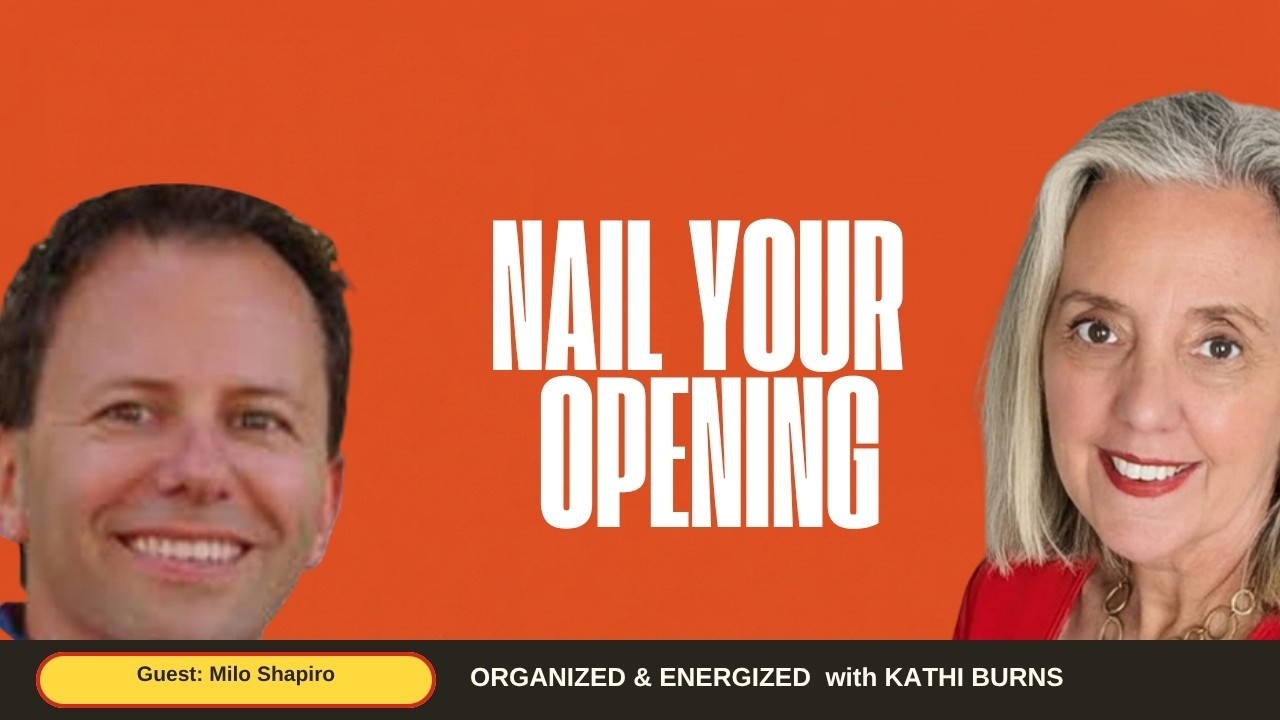
with Milo Shapiro, public speaking coach, keynote speaker and founder of IMPROVentures and Public Dynamics · March 7, 2025 · 39 min
Public speaking coach Milo Shapiro spent 15 years as an IT programmer before turning his love of improv into a team-building company, a keynote career and a coaching business.
Milo says the way past the fear of public speaking is to build skills first, such as balancing stories and data, using your face, body and voice, and creating a through line.
He cites a study that found college students decide in the first nine seconds of a class whether they're glad to be there, so he tells clients to open with a strong first line instead of thank-yous.
One of Milo's clients at the Coast Guard hired him just to get through staff meetings and went on to brief an admiral, congressmen and the White House.
Milo offers listeners 10% off an initial consultation when they mention Kathi Burns on his contact form.
Published · Updated
What is this episode about?
Kathi Burns, CPO®, Business FLOW Strategist, talks with her longtime friend Milo Shapiro, a public speaking coach, keynote speaker and author of Public Speaking: Get A's, Not Zzzzzz's! Milo was a COBOL programmer for 15 years before a separation package let him start an improv team-building company, and a National Speakers Association chapter president told him to couch his improv games in a keynote. A QVC seller who needed help fast turned him into a coach. You'll hear how a nervous Coast Guard client went from dreading staff meetings to briefing the White House, why Milo says the fear of public speaking shrinks once you fill the pool with skills, how to use your first nine seconds, why a speech is a performance, how local references can lose an audience, and why your introducer matters.
Do you want to be authentic or do you want to be good?Milo Shapiro
Jump to links and resources · Part of How do I become known as an expert? · All episodes · Every guest
What are the key takeaways?
- Milo was told by a National Speakers Association chapter president to couch his improv games in a speech about something, which led to a keynote on moving past the fear of failure.
- He became a coach after a QVC seller he worked with three times sold out his entire product line in a seven-minute slot.
- Milo compares stage fright to a diver afraid of an empty pool: breathing and relaxation techniques won't help until you fill the pool with learnable speaking skills.
- He tells clients to drop thank-yous and housekeeping and open with a strong first line, because listeners decide early whether they're glad to be there.
- Milo says a speech is a performance, a bigger version of you, and audiences want that; practicing is not inauthentic.
- Local, timely and American references can lose an international or younger audience, so he now adds a short explanation before referencing someone like Gloria Steinem.
- Because speakers can't control who introduces them, Milo sometimes coaches his introducer and has asked meeting planners whether someone else should do it.

This episode is brought to you by the Business Logjam Session
A private 75-minute online session with Kathi Burns to find the one thing holding your business back and leave with your next steps. It is the same F.L.O.W. process Kathi uses with her own clients: Focus on your goals, Locate your logjams, Outline your solutions, Walk away knowing your next steps.
Find What's Holding Me BackInterested in sponsoring the show? Get in touch.How do you turn your expertise into a keynote speech?
Couch what you do in a speech about something with lessons other people can use, even if they don't do what you do. A National Speakers Association chapter president gave Milo that advice when he said he couldn't just play improv games with a crowd. Milo joined his local chapter, learned how to develop a keynote, and built one about moving past the fear of failure where the audience plays games for about half the time. He later did the same with his book, cutting it down into a 75-minute speech for the city clerks of California.
How do you become a public speaking coach?
Milo became a coach because people kept asking him for help after his speeches. A QVC seller whose company would be cut if he didn't sell more in two weeks insisted that Milo help him. They watched his VHS tapes and worked together three times, and five minutes into his seven-minute slot he sold out his entire product line. Milo put coaching on his website, and he's now about 80% coach, 15% speaker and 5% team builder.
Can a nervous speaker become a confident one?
Yes. A client of Milo's who works for the Coast Guard hired him just to get through the weekly staff meeting, where she said she'd sweat through her uniform waiting for her turn. As she learned what most of us were never taught, her commanding officer had her brief an admiral, who then had her brief a congressman, who asked her to brief the White House. After the second congressman, she told Milo she was so excited to try the new skills that she forgot to be nervous.
How can you overcome your fear of public speaking?
Build the skills first, and the fear of public speaking shrinks to normal nerves. Milo compares it to a diver afraid of an empty pool: breathing techniques won't help until there's water in it. Filling the pool means learning to balance stories and data, using your face, body and voice, building a through line, and getting feedback.
What is a good opening line for a speech?
A good opening line gets to the heart of your topic in the first nine seconds, not with thank-yous. Milo's example is a geology professor who opens by saying rocks are the only thing here nine million years ago that will be here in nine million more. A father of the bride he coached silenced a room that way.
Is practicing a speech inauthentic?
No. Milo asks clients whether they want to be authentic or good, because a speech is a performance, a bigger version of you. He points out that nobody watched Breaking Bad and complained that Bryan Cranston didn't seem authentic. Audiences want a bit of a performance, so cover everything you need to in an entertaining way and calm it down when you're one-on-one.
How do you avoid losing your audience with references?
Know who is in the room and explain any local, timely or national reference before you use it. Milo once referenced Gloria Steinem at what turned out to be an international conference, and afterward someone asked him who she was. He kept the story but now starts with a short explanation of who she is. He also learned in Texas that a reference he didn't think of as political can read as political to some audiences.
Why does a speaker's introduction matter?
Your introduction matters because a flat introducer drags the audience down before you even speak, and you have to work uphill. Milo sometimes coaches the person introducing him and has asked meeting planners whether someone else would be a better choice. He says a video intro can work if it's well done and you can measure up to it.
Where does each part of the conversation start?
- 0:00 Meet Milo Shapiro
- 0:40 From IT programmer to improv
- 2:19 Starting an improv team-building company
- 3:05 Couch it in a keynote
- 3:34 How he became a speaking coach
- 4:58 Follow your passion and listen
- 7:15 Writing a book of top 10 lists
- 9:33 Ellen: from nervous to briefing the White House
- 12:22 How to get past the fear
- 12:36 Fill the pool before you dive
- 14:49 Your first nine seconds
- 17:04 Authentic or good?
- 18:08 Everything is a speech and a sale
- 19:36 Networking: commercial vs elevator speech
- 20:04 How he celebrates wins
- 22:54 Don't lose your audience with references
- 25:20 Advice to his younger self
- 27:29 Not everyone has to like you
- 29:39 Why your introduction matters
- 32:52 Use voices for characters
- 35:03 His offer for listeners
- 36:39 Wrap-up
What resources were mentioned?
These episodes continue the same thread as this one: Dr. Julie Marty-Pearson, Vince Warnock, Anne Bartolucci, Ally Machate also answer the question "How do I become known as an expert?", and the rest are the most recent conversations on the show.
 PodcastingEpisode 146
How to Grow Your Confidence Through Storytelling & Podcasting with Julie Marty-Pearson


See every episode on the podcast archive or filter by topic on the How do I become known as an expert? hub.
How can I support the show?
- Subscribe on Apple Podcasts, Spotify or YouTube, or add the RSS feed to any app.
- Rate and review. A rating on Apple Podcasts helps new listeners find the show, and Kathi reads every review.
- Share the episode with one business owner who needs it; the share buttons are at the top of the page.
- Grab a free eBook: 6 Steps to Organize & Energize Your Home, 6 Steps to Organize Your Home Office or 6 Steps to Organize & Energize Your Life.
- Work with Kathi. The Business Logjam Session is a private 75-minute session to find what is holding your business back.
- Be a guest. Apply here if you have a story about clearing the obstacles in your business.
What did they say, word for word?
The transcript below is edited for readability: filler words and false starts are removed and speaker names are added. Nothing was added or summarized.
Read the full transcript +
Kathi: Hi everybody. I'm here with Milo Shapiro, and we're going to talk about speaking, how you can make an impact speaking and learn how to use dynamics in public. Yeah, with publicdynamics.com. So, welcome, Milo.
Milo: I love when you jump right to the website like that. I usually have to hope it comes in later. publicdynamics.com, right there. Thank you.
Kathi: Yeah, why not? Hey, I'm glad to have you here. We've known each other for what, oh gosh, I don't know, 18-plus years.
Milo: Yeah, I think actually more.
Kathi: Could be.
Milo: Well, I started the company that led to my speaking business in 2000. I think I met you shortly after that. So, we'll let the listeners do the math.
Kathi: It's been a while.
Milo: Yeah. We won't say how old we are or anything like that.
Kathi: Talk to me, Milo. Tell me about your beginnings. What's the beginning of your career as a public speaker or as a speaking coach?
Milo: It's actually kind of a funny story, because it was the last thing I thought I was going to be doing when I started my business. I was an IT guy. So, COBOL programming, ancient-world stuff, from '85 to 2000. And during that time, I fell in love with improvisation. So, all of my evenings and my weekends, even my vacations, traveling the West Coast and up into Canada, studying with some of the masters of improv. That was my whole passion. But who quits their job to do improv? Well, in '99, they offered us voluntary separation packages if we would leave after a merger, when there were too many people. And a couple of years before that, when this new thing called websites came out, I don't know if you've heard of them, but in '97 they were new, somebody told me about a website for a company back east that was doing team building with improv. I don't know what was on my desk at that moment, but I stopped doing it. I was like, what? Improv? Team building? And I started looking at their website, and it all made such sense, because improv teaches us listening skills, building on each other's ideas, creative problem solving. I was looking over their site, and they actually said what games they would play. I was like, good choice. Good choice. Oh, not a good choice. I would do that. And I just made a little list for myself: if I ever did a team building course, what improv games would I put in it? And I shoved that in a drawer, because who quits their job to do an improv company? Well, when they offered the separation package, I was like, if I don't do this, this is going to be one of those deathbed things, that I spent 45 years doing it and regretted that I didn't do what I felt passionate about. So I started my company, IMPROVentures, doing these team building events. And after not too long, people in the classes were saying, this is really powerful stuff, but don't just do it with 15 or 20 people at a time. Do it for big crowds, like a motivational speaker, and get them all playing these games, because we're learning a lot. And I said, I can't just play games with a crowd and call that a motivational speech. Well, I said that to someone at an improv festival, and he laughed. I said, why is that funny? He goes, you don't know who you're talking to, do you? I said, I know you represent the Las Vegas team, and I'm here from the San Diego team. And he said, I'm also the president of my chapter of the National Speakers Association, and yes, you absolutely can lead the crowd in improv games. You just need to couch it in a speech about something, and you don't know how to do that yet. Join your local chapter of National Speakers Association. So I did, and got involved, and learned how to develop a keynote. I developed a keynote where for about half the time I get the audience playing, in a speech about moving past the fear of failure, not being so tied to being perfect, and being willing to make mistakes and learn from them, because in improv we can't be perfect. If we try to, we do terrible improv.
Kathi: Yeah.
Milo: So that took off, and I became 80% speaker, 20% team builder. I was having fun with it. The speaking was fun. And then the unexpected happened. People kept lingering after my speeches and saying, would you work with me on my speaking skills? Would you come and work with my staff? And I kept saying, no, I don't do that. I've had lots of training from Toastmasters and from National Speakers Association, but helping other people, it's not what I was trained to do. But this one guy was really insistent. He said, I really think you're the one who has to help me, and I'm in a real hurry. It's important. I said, what's going on? He said, I sell on QVC. 90% of our company's sales is QVC, and they told us we're not selling enough for their standards, and they're going to cut us if I'm not better in two weeks and sell more.
Kathi: Yeah.
Milo: So, he came over with a stack of VHS tapes, and we watched him on QVC, and I was like, oh, yeah, I see things you're doing wrong. We can help you. Even though I didn't have a background in coaching, I worked with him, I think, three times. He flew back to Pennsylvania for his seven-minute time slot. Everything on QVC is seven minutes. And five minutes into it, long story short, he sold out his entire product line. She said afterwards, you were completely different on camera. I'd never seen this side of you before. What did you do? And he said, oh, I hired a coach. I said, did you give them my card? Because that could have been life-changing for me. But he didn't. Too bad. But I said, I guess I should put this on my website. And that took off. And now I'm probably 80% coach, 15% speaker, 5% team builder. But I'm still happy whichever one rings on the phone. So that's how it happened.
Kathi: You get to do all three things that you love, which is fantastic. And that's what I find interesting: when we follow our passion, it leads into things that will make us money. I think it's inevitable.
Milo: I didn't see it coming, but yeah, I think people tell you what you should be doing sometimes. What I didn't do for a long time was listen.
Kathi: Which is interesting, since you're in improv, and that's a big part of improvisation. I love watching improv groups. It's just amazing to me how they can be so quick-witted and so quick. But I want to go back to the thing that the National Speakers Association guy said: take what you do and couch it in a keynote.
Milo: Yeah.
Kathi: I love that phrase. I had never heard that, couching it in a keynote. But I think for listeners out there who might want to get into speaking a little bit: take your passion and couch it in a keynote, and use a coach to learn how to actually create keynotes.
Milo: Right. What is it about what you do that would make for interesting storytelling that has lessons other people can learn from, even if they don't do what you do? I'm not trying to get the audience to become improvisers. If someone's interested, I'll tell them more about how. But what I'm interested in them getting is, what were some of the lessons that I got that I can share with you? And then when they play the games, even for a little bit, in pairs in the audience, if we do that, they get to experience it and get a flavor for it, and it stays with them. Same with the speaking. The full circle on it is, now I speak on speaking. I just flew to Napa to give a speech to the city clerks of California, and I did a 75-minute speech on improving their speaking, because it comes up where they have to speak to the mayor or to the city council or to the press. And I was really flattered to hear… I waited a few days before contacting the event planner, because she was busy. I said, how did it go? She goes, people were quoting you the whole rest of the week, saying, oh, I just caught something Milo said I shouldn't do. And everybody laughed. So, they related. So, now I'm speaking on another expertise. I did the couching thing again. Of course, having the book helped. I just cut the book down to a speech.
Kathi: Absolutely. So the book is Public Speaking: Get A's, Not Zzzzzz's!, right? We don't want to be putting our audiences to sleep.
Milo: And I had no interest or intention of writing a book. The reason it happened was my clients from 2004 to 2007 kept asking me, is there a good book you can recommend? And I told you how I became a coach. I never read a book. So, I started getting books and reading them, and I couldn't get through them. They were just so boring, and this is a topic I found interesting. I'm like, the book should be interesting. So, I thought, I'm purposely going to write a book that I would want to read, because it would be fun. So, I did it all like David Letterman top 10 lists: the top 10 ways to blow it with your handouts, the top 10 ways to alienate your audience, and all these top 10 lists. And it's a great way to write a book, because I figured out all the chapter headings by all my top 10 lists, and then I made the list of 10, and then every day on my lunch hour I just filled in the blanks on two or three of them until I had a book.
Kathi: Fantastic. I did the same thing. I came up with 10 chapters, and then you have your 10 topics and you just start filling in the blanks. Oh, I want to read this book, actually. I'm going to pick up a copy of that for sure.
Milo: A lot of people told me they bought it to support me, and then they contacted me and said, hey, by the way, I finished the book. I got so caught up in it, and hearing your voice in my head, that I was enjoying it so much that I actually read all the way through. Because how long does it take to read a top 10 list? You have to get through the first two chapters, where I'm giving a lot of background. But after that, when the top 10 lists go, it's four or five pages, six pages on each one. So, it's an easy read.
Kathi: Yeah. And that's a huge kudo, to say they actually read the book, because most of us buy books and never read the book. We just have all these books on the shelves. I can't tell you how many of my clients have five to 10 to 20 organizing books. They just do. And I'm helping them clear them out, because I'm like, have you read that one? Books are disorganizing you. You have me, so you no longer need the book. They're like, oh, thank goodness. Because I think books on shelves are also guilt-ridden. It's like, I bought it, I should be reading it, I spent the money on it, why am I not getting through it, and blah, blah, blah.
Milo: Right. What if someday I decide I have the time? And it's not going to happen if it hasn't by now.
Kathi: Yeah. Exactly. So, you told me about one client transformation. Talk to me about another client that you've had, in whatever line, whatever capacity you were filling at that point.
Milo: One comes to mind. I usually use fake names, but she has become such a testimonial on my site and everything that she lets me use her name. She works for the Coast Guard, and she called me up and she said, here's the story. Once a week at our staff meeting, we do that thing where we go around the table and share what's going on. And she said, I always pray I'll be at the beginning of the circle. She goes, I'm not going to be good no matter what. I'm going to be a babbling mess no matter what, but at least if I'm first, it's done. If I'm last, I'll sweat through my uniform before it gets to me, and I'll usually be worse for all the stress. She said, I just need to be good enough that I can get through that. I was like, okay, we can get you to that. So, we did, and she got better, and she learned what she didn't know, because most of us were never really taught how to do this. We're winging it, and it's a shame, because there are dos and don'ts and things we can learn, and strategies, and she got really quite good at it. And one day her commanding officer said to her, by the way, the admiral is coming in, and he is going to need to be briefed about the Tijuana border situation. So, you're going to do it. She said, no, no, no, no. I'm the one who was so nervous I had to hire a coach just to talk to my co-workers. He said, oh, I could care less if you're nervous. You're the best one here now. You're doing it. So, she made a couple of appointments with me. We got ready for the admiral. She briefed the admiral, thinking, phew, that's over with. He starts to leave, and then he turns around and goes, by the way, she was very good. She should be the one to brief the congressman. And walks out. And she says, I don't want to brief the congressman. Commanding officer says, you don't get to say no to the admiral. Another couple of visits to get ready for the congressman. He doesn't say anything on the way out the door. She goes, thank goodness that's over with. No, he writes an email, and he said, she made the Tijuana border situation so clear to me, and it was so interesting the way she did it, she should brief the White House on my behalf. So, in three steps, she went from her co-workers to the White House, and then another congressman. And after the second congressman, she was telling me how it went, and I said, you haven't used the word nervous in talking about that day at all. She goes, oh, I think I was so excited to try out the new stuff, I forgot to be nervous. I said, did you even hear what you just said? She said, oh, yeah. I think I may have conquered this. And she stayed with me. She comes back to me every once in a while to work on specific programs, because I don't just work with fear for people. I work with them on continuing to make a better delivery style, and specifics of writing. She's an okay writer. I help her make it really good, and then she goes out there and kicks butt. So she comes back, but fear is just not even on her to-do list for speaking anymore. She now enjoys it, because she learned how to play with it, and she learned how to make the most of what she had. So, it was no longer scary anymore.
Kathi: I love it. Well, speaking of fear, that is the biggest obstacle to public speaking. So, can you give us a few steps of how to start getting over that fear factor if you have to present?
Milo: So, I'm going to use an analogy for a minute, and then we'll get to that. The analogy is, if you were a diver and I was your diving coach, and you were on the high board and you were scared to dive into the pool, I could come over to the side of the pool and talk to you about breathing techniques, relaxation techniques, visualizing success, self-hypnosis. But if there's no water in the pool, chances are nothing I say is going to make you feel any more comfortable and calm about diving into blue concrete. So, my first step should not be to get you over the fear. The first step should be to get you off that board and teach you how to use the hose and show you how to fill the pool, so that by the time you get on the board the next time, when you're looking down at some nice soft water, not that much can go wrong. You might have some butterflies in the tummy, but it's not fear. It's just a little anxiety and excitement and everything else. So, what is putting the water in the pool of public speaking? It's learning the right balance of stories and data. It's learning to use your face, your body and your voice more effectively. It's learning how to create a through line, so that you continue to pull people in, and all of a sudden they go, oh my gosh, was that 30 minutes? That flew by. It's telling stories more effectively. These are all learnable skills. It's not something I can just say, go do this. But those are the kinds of skills we want to be developing. And when someone is giving you the feedback to say what's working and what's not… Working in a vacuum is really hard. Please don't try things out on a spouse. At least find a friend. Spouses are the worst, because they have expectations. But also not your best friend. Find someone outside there if you aren't going to hire a coach. But a coach is going to make a big difference, because I think sometimes half the value I bring to people is telling them, that's fine. Stop working on that. It's page three that's not right yet. Let's go to page three. So yes, we're working on page three, but I've also let them off the hook on pages one and two. They know they're okay with it, or I would have said something, because people know I'm kind, but I'm honest. And we work, and then maybe if we get all the way to the end, we'll go, let's do it again. Let's fine-tune page one a little bit more, even though it was good enough. But by the time I say that was really good, they know I mean it, and they get to feel it, and then they go out there and kick butt with it.
My first step should not be to get you over the fear. The first step should be to get you off that board and teach you how to use the hose and show you how to fill the pool.
Milo: I had that recently with a father of the bride. He brought me a terrible speech that he was delivering terribly. So, good thing you're my client now. And the first thing I had to help with, and this is a tip that you can make use of… I'm backtracking, then I'm going to come back to the point. I saw a study years ago that said that college students make a determination in the first nine seconds they're listening to a professor whether they're glad they're in his class. So from the 10th second to the end of the semester, the best he can hope to do is change their mind. It's harder to change someone's mind than to make an impression. So what do most people do with the first nine seconds? Let's go back to that professor. Okay. This is Campus Center, room 375. This is Intro to Geology. The book is also called Intro to Geology. That's probably not more than nine seconds right there, as compared to using those nine seconds with something like this: the only thing that's on this planet now that was here nine million years ago, that's going to be here in nine million years, is rocks. How about we get to know them? Welcome to Intro to Geology. I'd be like, I'm down for rocks. What a difference. And yet so few people do that. They thank the crowd for coming. Now, back to the wedding speech. Thank them for coming. He made an issue of the fact that everybody appreciated it, who came so far. Blah, blah, blah. The same stuff we've heard a million times. So I said, I want you to throw all of that away. I want you to have a strong opening line. And we worked on a lot of other stuff, his delivery and the rest. But his opening line: he came out, waited until it was almost quiet in the room, because they were watching him. He was standing there. I said, just wait it out till it gets quieter. And then he says, it's hard to put in words the feelings that run through a young man's mind the first time he holds his baby daughter in his arms. And as he finished that sentence, the remaining noise in the room went to nothing. Silent. People stopped stirring, like, whoa. He is not wasting a moment. He is getting to the heart of this fast. And it just made such a difference. I saw the video of it. I was so proud of him, because he'll be the first to admit he was pretty bland when we started. But then he started having fun with it, and the personality that we got one-on-one in talking, because he's got personality, finally started to show through, because he got it.
It's harder to change someone's mind than to make an impression.
Milo: A lot of times people go, oh, I feel like if I'm practicing, I'm not being authentic. Well, if authentic is not good, do you want to be authentic or do you want to be good?
Kathi: Exactly.
Milo: It's a performance. Nobody ever watched Breaking Bad and said, oh, that Bryan Cranston, I don't think that's what he's like at all. He didn't seem authentic. No, he was playing a character. So, okay, it's not quite that, but it's a performance. It's a bigger version of you. And it's okay to do that, and then calm down a little bit when you're one-on-one, because nobody performs like they are in person. And that's fine. The audience wants a bit of a performance. If you had a choice between two speeches, and one was called A Speech on This Topic by Milo Shapiro, and the other one was called Everything You Ever Wanted to Know About This Topic, with song and dance and a lot of razzmatazz, and the ticket prices were the same, would anyone go to the first one? No. Just make sure you're covering everything in that entertaining way.
Do you want to be authentic or do you want to be good?
Kathi: I love the way you said razzmatazz.
Milo: I don't think I ever said it quite like that before.
Kathi: I love it. I love it. Well, you've got to use your body, because that is what it's all about. I think everything in this life is a speech and a sale.
Milo: Yeah. Yeah.
Kathi: Everything that we do. We hire a babysitter, speech and a sale. You go to the grocery, could be a speech and a sale. You never know, when you're trying to find that perfect avocado or whatever. And the better that you are… I know I've had a speech coach for the past three years, and you can't not benefit from learning how to speak, even if you're not a speaker. It's just what it is.
Milo: I've had so many people tell me, this is helping me with my dating. This is helping me with job interviews. This is helping me with just interactions. I'm negotiating better, because you know how to use your speaking style. Now, it is a lot harder when people say to me, what I want to do is get better at speaking one-on-one. Then I have to say to them, we're working on speaking skills, so we're going to practice it in the context of giving a speech, and we're going to let it trickle down into those, and we can do some exercises one-on-one. I certainly do that, but I don't start with one-on-one, because it's just too hard to improve people in those little bits and bites and starts and stops like that. But if they can give a great speech, it's certainly a lot easier to say one sentence, or to learn how to join a conversation, or how to ask questions. One of the things I end up talking a lot about is how to improve networking, because there are so many things people do wrong in networking settings, both live and the you-get-40-seconds-to-talk-about-your-business, and you'll be the fifth one out of 10, and that's your time. Which is not an elevator speech. That's different than an elevator speech. That's a commercial. And people mix up the two and how they should approach each of them. I talk about both with my clients.
Kathi: Oh, I love that. I love that. You're a wealth of information. So, let's see. When you have a big success, you get off a stage, or, well, you just came from one, how do you celebrate your successes?
Milo: Oh, what an interesting question. First I deposit the check. That's a big celebration in and of itself. I don't know that I do so much. I think I pace myself through the year, and I do what I want to do. I know what my general budget for life is, and I do what I do when I want to do it. So sometimes the bank account goes down, sometimes it catches up, sometimes I'm being cheap with myself, sometimes I splurge. I don't know that I too often do something to celebrate specific wins like that. I feel the celebration in my heart, just driving home and feeling that good. So it's not like, now I must go out to Ruth's Chris for a big meal or something like that. I might have done that two weeks later during a slump. You never know.
Kathi: Right. Right. I asked that because I found myself publishing books, making big mountains, accomplishing, and then not doing anything about it, or not even stopping to pause and say, good job, Kathi. So 2024 for me was a year of acknowledging celebrations and actually celebrating, taking time to say good job, and breathe before moving on to the next thing, as I'm like an Energizer Bunny.
Milo: So I'm big on November gratitude, and there's no reason one needs to wait till November. But I have kind of a mental reminder starting November 1st that every day from then until Thanksgiving, I post something I'm grateful for. And sometimes what I do is I go back through my calendar, and I see stuff that happened in February or March, and I'm like, oh my gosh, I forgot how important that was to me, because that's 10 months ago now. And also when I do my holiday letter, which I do as a website thing, it gives me a chance to take pictures, because things in January and February get lost to us by the time that comes around. So that's something that I do. It's one of the reasons it drives me crazy when Christmas starts moving back into October. Don't lose Thanksgiving. What a wonderful concept and holiday, and I don't want it lost. I'm fine the day after, but just give me Thanksgiving.
Kathi: Yeah, please. Yeah, stop. Stop. Thanksgiving just gets blurred, because they start Christmas in August now.
Milo: I know. I saw Christmas decorations up before Halloween this year. I said, stop it.
Kathi: Oh, yeah. I saw them in stores, in neighborhoods. I saw them in September at Costco. Seriously, you're going to be doing that? What happened to Halloween?
Milo: It never gets overlooked, but I totally agree with you.
Kathi: What happened to Thanksgiving? Oftentimes, except for food, there's not a big purchase situation, I suppose.
Milo: Right, there's no marketing except by Ralphs.
Kathi: No marketing, and the turkeys are just gone.
Milo: Oh, for people listening nationwide, Ralphs is a supermarket chain here. It's very easy to do. That's one of the things I talked about up in Napa in this speech: ways that you could lose your audience. Local references is one of them, or timely references, or American references if it's an international conference. I spoke at the American Society of Training and Development. First word is American. Nobody told me it was the international conference of the American Society of Training and Development. And I was the first speaker on the first day, so I didn't even have a chance to mill about and discover how international it was. And I made a number of references to Gloria Steinem at a point in my speech, and the story makes sense and it works very well there. And afterwards someone came up to me, and he said, I enjoyed your speech very much, but can you please tell me who is this Gloria Steinem you kept talking about? And that's when I found out that most of my audience probably had no idea who she was. And now enough time has passed that even in an all-American audience, I wouldn't assume the younger audience knows who she is either. So I haven't taken that story out. I just start with a small explanation of who she is, and then I go into the story and how it affects what I wanted to say about her. Small difference, but all the difference in the world, if you don't know who Gloria Steinem is, to feel left out.
Kathi: Yeah, absolutely. Then the whole time maybe you've lost them, and they were just wondering, who is this lady? She must be very important. What does she do?
Milo: Yeah. And because she's a political character, there are people in the audience… I used her in a speech in Texas one time, and somebody came to me and said, kind of surprised you had the guts to talk about Gloria Steinem in this crowd. I'm like, is that not okay? A bit liberal to talk about. I was like, but I wasn't talking about her politics. That was what I thought was interesting. I was talking specifically just about the fact that the Equal Rights Amendment didn't pass in the '70s, but that even though it didn't, many counties and states and corporations have chosen to create equal rights policies. It was how, when one thing doesn't work, other things come out of it. And yet they were like, I wouldn't have given that speech here in Houston. That was gutsy. So something to be conscious of too is, who is your audience? Because I don't go political, I just didn't think of that as political in that sense.
Kathi: Right, right.
Milo: In retrospect, I realized the person was probably right.
Kathi: Yeah. You talk about rights. Okay. Interesting. So, now you're back full circle, doing all the things that you love and you're good at. If you had to tell your 18-year-old self advice, if you had to give yourself advice, what would you tell that young man?
Milo: Oh, wow. Be willing to make more mistakes. Not that I was a perfectionist, but I couldn't outright fail. And when I did accept the… I kind of told that story like, oh, I think I'm going to go off and do this thing. It was not that simple. It was not sleeping, not eating, almost making myself sick at the thought of walking away from the career that I went to college for, the guilt that my parents paid for my college years and I wasn't going to do anymore what they paid for, and all this. It was really a very difficult thing. And then I took a personal improvement course, and they were talking about something, and it wasn't exactly that. But you know how you hear what you need to hear. And what I heard, and what he said, is, if you do this and you fail, it doesn't mean anything about you. No one is going to think, what an idiot, you quit your great job and tried this thing. They're going to think, oh, it's too bad that didn't work for him. Or, good for him for trying. But I was so caught up, I wasn't aware of it, in worrying about what other people would think if I failed, that that was stopping me from going. Then I'll get another IT job. Life will go on. I won't get as much vacation time, and maybe I won't start at quite as high a salary. But it wasn't going to be the end of the world if I failed. And yet I didn't get that on a deeper level. So this course really changed that for me.
Kathi: Yeah. And I think the younger we are, the more it's a big, bad, looming decision, because we haven't had enough years to realize that the small little shifts that appear huge at the time are always retractable. You can always change. And in fact, change is the one constant thing in life anyhow. So you cannot not change, even if you wanted to.
Milo: Yep. Here's another one, too: the idea that everyone has to like me. Oh, man. That was a hard one. I still remember someone from my last job. I still remember his name. It's been probably 30 years since I've seen him. And he did not like me. To this day, I don't know why, but it really just ate at me that he didn't like me. And I tried to be kinder, and I tried to be helpful, and I tried to do it all, and nothing. And now I look back on it and go, why did I care what he thought? He was kind of a jerk. Not just for not liking me, he just was kind of a jerk. But I couldn't deal with the fact. And now, as I've gotten older, there have been times I'm like, wow, that person clearly doesn't like me. Too bad. Move on. And it releases a lot of energy to not have to feel compelled to be everyone's cup of tea. And in business, I shouldn't be everyone's cup of tea. That's one of the things I say about improv: if you try to do something you're sure will appeal to your entire audience, you're likely to entertain nobody. Not saying you should offend everybody, but some people shouldn't like it. And my keynotes too. The opening I did on my keynote this time was very risky. I did something where I came out and purposely spoke really badly until the audience looked a little uncomfortable, and then I had PowerPoint words up there that said, holy cow, this guy's terrible. I can't watch him for an hour. It was just a fun little opening, and enough people laughed that it worked. But there were probably some people who were rolling their eyes and thought it was corny. As long as that's only 10 to 15% of the audience. If the other 85% are laughing and thinking, this guy's going to be kind of fun, this isn't going to be a standard boring speech, it's worth 15% of the audience going, rather than not entertaining 85%.
If you try to do something you're sure will appeal to your entire audience, you're likely to entertain nobody.
Kathi: Back to setting the stage in the first nine seconds. It's interesting you said nine seconds. As a stylist, I know it's three to four seconds for people to judge you on how you look, whether you're going to be safe or whatever. And you don't need nine seconds for that. It's boom, I can see her.
Milo: Yeah. Yeah. And in nine seconds, you do have to hear a few words.
Kathi: Say, okay, yeah, this is going to be a ho-hum speech right there. That's why openings are so important.
Milo: Yeah. Yeah. And intros, too, because we don't have any control over who introduces us. So, I actually work sometimes with the person who's introducing me, to give them some tips and some ideas and ways to try and make it lively. Because if someone just drags the audience down before you ever get there, what are you going to do? Look how comedians do it. The best-paid person is the host who opens and does the little bits in between, usually more so than the headliner, because it's so important that the audience not be turned off before the first person ever gets out there. That's what's happening with my introducers sometimes. Sometimes I felt like I was following Johnny Carson. And sometimes I felt like I was following, I don't even want to come up with the name of a bad speaker, but someone who just made me feel like, well, now I have to work uphill. Thanks for that. I've even said to the meeting planner on occasion, is that person a good speaker? Is that a good choice for introducing me? And once in a while, the person will stop and go, maybe we'll ask someone else. I have a feeling that would be a better choice. Some people just… if I worked with the person professionally, I could make them good, but I don't have that right. They're the person running the conference, and I've just met them, in some cases. It's a definite problem.
Kathi: How do you feel about having video intros before you hit the stage?
Milo: I've only seen it a couple of times, and I think it can actually be good. It depends on if it's well done, if it suits the person. The risk is, if you put a lot of glitz into the opening, you'd better measure up to it. So, if you're a step down from your intro, it's a bad thing. But if you're a bubbly, lively person, and that sets people up to expect it, sure, why not?
Kathi: Yeah, I've been considering doing that, because I've had a few dead intros as of late. And you're right, it's an uphill battle. But the question is, do you get a voiceover, or is it you? Those are two different ways.
Milo: Me introducing me, I'd have to see if I could like that.
Kathi: No, no, no, no, no. The ones I've seen that are really well done are clips of the speaker, a narrator, and just an introduction of accomplishments. They show the speaker speaking in front of an audience, and then they're like, hey, and welcome to the stage.
Milo: And I think for me, I would probably… I missed the end of what you said. We spoke over each other.
Kathi: And then she runs up on stage and she starts a speech.
Milo: Yeah, I could see that really working. For me, I would probably want it to be a woman's voice, to have that contrast. For you, I would say, again, I think in general contrast is good, unless you know you're mostly speaking to women's audiences, in which case I would have a woman introduce you. But for me, I like that vocal variety difference. And I've often said to people, for as much as we can improve our vocal variety, there is no better vocal variety than two people speaking. So there are times it's better to cut to someone and let them talk for a minute. Not in a keynote, obviously, but in situations where that can happen, where you can play off someone, you can get someone to ask you a question. Find someone with a different voice, and it can be really powerful. Or do a different voice. When I do characters in my stories, and I almost always do characters in my stories, they never sound like me. It creates all kinds of opportunities. When Grandpa is talking in my stories, it's always this. And anytime from that point on in my story, when I do this, it's Grandpa talking. Did my grandfather talk like that? Yes, New York accent. But his voice was actually extremely similar to mine, except I no longer have that thick accent that I used to have. But I do that with him, because then a couple of things happen. It's vocal variety, and I never have to say, and then I said, and then he said, and then I said. It's just so clear when I say, why don't you sit down on the bed for a minute, we can talk. Mom just said dinner is ready. Yeah, but sit down for just a minute. All the he said, I said stuff goes away. It's obvious with the change of voice and that little turn of head that I do, or full body if I'm on stage.
There is no better vocal variety than two people speaking.
Kathi: Wow, you're so good. You're such a pro.
Milo: It's finding those opportunities, and people miss them. So they'll read something, and I'll go, here's what I think you should do with it. And over and over again, what I've heard for, what is it, 20 years of coaching, 24 years in business, is, how did you come up with that? I never would have thought of that. Well, 35 years of improv will teach you: what else can we do with something? How can we twist it? Or I like what you said, but it's not a good intro. Move that down, move this up, say this, so by the time you get to this, it's way more interesting and we're excited to hear it. I had one client who started out telling the story… she had a trauma when she was eight or nine years old. So she started her story from the beginning, when she was five or six. Not interesting. It was a very average life, and learning about her life was like… by the time she got to the trauma, she had to win the audience back. So we made her story start a little later and gave her a different introduction that was really intriguing, so that people were like, whoa, what? And now you're going to backpedal? Okay, I'm going to listen through this to see how that relates to this. And there's more that I can go into, but it totally changed it. And she said, thank you. She said, I saw the difference in the audience reaction. Because she had done the speech numerous times, the new version, completely different.

Kathi: Love it. Love it. Well, I know that you have something to offer the listeners here. What is it that we're going to provide? They can do a download, or call, or what are you offering, Milo?
Milo: Sure. Yeah, I was happy you asked if I would be willing to. My initial appointments are very separate from the rest of the coaching. We do an analysis. We do a whole back and forth. It's not like Myers-Briggs or one of those other assessments. This is very specifically on speaking skills. And in that appointment, a lot of people come out going, I didn't even know there were this many questions to ask. I know a lot more about myself and what my goals to improve are. And then, if they choose to work with me, so do I. The second part is, I teach something called the four steps to successful speech structure. It throws the old model that goes back to the 1940s out the window. It's still being taught so many places, including Toastmasters in some cases. And that all comes in your initial consultation. After that, if you choose to continue, then it's more about doing feedback and stuff. So, coming back to your question, I'm offering 10% off on initial consultations, in case someone wants to try the assessment and learn the four steps. If they want to go off on their own after that, they can, or if they want to choose to continue with me after that. But just mention Kathi Burns when you write up my intake form. So the best way to reach me is to go to publicdynamics.com. Go to the contact form, fill it out, and in there there's an area that says something like, anything else you want to tell me. Put Kathi Burns with an exclamation point.
Kathi: All right, Kathi Burns. You got it. 10%.
Milo: You don't even have to spell Kathi right. But if you want to spell it right, it's with an I.
Kathi: Yes. And a K.
Milo: And a K. That's right. You should point that out.
Kathi: It's been fantastic. I really appreciate speaking with you, and I love, of course, listening to you speak. You're such a pro on this, and always entertaining, and it's a pleasure. I'm so glad that we finally got this podcast time right, and I look forward to seeing what happens with you next. I'm watching you.
Milo: I'll come back in a year and tell you what's different.
Kathi: You got it. You got it. Thanks, Milo. And thanks, everybody, for joining us on Organized and Energized! The Podcast. Join us next week. We'll be back, same time, same bat channel. And if you like it, go ahead and give us a thumbs up on YouTube. If you like it, give us a yes on any platform that you're watching, because you can watch it on any platform at all. I'd appreciate the kudos and the comments. Thanks, Milo. Take care.
Where can I find the links and resources from this episode?
Connect with Milo
Organizations and companies
Inspired? Here Are Your Action Steps:
- Write down what you do and the lessons in it that people outside your field could use, then shape it into a keynote.
- Work on the skills before the nerves: balance stories and data, and practice using your face, body and voice.
- Build a through line that keeps pulling your audience from one point to the next.
- Get feedback from a coach or a friend, not your spouse.
- Cut the thank-yous from your opening and write a strong first line that gets to the heart of your topic.
- Wait until the room is almost quiet before you say your first line.
- Check your talk for local, timely or national references and add a short explanation where your audience may not know them.
- Use a different voice for each character in your stories so you never have to say "and then he said."
- Ask who will introduce you, and give your introducer tips to make the introduction lively.
Frequently asked questions
How can you overcome your fear of public speaking?
+
Milo Shapiro says to fill the pool first. Breathing and relaxation techniques won't calm a diver looking down at an empty pool, and they won't calm a speaker who lacks the skills. Learn to balance stories and data, use your face, body and voice, build a through line and tell stories well, and get feedback from someone outside your household.
How do I start my opening speech?
+
Skip the thank-yous and housekeeping and open with a strong first line. Milo cites a study that found college students decide in the first nine seconds whether they're glad to be in a professor's class. He also tells clients to wait until the room is almost quiet before they begin.
What is an example of an opening speech?
+
A father of the bride Milo coached waited for the room to quiet, then opened with: it's hard to put in words the feelings that run through a young man's mind the first time he holds his baby daughter in his arms. The room went silent. Milo's other example is a geology professor who opens by saying rocks are the only thing that was here nine million years ago and will be here in nine million years.
Isn't practicing a speech inauthentic?
+
Milo asks whether you'd rather be authentic or good. A talk is a performance, a bigger version of you, and audiences want that. He compares it to an actor playing a role.
What's the difference between an elevator speech and a networking commercial?
+
Milo says they're different tools. At networking events where everyone gets 40 seconds to talk about their business, you're giving a commercial, not an elevator speech, and the two should be approached differently. He covers both with his coaching clients.
Who is talking in this episode?

About the Host, Kathi Burns
Kathi Burns, CPO®, is a Business FLOW Strategist based in San Diego. For the last 20+ years, Kathi has helped clients create systems they can stick to. She is the author of How to Master Your Muck, Organizing With Tetris and Home Organization, The Smart Guide, and co-author of four more titles; all are in Kathi's shop. Kathi's business has been featured on Good Morning America, and her advice has been featured in Oprah Magazine, Martha Stewart Living, Better Homes and Gardens and Entrepreneur Magazine.
More about Kathi · Shop Kathi's books · Business Logjam Session · Apply to be a guest

About Milo Shapiro
Milo Shapiro is a public speaking coach, keynote speaker, improv performer and author based in San Diego. He spent 15 years as an IT programmer, writing COBOL from 1985 to 2000, before taking a voluntary separation package and starting IMPROVentures, an improv team-building company, in 2000. After joining the National Speakers Association he built a keynote around improv games, and since 2004 he has coached speakers one-on-one through Public Dynamics, mostly over Zoom. He is the author of Public Speaking: Get A's, Not ZZZZZZ's!, a book of top 10 lists, and his keynote clients include Southwest Airlines, Pfizer, the U.S. Navy and General Dynamics.
Want help putting this into practice?
Book a Business Logjam Session with Kathi
A private 75-minute online session to find the one thing holding your business back and leave with your next steps, using the same F.L.O.W. process Kathi uses with her own clients: Focus on your goals, Locate your logjams, Outline your solutions, Walk away knowing your next steps.
Prefer to start small? Download Kathi's free eBook 6 Steps to Organize Your Home Office.
Published · Updated
This episode page is for general information. Guests speak for themselves, and their opinions, statistics and examples are their own. Nothing here is legal, financial, medical or mental-health advice; talk to a qualified professional about your own situation. Some links go to the guest's own products or free offers; addSpace does not earn a commission from them unless stated.