

Episode 142
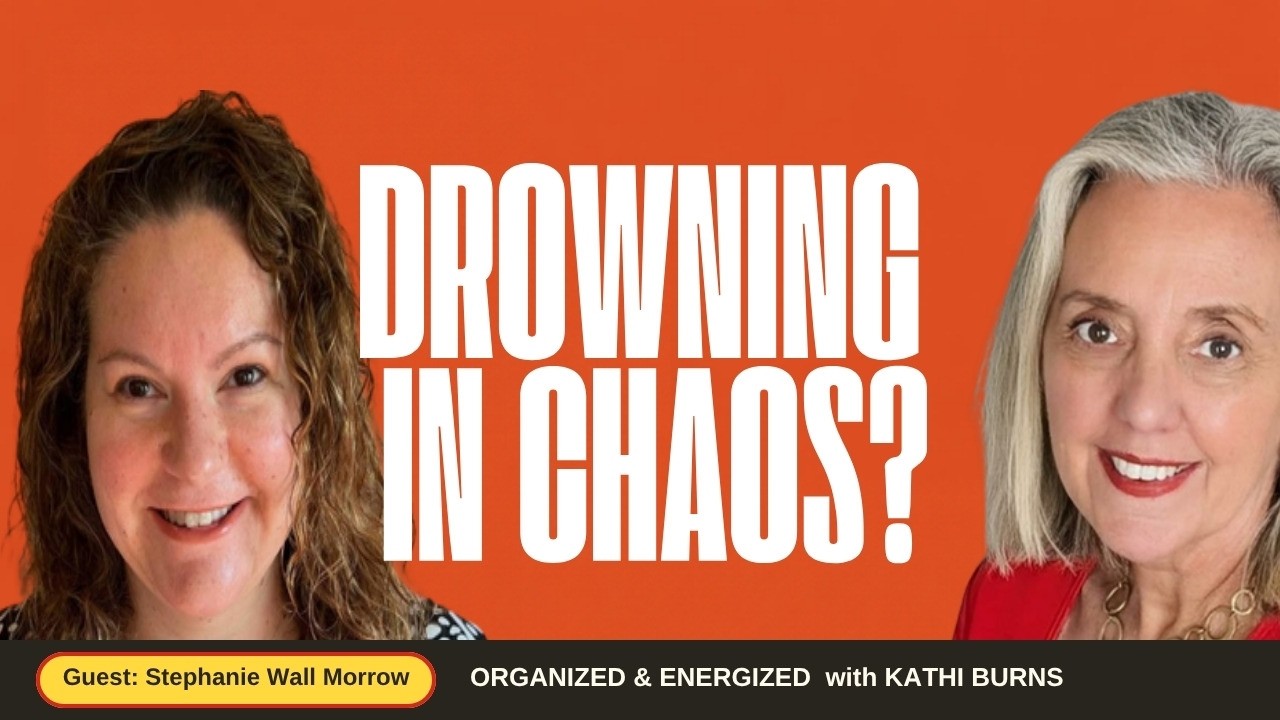
with Stephanie Wall Morrow, wellness and lifestyle coach and founder of The Self-Care Circle · April 8, 2026 · 29 min
Wellness and lifestyle coach Stephanie Wall Morrow schedules time for herself every day, the same way she books any other appointment.
She says that when she prioritizes self-care, she has more energy, gets less thrown off by the unexpected, and shows up better in all of her roles.
Stephanie, who has ADHD, coaches mostly working professional women and works on calendaring and scheduling with nearly every client.
Her household runs on a shared Apple calendar that the whole family, visiting relatives and the babysitter can see.
Her community, The Self-Care Circle, offers a weekly 30-minute self-care session, a weekly restorative yoga class and a monthly workshop.
Published · Updated
What is this episode about?
Self-care for busy women starts with putting it on the calendar, says wellness and lifestyle coach Stephanie Wall Morrow. Kathi Burns, CPO®, Business FLOW Strategist, talks with Stephanie about how she manages a business, a nonprofit, two young kids and ADHD by booking one thing for herself every day: a Pilates class, a yoga class, or a block of unplanned "me time." Stephanie explains how friends started asking why she wasn't falling apart during the 2020 shutdown, and how the answer became her coaching work. You'll hear how she coaches people with ADHD, why community matters, what financial self-care is, how a shared Apple calendar keeps her household on track, and the airplane oxygen-mask conversation that changed how one of her clients takes care of herself. She also shares how her family celebrates wins and why she'd tell her younger self to shift gears sooner.
As long as I continue to prioritize my own well-being and take care of myself, then all of the other things just fall into line.Stephanie Wall Morrow
Jump to links and resources · Part of How do I grow my business without burning out? · All episodes · Every guest
What are the key takeaways?
- Stephanie Wall Morrow books something for herself every day, such as a Pilates class, a yoga class or unplanned "me time," and treats it like any other appointment.
- She coaches each ADHD client differently, but calendaring and scheduling come up with almost everyone: balancing what has to get done with what makes them feel good.
- Her online community gives clients a place to share tips, vent or get a pep talk, so they know they are not alone.
- Financial self-care, one of her most popular workshops, means a little planning and a few tweaks ahead of time so a big unexpected expense doesn't become a crisis.
- Her family keeps one shared Apple calendar that anyone in the house, visiting family and the babysitter can check on any device.
- A long-time client changed how she cared for herself after a conversation about the airplane rule of putting your own oxygen mask on first.
- Stephanie's advice to her 18-year-old self: shift gears sooner, because there is never a perfect time.
This episode is brought to you by the Business Logjam Session
A private 75-minute online session with Kathi Burns to find the one thing holding your business back and leave with your next steps. It is the same F.L.O.W. process Kathi uses with her own clients: Focus on your goals, Locate your logjams, Outline your solutions, Walk away knowing your next steps.
Find What's Holding Me BackInterested in sponsoring the show? Get in touch.How did self-care help Stephanie Wall Morrow get through the 2020 shutdown?
Stephanie had been scheduling self-care sessions for years, and during the 2020 shutdown friends kept asking why she wasn't falling apart. Her husband had been laid off, and her nanny, a new nurse, had been pulled into the ICU. When she looked at what she was doing differently, the answer was her regular yoga and Pilates practice. That moved her from doing it because she knew it was good for her to teaching it.
What does self-care for busy women look like?
For Stephanie, self-care for busy women means doing one thing for yourself every day and putting it on the calendar. One day it's Pilates, the next it's yoga, and on Thursday she blocks unplanned "me time." She says it helps her show up in every role she has, from entrepreneur to mom.
How do you coach someone with ADHD?
Stephanie says there is no one-size-fits-all, so her larger coaching program is customized to each person. Calendaring and scheduling come up with almost everyone, balancing deadlines and must-dos with what makes the person feel good. Some of the work is self-discovery, so clients can adjust or build a framework based on what they learn about themselves. She pairs one-on-one sessions with an online community where people share tips, vent and see they're not alone.
What is The Self-Care Circle?
The Self-Care Circle is Stephanie's virtual self-care community, which she first built during the 2020 shutdown and relaunched after people without ADHD asked how they could take better care of themselves. Each week there is a 30-minute self-care session on a new topic, with no pre-work and no homework. There is also a weekly restorative yoga class, the format she says has always been the most popular. Once a month she runs a different self-care workshop.
What is financial self-care?
Financial self-care is doing a little planning and making a few tweaks ahead of time so a big unexpected expense doesn't turn into a crisis. It's one of Stephanie's most popular workshops. She learned it young, and with her husband in a volatile industry, she says her family has never reached a point where money got crazy stressful.
What is the best way to organize a busy family's schedule?
Stephanie's answer is one shared calendar that everyone can see. Her family uses a shared Apple calendar, so anyone can pick up any device in the house and see what's happening with each person. Visiting family and the babysitter check it too. Her close second is planning, because looking forward to something brings as much joy as doing it.
What does "put your own oxygen mask on first" mean?
It means you can't take care of anyone else if you don't take care of yourself first. Stephanie used the airplane safety rule with a client who had spent years focused on everyone but herself. It clicked: she stopped answering every call from her college-age son and let problems at home get handled while she traveled. She then saw how much she gained from more sleep and from 30 minutes she had never thought she could fit in.
How do you celebrate small wins?
Stephanie's family celebrates with experiences rather than things, because she read that people remember experiences better. That can be brunch at a favorite restaurant, ice cream after a good grade on a test, or a trip for a big milestone. For a quick win, she suggests putting on your favorite song and dancing for three minutes. She calls celebrating one more way to fit self-care into your day.
Where does each part of the conversation start?
- 0:00 Meet Stephanie Wall Morrow
- 0:48 Coaching working women with ADHD
- 2:11 From corporate MBA to yoga and Pilates
- 2:56 What the 2020 shutdown taught her about self-care
- 4:34 Do one thing for yourself every day
- 5:56 Make an appointment with yourself
- 6:54 How she coaches people with ADHD
- 8:39 Why community matters
- 9:59 Weekly sessions, restorative yoga and workshops
- 11:01 Financial self-care
- 12:41 Her favorite organizing hack: a shared calendar
- 15:44 Put your own oxygen mask on first
- 19:48 How she celebrates wins
- 22:26 Advice to her 18-year-old self
- 23:49 Don't beat yourself up
- 26:29 Wrap-up
What resources were mentioned?
- The Self-Care Circle
- Stephanie's free three-step guide to finding clarity and focus
- Shared Apple calendar (iCal)
- The Artist's Way by Julia Cameron
These episodes continue the same thread as this one: Lia Dunlap, Carly Church, Ginny Priem, Magdalena Grace also answer the question "How do I grow my business without burning out?", and the rest are the most recent conversations on the show.

 MotherhoodEpisode 147
How To Build a Village That Supports Your Business and Your Life with Carly Church


See every episode on the podcast archive or filter by topic on the How do I grow my business without burning out? hub.
How can I support the show?
- Subscribe on Apple Podcasts, Spotify or YouTube, or add the RSS feed to any app.
- Rate and review. A rating on Apple Podcasts helps new listeners find the show, and Kathi reads every review.
- Share the episode with one business owner who needs it; the share buttons are at the top of the page.
- Grab a free eBook: 6 Steps to Organize & Energize Your Home, 6 Steps to Organize Your Home Office or 6 Steps to Organize & Energize Your Life.
- Work with Kathi. The Business Logjam Session is a private 75-minute session to find what is holding your business back.
- Be a guest. Apply here if you have a story about clearing the obstacles in your business.
What did they say, word for word?
The transcript below is edited for readability: filler words and false starts are removed and speaker names are added. Nothing was added or summarized.
Read the full transcript +
Kathi: As promised, here I am with Stephanie Wall Morrow. We're going to talk about health, yoga, meditation, balance, and how to deal with ADD and ADHD with calm and poise. So welcome, Stephanie. Welcome, welcome.
Stephanie: It's good to be here with you, Kathi, and also with all of your listeners. I think it's awesome that you guys are listening to this. I know that in order to say yes to this, you probably said no to something else. So I think it's great that you said yes to this today.
Kathi: I love that. Spoken from a person who truly knows ADD and ADHD.
Stephanie: For sure.
Kathi: We all have a limited amount of time, and we choose where we take it, and I am also honored that people are listening. Time, once gone, is gone. So let's make this a valuable session. Stephanie, I know you're in Atlanta. Tell the listeners what you're all about. What do you do?
Stephanie: Well, I have taken advantage of, I think, a combination of technology and phase of life, and I work with people from all over the world. Most of them are working professional females, all to different extents. As somebody who has ADHD myself, and I didn't find out about it until a certain point in my life, I find myself working with a lot of people that have that as well. It is a challenge. Our brains work differently. But I love the fact that in today's world, with all the technological resources that we have, it allows me to help a lot of people in a lot of different places, all dealing with these same types of challenges: How do I keep going? How do I have energy? How do I balance all of the different things? Which is an organizational nightmare at times when you don't have a plan. So it's been really, really nice to enter this phase in my life, after working in corporate America doing a different type of coaching for many years, getting into more of the one-on-one and being able to help more people, regardless of where they are in the world and in their journey.
Kathi: I know you have an MBA and you came from corporate, and I read in your bio that you're doing yoga and Pilates and some stress reduction. So talk about the bridge between where you were and what you're doing right now.
Stephanie: Yeah, so it was interesting. I feel like there are times when life just unfolds and makes things happen for you. I started noticing that whenever I would prioritize what I call self-care sessions, I would feel better. I would have more energy. I would be less thrown off when the unexpected happened, which, let's just be honest, in life happens a lot more than we would like it to. And I noticed that not only would I feel good, but I ran into this pattern where people were asking me a lot of different questions, and a lot of it was a how-to. They were like, I don't understand. How are you doing this? It started during COVID, when we were shut down and everybody was at home adapting to this new norm. I was getting all of these questions, and it caused me to pause and go, well, what is it that I'm doing? Because they were like, you're not falling apart. Everybody is falling apart, and we're shocked that you're not falling apart, because you've talked about your husband, who's been laid off because the industry he works in has been affected by what's going on in the world. And you're also talking about your nanny, who just graduated from college and, as a nurse, got pulled into the ICU and went from never having lost a patient in any clinical training to losing 337 of them in 90 days in this horrific circumstance in the world. So as people were saying these different things, I was like, wow, gosh, when you put it that way, what am I doing?
Stephanie: So I went on this journey of self-discovery, and I realized that, as somebody who had practiced yoga for a long time and had done Pilates for a long time, it went from this thing that I do because I know it's good for me to, wow, look at what it's doing to me and for me and for those around me. And that led me to expand into teaching it, going through a lot of training. I'm an education nerd. I'm definitely a nerd. I think it's probably better described as a lifelong learner. Anytime I have the opportunity to learn something new, I get very, very excited about that.
Stephanie: And now the way that I look at it is: how can I do something for myself every single day that I know takes care of me? Today that was a Pilates class. Tomorrow is a yoga class. On Thursday I have on my calendar what I call me time, which is: I don't know what's going to happen, but I'm going to go with the flow and see how that unfolds, without having something scheduled where you have to execute or perform. When I continue to focus on those aspects of self-care, whatever they might look like on a given day of the week, it makes the flow of the day a lot easier. It also allows me to show up in all of the different roles that I have. Like a lot of working professional moms out there, you wear a lot of different hats. Some days I'm wearing my entrepreneur hat. Sometimes I'm wearing my nonprofit hat. Sometimes it's a teacher hat. Sometimes it's a mom hat. Sometimes it's a problem-solving hat. All of these different things are great. They challenge me. As someone with ADHD, you get very excited by these different things, so it's also very easy to get pulled off in one direction. And I find that as long as I continue to prioritize my own well-being and take care of myself, then all of the other things just fall into line.
As long as I continue to prioritize my own well-being and take care of myself, then all of the other things just fall into line.
Kathi: I think that's really succinct, the way that you said it. It sounds like calendaring is something that's very important to you, that you actually have a yoga class set, you have the Pilates class set. I know myself, struggling with, I don't have ADHD, but ADD, the calendar is so very important. If I have an appointment with myself for Pilates, I will go. If I don't, I'll be like, ah, I don't know. And I absolutely love the me time that you put in the calendar. It reminds me of The Artist's Way. I don't know if you ever studied that, but in The Artist's Way, you have a date with yourself. Just be with yourself and go out and do something just for yourself. I think that the more present we are with ourselves, and giving ourselves nurturing time, as you said, the better we're able to be present with everybody else. So I second that motion. I am with you all the way.
Stephanie: Yeah. Absolutely.
Kathi: So let's talk about your coaching, because I know that there are so many people, women in particular, who juggle so many things, and those that have the added stress of ADD or ADHD. How do we do all that? What do you do when you're coaching women or men that have those challenges?
Stephanie: It's definitely a challenge. I use the term quite frequently: everything is a work in progress. It's a reminder that change is always happening in the world. We can't always control the change, but we can at least control how we react to it. In my larger coaching program, that one is completely customizable based on what the person needs, because with the way that the mind is wired differently with that type of neurodivergence, it's not a one-size-fits-all. Calendaring and scheduling is one thing that I probably do tackle with everybody at some point in time. It's a balance between making sure you get those things done that you need to do, things that have deadlines, things that might have ramifications if they're not done, but also balancing that with: What makes me feel good? What do I want to be able to do? How do I want to feel in those different things? Some of it is yogic and meditative, in the sense of self-discovery. What can I become more aware of? What can I learn so that I can make adjustments, or maybe even lay out a framework for the future that's based on what I've learned about myself? A lot of it is individual work, like how you and I are talking today, in one-on-one sessions like that.
Everything is a work in progress.
Stephanie: I do also have a community component in it, which I find is very helpful. It's great to know that you're not alone. I think it's extremely sad that, with as much connection possibility as we have in today's world, people are feeling lonelier than ever. So I love the digital community that we have, where sometimes people are sharing a tip of something that works well for them. Other times somebody needs to vent or needs a pep talk. I moderate the conversation. Sometimes I'm popping things in there, but other times it's really just that community feel of people being able to come together and know that somebody else is dealing with the same types of things that they deal with.
Stephanie: And one of the things that was interesting when I started that programming: I ended up working indirectly with a lot of people that did not have ADHD. They might have something else going on, or they might just say, I need this kind of help. What can I do? Do you have someone you can refer me to? In some cases I did, and in other cases I didn't. So that actually led me to bring back a program that I had created during COVID, when everybody was at home and looking for some of that normal routine. That is another digital community where once a week we have a specific self-care session. It's a different topic each week. It's short and sweet. It's 30 minutes. You don't have to do pre-work. There is no homework. There are things that you can just leave with and start doing right away. Then there's a once-a-week restorative yoga session, which, out of all of the yoga formats that I've taught over the years, is the one that's always been the most popular. I think it's because people don't rest enough. Even when they're prioritizing it, they still need more of it. It's accessible to all body types. You can do it with an injury. You can do it when you're in surgical recovery.
Stephanie: And then once a month I do a different workshop that's self-care focused. That one's probably my favorite part of it, because there'll be something this month that is very traditional, almost stereotypical of what somebody might think of as self-care, and then the next month it's something totally different. One of the ones that I've done that's been really popular is a financial self-care session. That's something people don't really think of as self-care until life happens and they have this big unexpected expense and they're like, oh my god, what am I going to do? With a couple of tweaks and a little bit of planning at some point, you're okay with it. That's something somebody taught me at a very young age. It does involve a lot of discipline, but with my husband still being in an industry that's very volatile and up and down, we've never reached a point where things are so crazy stressful that it's like, oh my god, what am I going to do?
Stephanie: And I had enough people say to me, but I don't have ADHD. What else can I do? Because I love this vibe. I need to take better care of myself. So I essentially took that program that I had during the shutdown, and put back on a shelf when everybody was excited to be back in person, and I just relaunched it this month.
Kathi: I love that.
Stephanie: So far people are very excited. And again, it's virtual, so anybody can access it from wherever they're at.
Kathi: Right, right. And we all need to pause. We all need to get more balance. I've been doing yoga and Pilates and meditation forever, and thank goodness for it, because I know that I always have a better day.
Stephanie: Yes.
Kathi: When I do it, it's always better. The world is more bright and shiny and I'm more focused, which is the most important thing: keeping that focus line and letting things flow. I love that. So what is your favorite organizing tactic that you use for yourself? Because you have a lot of irons in the fire. You're doing all these different programs. Every week you have this, and then you have that, and then you have the monthly. What's your favorite organizing hack for you?
Stephanie: Oh gosh, it's tough to pick one. The calendar, definitely. That is something that we live and die by in our house. We have a first-grader and a fourth-grader and a puppy. So it's a lot of people that need a lot of things, and those people can't drive yet. We've got to get them all to the right place at the right time. And in fourth grade this year, it's been great to see how they've started to learn these organizing skills, and all of them are tying into a calendar and agenda. How can you pace yourself for these things? So that one is definitely number one.
Stephanie: But I would say that my close second involves planning. There are times when I might be doing it on my own, I might sit down and do it with a friend, or I might do it with the family as a whole: looking at the goals or the visions or the things that we want to be able to do, and how we can make sure those happen. That could be something like: it's beautiful in the spring, we'd love to go to the park, how can we make that happen? Because if we don't, then all of a sudden it's crazy hot here in June and we're like, oh man, we missed all the spring weather. I say planning because I find that I, and a lot of the people that I work with, get as much joy out of the planning and the anticipation as out of the actual thing. Whether it's something small like going to the park or something big like a bucket-list vacation, that journey along the way gives them just as much, if not more, satisfaction as doing the actual thing. So I would say number two is definitely supporting number one: getting a calendar and knowing that yes, there is a finite amount of time in the day, but you can still do all the things that you want to do. You just have to find—
Kathi: What calendar do you use?
Stephanie: We use a shared Apple calendar. We're Apple people, so you could pick up any device that any person in the house has, or the group devices. We have a lot of extra iPads, because we refuse to give the children iPads. They're not old enough for that kind of responsibility. So we have the house devices, but you could pick up any one of those things and know exactly what's going on with each person, which is helpful. We don't have family that lives nearby, so if we have family in town, they can grab it. Our babysitter can use it. It's just easy for everybody to know what happens. So thank you, iCal.
Kathi: I love the shared calendar idea, for sure. Absolutely. So tell me about one of the most memorable points in your career, with one of your clients or one of your experiences, once you jumped off the corporate train, so to speak, and became your own boss.
Stephanie: Oh, wow, that's good. So it's a client who does work in corporate America, and she's definitely a badass. Well, can I say that on a podcast? I think it's okay to say that. Her kids are grown now. The youngest one is in college. The older two have graduated. It's funny, because she had this high-powered career where she was flying around the world with young kids. She'll tell stories about what her kids thought she did, and one of them would joke, I don't know, she just flies around the world and tells people what to do. Which is probably very, very true. She would design these amazing programs and implement them in large-scale businesses, dealing with all these time zones and all these different things. But she was so focused for the longest time on everybody else but her. And I think a lot of us do that, even when you don't have kids. I think it's just in a female's nature to do that.
Stephanie: So after her thinking about it for a long time, but also me getting into the mix and being that accountability buddy, it just struck one day. We had the conversation about the airplane safety video. You don't have to be a million-mile frequent flyer to know that the safety video always talks about putting your own oxygen mask on first. It's in the instructions. You can't help anybody else in this type of emergency if you don't have it on. And that was something that just completely clicked. It went from, okay, yes, my child might need something, but you know what? He's a college sophomore. He's going to figure it out. I don't need to answer the phone right now. Or, this is going on at the house and I'm out of town, the dogs need something. It'll get taken care of. It allowed her to really recognize, for the first time, and then recognize repeatedly: I've got to take care of me, because if I don't take care of me, the rest of it's just not going to happen. Or if it does happen, it's going to be mediocre, it's going to be bumpy. I think nobody shows up to a situation thinking, oh jeez, I hope this goes awfully. Nobody intends that. But the more she went through this, the more she started realizing how many things were linked to one another. She realized, oh wow, this is why I don't get enough sleep. And this is what it's like to sleep more and have quality sleep and feel rested. Oh, this is what it's like for me to have time to be able to do this, which I felt like I could never fit in before, but in reality, it's 30 minutes. I probably had a ton of places where I could have fit it in, but I didn't prioritize it because I didn't realize how much of a difference it made. Essentially, putting on my own oxygen mask.
Kathi: So you got her into meditation and taking the time for herself. It's so funny that you said that, because at the very beginning of this podcast I was thinking about the person on the plane with the oxygen mask.
Stephanie: Really?
Kathi: Yeah, that was what I was thinking. I was like, yeah, this is what we need to do as women. We need to put on the oxygen mask first. And then here you are with the story. So that's the universe again. But that's the whole thing. We need to be reminded that we need to have self-care, because the more we take care of ourselves, the better we take care of other people.
Stephanie: For sure. For sure.
Kathi: Yeah, absolutely. I love that. So tell me, when you have a new client or you reach a milestone, how do you celebrate your successes?
Stephanie: Oh, I love to celebrate. This celebration thing came up, I think, when I was in high school. I was in a journalism class and we were going through sensational headlines. You might turn on the evening news, and in a 30-minute broadcast, 29 minutes of it are just awful, weighty crisis things, bad things. Why doesn't anybody ever talk about good news? And I started realizing that, as a society, we don't celebrate. Okay, there's the parade for the football team that won the Super Bowl. But where are these regular moments where you could find great things to celebrate? So I guess I would sum it up in general: when we celebrate in our household, and with our friends and our family, those people that are part of our regular day-to-day, we celebrate a lot in an experiential manner. I remember reading way back in the day that people have much better memories from an experience than they do from an actual thing. So it might depend on what we can squeeze in. The other day we went to brunch with friends, at one of our favorite restaurants that we don't have enough time to go to. When life was simpler, we used to go there pretty religiously, at least once a week. And it was just this amazing, fun experience to celebrate our anniversary and our son's birthday, which are on the same day. Apparently that's a thing in our family, because my husband was born on my in-laws' anniversary. So we thought, okay, this is something that we know we've had great positive memories from, a great way to celebrate. If somebody gets a good grade on a test, we might go get ice cream. If there's a big milestone coming up, we might make a vacation out of it, because we love to travel and experience those different things.
Stephanie: So I would encourage anybody out there who's wondering, well, how can I celebrate? There are a lot of little tucked-in ways that you might not realize. You might pop on your favorite song and just dance to it for three minutes. That is a celebration. But give yourself those wins, celebrate them, and don't discount them in any way, because that celebration makes you feel so much better. To me it's just one more way of moving through self-care in your day, one more way of pausing and acknowledging and saying, yeah, good job.
Give yourself those wins, celebrate them, and don't discount them in any way.
Kathi: For sure. So, Stephanie, tell me this. If you could turn back the clock and give your 18-year-old self some advice, what would you tell her? What's your word of wisdom?
Stephanie: I would say probably shift gears sooner. I feel like with timing, for the vast majority of things in life, there's never going to be a 'this is the best time to do fill-in-the-blank.' In my adult life, I guess technically this is career number four. So I think those opportunities were there, but I was hesitant for too long, because now I start to think, hmm, what would I be up to now if I had not resisted that? If I had taken the opportunity sooner? Because there have been a lot more opportunities to shift gears in my life than times when I've actually decided to take that shift. So don't be afraid to do it, because it might be the best thing that ever happened to you, and you won't have to wonder anymore. You'll know.
Kathi: Yeah, that's really good advice, for sure.
Stephanie: Absolutely.
Kathi: So is there anything we should have talked about that I haven't asked you yet? Anything on your mind?
Stephanie: I guess I would just say that if you have been looking at, what can I do to take better care of myself? What can I get organized? What can I make easier? What system could I put into place? Don't beat yourself up if it's something that hasn't happened yet. Just go ahead and set aside some time to make it happen, because I think it's very easy for us to get down on ourselves. And I think there's no reason to go that route. The fact that you're recognizing it now is 90% of it. You've just got to take that last little boost. It doesn't matter where you are. There's always the opportunity to keep going, to keep evolving. And when you really start to become more aware of it, there are a lot of things that you can do to make things easier and to make yourself feel better on a consistent basis.
Don't beat yourself up if it's something that hasn't happened yet. Just go ahead and set aside some time to make it happen.
Kathi: I'm with you on that. Now, you might have something that you want to offer the audience.
Stephanie: I do. What we'll do is put this as a link in the notes so that you can click on it and download it. I've got a guide that I find super successful when people are in a state where they're just wondering, how do I get these things done? Sometimes that state has come from, today, on this Tuesday, I've got to make sure I do these few things. Sometimes it's, whoa, I've got a lot going on this week. Or maybe they're looking at the broader picture: how am I going to make this happen in this season of my life? It can apply either way. It's a very easy, very short three-step guide. The idea is: how can I find clarity? How can I find focus with these things that are going on? And I love it when I get feedback from people on it. A lot of them will say, I've been doing number two and number three for years. I never thought to do number one. And now it's helping me do what I need to do in a way that is easy for me. So take a look at that guide if it resonates with you, and share it with somebody else. They might need to see it, too. I also have a spot in there if anybody wants to set up a chance to speak one-on-one. I do offer complimentary calls for people who are interested. I love helping people. That's just what brings me the most joy and the most satisfaction, so the fact that I have the opportunity to do that on a continuous basis, I'm very grateful for. So check it out. It's very easy, very simple. And if it lands with you, maybe we'll talk. And if not, just thank you for being here. Thank you for taking this time for yourself, because whether you thought about it or not, this is a form of self-care.
Kathi: Yes, it is, indeed.
Stephanie: It is, indeed.
Kathi: And that's why I created the podcast. Absolutely. So I really appreciate you. I appreciate you being on, Stephanie, and I wish you much success, and have fun celebrating more experiences, as I will as well. And guys, if you like this, please give us a thumbs up. Please give us a comment. Share it with your friends. Help me spread the love for the podcast. I'd very much appreciate it. Share, share, share, and we will share back at you. The download link will be in the show notes. Go ahead and download that and get in touch with Stephanie, because if you're struggling at all, things can be so easy. That's why I love your little three-step thing. Just do three small things. It's what I do all the time with my clients. Step one, step two, step three. Let's keep it simple. The whole point is moving forward. So until next week, you guys, we will see you. And thank you, Stephanie. I appreciate you.
Stephanie: Thank you.
Where can I find the links and resources from this episode?
Connect with Stephanie
Organizations and companies
Books and resources
Inspired? Here Are Your Action Steps:
- Book one thing for yourself on your calendar every day, and treat it like any other appointment.
- Block a few hours of unplanned "me time" this week with nothing scheduled.
- Set up one shared calendar that everyone in your household, and anyone who helps, can see.
- Sit down with your family or a friend and plan one thing you want to do this season before it passes.
- Make a small plan now for a big unexpected expense.
- Find a community of people dealing with the same challenges, so you know you're not alone.
- Pick an experience, not a thing, to celebrate your next win.
- Stop beating yourself up over what hasn't happened yet, and set aside time to make it happen.
Frequently asked questions
How can a busy mom manage self-care?
+
Stephanie Wall Morrow, a working mom of two young kids, puts self-care on the calendar like any other appointment. She does one thing for herself every day, such as a Pilates or yoga class, and also blocks unplanned "me time." Kathi Burns agrees: when she has an appointment with herself, she goes.
What are some good self-care activities for adults?
+
In the episode, Stephanie names yoga, Pilates, restorative yoga, meditation and unscheduled "me time." She also counts financial planning as self-care, along with small celebrations such as dancing to your favorite song for three minutes.
How do people with ADHD struggle with self-care?
+
Stephanie, who has ADHD, says it's easy to get excited by many different things and get pulled off in one direction. In her coaching, calendaring and scheduling come up with almost everyone, balancing what has to get done with what makes the person feel good. She also says a community helps people see they're not alone.
Why does self-care make you more productive?
+
Stephanie says that when she takes care of herself every day, she has more energy, gets less thrown off when something unexpected happens, and shows up better in all of her roles. As long as she prioritizes her own well-being, she says, everything else falls into line.
What is financial self-care?
+
It's one of Stephanie's most popular workshops: a little planning and a few tweaks ahead of time, so a big unexpected expense doesn't turn into a crisis. She says it takes discipline, and it has kept her family steady even with her husband in a volatile industry.
Who is talking in this episode?

About the Host, Kathi Burns
Kathi Burns, CPO®, is a Business FLOW Strategist based in San Diego. For the last 20+ years, Kathi has helped clients create systems they can stick to. She is the author of How to Master Your Muck, Organizing With Tetris and Home Organization, The Smart Guide, and co-author of four more titles; all are in Kathi's shop. Kathi's business has been featured on Good Morning America, and her advice has been featured in Oprah Magazine, Martha Stewart Living, Better Homes and Gardens and Entrepreneur Magazine.
More about Kathi · Shop Kathi's books · Business Logjam Session · Apply to be a guest

About Stephanie Wall Morrow
Stephanie Wall Morrow is a wellness and lifestyle coach based in Atlanta and the founder of The Self-Care Circle, a virtual self-care community. She has an MBA and a background in corporate leadership, where she did a different type of coaching for many years, and she teaches yoga, meditation and Pilates. She has coached more than 12,000 people, most of them working professional women. Stephanie found out later in life that she has ADHD, and many of her clients have it too. Her community offers a weekly 30-minute self-care session, a weekly restorative yoga class and a monthly self-care workshop. She also leads a children's nonprofit.
Want help putting this into practice?
Book a Business Logjam Session with Kathi
A private 75-minute online session to find the one thing holding your business back and leave with your next steps, using the same F.L.O.W. process Kathi uses with her own clients: Focus on your goals, Locate your logjams, Outline your solutions, Walk away knowing your next steps.
Prefer to start small? Download Kathi's free eBook 6 Steps to Organize & Energize Your Life.
Published · Updated
This episode page is for general information. Guests speak for themselves, and their opinions, statistics and examples are their own. Nothing here is legal, financial, medical or mental-health advice; talk to a qualified professional about your own situation. Some links go to the guest's own products or free offers; addSpace does not earn a commission from them unless stated.