


Episode 2
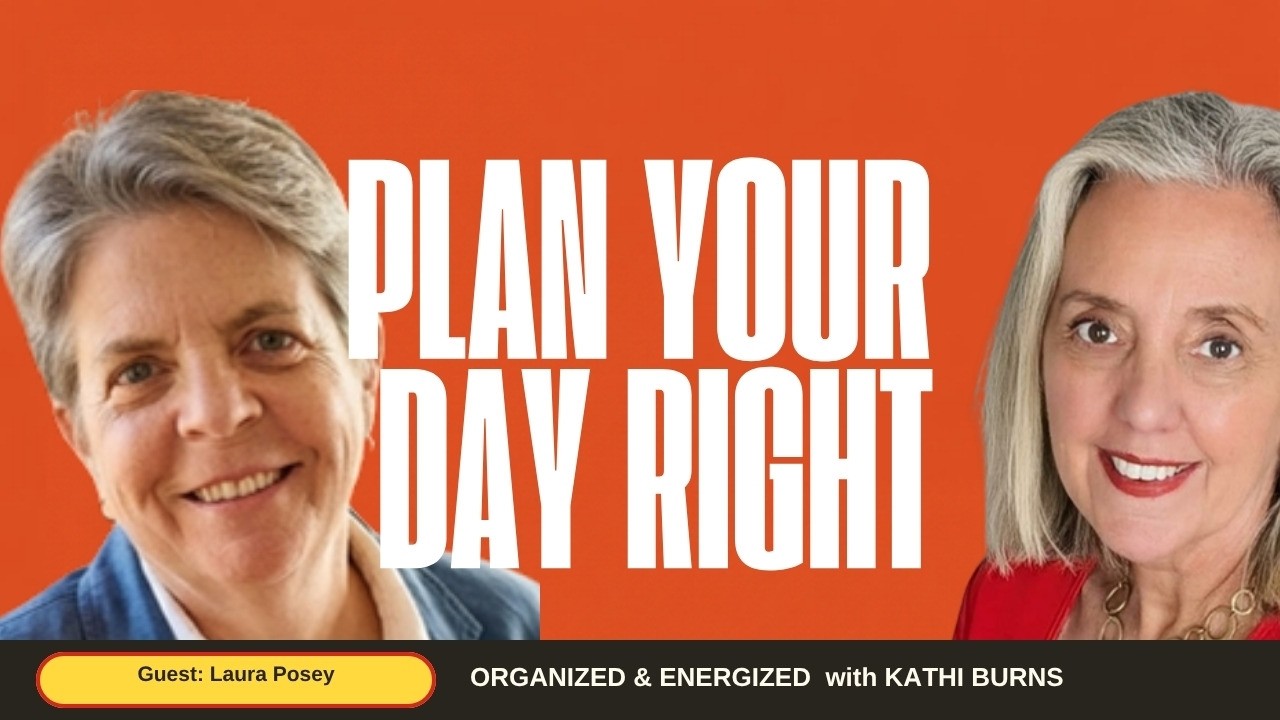
with Laura Posey, founder and Chief Instigator of Simple Success Plans · October 22, 2021 · 18 min
Laura Posey, founder and Chief Instigator of Simple Success Plans, helps entrepreneurs reach their biggest goals using one single sheet of paper.
Laura says procrastination is a symptom: when the next step isn't clear, the brain gets confused, shuts down and goes looking for something it already knows how to do.
She tells listeners to start every task with a clear verb and keep it small, so "research this topic" becomes "Google this topic and write down the first five things you find."
Laura's Daily Success Checklist lists her annual goals, quarterly projects, daily success habits, a one-hour focus block, three project tasks, everything else and an end-of-day reflection.
The checklist is free on simplesuccessplans.com in printable and online fillable versions, with a tutorial video and examples.
Published · Updated
What is this episode about?
Kathi Burns, CPO®, Business FLOW Strategist, talks with Laura Posey, founder and Chief Instigator of Simple Success Plans, about how to plan your day for success. Laura helps entrepreneurs reach their biggest goals using one single sheet of paper and has supported more than 3,000 coaches, consultants and service providers, from solopreneurs to seven-figure businesses. You'll hear why Laura calls procrastination a symptom of unclear tasks, how to write a task with a clear verb and make it small enough to start, and how to stay focused when you work from home by tying your work to a feeling. Laura then walks through the Daily Success Checklist she uses every day: annual goals, quarterly big rocks, daily habits, a one-hour focus block like Money Monday, three project tasks and an end-of-day reflection that lets you switch off your work brain.
Procrastination is just a symptom. It's not that people are born as procrastinators.Laura Posey
Jump to links and resources · Part of How do I grow my business without burning out? · All episodes · Every guest
What are the key takeaways?
- Laura Posey says nobody is born a procrastinator; people put things off when the next step isn't clear and their brain shuts down.
- Every task should start with a clear verb, such as "Google" instead of "research," so your brain knows exactly what your hands should do.
- Tasks that look too big feel like they will take forever, so break them into a chunk small enough to check off fast.
- Laura notes that motivation shares its root with emotion, so she connects work to a specific client she wants to help or to exactly what the money it earns will pay for.
- If you can't imagine how reaching a goal will feel, Laura suggests recalling another big leap you made, like getting fit or earning a degree while working full-time.
- Her Daily Success Checklist covers annual goals, quarterly projects, daily success habits, a one-hour focus block, three project tasks, everything else and a reflection.
- The end-of-day reflection asks what you're proud of, what you accomplished, what you learned and what you're grateful for, so you can step away from work and be present.

This episode is brought to you by the Business Logjam Session
A private 75-minute online session with Kathi Burns to find the one thing holding your business back and leave with your next steps. It is the same F.L.O.W. process Kathi uses with her own clients: Focus on your goals, Locate your logjams, Outline your solutions, Walk away knowing your next steps.
Find What's Holding Me BackInterested in sponsoring the show? Get in touch.Why do people procrastinate?
Laura Posey says procrastination is a symptom, not something people are born with. When the next step isn't clear, your brain gets confused, shuts down and looks for something it already knows how to do, like Facebook. The fix is to be mindful of how you write the tasks on your list.
How do you write a task you will actually do?
Start the task with a clear verb. Laura says it doesn't matter whether your list lives on paper, in a calendar or in an app; what matters is that the first word tells your brain exactly what your hands should do. "Research this topic" sounds like school and a library, so your brain checks out. "Google this topic" is something you know how to start right away.
How do you break big tasks into small steps?
Cut the task down until your brain looks at it and says it could check it off fast. Laura's example: "research" sounds like it could take all day, but "Google this topic and write down the first five pieces of information that show up" is a small chunk. She compares a good task list to school homework with clear step-by-step directions, like a recipe. Kathi adds that the follow-up step is what gets her off Google.
How do you stay focused when working from home?
Laura says focus comes mostly from motivation, once you've cleared out the procrastination and overwhelm that send you looking for distractions. You need a reason strong enough to keep you at your desk instead of watching TV, doing laundry or playing with the dog, and that reason has to connect to a feeling.
How do you stay motivated to work toward your goals?
Connect the work to an emotion. Laura points out that motivation and emotion share the same root. Picture a specific client the work will help, or decide exactly what the money it earns will pay for, such as paying off a credit card bill, a child's college fund or a kitchen renovation. That feeling has to be stronger than the pull of TV or Facebook, and Laura says the more you do it, the easier it gets.
What if you can't picture how reaching your goal will feel?
Borrow the feeling from a past win. Laura suggests looking back at another time you made a big leap, such as in your physical fitness or earning a degree while working full-time, and remembering how proud and strong you felt. When you make the next big leap, you'll feel those same things again. Kathi calls this using an anchor event.
How to plan your day for success?
Laura Posey plans her day on one Daily Success Checklist. It lists her annual goals, her quarterly projects or big rocks, her daily success habits, a one-hour focus block, three project tasks, all the other things that need doing, and an end-of-day reflection. She reads her annual goals every single day.
Why should you give each day of the week one focus?
A single focus gives the day a clear arc and makes hard work less intimidating. Laura has clients focus on one thing each day of the week; for her it's Money Monday, a timed hour of nothing but financials, from bookkeeping and bill paying to reports and investments. Kathi has her clients set an intention for each day, such as a project day, organizing day or interview day.
Where does each part of the conversation start?
- 0:00 Meet Laura Posey
- 1:08 Why we procrastinate
- 2:49 Start every task with a clear verb
- 4:01 Make tasks small enough to start
- 6:36 Staying focused when you work from home
- 7:23 Motivation comes from emotion
- 9:31 Feel where you're going
- 11:00 When you can't picture the feeling
- 12:35 Laura's daily success checklist
- 14:24 The end-of-day reflection
- 16:10 Giving each day one focus
- 17:31 Wrap-up
What resources were mentioned?
These episodes continue the same thread as this one: Lia Dunlap, Carly Church, Ginny Priem, Stephanie Wall Morrow also answer the question "How do I grow my business without burning out?", and the rest are the most recent conversations on the show.

 MotherhoodEpisode 147
How To Build a Village That Supports Your Business and Your Life with Carly Church


See every episode on the podcast archive or filter by topic on the How do I grow my business without burning out? hub.
How can I support the show?
- Subscribe on Apple Podcasts, Spotify or YouTube, or add the RSS feed to any app.
- Rate and review. A rating on Apple Podcasts helps new listeners find the show, and Kathi reads every review.
- Share the episode with one business owner who needs it; the share buttons are at the top of the page.
- Grab a free eBook: 6 Steps to Organize & Energize Your Home, 6 Steps to Organize Your Home Office or 6 Steps to Organize & Energize Your Life.
- Work with Kathi. The Business Logjam Session is a private 75-minute session to find what is holding your business back.
- Be a guest. Apply here if you have a story about clearing the obstacles in your business.
What did they say, word for word?
The transcript below is edited for readability: filler words and false starts are removed and speaker names are added. Nothing was added or summarized.
Read the full transcript +
Kathi: Hi everyone. Today we are talking to Laura Posey. Laura is the founder and Chief Instigator of Simple Success Plans. Her superpower is helping entrepreneurs achieve their biggest goals using one single sheet of paper. Laura has successfully supported over 3,000 coaches, consultants and service providers, including solopreneurs to seven-figure superstars, in creating their own simple success roadmaps. Today, as a girl after my own heart, Laura is going to show us what she recommends to do to plan your day for success. So welcome, Laura. I'm so glad you're here, and I'm looking forward to seeing what you have to say about planning our days for success.
Laura: Thanks for having me. This is one of my favorite things to talk about.
Kathi: I love it. A girl after my own heart. Being a professional organizer is all about plan, plan, plan, goals, goals, goals. So you got it. Definitely want to see what you have to say. So the first question that I have for you is, why do you think people procrastinate on doing the things that will lead them towards their goals?
Laura: Yeah, that's a huge question. Procrastination is one of the number one things that people say they need to fix when they come to me. And procrastination is just a symptom. It's not that people are born as procrastinators. They just don't have things set up in a way that allows them to work in a steady manner. And so what happens is, when there's something in their environment, when the next step isn't clear for them, they get confused. And as soon as your brain gets confused, it shuts down, and it goes and says, "This is confusing. I don't want to do this anymore. What else can I do that I know how to do? Oh, look, there's Facebook. I know how to do Facebook." Or it'll just go and do something that it knows how to do. And so the two big things to really help you get through that procrastination and to get rid of that from your life are to be really, really mindful of the way you create the tasks on your task list. People will tell you, "Oh, you got to put them on your calendar, and you got to write them in order." I don't care where you put them. I don't care how you write them. I don't care whether you type them or handwrite them or put them on your calendar or whatever. But you have to do two things with them.
Procrastination is just a symptom. It's not that people are born as procrastinators.
Laura: One, you have to make it crystal clear. Now, tasks are actions that you want to take. They're things to be performed. And so your task has to start with a verb, and it has to start with a really clear verb. When it starts with the right action, your brain goes, "Oh, I can do that." So, for example, let's say you're going to write a blog post and you want to go do some research about a particular topic. Well, if your task says research this topic, your brain goes, research, that sounds really complicated. I remember doing that in school, and I think it involved a library. I'm out. And it goes to find something else that it knows how to do. Boom. You're procrastinating. But if you just change the beginning of that and say Google whatever this topic is, your brain goes, "Oh, I know exactly how to Google something. I just open a browser, I go to Google, I type it in, and I'm off to the races." So that task has to be really clear. And most importantly, that first verb has to be really clear. Your brain's got to know exactly what you want your hands to do.
Laura: The next thing that I see is that an awful lot of tasks that people write down are just way too big. Your brain looks at it and goes, "That's going to take forever." Again, using our example of the research versus Google: when your brain sees the word research, it thinks that's going to take forever. Research is a long process. I might be at this all day. I don't have time for that. I don't want to do it. None of that sounds exciting. I'm out. But again, when you break it down into, oh, Google this topic. Oh, I could totally Google this topic. And then write down the first five pieces of information that show up in that Google search. Oh, I could totally do that. That's such a small chunk that your brain looks at it and says, I can do that. And so if you want to knock out your procrastination, take a look at your task list. Make sure that your tasks are very clear, with a very easy-to-accomplish verb. And make sure that they're small enough that your brain looks at it and goes, I could check that off really fast.
Your brain's got to know exactly what you want your hands to do.
Kathi: I really like that. I like that you use Google as a verb. I was thinking, oh, Google. For me, research is easy. Google is like, oh, I'll go off into the internet. But if you follow it up with writing the five things that you find right away, then boom. Oh, okay. Easy. Now I did that, so I need to get the heck off of Google.
Laura: Yeah. It's sort of like creating a little workbook for yourself. Remember when you were in school and you had homework? The homework had really clear step-by-step directions. Do this and then do this and then do this and then do this. It's like a recipe. And when you can get your task list to look like that, you can accomplish anything, and it's easy because they're little tasks and you check them off, and it's like, "Oh yeah, look at all the stuff I got done today."
Kathi: Yeah. And it feels really, really good to check those things off.
Laura: Exactly. Procrastination will just disappear.
Kathi: Yeah. The tasks go away, and then you reach your goals. Woohoo.
Laura: Exactly. That's a good thing.
Kathi: I know that oftentimes my clients complain of overwhelm, and I think it's overwhelm because, again, like you said, their tasks are unclear. They don't have clarity. They just think, oh, as you say, research. Oh my gosh, there's no way. I'm overwhelmed. I am going to go do something that I know how to do. So that is fantastic advice.
Laura: Absolutely.
Kathi: All right. So now the big topic that all of us are talking about: we're all working from home, right? There are so many distractions at home. How do you say that people should avoid these distractions and stay with that laser-beam focus? What do you have to say about that?
Laura: Yeah. So that focus, a lot of it comes from motivation. First of all, we've got to get rid of the procrastination and the overwhelm and all of those things that lead us to seek distractions. But we've also got to have some motivation to accomplish the tasks that are on our list, to sit down at our desk and do some work instead of go watch TV or do the laundry or take a walk or play with the dog or whatever else you've got going on. And so when we look at the word motivation, the root of the word motivation is the same as the root for the word emotion. So motivation is all about feeling, and your work has to be emotional. It has to connect to some deeper feeling. And there's lots of different ways that you can connect it to different feelings. So you can think about the importance of your work and how you're helping people, and really get a specific person in mind: a specific client or prospect that you really want to help. And think about how the work that you're going to do right now is really going to change that person's life. That's one way to get emotionally connected to the work.
The root of the word motivation is the same as the root for the word emotion.
Laura: Another way to get emotionally connected is to think about, okay, well, if I do this work, I'm going to get paid. Whatever it is that I'm producing, even if I'm writing a book and it's going to take a long time, ideally I'm going to get paid for that book. And so you can start to think about that money that's going to come in, and then think really deeply about what are you going to use that money for? How is that going to enrich your life? And not just the numbers piece of it, but think about, oh, well, I'm going to make this $10,000 from doing whatever this is, selling a book, running a coaching course, whatever. And I'm going to take that money. I'm going to have $5,000 of that just to go pay off this credit card bill that's been haunting me. Or I can put this $5,000 in my child's college fund, and that is going to help my kid go to school and be able to focus and not have to be burdened by all these student loans. And so when she graduates, she's going to be able to just launch into her life. Or that money is going to go towards a down payment on my next house or my kitchen renovation. But create something that that money is specifically earmarked for that's really exciting and motivating for you. You really want to connect those goals to your life and your emotions.
Kathi: Absolutely. I'm a big student of the law of attraction, and it's all about you tap into the emotion behind and the feeling behind why you're going where you're going. And then if you just hold on to that, you get to where you want to go. If you can't really feel how it's going to be when you're done, you can get sidetracked very easily. So I am very much sympathetic with that idea. I think it's key to actually getting anything, manifesting anything in your life. So love that.
Laura: Absolutely. And without that strong emotion… That emotion has to be strong enough to override anything that's going to get in your way, any obstacles, any challenges. It's got to be stronger than the pull of watching television. And if you feel yourself starting to get distracted, it's like, well, gosh, I really want to go play on Facebook right now. Stop and ask yourself why. What is it that I'm going to get over there? And how do I create an emotion over here that's stronger? Not just, oh, Facebook is bad, it's a waste of time. That's not helping. But tap into a stronger emotion that's more powerful than the lure of Facebook. And there's a whole biochemical thing that's going on underneath of all of this with the emotions. We're not going to go down that rabbit hole. But you really are hacking the chemicals in your brain to keep you on track and keep you focused. And the more you do it, the easier it is.
Kathi: Yeah, I think you're right. And sometimes finding the feeling of how it's going to feel is hard. It's difficult for certain things, I found in the past. It's like, oh, I can see it. I can maybe see myself there, but feeling how I'm going to feel when I'm there, if I've never been there… Do you have any secrets for that? Because that, I think, is a big kicker. I can see it. I can kind of put myself into it, but how am I going to feel? I don't know, because I've never been there.
Laura: Yeah. And so a lot of times what we do then is we start to think, well, what is something that I've done in the past that I can relate this to? So if I'm taking a big leap forward in my business and I've never been to that place, maybe I can look back and say, well, where else in my life have I made a big change or made a big leap forward? Maybe you've made a big leap forward in your physical fitness, or maybe you pushed through and got a degree while you were working full-time. Think of another place in your life where you've had that big change, and how amazing that felt, how proud you felt of your accomplishment, how strong you felt. Think about all of those things. And know that when you make that next big leap, you're going to feel those same things again.
Kathi: Yeah. Because they're all kind of the same emotions: joy, abundance, peace, elation. Oh, that's great. So use an anchor event of where you felt what you want to feel again.
Laura: Yeah.
Kathi: Perfect. Okay, so let's move on, because I know we're running out of time. This is a big one, and I want to hear what you do to plan your day for success. What do you use for your litmus, your checklist? How do you go about it?
Laura: So I use a daily success checklist. Here's mine right here. And it's got some very specific pieces parts to it. So I'm going to cover this up, because these are my goals and I don't share them. So in the top here, we write down, and I preprint, these two places right here. Let me pull it over here. So these are my annual goals, and I read through those every single day. These are my quarterly projects. These are the big rocks, if you will, that I have to get moved this quarter if I'm going to hit my goals. These are my daily success habits. So these are the things that make me better mentally, better physically, better spiritually. So this has to do with eating right. I practice Spanish and I practice my violin; that keeps me mentally sharp. I close my activity ring on my watch, so I get some physical activity. And then I journal. That's a spiritual piece for me. Then each day has a focus hour. So we have our clients focus on one thing each day of the week. So for me, this is Money Monday, and so I do all my financials on Monday. I spend an entire hour working on financials. Then we have three project tasks. So something from this project list over here, three things that I can do to make progress on those. Then all the other stuff that needs to be done.
Laura: And then the last piece is a reflection, and we always wrap up with the reflection piece. Look at: what are you proud of? What did you accomplish? What did you learn? And what are you grateful for? So that at the end of your day, when you finish that reflection piece, you can shut off your work brain. You know that when you've checked this off, you've done all the things that you needed to do to be successful today, and you're done. Your work part is finished, and you can step away from your desk, step out of your office and into your life, and be completely, fully present in the rest of your life instead of going, "Wait, did I do that?" It's all done. And that keeps you hyper organized.
When you finish that reflection piece, you can shut off your work brain.
Kathi: Yeah. And being grateful and having closure helps you to begin the next day as well.
Laura: Yes.
Kathi: With a heart open and feeling, hey, I got that whole thing done yesterday. Now I can start again. And you have more energy. Much more energy around it. I love having the three rocks that you need to move as your quarterlies. I think that's really, really good. I'm definitely going to use your sheets for a while and see what happens with that. Now, I think this is something that you are giving to the audience, right?
Laura: Absolutely. Yes, I am. Everybody can get a free copy of it. I put it together so that they can download the checklist. There's a printable version and an online fillable version. There's a tutorial video. There are some samples and examples. Everything is right there. So they just click one button and everything will come up on the page, all the downloads and the video and everything. Just kind of a whole kit.
Kathi: I love it, and I welcome all you people to do this. We're really simpatico, because whenever you talk about having, okay, Monday's your money day, I do the same thing, where I have my clients umbrella each day with their intention of what they're going to do for that day, whether it's project day, organizing day, interview day, whatever it is. Having that arc over your day helps a lot. And having it for one hour actually seems a lot less intimidating as well. I mean, we can do anything for an hour, right?
Laura: Yeah. And I have people put a timer on it. So, Money Monday: if I don't have an hour's worth of bookkeeping and bill paying and all of that, then I'm going to go look at reports. I'm going to look at investments. I'm going to research investment opportunities. And I am going to do nothing but money until that timer goes off.

Kathi: Fantastic. Fantastic. Well, I think you all should download this and check it out. Laura is a wealth of information. She's been doing this for a long time. Like I say at the top, there are thousands and thousands of clients that she's helped over the years. So grab it, check it out, and see how you can move your big rocks forward towards your big goals. And at the end of the year, I bet, I guarantee, you're going to get more done. So thank you so much for your generosity and giving the gift to these people. And of course, I wish all of you much success. And thank you, Laura. You've been a huge wealth of information, and hopefully motivation and inspiration for all of us.
Laura: Thanks for having me, Kathi.
Kathi: Absolutely.
Where can I find the links and resources from this episode?
Connect with Laura
Organizations and companies
Inspired? Here Are Your Action Steps:
- Rewrite each task on your list so it starts with a clear verb.
- Swap vague verbs like "research" for concrete ones like "Google."
- Break any task that looks like it will take forever into a chunk you could check off fast.
- Before you sit down to work, picture the specific client your work will help.
- Decide exactly what the money from a project will pay for.
- When you feel the pull of Facebook or TV, stop and ask yourself what you're going to get over there.
- Read your annual goals every day and pick three tasks that move your quarterly projects forward.
- Give one hour a day a single focus, like Money Monday, and set a timer.
- End each workday by writing what you're proud of, what you learned and what you're grateful for.
- Download Laura's free Daily Success Checklist and try it for a while.
Frequently asked questions
What is the best way to plan my day?
+
Laura Posey uses one Daily Success Checklist. It holds her annual goals, quarterly projects, daily success habits, a one-hour focus block, three project tasks and everything else, and it ends with a reflection on what she's proud of, what she learned and what she's grateful for.
Why do people procrastinate?
+
Laura says nobody is born a procrastinator. When the next step isn't clear, your brain gets confused, shuts down and goes looking for something it already knows how to do, like scrolling Facebook.
How do you write tasks you'll actually do?
+
Start every task with a clear verb and keep it small. "Research this topic" sounds like a day in the library, but "Google this topic and write down the first five things you find" is something your brain knows how to start right now.
How do you stay focused when you work from home?
+
Laura says motivation shares its root with emotion, so connect your work to a feeling. Picture the specific client your work will help, or exactly what the money it earns will pay for, like a credit card bill, a college fund or a kitchen renovation.
What if you can't imagine how reaching your goal will feel?
+
Think of another time you made a big leap, such as getting fit or earning a degree while working full-time. Remember how proud and strong you felt, and know you'll feel that again when you make the next leap.
Who is talking in this episode?

About the Host, Kathi Burns
Kathi Burns, CPO®, is a Business FLOW Strategist based in San Diego. For the last 20+ years, Kathi has helped clients create systems they can stick to. She is the author of How to Master Your Muck, Organizing With Tetris and Home Organization, The Smart Guide, and co-author of four more titles; all are in Kathi's shop. Kathi's business has been featured on Good Morning America, and her advice has been featured in Oprah Magazine, Martha Stewart Living, Better Homes and Gardens and Entrepreneur Magazine.
More about Kathi · Shop Kathi's books · Business Logjam Session · Apply to be a guest

About Laura Posey
Laura Posey is the founder and Chief Instigator of Simple Success Plans, which offers planning tools for coaches and consultants. Her specialty is helping entrepreneurs reach their biggest goals using one sheet of paper, and her site describes a one-page business plan framework called the Success Circle. At the time of this episode she had supported more than 3,000 coaches, consultants and service providers, from solopreneurs to seven-figure businesses; her site now says she has helped more than 11,000 entrepreneurs. Laura plans each day with her Daily Success Checklist, which tracks her annual goals, quarterly projects, daily habits such as practicing Spanish and violin, a one-hour focus block and an end-of-day reflection. She offers the checklist free on her site.
Want help putting this into practice?
Book a Business Logjam Session with Kathi
A private 75-minute online session to find the one thing holding your business back and leave with your next steps, using the same F.L.O.W. process Kathi uses with her own clients: Focus on your goals, Locate your logjams, Outline your solutions, Walk away knowing your next steps.
Prefer to start small? Download Kathi's free eBook 6 Steps to Organize Your Home Office.
Published · Updated
This episode page is for general information. Guests speak for themselves, and their opinions, statistics and examples are their own. Nothing here is legal, financial, medical or mental-health advice; talk to a qualified professional about your own situation. Some links go to the guest's own products or free offers; addSpace does not earn a commission from them unless stated.