

Episode 78
with Stasha Washburn, the Period Coach and founder of the Period Coaching School · June 1, 2023 · 37 min
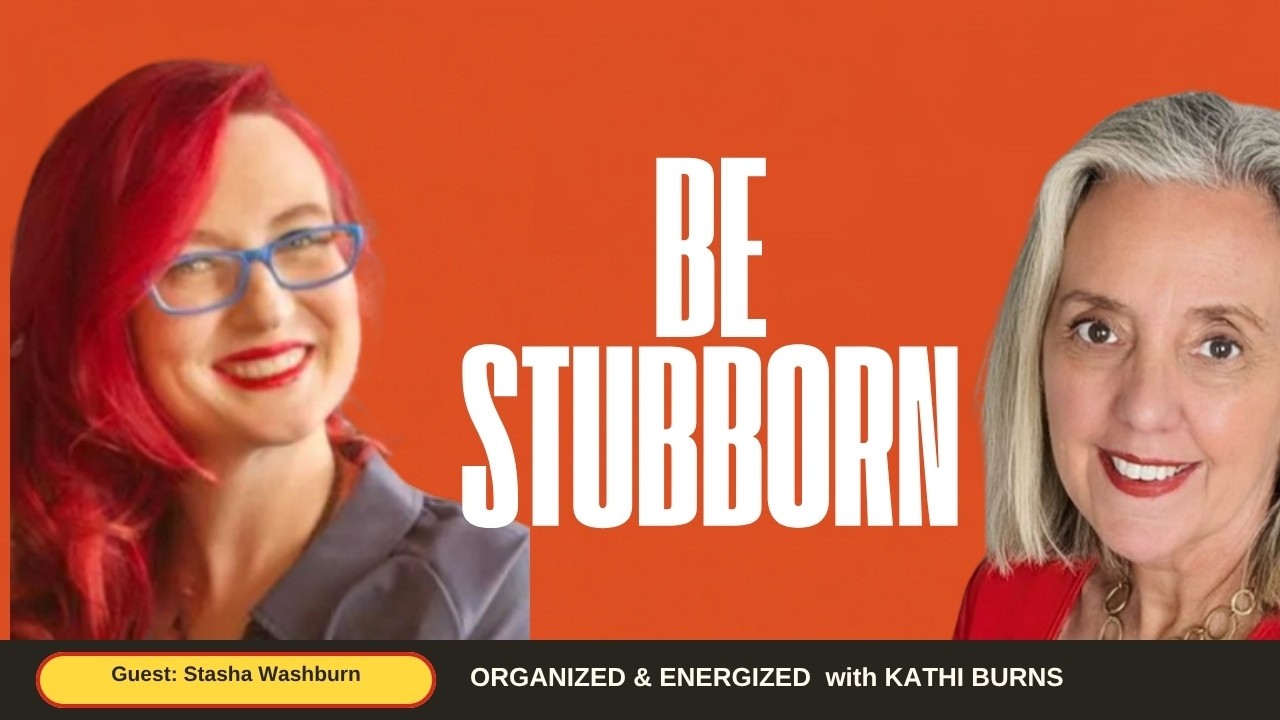
Stasha Washburn, The Period Coach, plans her business by the phases of her monthly cycle instead of by a repeatable five-day week.
She uses the follicular phase for planning and strategy, ovulation for batch recording, the luteal phase for writing and for noting what isn't working, and her period for working out why.
Stasha tracks her hours and worked 1,152 hours in 2021 and 1,162 the following year, about half of a standard 2,080-hour work year, while running a Kickstarter, a card deck launch, her coaching school and private clients.
She plans the whole year at the start, gives each month one main project, and runs every launch from its own Asana board linked to its SOPs, spreadsheets and documents.
Published · Updated
What is this episode about?
Kathi Burns, CPO®, Business FLOW Strategist, talks with Stasha Washburn, The Period Coach and founder of the Period Coaching School, about cycle syncing productivity: planning your work by month instead of by weekday. Stasha went from restaurants and dance to health coaching so she could see clients from home and close her calendar on her worst days. You'll hear how she uses each phase of her cycle for a different kind of work, from strategy to batch recording to reviewing what isn't working, and why she says a blank screen usually means you're in the wrong phase for that task. She explains how she gets everything done in about half the hours of a normal work year, how a low point sent her to a friend's futon to relaunch under the name The Period Coach, and how she plans a year of launches in Asana.
All of the things get done in half the time because we're chunking with our cycle.Stasha Washburn
Jump to links and resources · Part of How do I grow my business without burning out? · All episodes · Every guest
What are the key takeaways?
- Stasha suggests treating your work as a monthly cycle rather than a repeatable five-day week, and assigning each type of work to a phase.
- She plans and builds strategy in her follicular phase, batch records in ovulation, writes and notes what isn't working in her luteal phase, and decides during her period whether to automate, delegate or eliminate those things.
- In the days before her period, Stasha notes what isn't working without judging it or trying to fix it right away.
- Her clients know there is about one week a month she may not be able to schedule, and they plan their two sessions a month around it.
- Stasha has tracked her hours for two years and works about half of a standard 2,080-hour year.
- She plans the year at the start, gives each month one main project in Asana, and keeps an SOP board for each recurring project such as webinars, the summit and the Kickstarter.
- Batching similar tasks, like a Canva day for graphics across several projects, cuts down on task switching and keeps her branding consistent.

This episode is brought to you by the Business Logjam Session
A private 75-minute online session with Kathi Burns to find the one thing holding your business back and leave with your next steps. It is the same F.L.O.W. process Kathi uses with her own clients: Focus on your goals, Locate your logjams, Outline your solutions, Walk away knowing your next steps.
Find What's Holding Me BackInterested in sponsoring the show? Get in touch.How does cycle syncing productivity work for a business?
Cycle syncing productivity means planning your work by the month instead of by the weekday. Stasha Washburn says to stop treating your week as a repeatable five-day process with planning every Monday at 9. Instead, she does her planning in her follicular phase, reviewing the year, quarter and week, and gives other kinds of work to other phases.
When should you review what isn't working in your business?
Stasha reviews her business in her luteal phase, the week or two before her period, because that's when she notices everything that isn't working. Her advice is to note each problem without judging it or trying to fix it. During her period she asks why it isn't working, and if she's stuck at a blank screen, she switches tasks.
How do you batch content around your cycle?
Stasha writes in her luteal phase, edits during her period and early follicular phase, and batch records at ovulation, when she says her confidence peaks. That gives her a month of content ready to upload. She calls her system what, why, how, do: the luteal phase shows what isn't working, her period is for asking why, the follicular phase is the how, and then she does it, whether that means automating a task or calling a meeting with her VA.
How much does Stasha Washburn work in a year?
Stasha works about half of a standard work year: 1,152 hours in 2021 and 1,162 hours the next year, against the 2,080 hours of a 40-hour week. She has tracked her hours for two years. In that time she ran a Kickstarter, created a card deck, ran her coaching school and saw private clients.
How do you restart a business after a major setback?
Stasha relaunched by committing fully and making self-care part of the work. After a partner spent all her money, she moved onto her best friend's futon and built ThePeriodCoach.com at her kitchen table, dropping her earlier names to confront the taboo head on. Her friend made sure she rested and got out of the house that year. By the end of it she had clients, a successful first launch, and speaking invitations that kept her on the road six months a year.
How do you plan a year of launches in Asana?
Stasha plans the whole year at the start and gives each month one main project, such as a Kickstarter in May or a summit in September. Each recurring project has its own Asana board of SOPs linked to the spreadsheets and documents it needs. Tasks start at the beginning of the month and get specific dates as each launch gets closer. Kathi uses Trello the same way to keep her team on track.
How do you bring up the menstrual cycle with coaching clients?
Add one question to your intake form asking whether the client is comfortable talking about their cycle. For existing clients, Stasha suggests saying you learned something about how your work interacts with the cycle and asking if they'd like to talk about it. Her business coach students add a single question, while health and relationship coaches ask a few more.
What is the Period Oracle Deck?
The Period Oracle Deck is a card deck Stasha created with visuals by her partner, an artist. It has a goddess for each phase of the cycle, each tied to a season, plus cards for the senses, movement, journal prompts and a spirit card. She uses the cards to communicate with her partner, including a chocolate card, and they spent two years testing sample decks.
Where does each part of the conversation start?
- 0:00 Meet Stasha Washburn
- 0:30 Her background
- 0:43 Pop-up dinners in Los Angeles
- 1:08 Living with endometriosis
- 1:30 A dancer's life
- 2:20 Training as a health coach
- 2:51 Athletes with period problems
- 3:20 The system she built
- 3:58 What is endometriosis?
- 5:48 Stubbornness builds a business
- 6:14 Your cycle and productivity
- 6:40 Tap into your cycle
- 7:19 Think in months, not days
- 7:28 Plan in the follicular phase
- 7:48 Review in the luteal phase
- 8:33 Fix it during your period
- 8:57 The wrong phase for the task
- 9:32 Why vacations recharge you
- 11:24 After your period
- 11:51 What, why, how, do
- 12:40 Batching your content
- 13:34 One week off a month
- 14:39 Tracking her hours
- 15:02 Working half the hours
- 16:33 Her biggest low
- 17:01 Starting over on a friend's futon
- 18:01 A year of self-care
- 18:49 Her first launch
- 19:02 Speaking on the road
- 20:16 Her favorite organizing tool
- 20:30 Planning the year in Asana
- 21:09 SOPs for everything
- 22:58 Monthly chunks
- 23:41 Batching tasks in each phase
- 24:06 Consistent branding
- 25:00 Why everyone should understand cycles
- 27:19 Raising it with clients
- 28:45 The Period Oracle Deck
- 31:08 The chocolate card
- 31:38 Men have cycles too
- 32:24 Her free productivity video
- 33:02 A cycle-tracking mandala
- 34:39 Wrap-up
What resources were mentioned?
These episodes continue the same thread as this one: Lia Dunlap, Carly Church, Ginny Priem, Stephanie Wall Morrow also answer the question "How do I grow my business without burning out?", and the rest are the most recent conversations on the show.

 MotherhoodEpisode 147
How To Build a Village That Supports Your Business and Your Life with Carly Church

See every episode on the podcast archive or filter by topic on the How do I grow my business without burning out? hub.
How can I support the show?
- Subscribe on Apple Podcasts, Spotify or YouTube, or add the RSS feed to any app.
- Rate and review. A rating on Apple Podcasts helps new listeners find the show, and Kathi reads every review.
- Share the episode with one business owner who needs it; the share buttons are at the top of the page.
- Grab a free eBook: 6 Steps to Organize & Energize Your Home, 6 Steps to Organize Your Home Office or 6 Steps to Organize & Energize Your Life.
- Work with Kathi. The Business Logjam Session is a private 75-minute session to find what is holding your business back.
- Be a guest. Apply here if you have a story about clearing the obstacles in your business.
What did they say, word for word?
The transcript below is edited for readability: filler words and false starts are removed and speaker names are added. Nothing was added or summarized.
Read the full transcript +
Kathi: Hi everyone, I'm back. I'm so excited because we have Stasha in the house, and we're going to talk about menstruation, your flow, how you can harness it. But first, we're going to jump into her backstory so that you can see who she is, why she's here and what she's doing. And then we're going to give you some tips so that you can be productive and energized in your business. So, welcome, Stasha.
Stasha: Hello. Thank you for having me.
Kathi: Absolutely. This is going to be a fun conversation. So, talk to me a little bit about your background, Stasha. What have you been doing? I know you've been an entrepreneur for what, 25 years, right?
Stasha: A little bit. I was actually in the restaurant industry back in the day. So I started holding my own pop-up events in Los Angeles, doing pop-up dinner events and afternoon teas and sushi on artwork Thursdays. So, journey.
Kathi: Nice.
Stasha: Yeah. So, oh boy. I actually got started doing the work that I'm doing now primarily because I have endometriosis. At a certain point, like I said, I was in the restaurant industry. I bartended. I was a dancer before that, a dance major in college, danced in companies in high school. So, a very active life. And there just came a point where I went, you know what? I was in my early 30s, and I was like, oh, I can't do this forever. This isn't going to last. I was hard on my body in my teens. Well, basically from the age of three, but teens and 20s. But I was like, I've got to figure out something else to do. I was working in a ballet barre studio teaching, and a lot of people were asking me questions about cooking healthy, because I also cooked. So I was talking with all our clients about healthy eating and ways to make life easier to cook. I thought maybe I'll go back for health coaching. It was the first year the Institute for Integrative Nutrition had an online program, and I was from New York City, so I had already heard of them and knew them. I had moved to California, but I thought, they're online now. I'm going to go do this, and then I can see clients from bed, and I can close off my calendar the week that I have my real bad endo, and then I can come back. So I thought, well, at least this is something that I can do that works for me a little bit better. So I started doing that, and I started working with athletes, and they all had period problems.
Kathi: Ah, yes. They're trying to perform, right?
Stasha: Yeah. So they all had period problems. I'd spent 20 years researching menstrual cycles and food and health and Chinese medicine and Ayurveda. So I just started doing that and helping other people. And in the process, I had developed my own system, and now that's the system that I teach to my clients, to my students, to my coaching students. I'm training people to become period coaches now, so I train them in that system. It's very bio-individual and unique. So it was just a little series of fortunate events, I guess, based on one very unfortunate event, but we worked it out, and now it's great. I love the work that I do and the clients that I have and the people that I get to talk to, and it's fantastic.
Kathi: I love that. What I love about your story, Stasha, is that you followed your intuition. First off, you help yourself, and then that allows you to help others. And I think everyone listening out there, if you can listen and tune into that yourself, if you're looking to maybe make a switch, see what you've been doing that you're passionate about that's been helping you, and that's going to be your gift that you can move forward and help others. And don't you think that if you do that, Stasha, you're always going to have a successful business, if you just follow your heart and you keep at it? Obviously, it's not an overnight kind of thing.
Stasha: Yeah. I always tell my clients, unless you're from a family with a crap ton of money, sheer stubbornness will get you into a successful business.
Unless you're from a family with a crap ton of money, sheer stubbornness will get you into a successful business.
Kathi: Yeah.
Stasha: You can pay your way or you can be stubborn.
Kathi: Exactly. I started my company on $49, so I get that.
Stasha: I had the bare minimum, $25 in my savings account.
Kathi: There you go, girl. Oh, you beat me then. You're 25, I'm 49. And here we are.
Stasha: Right. Exactly.
Kathi: So, talk to me about cycling and productivity. I do have a few clients who just really get shut down at that time of the month, and they're like, we've got to reschedule our appointment. So what are some workarounds that you've discovered that you could give advice on for women out there that are struggling with a similar thing?
Stasha: Yeah. So across the board, if you're struggling and you identify as female, I would say tap into the moon cycles. And if you have a menstrual cycle, tap into your menstrual cycle, because it's stronger until you flip into wise woman, and then it's more of a moon cycle thing. But we're very cyclical beings, and that monthly cycle is really what we're good at. So you have to stop thinking of your workday as a day and a repeatable five-day-a-week process. Instead of Monday at 9 is planning, 10 is social media, 11 is admin, lunch, Facebook groups, clients, whatever. Instead of it being this thing that you do every day, and every day you're trying to beat yesterday's high score, think of it more like a month, and one day in a month. So instead of this is the time that I do my planning, it's follicular is the time that I do my planning. In this week, I will go through and look at the year plan, the 10-year plan, the quarterly plan and this week's plan, and execute things. So you have to start thinking of things in a bigger grand scheme. Review is your luteal phase. That time right before your menstrual cycle, the week to two weeks before your actual period. It's a great time to review, to reflect, to see what worked, to see what didn't work, and use that. Because, and I say this lovingly, if you think about the few days before your period, when you're mad at everything and everyone and you want to murder people with a rusty spoon, you know what's not working, clearly.
Kathi: Oh, smart.
Stasha: Right? So if you can just remove the judgment of this isn't working and it's my fault, which is what we do as women, but just say, okay, this isn't working. Don't judge it. Don't try to fix it, but just note it. And then you can move into the menstrual phase, where your hormones all come down to a base level, a little clearer, and you can go, okay, now why isn't this working? And then how do we fix it? And then you can go and fix it. You can do that with your business. You can do that with relationships. You can do that with anything. But if you're running a business and you find yourself sitting at a blank screen, or you can't get something done, or you're just getting really frustrated, you're probably in the wrong phase for that action. You just need to switch around. Your brain chemistry changes with your hormones, and it just gives you superpowers in each phase. We just don't respect all of our superpowers. Some are more highly prized than others. So we prize productivity in a capitalist, patriarchal society, but we also need the rest, the self-care, that time for ourselves. And we have strengths for those times. And if we can embrace that, it actually makes it much easier. And I think we all know that. You go on vacation for a couple of weeks, and you come back and you're excited about your business again. You're rejuvenated. You're ready to work. You're excited about stuff. So we know that rest works. We just don't give it to ourselves. And if we do, we're oftentimes not doing it in the best phase of our cycle to really capitalize on it.
If you find yourself sitting at a blank screen, or you can't get something done, you're probably in the wrong phase for that action.
Kathi: That's so smart. That's a whole new perspective for me. I totally believe in blocking time, and if you know what you should be doing, you know what you didn't do. So I think what you're saying follows right along with what I'm telling my clients already. Just know what you want to get accomplished, but you don't have to pigeonhole yourself. So, say Monday is admin day, but it gets junked up for whatever reason. Your car gets in the shop or whatever. Then you know that it's something that you have to get back to, but it doesn't have to be such a have-to-do thing. And as artistic creatives, and most of us women entrepreneurs are artistic creatives, we don't like to be put into that box anyhow. But we do have to have the plan. To have it be flexible is brilliant. And following your cycle is really an interesting idea, and I applaud you for doing this, Stasha, because I don't think that anybody else out there is talking about this.
Stasha: It's not popular.
Kathi: No, it's not popular. In some places, it's even just, women go away when you're in that thing. I think it's huge what you're doing. Okay. So, follow your cycles. And I love the idea of reviewing when you're cranky. That's so smart. So right after your flow, when you're back into it, what's the best thing to do after that?
Stasha: So when you come out of menstruation, your estrogen starts to rise, and your estrogen is directly tied to your verbal skills. So it also helps for strategy. Well, that's also a combination of things that are going on. Don't go out and say Stasha said estrogen is strategy. It's a whole combination of things. So I always call follicular the how phase. In my system, there's the what, why, how, do. So in luteal, we know what's working, what's not working. I always say, look at the good side too. You know what's not working, but what is? Both sides of the coin there. Menstrual, you're really good at the why. Hormones are at a baseline. You've got a little clearer head there. So, why is this working? Can we do more? Why isn't this working? Do we automate it? Do we get rid of it? Do we delegate it?
Kathi: So in follicular, strategy, right?
Stasha: Exactly. So in follicular, we can do the strategy. Okay, well, if we automate it, then I'm going to go get in there and do some tech nerd stuff. If we're going to delegate it, then I need to call a meeting with my VA. If I'm going to eliminate it, then I might still need to call a meeting with my VA and let them know. You can start to do that. It's also a great time to record. If you batch your content, you can write in luteal, when you're very passionate. And then you can edit in menstrual and maybe the beginning of follicular, and then ovulation, when that estrogen peaks, the testosterone peaks, the confidence peaks, you can go batch record, and then you've got your whole month of content ready to go. You can edit in early luteal, when you're still feeling good, and then that's it for the next month. You just hit play, upload.
Kathi: Yeah. This is why I like you, because we're right on the same page with that. Chunk it out, baby. Chunk it in chunks. It's the only way.
Stasha: Yeah. Exactly.
Kathi: It keeps you sane and keeps you feeling like, hey, I'm really making a lot of progress here. It's great. And when you have those days where you really can't function, you've got the backup.
Stasha: Yeah, exactly. I have, full disclosure, five-ish days that I can't. I get very dizzy, very faint. So getting to the kitchen and back, sometimes I have to stop and rest. And if I do push, I end up with cramps, and that endo flare starts, and then, of course, I panic a bit, and the PTSD kicks in. So I don't really do that. I just give myself that time. My clients know that there's going to be about one week a month that they may not be able to schedule, and they know to make sure they get their two sessions in per month. Sometimes it falls on a weekend, and I'm fine, and the calendar's open, and no one knows. Sometimes it doesn't. So everyone knows; clients know. I consider it just modeling taking care of yourself in the way that you need to. And at the end of the day, I've tracked my hours religiously for two years now, and I work half-ish what a normal person works. A normal 40-hour work week is about 2,080 hours in a year. In 2021, I worked 1,152. And last year, I worked 1,162. So I work about half-time, but I created a Kickstarter, created a whole new period oracle card deck, run my period coaching school, had my private clients, grew the list. All of the things get done in half the time because we're chunking with our cycle.
All of the things get done in half the time because we're chunking with our cycle.
Kathi: Yeah. And chunking in general is fantastic. I just moved. This is my new studio. And I had to take off four weeks of recording any podcasts or doing anything really business-wise. But fortunately, I had all the stuff in the backlog, tick, tick, tick. My podcast still came out every week. Chunking just makes that so much easier to do. And I'm really glad to be back in action, but I was really, really glad to have that latitude to not have to stress and worry. My media manager kept popping stuff out because everything was just there and ready to go. So, yay. There's something to be said about chunking. So, talk to me about a time before you figured this out. Tell me about a low that you had. I know you've had a lot with your, well, let's talk about a low in business. How did you get yourself out of that? What do you do when you're feeling peaked out or down or unable to even do anything? What's your go-to?
Stasha: Well, I think the biggest low in my business was when I was transitioning. I had a partner who spent all of my money, hence the $25 in my account. I was running the pop-up restaurant, which is exhausting, and I was seeing athlete clients, which was also exhausting in its own way. And yeah, he just spent everything. And I went, okay, well, we're breaking up. I need to move. I have nowhere to go. I'm going to go live on my best friend's living room futon, I guess. And that's actually when I basically said, you know what? I'm putting together ThePeriodCoach.com. I'm just going to wholeheartedly embrace it, instead of hormonal balance coaching. I was Stasha Health Catalyst before that, and then I was Stasha, hormonal balance coach, and I was like, you know what? We're just going to call it what it is. We're going to confront the taboo with the business name right then and there. And yeah, I dove in big time, and I really just sat at my best friend's kitchen table. God bless her. Thank you, my best friend. And put together the whole website and launched the business, really. And that was a year of intense self-care. Again, thank you, my best friend, who would not allow me to just sit and work, who forced me to go to the Korean spas, because it was 15 bucks to get in. And she'd be like, I got it. We're going. You could spend the whole day. 15 bucks. Just get in the car. We're going to free Met Gala night tonight. We're going. So she paid attention to things that were going on in LA. She kept them price conscious, or just did it, but she made sure I got out of the house and took care of myself and rested and rejuvenated, went to the tubs, all that good stuff. And it was a really good inner working year. So she helped substantially with that and with keeping myself moving forward. And it stuck, right? So after that first year, the business was up and running. I had some clients. I started teaching women how to run their businesses, and the first launch was great, and we made some money, and that was it. We just celebrated, and then I started traveling to speak. So it was kind of nice not having a home, because I was on the road six months out of the year or more after that. So yeah, it all worked out really well. And it was that full-on doubling down of, I'm just doing it, wholeheartedly doing it, and I'm going to deeply self-care in the process.
We're going to confront the taboo with the business name right then and there.

Kathi: Yeah. You were so blessed to have someone to remind you to self-care. And for the women out there who are listening, make sure you do self-care. I hope and pray that you have someone in your life that will keep reminding you. But you know what? You're responsible. And if you don't have anybody to do that, you need to do that for yourself, because just like you now, you get so much done in less time because you're whole. You're whole, you're centered, you're vibrant, you know what you're doing. So that's fantastic.
Stasha: Or be the person that takes somebody else out. If you are the one, like, you know what? I'm going to go make sure that my bestie is doing self-care. You're still doing self-care for yourself, but take someone along with you.
Kathi: Yeah, absolutely. Really good point. Okay, so you're very productive. So talk to me about your favorite organizing hack. What do you do? What's your favorite little tactic to keep yourself organized? Obviously, you get a lot done in a little bit of time.
Stasha: I don't think that everything would get done if it weren't for Asana. I go in there and I set dates for the year. So we get launches that pop up, things that are supposed to be happening pop up. We get alerts that things are coming, and reminders. I sit down, I plan out the whole year at the end of the year, the beginning of the year, and I know exactly what I can do. I can do a Kickstarter, I can do a summit, I can do two launches for programs, I can write a book. I know what I can do in a year. And so I put it all on there, and then we put all of it into Asana, and we already have the SOPs for everything. So the webinars are their own board, the Kickstarter is its own board, the summit's its own board, and we go through and it links to all the spreadsheets, all the documents. So when you're in Asana, you can go, okay, I need to go email the speakers for the summit. And then you can just click the link. There's the spreadsheet, there's everyone's email address, done. So I think Asana is the glue.
I think Asana is the glue.
Kathi: Yeah, I use Trello, and it's a similar thing. And thank God for programs like this, Trello or Asana. Check into it, listeners, if you haven't really done anything and you're getting ready to ramp. And if you are ramped and you feel like there's a bunch of loosey-gooseys floating around, get yourself something like that, Asana or Trello, because it's a way to communicate with your team, and it's a way to keep yourself on track. So whenever you go into Asana and you set your whole year in advance, and this is pretty amazing, by the way, I'm going to write a book, I'm going to do a Kickstarter too, it's like, go, girl, go. So in Asana, how does that work out calendaring-wise? Does it tie in with your main Google calendar, and you have the events? How are you working?
Stasha: I don't have it connected. So what I do is I go in at the beginning of the year, and I'll just put things for the beginning of the month. So we're in pre-launch, and it's like, we need to update the landing pages for this freebie, and it'll just go on to the beginning of the month. Then when we get closer to things and we start to shake dates out, I start putting in more specific dates. So then it's like, okay, the webinar is going to be at this time, and then I will go and put that information in. So we put everything in just month chunks. It just starts off with, the Kickstarter is going to be in May. The launch for the business program is going to be June. July and August will be prep for the Period Coaching School launch. September will be the Period Coaching Success Summit, the Period Coaching Success webinar. Doors will open to the school. November will be the Black Friday sale. December will be the giveaway. So every month has its main thing, and then the rest we do with flow. So it's like, okay, I'm in luteal. Who needs graphics? This webinar needs graphics, those slides need to be finished, and I've got a class I'm teaching for the school. Today is Canva day.
Kathi: I love Canva. So much fun.
Stasha: We can work on a whole bunch of different projects, but it's still the same thing, so you're not task switching very much. You're still working in a nice flow. You're getting a lot done, but you're knocking out this thing that needs to be done three months from now. It needs to be done, and we're here, so let's get it done, because we're also working on this thing. And that's also how you get branding consistency. We know how important that is. So if you're working in chunks like that, your branding stays more consistent. It's less like, oh, this crazy thing for this webinar, and then something totally different for that. So it really helps.
Kathi: Love, love, love. That's so powerful. I do a similar thing with the monthly: what's the intention of this month? So it's so funny, because we do very similar things with a little bit different tactic. And I just love hearing the different ways that people go about doing things, because it's like, oh, I could do that, or I could add that. It's awesome. Okay. So, what should I ask you that I have not asked you about? What do we need to talk about here? I mean, we could go on for hours about this, but what's burning in your mind that you want to talk about?
Stasha: Well, I think one of my get-on-a-soapbox-and-preach topics is how important it is to understand menstrual cycles, even if you don't have one, if you are working with clients who have them. If you give somebody a seated meditation in ovulation, you are setting them up for failure, and then you're going to wonder why they're not showing up for your sessions. Are you really going to have your client go home and have a conversation with her husband the day before her period? Really? It doesn't matter what the subject is. So I would love to just see more coaches, more women, more women who have women friends, more men, frankly, learn at least the basics, so that you can properly work with your clients, you can help your niece, you can help your daughter, whatever the circumstances are. I would love just the whole world to get a proper baseline education.
Kathi: Yeah. And that's your mission, and you're doing it. So how do you broach the topic if you're a coach and you're working with clients? How do you broach the topic of their cycle, without saying, you seem a little bit cranky today?
Stasha: Well, depending on your client.
Kathi: Exactly.
Stasha: Several different ways. The easiest is, you have your intake form for your clients, and the easiest thing to do is just put a question on there that says, if you're menstruating, I love to work with my clients in flow. Are you comfortable talking about this? Yes, no.
Kathi: Ah, okay.
Stasha: So right there, you can make it very easy. If you already have clients and you want to bring it up, one of my suggestions is to just say, hey, I learned this really cool thing about menstrual cycles and how what I do here affects them. So I would love it if you didn't mind talking about your cycle and where you are. It can be as easy as, I learned this really cool information and I'd love to share it with you, if that's okay, and putting it on your intake form. My business coach clients put that on their intake form. My health coach and relationship coach clients usually do a few more questions, and it's just sort of implied that we're going to talk about our menstrual cycles. But the rest of them, who are maybe not as intuitively, like, oh yeah, I can see how that fits, they'll just put a question on there, and then they can have that conversation with them.
Kathi: Okay, brilliant. That's great. So that's an easy takeaway tip for you listeners out there. There you go. Okay, so you have this oracle deck. I have to hear about this just a little bit, and then we've got to do a wrap. Let's talk about the oracle cards.
Stasha: So my partner is an artist, and he created the visuals for this card deck. We have all of these amazing cards. We have a goddess for each phase of the cycle, and each phase has a season associated with it. So this one is clearly the winter, the menstrual card, winter season. All the card backgrounds have a little nod to the season that they represent. It represents the new moon, yin energy, water energy, so a lot of the cards in that particular phase have it. Then we talk about taste. We talk about sight and sound. We talk about smell. Of course, our essential oil ladies and our candle ladies love this one. Touch and movement. We have the what, why, how, do phase cards, with a bunch of journal questions to help you embrace those, and our spirit card. Maybe it's meditation, maybe it's journaling, maybe it's whatever, but there are some prompts in the deck. So we have those cards for each phase of the cycle. And you can use it as an oracle deck, where you can just pick one and go, okay, I guess I'm focusing on smell today, and you're just going to go be observant of your sense of smell that day. Or you can pull the cards out of the phase you're in and have a look and connect and say, oh, you know what? Movement. I'm going to play with movement today. Or, like we do, I'll put a card out for my partner. Especially when I'm moving into deeper luteal and I'm starting to feel fatigued and it's just tough, I'll put the deep luteal goddess out there. Or I might put the card of the phase I'm in on the refrigerator, so it's a nice reminder. Like, I'm going to go snack. Oh yeah, I was right, I'm in follicular. What's a good follicular snack? Oh, hummus and celery. Yeah, that'll do. So you can have a play with how you want to use them, but they're great for communication and partnerships, because there's a chocolate card in the deck. You can just hand your partner the chocolate card and be like, throw chocolate and run, babe. Throw chocolate and run.
Kathi: Run for the chocolate.
Stasha: Yeah. Quick. A big part of it was we spent two years playing with sample decks and using them as communication. And he did too. He would be like, I'm feeling really energized and full moon. Which one's the full moon card? And he'd go find it and pull it out.
Kathi: And that's a good point. Men definitely have cycles as well, and I think it's something that we don't really acknowledge. I see it a lot in my husband, mainly in my husband, because I see him every day of the month, so I can tell when the cycles are happening. They have their cycles. And I agree, I think the moon has so much to do with everything, because we're so much water, and the moon controls the tide. So, come on, it's going to control what's happening with ourselves as well. But that's pretty cool. Okay, so, special free treat. You have something that the kiddos can download out here that will help them progress in their business. So talk to us about that.
Stasha: Awesome. So I actually have two things. The first thing I have for you guys is the productivity freebie. It's a video that I did with some of my top tips for syncing your cycle in your business to up your productivity. So it's a great little mini video, and there are a couple of emails that follow up to give you some extra support and tips for implementation. And then the second thing goes along with that. I have a way of charting. If you want to track your menstrual cycle and know which phase you're in, you can put your period on your calendar, but that's just your period. That's not going to tell you, I'm in follicular, I'm in ovulation, I'm in luteal, I'm in deep luteal. So there's a mandala, a coloring freebie, where you can track things like the moon phase. So if you're in perimenopause, you can just track by moon phase. If you're cycling regularly, you can track by your period, but you put your energy, food, movement, basal body temperature, cervical mucus, digestion, moods, and you can stylize it. So it's a great little thing to help you know where you are, and then you can apply the productivity tips much easier.
Kathi: Nice. That's fantastic. I love that. Okay, go ahead and download that, gang, and put comments once you play with it a little bit. Come back on to the podcast page and put comments for us, so we get some feedback and know what's going on. There's also the six tips to organize your amazing home office. Make sure to download that. That's on the side. So we have a bunch of productivity stuff that you can download for free. So go ahead and hit it up. And I think this is a wrap, if there's anything else that you'd like to say. Stasha, this has been really, really interesting, and I'm sure that it's stuff that people have not heard yet. So you go, girl. I know you're heading down south. You're going to go down under and help some women down there. So I'm just really pleased that we were able to get you on the show.
Stasha: Thank you so much for having me.
Kathi: Absolutely. It's been a real pleasure, and we will talk when you resurface. Thanks, you guys. Signing off for now. We'll see you next week.
Where can I find the links and resources from this episode?
Connect with Stasha
Organizations and companies
Inspired? Here Are Your Action Steps:
- Stop scheduling the same tasks at the same time every weekday and plan your work across the month instead.
- Pick one week a month for planning: look at the year, quarter and week plans together.
- When you notice things that aren't working, write them down without judging them or trying to fix them yet.
- For each item on that list, ask why it isn't working, then decide whether to automate, delegate or eliminate it.
- If you're stuck at a blank screen, switch to a different kind of task instead of forcing it.
- Batch your content: write in one block, edit in another and record a month's worth in one session.
- Track your working hours so you can see how much you get done and when.
- Plan the year at the start, give each month one main project, and keep an SOP board for each recurring launch.
- Group similar tasks across projects, like a single day for all your graphics, to cut down on task switching.
- If you coach clients, add a question to your intake form asking whether they're comfortable talking about their cycle.
Frequently asked questions
How can you plan your business around your cycle?
+
Stasha Washburn suggests thinking of your work in months instead of a repeatable five-day week. She uses her follicular phase for planning and strategy, ovulation for batch recording, her luteal phase for writing and noting what isn't working, and her period for working out why. If she's stuck at a blank screen, she takes it as a sign she's in the wrong phase for that task.
Why review your business before your period?
+
Stasha says that in the days before her period she notices everything that isn't working. She suggests noting those things without judging them or trying to fix them. Then, during her period, she asks why each one isn't working and decides whether to automate, delegate or eliminate it.
How much does Stasha work?
+
She tracks her hours and works about half of a standard 2,080-hour year: 1,152 hours in 2021 and 1,162 the next year. In that time she ran a Kickstarter, created a card deck, ran her coaching school and saw private clients. Her clients know there's about one week a month she may not be able to schedule.
How does Stasha keep a year of launches organized?
+
She plans the whole year at the start, puts each month's main project into Asana, and keeps standard operating procedures on their own boards linked to the spreadsheets and documents. Specific dates get added as each launch gets closer. Within each phase she batches similar tasks, like a Canva day for graphics across several projects, which also keeps her branding consistent.
How did Stasha become The Period Coach?
+
Stasha has endometriosis, and after years in restaurants and dance she knew she couldn't keep working the way she had. She trained as a health coach online so she could see clients from home, and her first clients were athletes. After a low point she relaunched under the name The Period Coach to confront the taboo around periods, and she now trains other coaches through the Period Coaching School.
Who is talking in this episode?

About the Host, Kathi Burns
Kathi Burns, CPO®, is a Business FLOW Strategist based in San Diego. For the last 20+ years, Kathi has helped clients create systems they can stick to. She is the author of How to Master Your Muck, Organizing With Tetris and Home Organization, The Smart Guide, and co-author of four more titles; all are in Kathi's shop. Kathi's business has been featured on Good Morning America, and her advice has been featured in Oprah Magazine, Martha Stewart Living, Better Homes and Gardens and Entrepreneur Magazine.
More about Kathi · Shop Kathi's books · Business Logjam Session · Apply to be a guest

About Stasha Washburn
Stasha Washburn is The Period Coach and the founder of the Period Coaching School, which she started in 2020 to train coaches to work with clients who menstruate. Before coaching she was a dancer and dance major, bartended, and ran pop-up dinners and afternoon teas in Los Angeles. She trained as a health coach in the first year the Institute for Integrative Nutrition offered its program online, so she could see clients from home. She later renamed her business The Period Coach to confront the taboo around periods head on. Stasha is the author of The Revolution Will Be Bloody and created the Period Oracle Deck, and she plans her own business by the phases of her cycle.
Want help putting this into practice?
Book a Business Logjam Session with Kathi
A private 75-minute online session to find the one thing holding your business back and leave with your next steps, using the same F.L.O.W. process Kathi uses with her own clients: Focus on your goals, Locate your logjams, Outline your solutions, Walk away knowing your next steps.
Prefer to start small? Download Kathi's free eBook 6 Steps to Organize Your Home Office.
Published · Updated
This episode page is for general information. Guests speak for themselves, and their opinions, statistics and examples are their own. Nothing here is legal, financial, medical or mental-health advice; talk to a qualified professional about your own situation. Some links go to the guest's own products or free offers; addSpace does not earn a commission from them unless stated.