

Episode 73
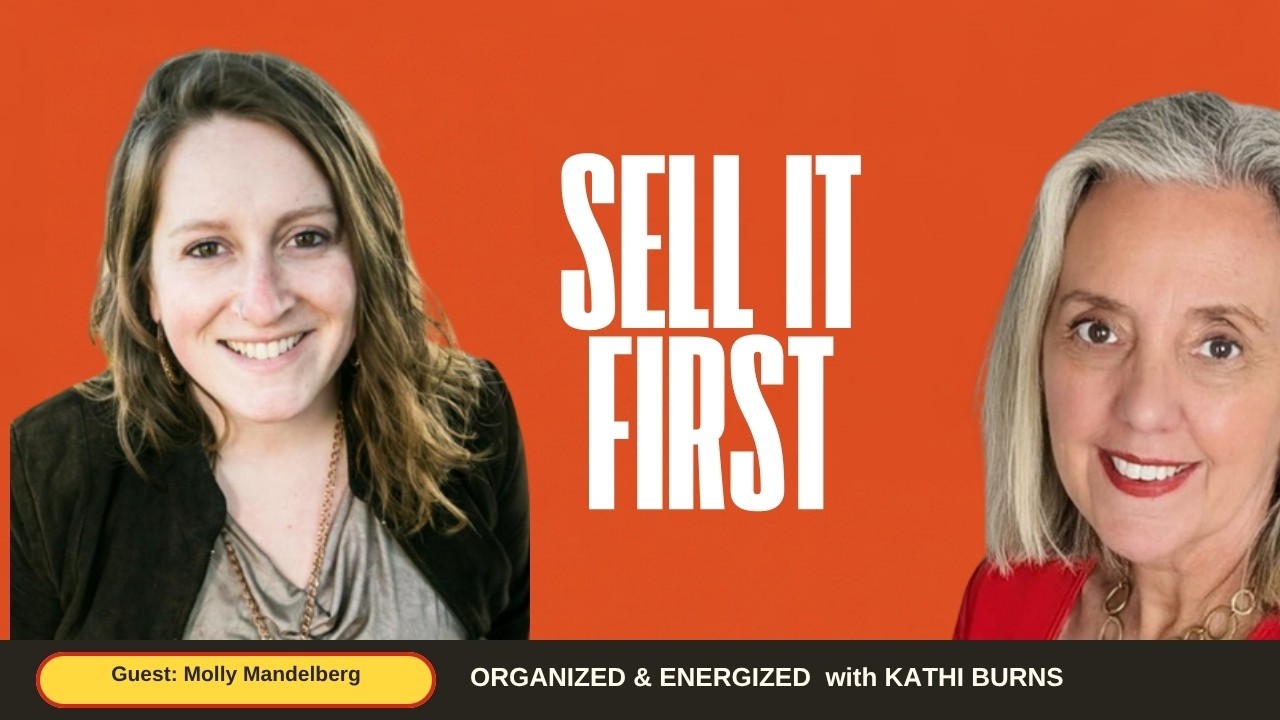
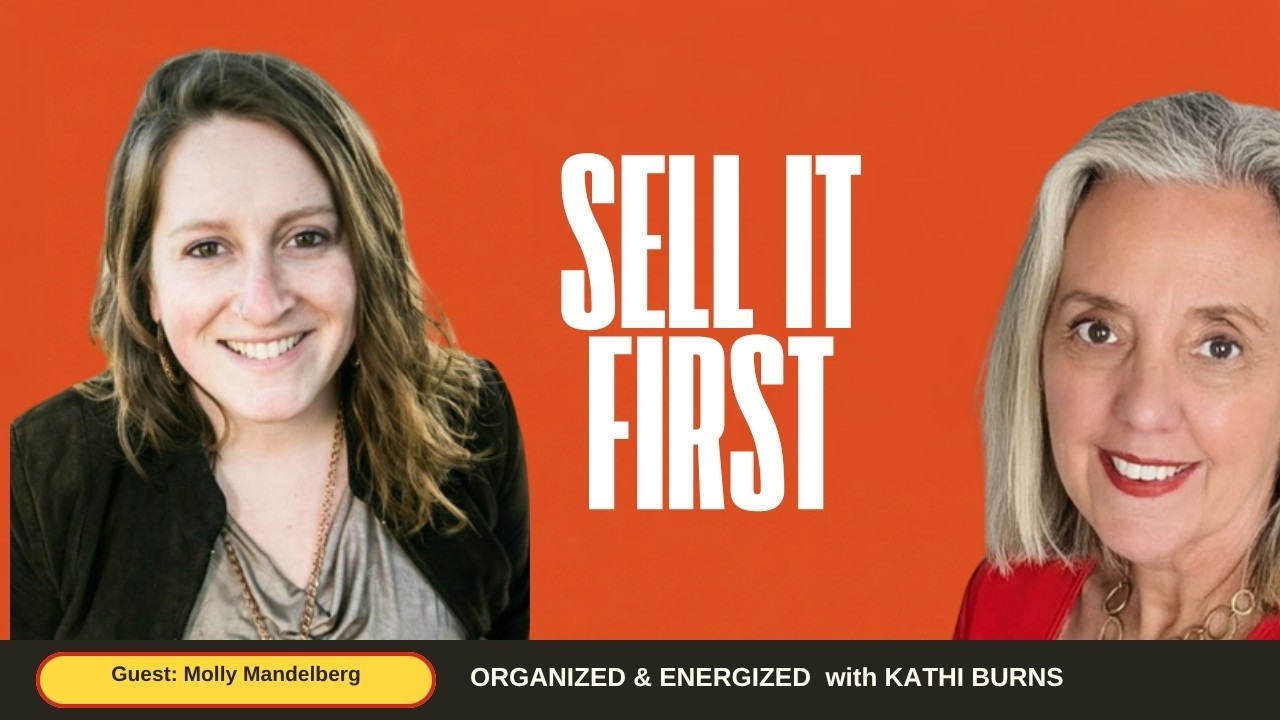
with Molly Mandelberg, founder of Wild Hearts Rise Up and host of the Tactical Magic podcast · April 12, 2023 · 39 min
Molly Mandelberg, founder of Wild Hearts Rise Up, moved from one-on-one hypnotherapy to courses and programs because one-on-one work put a cap on how many people she could serve.
She launched three or four courses before one sold, and now tells course creators to outline a course and sell it before building it.
Molly says the biggest productivity myth is that the more you do, the more productive you are; she keeps unscheduled days for creative work.
She published two books in a year, launches about six programs a year and takes calls only three days a week, three weeks a month.
Molly acknowledges herself for every finished task and sets rewards and accountability partners to see projects through.
Published · Updated
What is this episode about?
Energy management for productivity is the thread of this conversation between Kathi Burns, CPO®, Business FLOW Strategist, and Molly Mandelberg, founder of Wild Hearts Rise Up and host of the Tactical Magic podcast. Molly started as a hypnotherapist, noticed a cap on how many people she could serve one-on-one, and moved to workshops and courses she now runs from a converted Sprinter van. You'll hear why her first three or four courses didn't sell, why niching down helps you serve more people, the three things people pay for, and why she sells a course before she builds it. Molly then explains why doing more doesn't make you more productive, how she fits client calls into three days a week, the journaling and scheduling habits she relies on, and how she celebrates finishing a project.
It's vitally important to our creative process and to our productivity in general to have generative time that isn't generating time.Molly Mandelberg
Jump to links and resources · Part of How do I grow my business without burning out? · All episodes · Every guest
What are the key takeaways?
- Molly moved from one-on-one hypnotherapy to a one-to-many model because one-on-one work capped how many people she could serve and kept her in an office when she wanted to travel.
- She says it's easier to help more people when you're specific about who you serve, and suggests picking someone you'd want to spend the next three to five years with.
- In Molly's view, people pay for three things: health and beauty, relationships, and money, so an offer's name should speak to one of those pressing needs.
- Molly outlines a course, sells it, and only then builds it, so a paying customer gives her a deadline and proof the idea works.
- She calls 'the more you do, the more productive you are' the biggest myth, and keeps blank, unscheduled days so new ideas have room to come through.
- Molly journals every morning before getting out of bed and every night before sleep, and avoids her phone first thing so she starts the day from intention, not reaction.
- She batches and schedules her marketing content, has an assistant run her project management tool, and rewards herself for finishing projects.
This episode is brought to you by the Business Logjam Session
A private 75-minute online session with Kathi Burns to find the one thing holding your business back and leave with your next steps. It is the same F.L.O.W. process Kathi uses with her own clients: Focus on your goals, Locate your logjams, Outline your solutions, Walk away knowing your next steps.
Find What's Holding Me BackInterested in sponsoring the show? Get in touch.How do you move from one-on-one coaching to online courses?
Molly Mandelberg moved to courses by leading workshops first and investing heavily in training and mentorship. She had noticed a cap on how many people she could serve one-on-one as a hypnotherapist, and staying in one office stifled her love of travel. Her first courses failed, and she used the feedback from each to learn what to do differently next time.
Why should you niche down your business?
Molly says it's actually easier to help more people when you're specific about who you serve. She suggests asking who you'd want to be stuck in a room with for the next three to five years. She also says people pay for three things, health and beauty, relationships, and money, so two Reiki practitioners can sell the same service through different doorways depending on which of those they care about most.
Should you sell an online course before creating it?
Yes. Molly outlines the course so she knows what goes in it, then sells it before spending dozens of hours building it. Once someone pays, she has a deadline and a fire under her to create it, plus proof the idea is viable. Her early courses failed because their names sounded nice but didn't speak to a pressing need.
How does energy management for productivity work?
Molly says energy management for productivity starts with dropping the myth that doing more makes you more productive. Without pauses, there's no blank space for new ideas, insight or inspiration to come through. She calls it generative time that isn't generating time, and she credits that deep time with getting two books and about six programs out each year.
What daily habits help you manage your energy?
Molly journals every morning before she gets out of bed and every night before she goes to sleep, bookending her day with gratitude lists, emotional processing and questions about her vision. She tries to meditate daily, for five to 30 minutes, and walks her dog, works out, makes art and writes for herself. Kathi adds that even a five-minute pause before the day starts gives you space to set your intention.
Why limit client calls to three days a week?
Molly found that switching between calls and creative work on the same day was stressful and kept her out of her creative zone. She first cleared her Fridays as creation days, and now takes calls three days a week, three weeks a month. She doesn't let other people schedule her unscheduled days, which she uses for books, art, her oracle deck and her two podcasts.
What tools help a small business owner stay organized?
Molly relies on scheduling tools and a project management tool run by her assistant. She batches content, writing five emails at once, and uses an email platform, an online scheduler and a social media scheduler to drip it out on dates she sets. Kathi batches five podcast recordings in one day and recommends a weekly four-hour block for your big project.
How do you celebrate your wins as an entrepreneur?
Molly acknowledges herself for every task she finishes, even with a quick high five. She sets rewards, such as dinner out or a new iPad she couldn't buy until two side projects were done. For her last book she used a weekly accountability partner, and the two cheered each other on every step of the way.
Where does each part of the conversation start?
- 0:00 Meet Molly Mandelberg
- 0:36 How she got started
- 0:52 Starting as a hypnotherapist
- 1:20 The cap on one-on-one work
- 1:38 Missing life on the road
- 2:25 Courses that failed first
- 2:43 Turning deep work into courses
- 3:09 Marketing for spiritual leaders
- 4:11 Systems that buy freedom
- 5:00 Moving from one-to-one to one-to-many
- 5:35 Avoiding a niche
- 6:25 Who you'd spend years with
- 7:05 What people will pay for
- 7:38 Health and beauty
- 8:06 Relationships and money
- 8:39 Two Reiki practitioners
- 9:51 You are your best avatar
- 10:17 Two steps ahead
- 11:11 A money course before she was ready
- 11:52 Naming your offer
- 12:42 Sell it before you build it
- 13:00 A fire under you
- 15:22 The biggest productivity myth
- 16:09 Blank space for new ideas
- 16:42 Space breeds clarity
- 17:10 How much she gets done
- 17:19 Calls three days a week
- 19:01 Journaling morning and night
- 19:40 Daily meditation
- 20:05 Walks, workouts and art
- 21:33 Clearing her Fridays
- 22:15 Sacred unscheduled days
- 24:29 Journal before phone
- 25:07 Starting in reaction mode
- 25:32 Her favorite organizing tools
- 26:07 Batching and scheduling content
- 26:35 Project management and an assistant
- 27:41 A weekly four-hour block
- 28:41 How to celebrate
- 29:29 Acknowledge every step
- 30:07 Accountability partners
- 30:47 Rewarding yourself
- 32:51 Magnetic Influencer Collective
- 33:19 Her Etsy shop
- 33:34 Dreaming of a retreat center
- 35:16 Don't do it alone
- 36:21 Her thought leader quiz
- 37:34 Wrap-up
What resources were mentioned?
- What Level of Thought Leader Are You? quiz
- Wild Hearts Rise Up events and workshops
- Magnetic Influencer Collective, Molly's six-month group program
- Create, Launch, Deliver, Molly's course on creating and launching courses
- Peace with Money, Molly's money mindset program
- Molly's oracle deck and guidebook
- Tactical Magic podcast
- Procreate
These episodes continue the same thread as this one: Lia Dunlap, Carly Church, Ginny Priem, Stephanie Wall Morrow also answer the question "How do I grow my business without burning out?", and the rest are the most recent conversations on the show.

 MotherhoodEpisode 147
How To Build a Village That Supports Your Business and Your Life with Carly Church

See every episode on the podcast archive or filter by topic on the How do I grow my business without burning out? hub.
How can I support the show?
- Subscribe on Apple Podcasts, Spotify or YouTube, or add the RSS feed to any app.
- Rate and review. A rating on Apple Podcasts helps new listeners find the show, and Kathi reads every review.
- Share the episode with one business owner who needs it; the share buttons are at the top of the page.
- Grab a free eBook: 6 Steps to Organize & Energize Your Home, 6 Steps to Organize Your Home Office or 6 Steps to Organize & Energize Your Life.
- Work with Kathi. The Business Logjam Session is a private 75-minute session to find what is holding your business back.
- Be a guest. Apply here if you have a story about clearing the obstacles in your business.
What did they say, word for word?
The transcript below is edited for readability: filler words and false starts are removed and speaker names are added. Nothing was added or summarized.
Read the full transcript +
Kathi: Hi everyone. I'm back and I'm with Molly. I'm with Molly Mandelberg, and we're going to talk today about expanding your productivity by using your energy, and hopefully using less energy to do more. So, hi Molly. Thanks for coming on.
Molly: Hi. Happy to be here.
Kathi: Yeah. I know you're in your van, and now you're in Austin, Texas. Now, this is someone that you might aspire to, ladies. She travels. She's a gal about. She travels all over the place in her van doing business, making lots of money, and going wherever the heck she wants to go. So talk to me, Molly, a little bit about how you got to where you're at. Well, first off, how did you start in your business? Let's start there. What was your ideal goal?
Molly: Yeah. I started my business about eight years ago. And when I started, I was doing hypnotherapy, and I was nicheless. I had the point of view that hypnotherapy could help anyone do anything. And so I was going in all directions trying to get anybody I could possibly get as a client. And I enjoyed the work that I was doing. I felt like I was really helping people. I was able to change lives, so to speak. But two things were going on in the background. One was I was starting to notice there was this sort of innate cap on how many people I could serve in a lifetime of one-on-one work. So I started having this desire, this drive to lead workshops, create courses, build programs, and switch to more of a one-to-many model. And at the same time, I had paused my nomadic ways. I had already been nomadic for about seven years at that point and was trying to stay in one place to work in an office to see people face to face, and that desire for travel and moving around and being in different places was feeling really stifled. And so that also was encouraging me to figure out a way to bring my business online and to serve people without having to be in a brick-and-mortar office of some kind.
Molly: And so I started leading workshops. I started investing heavily in training and mentorship and getting the support that I required to both find the courage and the belief in myself and also the strategic know-how to actually put these things out into the world. And it wasn't like I launched a course and boom, my whole life changed and everything was easy. I actually had to fail a few times: launching courses that didn't work, learning from my mistakes, getting the feedback and paying attention and not allowing that to collapse me, but actually allowing that to teach me what I needed to do differently next time. And after a little while I realized that I had a really great passion for synthesizing deep and powerful work into digestible content and helping other people use these technologies and these systems to do the same thing: to go from a one-to-one model to a one-to-many model, and to do it with as much ease as possible, with as much integrity and authenticity as possible, and to do it in a way that honors our magic. I work mostly with pretty spiritual, woo-woo leaders, mentors, healers, people who don't necessarily vibe with the bro-y marketing strategies that are out there and want a more intuitive approach or a more holistic, heart-centered approach.
Molly: So I have a lot of fun bridging that gap between understanding the energy, and how our belief in ourselves and our belief in our business and our belief in our work can impact everything we're creating, and bringing business strategy and technology and systems to that place. Bridging that gap between being spiritual and intentional and aware and conscious and wanting to bring that magic into the world in an exponentialized way, and needing the tools and the support to do that without falling into overwhelm or burnout over and over and over again. And that's the beauty of setting these systems up: with the right things in place, I can travel the world. I can work less days per week. I can spend serious quality time with my loved ones and do the things that I want to do and be in the places that I want to be and become the person that I want to become and follow my passions and make art and see music and do all the things that I love to do, while still running a thriving business and knowing that I'm making a difference in people's lives.
With the right things in place, I can travel the world. I can work less days per week.
Kathi: Yeah, you're the ideal avatar for women who want to just do their own thing in their own time in their own way. And I love what you said about going from one to many. And I think that's where a lot of women are right now who have launched. They're very successful at what they do one-on-one, and they're moving into the one-to-many. I know that happened with me as well when COVID hit. Sometimes that caused a shift for a lot of people. You did it intentionally prior to that, but a lot of people, we just got popped into that. So talk to me about, whenever you did a few courses and you had some failures, what do you see was the thing that really didn't work with the courses that you had launched in the very beginning, before you took all the training or maybe halfway through the training? What happened with that, and where did you see it stumble?
Molly: So one of the things was, like I said, at first I was niche averse. I was avoidant to niching down. And I know that niching has a lot of… I say niche because it rhymes with rich, and niche rhymes with quiche. So if you are a French-speaking person, I apologize. But niching down can bring up a lot of emotions, because we don't want to turn anyone away. We want to help as many people as possible. And what I had to come to realize was that it's actually easier to help more people when you're more specific about who exactly you can really serve. And even though you can serve many people with a lot of the modalities that are out there that we're helping people with, it's likely that you resonate deeply with certain kinds of people a little bit more than you resonate with others. And if you're thinking, I'm going to be stuck in a room… For example, I work online, so I'm not actually stuck in a room with anyone except my little dog who's behind me. If you're going to be stuck in a room with this person, this avatar client of yours, for the next three to five years, isn't it somebody that you want to hang out with? Don't you want it to be someone that you enjoy spending time with or that you vibe with? And so when you start looking at it that way, it starts to become more clear who you want to hang out with, who you want to spend time with, who you really want to see transform and self-actualize and transcend their stuff through your support.
It's actually easier to help more people when you're more specific about who exactly you can really serve.
Molly: And then I had to recognize that there are certain things that people will pay money for and certain things that they won't. So when we're looking at naming a course or creating a new program, we want to use this beautiful language that sounds like, ooh, that's nice. But if it's not put through one of the lenses of the things that people pay money for, it's not going to be a course that sells. And that sucks to acknowledge, but it's actually pretty easy to meet that benchmark, I guess you could call it, that framework, by looking at what those things are. So the three things that people pay for are health and beauty, which we see rampant on the internet: anything that's going to help people feel better in their bodies or feel healthier or feel like they're able to acknowledge their beauty or take care of themselves the way they want to take care of themselves. That's health and beauty. That's one of the three mega niches. The next one is relationship. That could be relationship to self, relationship to partner, relationship to family, relationship to kids, all kinds of relationships. But relationship is a place that we have enough urgent desire that people will pay money to help solve those problems. And the third one is money, or finances, or wealth. How do I make more money? How do I keep my money? How do I spend smarter? All of those things. How do I invest? That's a place that people will spend money to fix or figure out or get better at.
Molly: So if we look at the deep work that we do, two different people could be running the same business. Let's take just a silly, not silly, but an easy example: two Reiki practitioners. They're helping people with their bodies. They're helping people with their soul, their spirit, their intention. One of them could be deeply passionate about embodiment and about somatics and about the physicality of that. And so they're more easily going to go through the health and body sort of pathway to sell the same services. Whereas the other person is really passionate about family and connection and community, and they're going to sell their Reiki magic through a totally different portal. And so different people are going to end up getting the same services, but they walk through two different doorways, because that urgent desire that they have, that pressing need, that prayer that they've been asking for support with, is beaconed out by these two different options. And they get to find the person that helps through the lens that they're most desiring to figure it out through.
Kathi: Yeah, I think that's really important. I think that people are scared of creating a niche. They don't want to go down and eliminate the people, especially when people are first starting out. If you are out there in the audience listening, if you're just starting, you don't want a niche, but you do want a niche. And what I found a long time ago, and tell me if you agree with this, is that we are our own best avatar. When you had said something about who do you want to spend three hours with in a room five days a week, is it going to be someone like you who you resonate with, or is it going to be somebody that you can't even relate to? So don't you think that that's true?
Molly: Yeah, it almost always ends up being some version of you, often a past version of you. And what one of my mentors says that I love is that you only have to be two steps ahead of your people. And so you don't have to have everything figured out to help that person who's like you. You just have to be a couple steps further down the road. And that's definitely where I was when I chose this niche of, okay, y'all need help launching courses. I started by just letting my friends hire me, because I was like, I figured out this whole email sequence, sales funnel, connected to a software to deliver the course, this whole process of technology. I know how to do it. You guys want to figure out how to do that? I'll help you do that. And now I'm probably a lot more than two steps ahead of those people that I'm helping. But it only had to be that much to know that I could help them.
Molly: And to answer your earlier question of why those failures happened, they were for varying degrees. I launched probably three or four courses before one finally started selling and taking off. One of them, I started trying to be a money mindset coach before I had really addressed my money mindset issues. I have since created a money mindset program from a place of true prosperity and abundance that definitely sold and gets amazing results for people. It's called Peace with Money. But the first time I tried to launch a program about money magic and mindset, I was not in a healed place with my relationship to money. And so it was coming from a place of, ooh, this doesn't feel quite aligned or right for me. And I think that's why that one didn't sell. And then a couple of the other ones just weren't specifically targeting a pressing desire enough. It sounded like, oh, that's nice, but not a, I need that right now, I'll come and pay you for it. And so we want to look at the names of our offerings when we're doing a leveraged model like this, or even naming your free consult if you're doing a consult model for your business. Is it something that when they see it, your people will say, that is for me? If they can look at that and say, that's what I want, that's for me, then they're more likely to come and check it out and more likely to come and say yes to it. So we've got to put it through that lens.
Molly: And I didn't have enough of those distinctions at first. I just thought, oh, I have this cool idea. I could make something. I'll just go make that and then try to sell it. So that's actually something I encourage people to do. Also, I have a course about creating, launching and delivering courses called Create, Launch, Deliver. And one of the things is to look at what it is that people want from you, but also the thing you want to create. Try it out by selling it first. Maybe outline the course so you know what's going to go in it, but don't spend dozens of hours building out the entire program until someone has come and said, yes, I want that, here's my money. And that does a couple things. Once they pay you for it, you now have this beautiful energetic fire under your butt to go and follow through with creating it. It makes it so much more fun to do that work of building out the templates, of building out the videos, of showing up to record things. All of that is easier once you've been paid for it, because now there's this person waiting for you to finish it. And so that's one side of it. You're now being paid to deliver it. And the other side is you've proven the concept. You now know that the idea that you have is actually viable. And so it's better to follow through with it once you know that for sure. And so instead of spending a year or six months or even three months creating all of the content for your course before you ever tell anyone about it or let them purchase it, I say do it the other way around. Figure out everything you need to know about it so that you feel good selling it, and then sell it, and then follow through with it by the time it has to start. So you might need to set some time aside for that. But it's a totally different process that makes it easier.
Kathi: Yeah. And I think as creative, artistic… I know I fell into that a long time ago, where I just create, create, create. It was like, here, I'm going to give all my information to the world, but I didn't really ask if anybody wanted it. I thought it was great, right? Until you find that people really want to do it. So I think that's fantastic advice, and it's so easy. I agree. Once you have that one person that says, yes, I want it, then you have a deadline. Then you're able to settle your priorities in a more effective manner, because you know what you have to get done by a certain date. And I agree. I think it's a brilliant model, because then you're totally inspired and fired up, because you know that it's wanted and it's needed.
Molly: Yeah. And it's more fun to market it once that one person says yes and pays you, because you're like, wow, somebody sees this as valuable. It's not just me. Hey, everybody else, get on board. Is this for you? Come find it.
Kathi: Yeah. And that person, too, can help you model it. You can use them as a sounding board and say, what do you think about this? I'm going to do this module. Is this going in line with what you thought you were going to get from the course? So I love the market research part of it, for sure. Now, I know we want to talk about productivity, maximizing your time with minimal energy. So let's talk about the energetics. I'm all about energetics of stuff. Let's talk about energetics of productivity, if you would.
Molly: Yeah. Okay. Biggest myth out there, and I've been facing this with a lot of clients in the last few weeks, is that the more you do, the more productive you are.
Kathi: Yeah. I call it being stuck in your busyness.
Molly: Yeah. It seems obvious. It seems like, of course, the more I do, the more I get done. And it's like, well, actually, the more you do without stopping, without tending to yourself, without filling your cup in some way energetically… Even if your work fills your cup, and my work definitely fills my cup, if that's the only thing I'm doing, I don't want to say it can go stale, but it can run you ragged. And so, energetically, we need pause. We need time to reset. We need blank space for new ideas to come through, for insights and inspiration. If we're just go, go, going and pushing, pushing, pushing all the ideas out, there's no time for that deep insight, for that guidance, for that new awareness to come through, or for somebody to say something and it just spurs a new idea. It's vitally important to our creative process and to our productivity in general to have generative time that isn't generating time.
It's vitally important to our creative process and to our productivity in general to have generative time that isn't generating time.
Kathi: Absolutely. Yeah. I always say space breeds clarity, and clarity breeds productivity, and productivity means more success. So if you don't have that space there, if there's no gap in between all your busyness, so to speak, you're just going around like this. You're getting a lot done, but at the end of the day, you don't know what you did, right?
Molly: Yeah. And just for a little context, so people don't think I'm just saying this: I published two books last year. I launch about six programs every single year. I travel the world full-time, and I do calls for my business three days a week, three weeks a month. So I get a lot done. And I'm not saying that to say, oh, I'm so special, I'm so good. It's because I take deep time for myself. It can be really hard, depending on your life, to carve that time out for yourself. But I know it is vitally important if you have creations you want to allow forth. If you have big vision that you want to bring to life, the blank space, the creative dates with yourself and the filling of your cup through self-care, through pleasure, through wonder, through nature, all of those things are vitally important to the creative process. And to think that we can just keep pushing through and going without those things is not a healthy choice, in my opinion.
Kathi: It's not sustainable either. So, okay, you're doing three days a week, which I know because we were scheduling, which I think is fantastic. I wish I could get to that. I'm not there yet. But I guess I should ask, whenever you take pauses, what's your favorite method to really just clear your mind? Let's go into that.
Molly: I mean, there are certain processes and practices that I do daily that keep my energy where I want it to be, where I feel most alive and resonant and ready to go. One of those is a journaling practice. So I write every morning before I get out of bed, and every night before I go to sleep, the last thing I do is write. That looks like processing what's going on for me emotionally in the day. That looks like gratitude lists. That looks like asking big questions of the universe, asking for what I want to actualize, fleshing out my vision, expanding on what I think I'll feel like, what I'll be like when I have that thing I think I desire. Just all kinds of verbal processing to zhuzh my vibe, to enhance my mojo. And I do it in the morning and I do it at night so that I'm bookending my day with that kind of magic and intention. I also try to meditate every single day, depending on where I'm at in life, what I'm up to. Sometimes that's five minutes, sometimes that's 30 minutes. But it's a dramatically different day by the end of the day when I do it or when I don't do it. And so I've learned that over the years: just do that, or I'm just not quite as happy and whole at the end of the day.
Molly: But as far as what do I do with my free time? For me, I have a dog. I spend a lot of time walking the dog. That resets my energy. I love exercise. I'm sort of a recent… in my mid-thirties I got into exercise in a serious way. And so I love going to work out, and it changes my energy for the rest of the day. Sometimes for the few days afterwards I just feel better. And I like to create. So I make art and I write. Sometimes I write books. Sometimes I just write for myself. But having creative energy that isn't necessarily focused just on my business brings me great joy. It lights me up. And having those things that light us up… it could be playing with your kids. It could be taking a hike. It could be going swimming. Whatever the thing is for you. It could be adult coloring books, to do something that brings you that sense of lightness, that lightness of being, that sense of joy. We need time for that.
Molly: And I started to notice early on in my business that I was working five days a week, and I was trying to fit creative projects in between calls. And so I was trying to switch gears, go from facilitation gear to creation mode, back to facilitation gear. And those transition points were really stressful, and I couldn't quite get into the creative zone. By the time I got to my creative zone, it was time to shift out of that into the next call. And so I realized I would much rather have three busy call days than have calls spread out over five days a week. So first I cleared off my Fridays, and those would be my creation days. That's when I would write my book or I would work on my next piece of art, or whatever that creative project was. I created an oracle deck. I run two podcasts. Those creative projects needed time to come alive somewhere that wasn't in between all my other calls, or at the end of the day when I'm tired, or before the day when I'm starting to stress out about what calls I have. So something had to change, and for me that looked like more unscheduled days on my calendar. I can still schedule myself. We're having a call on a Monday right now. It's my only call of the day. I still had a lot of great stuff going on earlier. But it's rare. I just don't allow other people to schedule those days. So that's sort of my sacred time. I get to decide what to do with it.
I realized I would much rather have three busy call days than have calls spread out over five days a week.
Kathi: Yeah. I think it's fantastic that you could go, I did this and this and this and this and this. Because I would wager that a lot of you listening on the podcast, if people were to ask you what do you do to make yourself unwind or to feel good, you might not have the five or six or seven answers like Molly does. I have a few. Because when we get stuck in the work mode, we forget what brings us joy. So I love the idea that you can just go and say, I do all this, and it's because you've thought it out. And I think that's because you've taken the pause. I love the idea of you bookending the beginning and the end of the day. I do it as well. I know that I wake up with what I go to sleep to. So it's very important for me to bookend the end of the day and start the day with a little bit of space as well in my brain before I start that whole cycle of the day. And I would encourage all of you listening, if you haven't set up some kind of routine in your life to pause, hopefully at the beginning, before you start the whole shebang of the day, to pause. I would recommend that you do that, like you say, Molly, even for five minutes. Five minutes is fine. It doesn't have to be a 30-minute thing, as long as you just take that time to have the clarity, so that you can create the space for your intention for the day. I agree. I have some days whenever I don't do it, and I'm like, oh, okay. That day just didn't quite go like I thought it was going to go, and I had not taken that time.
Molly: Yeah. And I love that you use the word intention. That's totally the difference. A day without that intention is kind of forced to kick off from a place of reaction. So it's like you're choosing intention or reaction every single day. For example, if you pick up your phone and you look at social media or you look at your email first thing in the day, you're inviting other people's agendas from the get-go. And that means that you're in a reactionary place from the first moment of your day. So one of my clients, I love this, she says she puts her journal on her phone on the bedside table, so that in the morning, the first thing she reaches for, if she's trying to reach for her phone, her hand lands on her journal, and it's like, okay, she has to start there. I just love that little mind hack. And I do it to myself, too, sometimes, because the alarm is going off or something. I reach for the phone, and then I'm like, oh, nope. I don't touch that first. I'm not opening it. I'm not looking at it. I start with me and what I want to be and become and what I want to think and step into today, and set those intentions before you let other stuff come and impact you.
Kathi: Yeah. Because anytime you check your email, you're in reaction mode. Same thing with phone. The only reason that people are calling you or emailing you is because they want you to do something, say something, respond, whatever. I agree totally. I love the way you said it, that it's people coming into your day and setting up your day, as opposed to you setting up your day. Man, that's fantastic. I have to ask this, because I am a professional organizer. What is your favorite organizing hack? What do you use in your business that you rely on that just really makes things happen for yourself? It could be a tactic. It could be a program. It could be anything at all that you want to discuss.
Molly: Gosh, I could geek out with you on this.
Kathi: I know.
Molly: I'll just say overarching categories. Biggest thing is scheduling. I like to have that blank space, like I said, and I also like to show up on social media, on many different platforms, and show up on my podcast and show up on my email list and show up in all these places for my broadcasting and marketing. So batching content, making five emails instead of one at a time, and then having a way to schedule them out. So having an email platform, having an online scheduler, having a social media scheduler, those scheduling kinds of tools where content can be dripped out at dates that I specify or in time spans that I specify. That is the biggest timesaver when it comes to marketing for your business, in my opinion. Organizationally, I want to say having a project management tool and/or a virtual assistant.
Kathi: Yeah. And/or both.
Molly: Yeah. Well, and both. I have my assistant running my project management tool now, so that when I'm like, hey, we're doing this, she puts it in the right place in there so we can go back to it. We can add to it if we need to. But I was doing all of that for myself before I started having assistants doing it for me.
Kathi: Yeah, batching is so incredibly awesome. Again, we're on an off day, too. For some reason, both of us are doing this podcast on a day that we normally don't. At least I switched over to a different day. I like to do five podcasts in a day. Boom, boom, boom, and then it's done, right? And then I have a month plus right there in the queue, ready to go. Anything that you do over and over and over, it is great to batch. So I am with you on that, sister. And having your calendar… I think that everybody needs at least, and you do it a lot more, but I think bare minimum everybody needs a four-hour block for themselves, for creativity and projects during the week, just blocked out. It's your time, and that way you can use it for whatever. From a business standpoint, I like the idea of that's when you do your big project, that thing you've always been wanting to do, like your book. Molly, you are so prolific with everything that you do. I'm going to write a book this year; you'd write two books and eight courses and five launches. But if you don't do the four-hour block every week just for your big project, nothing's going to get done. So I just love your tactics, and obviously you're someone that is a really good person to model, because you're living your dream. You're in a Sprinter van. Love the Sprinter. We have one as well, and it's calling me out there in the driveway saying, come on, Kath, we need to go take a ride. Yeah, I think that's great. So this is what I also want to talk about this year: celebration. I find that I don't really celebrate as much as I should when I make that landmark, when I get where I want to get. What do you do to celebrate? What's your favorite celebration thing?
Molly: Yeah. Okay. So I love that you're bringing this up, because this is the greatest way to avoid burnout, I think, is just this. It's a new neural pathway for most of us: the practice of acknowledging ourselves every step of the way. And if we don't do that, we're always bent on never enough. It's not enough. I have to do more. Okay, this is complete. Now, what's the next thing? And we're always moving, moving, moving, going, going, going without taking the time to actually pause. The act of acknowledging yourself for every single task you do, even if it's just a high five to yourself, even if it's you checking it off the list and just looking at it for a moment, like, yes, I did that one. That feels really good.
Molly: So for me, I will use carrots, so to speak: when I finish this, I'll get this. Sometimes it's I'll take myself out to dinner, or when I do that task, I'll call someone right after and talk to them about it. Or I often use accountability partners. So, for example, writing the last book that I finished, I knew I needed somebody to hold me accountable, so I just found somebody else who I knew who was working on a book, and we had a weekly time. And then we said, hey, great job, at the end of it every time. And so we had that feedback loop of, we're doing this, we're making progress. We're not only showing up for each other to hold each other accountable, we're also celebrating each other every step of the way. And I had two projects I had been putting off that were very much not required for my business, which means that they were side-burner kinds of projects, but I still really wanted to see them through. And I said, okay, if I finish… I wanted to get a new iPad for this art app called Procreate that I just knew I wanted to make art on, which I finally got a week ago and have been making art every single day on it since then. But I wasn't allowed to buy the iPad until I finished these two projects. So I started making more time for those projects, because I had this carrot dangling in front of me: you get to play with that new game once these two big things that you'll totally ignore if you have that app… they need to get done first. And once you finish those things, you can go have that thing. So I use a little bit of bait for myself sometimes to follow through, but then it feels like this beautiful celebration. I get to treat myself.
Molly: And it doesn't always have to be money, either. It could be the celebration of just sharing it with somebody else and having that self-acknowledgement. It feels bold to do that if you never do that. If you think you need to discount your wins or not talk about how great you are, it's important to find community that will celebrate you in your bigness. And that's one of the things that I'm really passionate about creating, too: those spaces where women like us can share the big wins and not feel like we need to shrink or discount it, because a lot of us don't have those spaces in our normal lives. It's becoming more common, but it's not that common to feel like you're allowed to be all of your big, bright, shiny self and not feel guilty for being that bold or braggadocious or audacious. So yeah, I think there's lots of different ways to celebrate. Sometimes it could even just be you get your favorite non-sugar chocolate bar at the end of the day because you did your good work. It can be simple.
Kathi: It can be very simple, but it's so critical. And I love the way that you explain that. So talk to me about what project. What do you have in the brew, and what are you excited about coming around the corner?
Molly: Yeah. I have a lot of things. One of the big beautiful things: that program I just mentioned, where we're creating that new feedback loop, that new neural pathway, learning how to acknowledge our wins and celebrate, is part of my six-month group program called Magnetic Influencer Collective, and that is coming up again this summer. So I've got a couple of workshops that are sort of vision planning calls, which lead into that, and those workshops will be happening, I think, in June and July. So depending on when this podcast airs, you can go to wildheartsriseup.com/events and check those out. The big projects that I'm working on right now: like I said, I just got this fun app, and I'm making new projects for my Etsy shop, which is a side business of mine, making fun art to put on t-shirts and stickers and things like that. So that's kind of the fun thing I'm working on in my creative space at this moment. And then also looking at real estate. I've been thinking about building a retreat center, and now I'm starting to shift that vision into something else in the meantime. But I'm doing things outside of the creation of my business right now that also feel like they're fueling a lot of energy for me, which is exciting and fun.
Kathi: Yeah, I think you have to have the energy. You have to have the enthusiasm towards something that you're doing that's not just business. Because I think oftentimes what happens with me, anyhow, whenever that spark is there, somehow my business can weave right into it, because it's just the way that it flows. I think if you're doing your dharma, or you're doing what you should be doing in the world anyhow for your work, oftentimes your passions and your little side gigs end up just, oh, that works that way, too. Just like with you, with empowering women and having women have the ability to celebrate, to expand, to bring out their boldness with gusto and no fear, and not feel like they're bragging. I like that. Braggadocious. Is that what you said?
Molly: Yeah.
Kathi: All the side gigs kind of lead around to the same thing, because we are one big synergistic, synergetic being. We're multifaceted, but we have our own unified field in life. So I love that. Let's see. This has been a really good conversation. Is there anything that we should have talked about that you had on your mind that I didn't ask?
Molly: No, I think we covered a lot of great stuff. If anything, I would just want to encourage anyone out there who's bringing a dream like this to life: don't give up, and don't feel like you have to do it all yourself. There are really beautiful opportunities for community, for collaboration and for mentorship, and spaces that want to hold you and walk beside you as you create these kinds of big leaps in your life and your business. So don't feel like you're alone. If you feel like you've been doing it alone for too long, reach out and find support. I'm happy to support you. I have all kinds of offerings, like I said, some one-on-one and some group programs and things like that that people can get involved in, anywhere from very low cost to higher-end, higher-touch opportunities. But your vision is worthy of your attention, and your ideas deserve the space to grow and thrive.
Your vision is worthy of your attention, and your ideas deserve the space to grow and thrive.
Molly: So I'd actually be happy to… if anyone out there is listening and you feel like you're a coach or a healer, a holistic practitioner, and you want support, there's a really fun quiz on my website that you can take that's called What Level of Thought Leader Are You?, which will give you a nice snapshot of where you are right now and what to look at energetically as far as expanding into the next level. And I'm also doing, we'll see, this is coming out in a few months from when we're airing, but I'm doing right now a seven-day free coaching opportunity that you can apply for. The link is on my Instagram. It's wildheartsriseup.com/7days, the number seven, and you can find the application there if you want to get your hands on seven days of free coaching with me.
Kathi: How cool is that? I'll make sure to put the links. We'll make sure we have those in the show notes, the quiz link and the seven-day link and all that. So depending on when you're going to see this podcast, the free seven-day coaching might or might not be available, but jump on it if you see it, for sure. And I really appreciate your time, Molly. We are like-minded, synergistic, synergetic women, and I'm just stoked that I could interview you and you could interview me, because we always have great conversations.
Molly: Definitely. Yeah. Go check out your episode on my show, too. Kathi Burns is on the Tactical Magic podcast as well, and we had a great conversation.
Kathi: We did have a good time. Okay, you guys, signing off for today. Thanks, Molly. I really appreciate it. And we will see you guys next week. Bye-bye.
Where can I find the links and resources from this episode?
Connect with Molly
Organizations and companies
Books and resources
Inspired? Here Are Your Action Steps:
- Ask who you'd want to work with for the next three to five years, and niche down to that person.
- Check that your offer's name speaks to a pressing need in health and beauty, relationships or money.
- Outline your next course, then sell it before you build it.
- Use your first buyer as a sounding board while you create the modules.
- Block out unscheduled days or a weekly four-hour block for creative work and big projects.
- Group your client calls into fewer days so you aren't switching gears between calls and creative work.
- Journal before you get out of bed and before you go to sleep, and reach for your journal before your phone.
- Batch your marketing content and schedule it with email and social media schedulers.
- Acknowledge yourself for every finished task and set a reward for finishing a project.
- Find an accountability partner for a project you keep putting off.
Frequently asked questions
What is the most effective way to sell online courses?
+
Molly Mandelberg's approach is to outline a course and sell it before building it out. Paying customers prove the idea works and give you a deadline to create it. She also says the course name has to speak to a pressing need, ideally through health and beauty, relationships or money, so people see it and think, that's for me.
Why did Molly move from one-on-one work to courses?
+
She noticed a cap on how many people she could serve one-on-one in a lifetime, and she missed traveling while working from an office. So she started leading workshops and building courses. Her first three or four courses didn't sell, and she used each failure to learn what to do differently.
Why should you niche down?
+
It's easier to help more people when you're specific about who you serve. Molly suggests asking who you'd want to be in a room with for the next three to five years. She also says people pay for three things: health and beauty, relationships, and money.
Does doing more make you more productive?
+
Molly calls that the biggest myth. Without pauses, there's no room for new ideas and insight to come through. She published two books in a year, launches about six programs a year, travels full time and takes calls only three days a week, three weeks a month.
How does Molly celebrate her wins?
+
She acknowledges herself for every task, even with a quick high five, and says it keeps burnout away. She sets rewards for finishing projects; she didn't let herself buy a new iPad for drawing until two side projects were done. She also used a weekly accountability partner to finish her last book.
Who is talking in this episode?

About the Host, Kathi Burns
Kathi Burns, CPO®, is a Business FLOW Strategist based in San Diego. For the last 20+ years, Kathi has helped clients create systems they can stick to. She is the author of How to Master Your Muck, Organizing With Tetris and Home Organization, The Smart Guide, and co-author of four more titles; all are in Kathi's shop. Kathi's business has been featured on Good Morning America, and her advice has been featured in Oprah Magazine, Martha Stewart Living, Better Homes and Gardens and Entrepreneur Magazine.
More about Kathi · Shop Kathi's books · Business Logjam Session · Apply to be a guest
About Molly Mandelberg
Molly Mandelberg is the founder of Wild Hearts Rise Up, creator of the Magnetic Influencer Collective, a bestselling author, and host of the Tactical Magic and Reveal the Game of Life podcasts. She started her business as a hypnotherapist and now helps coaches, healers and conscious leaders turn their work into courses and programs, with offerings such as Create, Launch, Deliver and Peace with Money. Her books include Wild Hearts Rise Up: The Wild Woman's Roadmap to Conscious Leadership, and she wrote and illustrated an oracle deck. Molly travels full time and runs her business from a Sprinter van she converted into a tiny home, taking client calls three days a week.
Want help putting this into practice?
Book a Business Logjam Session with Kathi
A private 75-minute online session to find the one thing holding your business back and leave with your next steps, using the same F.L.O.W. process Kathi uses with her own clients: Focus on your goals, Locate your logjams, Outline your solutions, Walk away knowing your next steps.
Prefer to start small? Download Kathi's free eBook 6 Steps to Organize Your Home Office.
Published · Updated
This episode page is for general information. Guests speak for themselves, and their opinions, statistics and examples are their own. Nothing here is legal, financial, medical or mental-health advice; talk to a qualified professional about your own situation. Some links go to the guest's own products or free offers; addSpace does not earn a commission from them unless stated.