


Episode 113
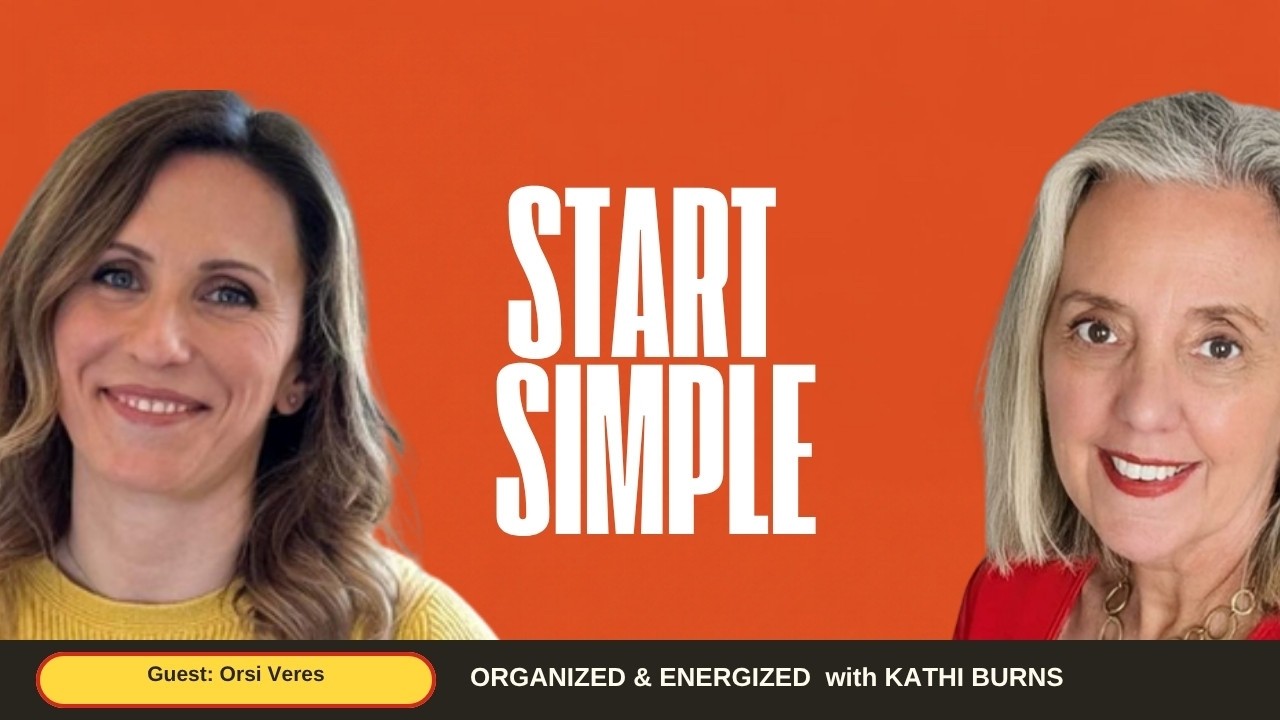
with Orsi Veres, founder of Design You Need, helping women business owners with branding, websites and course launches · March 13, 2025 · 34 min
Orsi Veres of Design You Need built her business as a side hustle for three years, starting in 2018, before leaving her corporate job at the end of June 2021.
Before she quit, she paid off her car loan and her house loan and saved a few months of cushion.
Orsi says a new business does not need a special logo or a big website: a logo can be the business name in a font, and one page with your services, who you help, a bit about you and contact details is enough.
She describes a client, an English teacher, whose online course for adults with no English made about 10K in each of its first two launches and now reopens every three months.
Orsi plans her week every Sunday, putting meetings and then tasks on her Google Calendar, because if it's on the calendar it happens.
Published · Updated
What is this episode about?
Kathi Burns, CPO®, Business FLOW Strategist, talks with Orsi Veres, founder of Design You Need, about branding, websites and how to launch an online course without the overwhelm. Orsi grew up in a small town in Transylvania, moved to Hungary at 12, and worked as an IT consultant and then in e-commerce for two multinational companies. She built her business after hours and on weekends for three years and planned her exit from corporate down to paying off her loans first. You'll hear why working from home during COVID gave her the time to grow, why getting out of the victim mentality was her biggest lesson, why a new business can start with a font-type logo and a one-page site, how a client's English course for adults made about 10K per launch, how Orsi plans her week on Sunday, and why finding your people matters when you work alone.
I have the best and the worst boss ever in one person.Orsi Veres
Jump to links and resources · Part of How do I get more clients? · All episodes · Every guest
What are the key takeaways?
- Orsi started her business as a side hustle in 2018 and worked on it every day after hours and every weekend for three years.
- Working from home during COVID saved her almost two hours of commute a day, and she says she got her job done in about two hours instead of eight, which left time for bigger client projects.
- She set a goal at the start of 2021 to quit by the end of June, paid off her car and house loans first, and saved a couple of months of cushion.
- Her biggest lesson in business was getting out of the victim mentality and accepting that she gets to choose how she reacts.
- Orsi says a new business can start with a font-type logo and a one-page website, and that the hard part is marketing yourself and getting in front of people.
- Her English-teacher client's course was built for people who are not tech-savvy, so the site was kept simple and given built-in translation into any language.
- When working alone felt isolating, Orsi joined networking groups and met like-minded entrepreneurs, online and in person.
This episode is brought to you by the Business Logjam Session
A private 75-minute online session with Kathi Burns to find the one thing holding your business back and leave with your next steps. It is the same F.L.O.W. process Kathi uses with her own clients: Focus on your goals, Locate your logjams, Outline your solutions, Walk away knowing your next steps.
Find What's Holding Me BackInterested in sponsoring the show? Get in touch.How do you start a business as a side hustle?
Orsi Veres started hers in 2018 and worked on it every day after hours and every weekend for three years while she kept her corporate job. She even changed jobs during that time, which meant learning a new role while still building the business. When COVID moved her work home, she saved almost two hours of commute a day and says she got her job done in about two hours instead of eight, so she had the bandwidth to take on bigger projects.
How do you plan your exit from a corporate job?
Orsi set a quit date, cleared her debts and saved a cushion before leaving. At the start of 2021 she gave herself a goal of quitting at the end of June. First she paid off her car loan and house loan with consistent payments, then saved a couple of months of cushion. She says quitting was terrifying and freeing.
What is the biggest lesson of running your own business?
For Orsi, it was getting out of the victim mentality and waiting for others to save her. In corporate there was always someone else to blame, a co-worker or a boss. In her own business she gets to change the way she reacts, and she says she has the best and the worst boss ever in one person. She calls building a loving, trusting relationship with herself the biggest shift.
Does a new business need a logo?
Not a special one, according to Orsi Veres. When you're starting out, she says, you don't need a fancy logo, a color palette or special fonts. A font-type logo, just your business name written out, is fine. Nobody knows you yet, so the harder and more important work is marketing yourself and getting in front of people.
What should a new business website include?
One page with your services, who you help, a bit about yourself and a way to reach you, such as an email or a booking link. Orsi says that is enough in the beginning, and that it's normal to build it yourself when you don't have the budget. She knows people who started with only an email and cold pitched their work. The most important part is getting experience, satisfied customers and testimonials you can put on the site.
How do you launch an online course?
To launch an online course, Orsi starts with a simple brand and a website built for the students. For an English teacher whose students had no English and little tech experience, she kept the site minimal and added translation. Orsi says the course made about 10K in each of its first two launches and now reopens every three months.
How do you plan your week as a business owner?
Orsi plans her week every Sunday. She puts every meeting on her calendar first, then gives her tasks their own blocks, because if it's on the calendar it actually happens. Blocking the time tells her what is a priority, so she doesn't take other calls in those slots. She uses Google Calendar because it works across all her devices, sends reminders and makes it easy to move things around.
How do you deal with feeling isolated as a business owner?
Orsi joined networking groups and started meeting like-minded entrepreneurs. All her clients are online, so after COVID, when everyone else went out again, she found working alone lonely and questioned herself often. Meeting other business owners, some 25 years ahead of her and still facing the same struggles, showed her she was not alone, and hearing how they handle clients, projects and processes helped her move forward.
Where does each part of the conversation start?
- 0:00 Meet Orsi Veres
- 0:32 Why she does what she does
- 3:25 From IT consulting to e-commerce
- 5:43 Starting as a side hustle
- 6:58 Working from home changed everything
- 8:04 Planning her exit from corporate
- 9:48 Growing up in Transylvania
- 10:57 Starting over in Hungary and Budapest
- 12:50 The biggest lesson of business
- 14:40 Branding when you're just starting out
- 16:36 A one-page website is enough
- 18:04 A client's course launch story
- 22:52 Growing an audience fast
- 23:40 Plan your week on Sunday
- 24:54 Google Calendar
- 26:12 Business can feel isolating
- 27:19 Find your people
- 28:57 Her move to New York
- 29:33 Free resources and the Website Refresh program
- 32:00 Wrap-up
What resources were mentioned?
- Design You Need: free blog posts on branding, websites, tools, email funnels and course launches
- Free call with Orsi
- Website Refresh program (Orsi said she was relaunching it)
- Google Calendar
These episodes continue the same thread as this one: Sue Kirchner, Yvonne McCoy, Louise McDonnell, Allan Ngo also answer the question "How do I get more clients?", and the rest are the most recent conversations on the show.


 Social MediaEpisode 144
How To Use Social Media More Strategically In 2026 To Find New Customers with Louise McDonnell

See every episode on the podcast archive or filter by topic on the How do I get more clients? hub.
How can I support the show?
- Subscribe on Apple Podcasts, Spotify or YouTube, or add the RSS feed to any app.
- Rate and review. A rating on Apple Podcasts helps new listeners find the show, and Kathi reads every review.
- Share the episode with one business owner who needs it; the share buttons are at the top of the page.
- Grab a free eBook: 6 Steps to Organize & Energize Your Home, 6 Steps to Organize Your Home Office or 6 Steps to Organize & Energize Your Life.
- Work with Kathi. The Business Logjam Session is a private 75-minute session to find what is holding your business back.
- Be a guest. Apply here if you have a story about clearing the obstacles in your business.
What did they say, word for word?
The transcript below is edited for readability: filler words and false starts are removed and speaker names are added. Nothing was added or summarized.
Read the full transcript +
Kathi: Hi everyone, we are back, and I'm with my girlfriend Orsi Veres, and we are going to talk about branding, launching, getting stuff done basically with your business. So welcome to the show, Orsi. It's so good to see you again.
Orsi: Thank you so much, Kathi. I'm so happy to be here.
Kathi: Yeah, it's been a while. We haven't connected for a few months. I helped Orsi and Orsi helped me. So it's a nice little cohabitation of talents and coordination of what she does best, what I do best, and it's a lot of fun. So anyhow, Orsi, talk to me about branding and design, and give me a little bit of a backstory on why you're doing what you're doing right now.
Orsi: Sure. I'm trying to give you the short story, because it's quite long in the sense of where it all started, but everything goes back to the way I was raised and how my family and surroundings and society were at the place where I was born. Literally, I saw women doing the regular jobs and the traditional roles that they have to do. And even as a little one, I felt like I want to do things differently. Not in a sense of, oh, I'm rebellious and I want to do it differently, but it's more of, there must be something else for someone like me, let's say. So I was always like, yeah, I want to do things differently, because they just didn't make sense. It didn't look good or satisfying enough to me that that's all they have to do or that's all they can do. And as I grew up and talked with more women, I found out that yes, they are struggling with doing just what is expected from them. They have amazing dreams and they want to reach some really great goals, but they are not allowed to, slash not able to, because they don't have the time, resources, energy, whatsoever. So as I started my business, I was always thinking about, okay, what's my why? What am I trying to do? Because obviously it's one thing to be profitable, but I always went back to: I want to be able to help women who feel a similar way. They have really great dreams, they want to achieve those dreams, but they don't have the resources. And obviously for a small business owner it's hard to find those resources, especially when you're overwhelmed with so many things. And I come from corporate, so I learned different tools, and I've been doing that for years. So I wanted to use that type of knowledge that I have and help them to get from A to B, C, D, whatever that would be for them. So with my knowledge and my support, they could reach their dreams, launch their courses, launch a business, or even just make that business even more profitable. So that became my why: to support those women who want to make a difference. And I'm not against anything traditional. I think it's really nice to do that, but it doesn't have to be just that, and I want to be able to help women who want to go further.
Kathi: Yeah. So you have the why and you have the who. How did you get into corporate? What were you doing then? And then I know you transitioned out. Let's talk about that just a little bit.
Orsi: Yeah, sure. So I started out as an IT consultant. I was working in IT. I was consulting for a company for a couple of years. It involved a lot of traveling, which was super fun back then, but also very tiring. It just makes you isolated, and it's all about work. You go from hotel to hotel, and it takes a lot of toll on you. Then I transitioned into e-commerce. I worked for two big multinational companies, and I was responsible for the e-commerce department there. One of them actually was such a multitasking job that I literally did all of it at one point, because I was the only one handling the entire thousands and thousands of products, plus website, plus orders and everything. And I found out that I actually really enjoy that part, being able to do multiple things and not just do one. And it was the time when I realized, oh, maybe I could run my own company. If I'm capable of doing so many things, what if I would do it for myself instead of someone else? Because with corporate, things are going slowly. If you want to make change, that's a lot of politics and a lot of this and that. So that's when the idea came for me to actually start my own thing. And then I looked at what I'm actually good at and what I enjoy doing, plus why I want to do it, or who I want to help. And that's how it all came together. Okay, let's help women business owners mostly. I also work with men, but my main target is women business owners who are on the market for quite a while, and they just need extra help because they're feeling overwhelmed. With my being a consultant, being in IT, I know tech. I'm a fairly easy learner when it comes to new technology or solutions, as well as with e-commerce, so I help them sell their products and services.
Kathi: And being from corporate, I know that branding was… you saw a lot of good branding, I'm sure, and you went into that as well now. So some people listening to this podcast are in corporate, thinking about making that exit strategy, thinking about starting out on their own. How did it work for you? Did you start a side hustle, or did you just go cold turkey and stop? How did that look?
Orsi: Oh, well, good question. I'm actually a person who, even though I sometimes look impulsive, I'm very much of a planner. I like to plan things out. And this was one of the biggest things I've ever done for myself, and it came with all sorts of changes and learnings. I had to learn all my bad habits slash limiting beliefs slash all the things. And I was very much afraid of going on my own and doing things. So I started out my business as a side hustle back in 2018. I was doing it for three years on the side, which meant every day after hours and every weekend, just working and trying to build my business. So I had that going on, and it was growing. But when it's a side hustle… and meanwhile I even changed jobs. It was a new job, so in a new job you also have to perform, and it's different when you're still learning and trying to fit in. And then COVID happened, which for me was actually a good thing, because then it meant I saved almost two hours of commute every day. Also, I could be at home, and I realized that an open office for me might not be the right setting. I was always working in an open office. There was a lot of chatter, a lot of information passed across the table and whatnot. And I couldn't focus on my job so easily, because it was distracting. And if I plugged my ears, they were like, oh, why are you so antisocial? Don't plug your ears. I'm like, come on, I cannot work, because you're talking all the time.
Kathi: Right. Right.
Orsi: So as soon as COVID hit and I started to work from home, I'm like, oh my god, I get my job done in two hours, what took me eight plus, with all the meetings. So I became way more productive. So I had more time to work on my business, and it was less taxing, and I started to take on bigger projects, because finally I felt like I had the bandwidth to do that. And then in 2021, at the beginning of the year, I set myself a goal: okay, I need to quit my job. But I did have my car loan, I had my house loan, I had all sorts of things. So first I had a plan to pay them off, which I did with consistent planning and payments. I paid them off, and then I set myself a goal to quit at mid-year, so end of June 2021. And the day came and I was terrified. But I actually did it, and it just felt so freeing. It was really, really cool. But obviously that's one thing to do, the big step, and leave. But that's when reality comes in. Okay, now you don't have this steady income. Now you have to do everything for yourself. However, I also saved up a couple of months of cushion to have it there in case something goes bad or I'm not able to get clients. But luckily I never had any issues so far. Yeah, that was the rough beginning.
I set myself a goal to quit at mid-year, so end of June 2021. And the day came and I was terrified. But I actually did it, and it just felt so freeing.
Kathi: That's really good, because you're really good at what you do. I love the fact that you have so much premeditation and planning, because I think that is also a skill that you transfer over to your clients, to show them how to plan and strategize on how they're going to launch, how they're going to look to the world with branding, and so on and so forth. So I see that as a really big strength in you. Now, tell people where you lived. Did you grow up in a small town? What country were you in? Because I know we've just made a shift here, so we're going to move into that.
Orsi: Yeah, sure. So I'm originally from Transylvania. My whole family is from there. I grew up in a small town where almost everyone knew everyone, and there were a lot of family gatherings, and we celebrated birthdays, name days. It was just a lot of… I could explain it like an Italian family: a lot of noise and a lot of things going on. Also, people weren't that self-aware of what type of effect their actions have on other people. And this is past revolution, past Soviet era. I'm not saying I have any issues in my family, but the close surroundings were much of a mindset.
Kathi: Yeah. The same thing about what you were saying about the mindset about what women are going to be doing, or what's expected of them. So when you took your corporate job, then you started commuting a lot to get to a bigger city to work in corporate. Is that correct?
Orsi: Well, actually, we moved from Transylvania to Hungary back in 2001. So I was just about 12 years old back then. We moved there because, with all the things, my parents tried a lot of different options to stay afloat, but life there was quite difficult. So they decided to move countries to have a better life for themselves and for us, which actually turned out to be true, even though there was a lot of hardship there and we struggled a lot. So by that age I already had to start from scratch, which probably formed the way I am, how resilient and how flexible I am to things. So we started off new, and then as soon as I graduated from high school, I went to Budapest, which is a three-hour drive from the town that I was living in. So we moved from a small town to another small town where I didn't know anyone, and then I moved to Budapest, where I again didn't know anyone. And literally, when I started to work, not long after, I started to travel. So it wasn't moving, but it was a lot of travel where I didn't know anyone again. So a lot of new things happened. And the commute started when I was in Budapest and I finished college and started my corporate jobs. That's when I had to commute every day. Depending on the business, but usually it was minimum one hour to get somewhere.
Kathi: Okay. So now you've been an entrepreneur for a while. What's the one lesson that your business has taught you as a solopreneur or an entrepreneur?
Orsi: Oh, there are so many. But the one that I think stands out the most, and that was the biggest revelation… again, I had so many limiting beliefs. I'm still not done with all of them. I'm constantly working on those. But the fact of getting out of the victim mentality and waiting for others to save me. I felt like while I was in corporate, it was always someone else to blame. Oh, it's because my co-workers are like this, or it's because of my boss, it's because of, I don't know. It was always someone else. And I never thought I was perfect, but when it was something bad, it was because of someone else. Oh yeah, I'm feeling like this because my boss was acting out. And yes, she was, but just the fact that, okay, I get to change the way I react to things. That wasn't existing before I even started my business.
Kathi: Yeah. Now you get to blame your boss, which is you.
Orsi: Yeah. I always tell this. I have the best and the worst boss ever in one person.
I have the best and the worst boss ever in one person.
Kathi: I say the same thing. That boss is really mean.
Orsi: Yeah. So just the fact of getting out from the victim mentality and starting to have a really great and trusting relationship, a loving relationship with myself. That was the biggest shift for me, to be honest.
Kathi: Yeah, I get it totally. So what would you suggest to someone who is thinking about launching a new business? Let's talk about branding a little bit, because I spoke with a woman the other day, and she's like, yeah, I built my own website. And I'm like, are you a web designer? And she's like, no. I'm like, okay. So let's talk about that just for a little bit, because I know people that are launching really need to have professionals help them with image. So let's talk about that for a little bit, because I know you're so good at it.
Orsi: Sure. Thanks. So when you're starting out, there's a difference between starting out and being on the market for a couple of years. When you're starting out, I don't think you need someone's help, also because you probably don't have the budget for it. So it's completely normal to have your website done by you and you doing everything. And probably that's what, I don't know, 95% of people do, because they just try to get out and make ends meet and find clients. So just in the beginning, I don't even think you need a special logo, which could be completely against what other brand designers say. I don't think you need anything fancy. No need to spend too much money on launching a business, and, oh, I need a logo, I need a color palette and special fonts. You don't need that. You can start with just the bare minimum. You can start with a font-type logo, which is just your business name written out, with maybe some nicer fonts if you want. But if it's just a regular font, that's completely fine too. It's not a big deal. I'm not saying nobody cares about it, but when you're new, nobody knows you yet. So there's nothing to worry about. I think what's hardest is to actually start to market yourself and start to do the marketing and get in front of people. And then obviously you need a nice website. I mean nice in terms of just having it. If it's just one page where you have your services, who you help, a bit about yourself, and contact information, either an email or maybe a booking link, that should be enough. Nothing fancy is needed in the beginning. If you're more on the market, that's different.
Kathi: Yeah, I totally agree. A lot of people get hung up on logos, and people don't even really look at your logo, and it's really about you. You know what I found? I went the opposite of you. I'm like, oh, I have to look beautiful and perfect and all that good stuff. And really, I agree, just a landing page with what you do, who you serve, is all that you really need. You don't need to overcomplicate things.
Orsi: For sure. Yeah. And getting experience. As soon as you have that out… obviously it's good to have a website, but I know people who haven't even had a website. They just had an email pretty much, and they started to reach out to people and send their work. They were cold pitching. You can do that. If you have a website, obviously that's an extra step. But the most important part is to get experience and start to have feedback on the things that you do, have satisfied customers, and have their testimonials put on the site, and then they can refer you to others.
Kathi: Yeah. So now I know you've morphed your business, expanded your business using all of your talents. We're running late on time, but give me a story about one of your clients. What's one of your most memorable experiences that you had as an entrepreneur with a specific client?
Orsi: Yeah, sure. One that really stands out to me, she's one of my favorites, because she puts so much work into what she does every day. I'm not saying others don't. Everyone does, but because I work with her closely, I see how much effort she puts into her work. She's an English teacher, still in her full-time job, but probably not for so long, which means that with my help, working on her business, she will be able to quit her full-time job, which I think is pretty amazing. And she's getting there quite soon. So she had a dream to teach everyone around the world who doesn't speak English at all. Adults; we're speaking about adults. She wanted to help them, and this means people who live in rural areas, third world countries, where paying money for something like this is a struggle. So Africa, India, Middle East. And even in her job, she's an English teacher. She teaches adults, but she came up with a technique that helps those people who literally have no English knowledge. And she also doesn't speak any other languages. But her technique is so freaking amazing that she's able to teach you even if you don't know anything, because she uses a lot of improv techniques, and she would use hand gestures and things like that to find the common ground between cultures and explain concepts with voice and sounds. It sounds a bit silly, but it works, and there's proof of that.
Kathi: Images? Does she use images as well?
Orsi: Yeah, images, and she's drawing. It's an online course that she does, and she's drawing and she would explain things. So it's super, super amazing. And when she reached out to me, she was like, yeah, I have this dream, but I'm not sure if I can do it. I was like, okay, let's talk. So we set her up with a branding and a website. And that was probably the most challenging one, because we're talking about people who not only don't speak English, they also are not that tech-savvy. They live in places of the earth where they might not have access to technology. They might know how to use a computer, but that's about it: click on buttons, and that's about it. So it had to be really simple and minimal. Also wording-wise, they don't know English, so we put translations on, so it would translate to any language in the world. So that was also something that we integrated. And the first round she launched, she made 10K, and then the second round she launched, she made 10K again. And now every three months we are reopening doors for people to join. She started off with beginner, and now she has intermediate, and now she's working on intermediate two, because people want to go further. They want to go to the next level, and they just love her. She does live classes online as well over Zoom, and she has students across, I don't know, around 60 countries. So that's amazing. Freaking amazing. And it's a super low price, I mean, from a US perspective, low price. Not for some. But the value they get is just so cool. And what really gives me goosebumps as well is when she shares the stories of people who learned how to use the language. This is not just about learning a language. It's helping them to integrate into society, helping them to get a job, helping them to talk to other people. A lot of people who move to the US and don't speak the language, or move to other countries and don't speak English, struggle a lot with work and friendships and just getting by and going to the pharmacy. And these people now share their stories with her: they had to go to the hospital with some emergency, and they could explain what was going on, and this was such a huge help. So it's literally changing people's lives.
This is not just about learning a language. It's helping them to integrate into society, helping them to get a job, helping them to talk to other people.
Kathi: That's incredible.
Orsi: Yes. So, so cool.
Kathi: All right. You know that we're going to have to drop her link underneath the show notes too.
Orsi: I will, definitely. Yeah, we have to do that.
Kathi: So congratulations to her and to you. And she's soon to branch out full-time in that gig. So yeah.
Orsi: Yeah, definitely. And when we met, she had just launched her Instagram account. She had nobody. She had no account prior to that. And in two months, she went to 200,000 followers. Now she has over 3 million across three social media channels, I think. I have to check the exact number, but it went crazy, because people just love it, because it's so easy and they can learn without… they don't shut down. Because everyone gets scared: oh, I don't know English, I don't know how to learn. It's like, no worries, you can. And they're obviously passing the word about her.

Kathi: That's an amazing success story for both you and for her. So yay, that's so cool. Okay, so let's talk just organizing for a minute, because you're super organized, I know. What's your favorite organizing hack that you use?
Orsi: I probably always struggle with time in itself. So my organization is more around my time and how I organize all the tasks that are just never-ending. So what I do is I plan my weeks ahead, usually on Sundays, because if it doesn't happen on a Sunday, I already feel behind. So on Sunday, I sit down and I look at my calendar. I put in every meeting that I have. Okay, I know I'm having one on Monday, et cetera. So those are the meetings. Also, I look at my tasks, and I also put them on my calendar, because if it's on the calendar, it actually happens. If it's not, then it's gone. But having it there on the calendar actually helps to block out the time. Okay, I know that this is a priority. I'm not going to take on other calls which are not a priority. If it is, then obviously things change. But just having this kind of spaciousness, especially for the important parts: I would put them on the calendar and then block out these times to make it happen. That has made a huge difference for me.
If it's on the calendar, it actually happens. If it's not, then it's gone.
Kathi: I love that. And what calendar do you use?
Orsi: I use Google Calendar. It's integrated with all my devices, and I add everything there, because I just love it. It sends me reminders, and I can easily add or remove things or move things around.
Kathi: Yeah, I absolutely love Google Calendar. I love the whole Google Suite. I'm getting ready to do a Google Suite mastery course myself, to show people how to integrate calendar and contacts and emails and all that good stuff together. I think it's such a good tool for everyone, but a lot of people don't know how to use it. So yay for you. That's good.
Orsi: Yeah. And I think it's a really great training to do, especially for those who are not so tech-savvy, because it literally changes lives. It's just so easy to use, and it just helps to keep everything on time.
Kathi: Absolutely. So is there anything that we haven't discussed that you'd like to bring up a little bit towards the end here?
Orsi: Maybe not necessarily a question. But it was also part of going through COVID, which I think happened with everyone: feeling isolated. And when you're a business owner, even if it's not COVID, you do feel isolated most of the time, unless you meet with clients in person. In my case, all my clients are online. They live in different countries or different cities, so I rarely meet them, and that has its own advantages and also disadvantages. So for me that was the hard part, especially in the past two years, I would say. Because before that it was like, oh, this is just so great. Finally, I'd been doing things on the side as a hustle, and then going full-time, it was COVID: oh, it's so great to be home. And then everyone started to go out and meet people, and I was still inside and not meeting anyone. So it felt lonely. And building not just yourself, your business alone, you can do it, and it's doable, but it's just not so much fun, to be honest. And you question yourself so often. So what I started to do is actually join networking groups and start meeting people, meeting like-minded entrepreneurs who made me realize that I'm not alone. There are other people out there who struggle with the same things. Maybe they are even 25 years ahead of me, and they still struggle with some of the things I do, which is, I mean, bad for them, good for me, in the sense that there's connection. And you can make connections even online, and that helped me so much going forward: hearing other people's stories, solutions, how they deal with clients, how they manage their projects, what their processes are. All these things just helped me so much. And also, as I start to travel, I get to meet these people. So I think one thing that is important to remember is you're not alone. Just go out there and find your people and find the community that lifts you up.
You're not alone. Just go out there and find your people and find the community that lifts you up.
Kathi: Yeah, I'm in huge agreement with you on that. Because we do feel like we're islands, and as women, I think it's super important that we are social, that we have an outlet to actually speak with people and brainstorm. Feeling that we're not alone is so very important to us. So I know networking is so important for all of us. And if you live in a rural community and there isn't anything local, that's fine. You can go online and you can find other people to network with. And I want to say congratulations. You have just now moved to the Big Apple, New York City. So you reached your goal. This is so cool. At least one of your goals. Congratulations on that. So for those who want to reach out to Orsi, she's now on East Coast time, which is fantastic. I love that.
Orsi: I love that. Thank you.
Kathi: Now, I know that you have an offer for people, or you have a free gift that you're going to provide to any listener out there who might be thinking about either launching or rebranding or upping their game. What's up with that?
Orsi: Sure. I consistently put out content, free content, on my website and my email newsletter. So I create biweekly blog posts on topics like branding, website, tools and course launch. So these are the four main things, also funnels, like email funnels. So anything that goes into maintaining and running a business and launching a course, you'll find resources there. So that's one thing that I can recommend. The other one is just setting up a free call and talking. It's not necessarily to hire someone. If you're not ready yet to hire, that's fine. We can still talk. I'm happy to provide information or point you to places where you can learn more. And I am also going to relaunch… it's not on my site yet, but as soon as I get there, it probably will be. I'm relaunching my program, the Website Refresh program. Those are the people who want to do it themselves. They are on the market, but they are not ready to spend thousands of dollars on designers. They are managing their websites by themselves. They just need that extra help to know how to make it convert better, make it look nicer. And that program is about that. So each week we go through different essential pages of the website. I give feedback. It's live training happening, and there are like-minded women there as well.
Kathi: I love it. And you know you're really good at that too, because you helped me with getting a little bit of direction. Because when we're stuck in our website, we don't really see the blind spots of things that could be improved. So you helped me a lot on that. So I highly recommend that all of you reach out to Orsi. Her heart is amazing, and she's really good at what she does. So reach out to Orsi, even if you just want to get a little analysis of what she thinks, because she has a good eye. So reach out to Orsi. I really appreciate your time, and it's so good to reconnect with you again, and I'm just ecstatic that you're now here in the US. Congratulations on that.
Orsi: Thank you. I hope we can meet sometime, if you or if I go to…
Kathi: Yeah, you need to get out. You need to get out to San Diego now, and I need to get back to New York. So we will definitely meet again soon. Let me know when you're around.
Orsi: And thank you so much for having me here. It was really, really awesome to talk to you and to connect.
Kathi: Absolutely. For now, gang, we'll see you at the next podcast. If you like this, please give it a thumbs up. Share it with your friends. If you have any friends who are considering leaving corporate or just need a refresh, please share this podcast with them. I'd very much appreciate it. Leave comments. That helps us a lot on YouTube, and you can find this podcast wherever you're listening. You can give comments and feedback. So we appreciate that. It helps Orsi and me grow my business. And I wish everyone out there listening great success and fun with your business. That's what it's all about. So thanks again, and we will see you next time around.
Where can I find the links and resources from this episode?
Connect with Orsi
Organizations and companies
Inspired? Here Are Your Action Steps:
- Write down your why: who you want to help and what you want to help them do.
- If you're in corporate, start your business on the side and give it set hours each week.
- Set a quit date, pay off your loans first, and save a few months of cushion.
- Notice when you're blaming someone else, and choose how you react instead.
- Use your business name in a clean font as your first logo.
- Build a one-page website with your services, who you help, a bit about you and a contact email or booking link.
- Ask satisfied customers for testimonials and put them on your site.
- Every Sunday, put your meetings and then your tasks on your calendar.
- Join a networking group, online or local, to meet other business owners.
Frequently asked questions
Can I make money by creating online courses?
+
Orsi Veres shares one example from her clients. An English teacher built an online course for adults who speak no English, and Orsi says the first two launches each made about 10K. The course now reopens every three months and has added an intermediate level.
How can I create my own online course?
+
In the episode, Orsi's client started with a teaching method she already used: improv, hand gestures, sounds and drawing to teach adults with no English. Orsi set her up with a simple brand and a website kept minimal for students who aren't tech-savvy, with built-in translation. The teacher also runs live classes over Zoom.
How to brand a small business?
+
Orsi says that when you're just starting, keep it to the bare minimum: your business name written out in a font can be your logo. You don't need a color palette or special fonts yet. Put your effort into marketing yourself and getting in front of people.
How much does branding cost for a small business?
+
Orsi doesn't give a price, but she says a new business doesn't need to spend much at all. It's normal to build your own website and logo at first when you don't have the budget. Her Website Refresh program is for owners who manage their own sites and aren't ready to spend thousands of dollars on designers.
How did Orsi leave her corporate job?
+
Slowly and with a plan. She worked on her business after hours and on weekends for three years. In 2021 she paid off her car loan and house loan, saved a few months of cushion, set a date at the end of June and quit.
Who is talking in this episode?

About the Host, Kathi Burns
Kathi Burns, CPO®, is a Business FLOW Strategist based in San Diego. For the last 20+ years, Kathi has helped clients create systems they can stick to. She is the author of How to Master Your Muck, Organizing With Tetris and Home Organization, The Smart Guide, and co-author of four more titles; all are in Kathi's shop. Kathi's business has been featured on Good Morning America, and her advice has been featured in Oprah Magazine, Martha Stewart Living, Better Homes and Gardens and Entrepreneur Magazine.
More about Kathi · Shop Kathi's books · Business Logjam Session · Apply to be a guest

About Orsi Veres
Orsi Veres is the founder of Design You Need. She grew up in a small town in Transylvania and moved with her family to Hungary when she was 12, then moved to Budapest after high school. She started her career as an IT consultant and went on to run e-commerce departments for two multinational companies, at one point handling thousands of products, the website and the orders on her own. She built her business on the side from 2018 and went full-time in mid-2021. Orsi helps women business owners with branding, websites, email funnels and course launches. Her site says she has lived in four countries, speaks six languages and now works as a Brand & AI Advisor.
Want help putting this into practice?
Book a Business Logjam Session with Kathi
A private 75-minute online session to find the one thing holding your business back and leave with your next steps, using the same F.L.O.W. process Kathi uses with her own clients: Focus on your goals, Locate your logjams, Outline your solutions, Walk away knowing your next steps.
Prefer to start small? Download Kathi's free eBook 6 Steps to Organize Your Home Office.
Published · Updated
This episode page is for general information. Guests speak for themselves, and their opinions, statistics and examples are their own. Nothing here is legal, financial, medical or mental-health advice; talk to a qualified professional about your own situation. Some links go to the guest's own products or free offers; addSpace does not earn a commission from them unless stated.