


Episode 74
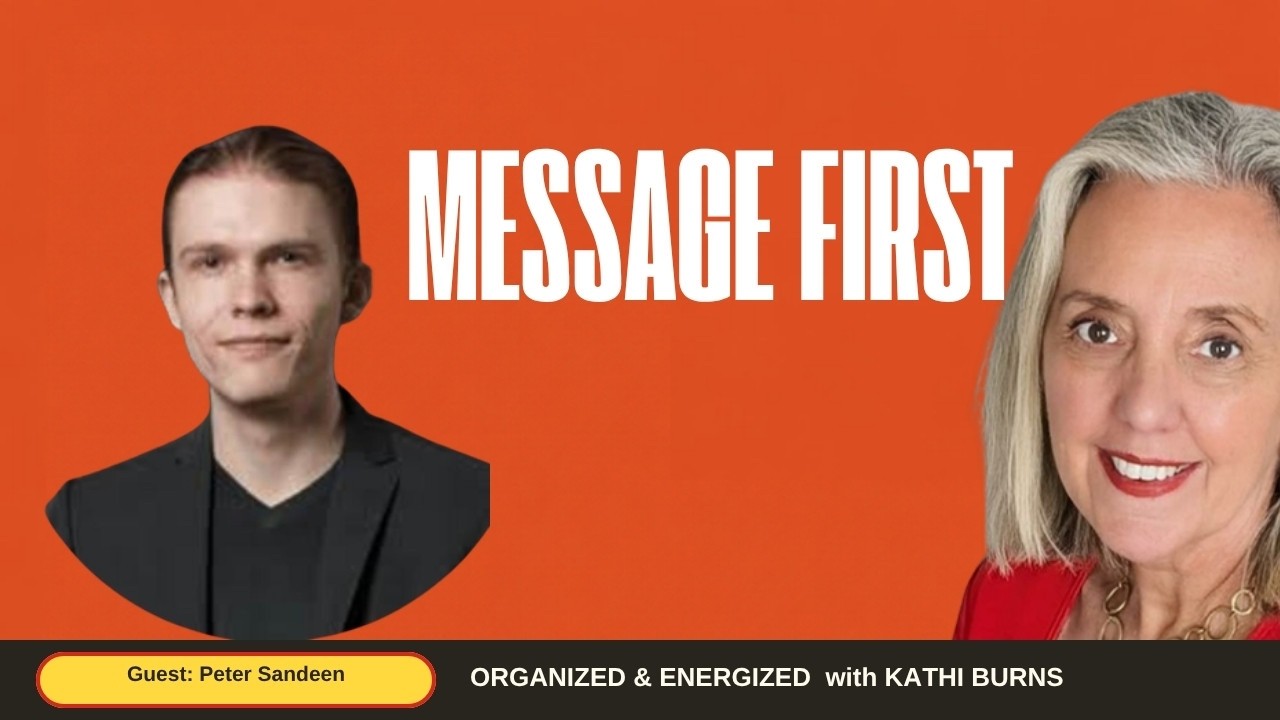
with Peter Sandeen, marketing messaging consultant, known as the marketers' marketer · April 19, 2023 · 36 min
Marketing messaging consultant Peter Sandeen starts with how target customers view what you offer, not with how you would pick them out of a crowd.
He says what actually motivates people to buy can be surprisingly different from what they claim, especially in B2B.
Peter's quickest test of a marketing message is whether you can make an ideal customer say "tell me more" within two or three seconds.
He tells most people who want a website redesign to change the content and the next step they offer instead, unless the design looks broken or contradicts what they stand for.
Peter's free video at 6figurewebsite.com walks through the steps for making a website work, from the message to what you offer.
Published · Updated
What is this episode about?
A website marketing message that works starts with what really motivates your customers, not with fonts and colors. Kathi Burns talks with Peter Sandeen, the marketers' marketer, about how to get more leads and sales from your website. Peter is Finnish, has worked in marketing full time since 2011. You'll hear the three steps he uses to find a client's message, his two-to-three-second test for whether a message works, how to get attention when what you sell is unique versus when the market is crowded, and why the next step you offer visitors has to match what makes you stand out. Peter also explains why he usually talks clients out of a redesign, how his business nearly lost all its income in 2020, and how he stays organized with one calendar, one Notion system and the habit of stopping what doesn't pay off.
Most differentiators are completely useless. They don't mean anything, or at least not enough for the target customer.Peter Sandeen
Jump to links and resources · Part of How do I get more clients? · All episodes · Every guest
What are the key takeaways?
- Peter Sandeen defines target customers by how they view what you offer, then looks at what actually motivates them to buy and what makes you stand out from the alternatives they compare you to.
- Overloading people with 20 benefits confuses them; Peter looks for the few most significant motivators.
- If you can't make an ideal customer's eyes widen and get a "tell me more" in two or three seconds, Peter says your message isn't there yet; advertising that the right people don't click is another sign.
- For something unique or hard to understand, Peter points to an outcome people don't expect but understand as soon as they hear it; in a competitive market, he points to a difference customers actually care about.
- The next step you offer, whether a free call, a PDF or a webinar, has to attract the people who value exactly what makes you stand out.
- Peter says design changes are worth making only if a site looks broken or contradicts what you stand for; otherwise, change the content.
- After his income nearly disappeared in 2020, Peter built a system for selling his coaching and launched an online course so he no longer relied only on referrals.

This episode is brought to you by the Business Logjam Session
A private 75-minute online session with Kathi Burns to find the one thing holding your business back and leave with your next steps. It is the same F.L.O.W. process Kathi uses with her own clients: Focus on your goals, Locate your logjams, Outline your solutions, Walk away knowing your next steps.
Find What's Holding Me BackInterested in sponsoring the show? Get in touch.How do you improve your marketing message?
Start with how your target customers view what you offer, then find what really motivates them to buy and what makes you stand out. Peter Sandeen says buyer personas usually describe how we'd pick people out of a crowd, which doesn't explain why they buy. He then compares you with the alternatives customers actually consider.
How can you tell if your marketing message works?
Give yourself two or three seconds with someone who should be an ideal customer: if their eyes don't widen and they don't say "tell me more," the message isn't ready. Peter Sandeen's second test is advertising. If the right people aren't clicking and moving forward, the message isn't good enough yet.
How do you get people's attention with your marketing?
It depends on whether what you sell is unique or competing in a crowded market. For a unique or hard-to-understand product, Peter points to an outcome people aren't expecting to be able to get, but one they understand as soon as they hear it. In a competitive market, he points to a difference customers actually care about, because most differentiators mean nothing to them. He adds that it's hard to see your own thing from the customer's side, which is why so many of his clients are marketing experts.
How do you get more leads from your website?
Say the right message plainly, then offer a next step that matches it. Peter calls putting the message on the site the easy part; saying the wrong thing in a fancy way can't fix results. The harder part is the next step: if your thing is being easy and practical, a free 500-page theoretical book attracts the wrong people. An approachable person might offer a weekly live Q&A, and the most experienced might showcase a case study.
Should you redesign your website or change your website marketing message?
Usually you should change the content, not the design. Peter Sandeen tells most people who ask about a redesign to change what the site says and the next step it offers. He fixes the design only if it looks broken or contradicts what the business stands for, such as a calm brand with a chaotic site.
How did Peter Sandeen rebuild his business after 2020?
He built his own marketing system instead of relying only on referrals. In early 2020, several client projects ended as planned, the new ones never started, and some long-term clients cut their marketing, so within about three months his income nearly disappeared. He asked colleagues for ideas, created a system for selling his coaching, and launched an online course he had planned for years.
What tools does Peter Sandeen use to stay organized?
Peter uses the basic Apple calendar for everything scheduled, and Notion for everything else. He likes the calendar's time zone support for his international clients, and he keeps contacts, to-dos, projects, products, marketing and even hobbies in one Notion system he set up with only what he needs. His unconventional answer is to stop doing things that don't pay off: he hadn't logged into social media in years except to run ads.
In what order should you build a website?
Message first, design last. Peter says to figure out the message, then what you ask people to do, then write the pages, and only then think about design if you really must. He suggests buying a ready-made design for 20 to 100 dollars and maybe changing a color; anything beyond that, admit it's a hobby rather than a business need.
Where does each part of the conversation start?
- 0:00 Meet Peter Sandeen
- 0:32 How he became a marketer
- 1:08 Why copywriting seemed like a magic trick
- 2:29 How to improve your marketing message
- 2:47 Start with how customers view you
- 3:31 What actually motivates people to buy
- 4:17 What makes you stand out
- 5:58 How to test your message
- 6:32 The three-second test
- 7:12 Use advertising as a test
- 8:34 How to get people's attention
- 9:11 Point to an unexpected outcome
- 10:04 Most differentiators don't matter
- 13:07 Putting your message on your website
- 14:39 Match your next step to your message
- 16:47 Ugly websites that convert
- 18:39 Change the content, not the design
- 20:35 When his business hit a downturn
- 23:28 Building his own marketing system
- 25:35 His organizing tools
- 27:42 Stop doing what doesn't pay off
- 29:13 Message first, design last
- 32:26 His free website video
- 33:58 Wrap-up
What resources were mentioned?
These episodes continue the same thread as this one: Sue Kirchner, Yvonne McCoy, Louise McDonnell, Allan Ngo also answer the question "How do I get more clients?", and the rest are the most recent conversations on the show.


 Social MediaEpisode 144
How To Use Social Media More Strategically In 2026 To Find New Customers with Louise McDonnell
See every episode on the podcast archive or filter by topic on the How do I get more clients? hub.
How can I support the show?
- Subscribe on Apple Podcasts, Spotify or YouTube, or add the RSS feed to any app.
- Rate and review. A rating on Apple Podcasts helps new listeners find the show, and Kathi reads every review.
- Share the episode with one business owner who needs it; the share buttons are at the top of the page.
- Grab a free eBook: 6 Steps to Organize & Energize Your Home, 6 Steps to Organize Your Home Office or 6 Steps to Organize & Energize Your Life.
- Work with Kathi. The Business Logjam Session is a private 75-minute session to find what is holding your business back.
- Be a guest. Apply here if you have a story about clearing the obstacles in your business.
What did they say, word for word?
The transcript below is edited for readability: filler words and false starts are removed and speaker names are added. Nothing was added or summarized.
Read the full transcript +
Kathi: Hi, everyone. I'm back and I'm with Peter Sandeen, and we're going to talk about marketing, messaging, all the stuff that we need to know as entrepreneurs. So welcome to the show, Peter. I'm so happy that you're here.
Peter: Thanks for having me.
Kathi: Yeah, absolutely. So you are the marketer's marketer. You have a lot of clients that already know about marketing, and you teach them how to go further down the road. What I'd like to start out with is for people to learn a little bit more about you and your background and how you became this marketing wizard.
Peter: Basically it started with me starting two different businesses and getting bored with both as soon as I figured out the marketing. That's really it. And after the second one, my wife pointed out that you only talk about marketing. Why don't you do marketing? So that's how it came about.
Kathi: Oh, that's very interesting. So you got bored. And what was your big aha moment about marketing?
Peter: I think the big change was two things. One was when she pointed out that that's really all I talk about anyway, so I should be doing that. But I think the second one was when I found copywriting specifically. I'm Finnish, and I had never lived in the States. I had never lived in a country that has a ton of spam mail. I mean, it is a thing here, but it's not at all the same thing. You get pizza places sending you a menu, that sort of thing. We don't get properly copywritten sales letters. And I heard of this concept that someone can send a direct mail message to someone and that person buys a $2,000 thing. This seemed like a magic trick to me. It completely seemed like a magic trick, and I needed to know how it works. So I got into copywriting, and I think within marketing that was the big thing that happened to me. That was very early on, fortunately. So I didn't spend too much time before I figured out that copywriting was the thing I wanted to understand first.
Kathi: Oh, I love that. And I think that's good that you followed your, of course wives are always brilliant, but if you do what you talk about and what you're passionate about. I feel for everyone listening out there that if you have something that you keep talking about and that you're really passionate about, that's really what you should be doing. So I love that you followed that instinct. So let's talk a little bit about how we can improve our marketing message. That's the big deal, right? To make sure that we are drawing and attracting the people to us that we want to have as clients. So how do you begin with clients when you are working with them?
Peter: So how I start is I look at the target customer. And I assume that many people who are listening have already done a lot of that. But there's a typical issue, and that is that most target customer exercises and buyer personas and all these are really about how we would pick these people out of a crowd. So we're describing what makes them stand out to us, and that doesn't affect why they buy from us. Instead, how they view us is what makes a difference to their thinking. So instead of defining it based on how we would describe them, which is necessary when you're buying advertising space and such, I start by defining how they view what we're offering. So that's where I start. Then there are basically two more key steps. One is looking at what actually motivates them to buy, and it can be surprisingly different from what they claim to be the case. Especially in B2B, it is very common that if you're talking to a middle manager or something, they are saying that the reason why we're buying is that it maximizes our profits and such. It might be, but it might just as well be that they think they're going to look good if they buy this thing. So what we're looking for is really what motivates people and what are the most significant motivators, because if you are trying to overload people with 20 benefits, it is overloading. It's just confusing. It doesn't create this sense of, oh, this is exactly what I want. Rather, it sounds like, that's cool. And then the third part is understanding what makes you stand out. And there are essentially two things there. First, you need to understand what you're compared to. What do people actually compare you to? And it's not just your competitors, but also how do your target customers see those alternatives? And only then can you start looking at what would make them see you as the best choice for them. And that's essentially how I work. Obviously, I also then put it all together into something that's really easy to use, but that's the process.
Kathi: It's so funny. I come from a sales background, and marketing to me was pretty different than sales. One thing that I knew in sales is that whatever their objection was, it really wasn't the objection. And I think in marketing, it's the same way. Why they say they're going to buy is not really why they're going to buy. I think there has to be that attraction magnet between you, because there's a zillion people selling the same widget out there. Why would they buy the widget from you?
Peter: Yeah. And even if you sell something that is entirely unique, as long as you're solving a worthwhile problem or helping people with some meaningful goal, they almost certainly have other ways to go about solving it or getting it. It might not be nearly as good as your thing, but it's not usually the case that people are just sitting at home thinking there is nothing in the world that could possibly help me with this. That is very, very rarely the case. So even if you sell something entirely unique, you are certainly still competing against lots of other things, just not direct competitors.
Kathi: Yeah. Do you have any practices that you would recommend for the people out there? Say they think that they have their messaging down. What would they do to see what's working? Are there soft checks or little marketing things they can do to figure it out before they really pop it onto the website? We're going to talk about the website here in a minute.
Peter: Well, yes and no. There are, but they're not the most simplistic things. Something you can do is, if you're talking to someone who should be an ideal customer, give yourself two or maximum three seconds to say something that should make their eyes widen and have them say, oh, tell me more. If you can't do that, then you don't have your messaging down. You're not really there yet. Because that's really what you're trying to create. You're trying to create something where people have that instant sense of, oh, why haven't I found this before? Or at least, if this is what it seems like, then why haven't I found this before? Obviously no one's going to say, oh, I want to buy this, in two seconds. That's not going to happen. But you should be able to create that sense of hope: this is how good this sounds. And another way to do it is to try advertising. If you're not getting the attention of the right people, if they're not clicking, if they're not moving forward, then your messaging isn't good enough. It can be okay, but there's a big difference between getting it to the point where it's passable, as in if you talk with someone for half an hour, they might say, oh yeah, that sounds cool. But that doesn't really work in marketing, because you very, very rarely get people to listen to you for more than five seconds, unless you create that instant sense of, oh, this looks really cool. So it's not a perfect test, but that's pretty much the test there is.
If you can't do that, then you don't have your messaging down.
Kathi: Yeah. And I know you can go down the advertising hole very quickly. I love the idea of finding who you feel is your ideal market and then seeing if their eyes light up, or looking for that magic phrase: tell me more. Tell me more. What are you talking about?
Peter: Yeah. Another one is, how do you do that? Any similar question is fine, but basically you should get that instant reaction of, oh, cool, you need to tell me more.
Kathi: Love it. Love it. How would you do that? Okay. So now you've engaged them. What do you feel as far as engagement goes? What's the easiest way you feel to draw people into your marketing spiel and to get their engagement?
Peter: There are basically two different situations. If you sell something that is difficult to understand, typically if you have, let's say, software or some unique service that solves a problem that people sort of know but don't necessarily value too much or don't understand the significance of, it's a different situation than if you're in a highly competitive industry. So if it is unique, then the typical solution is to point out some outcome that they're not even expecting to be able to get. I'm not saying always, but typically that's the easiest way to get them to instantly have that sense of, cool, tell me more. But it needs to be something they understand as soon as you say it. So it can't be that you say, hey, you can get this amazing thing, and they're like, is that amazing? I don't know. They do need to have that instant understanding of how valuable it would be. It has to be desirable even if they aren't actively seeking it.
Kathi: Yeah. I love. Oh, sorry. Go on.
Peter: Now, if it is a competitive situation, so they are potentially using a competitor or they have at least tried other options, then typically, again, not always, but typically the best option is to point out something that makes you different in a way they actually care about. Most differentiators are completely useless. They don't mean anything, or at least not enough for the target customer. So don't build marketing around them. You need to find a differentiator that makes them go, oh, that could work, even though I think the other things don't work. So I'm generalizing a lot, but those are the two most common situations.
Most differentiators are completely useless. They don't mean anything, or at least not enough for the target customer.
Kathi: Yeah. And I like the fact that, you know, everybody's like, features and benefits, features and benefits. And I think thinking of outcome instead of benefit is more important, because it's okay, I can get this here, I can get this here, but oh, this outcome, this is the outcome that you're picturing for me, or you're drawing this outcome. I can see it in my life. I think it lands a lot more solidly when we're thinking about that kind of thing. And then the differentiator, obviously, if you're in a highly competitive market: what makes it unique? Yeah, I love that.
Peter: But specifically in a way they understand and care about, because it is rare for people to see their own thing clearly enough to be able to articulate what makes them different in a way that other people care about. Because you, as the person building your own software or building your own product or planning your service and delivering it, whatever it is you do, you can appreciate the hours or hundreds of hours you've put into doing something that makes it so much better than anything else. And you might be right. I'm not arguing about whether you're right or not. The customer is not always right. Their feelings are valid, but that's different. They do not typically understand what you do nearly as well as you do. Even if they're expert buyers, they probably still don't understand your exact thing nearly as well as you. If that's the case, then you probably haven't been doing it for very long. It is just not the case. So it's often hard to see what it is for your own thing.
Kathi: Yeah, that's why you have a job.
Peter: That's why I have a job, and that's especially why I have so many marketing experts as clients, because they can do it for others. Not necessarily their expertise specifically, but they can help others. It's really hard to do your own thing and see it from the perspective of the potential customer.
Kathi: Isn't that the truth? I had one of my clients tell me the other day, I sign off Kathi Burns, CPO, and she's like, I googled CPO and there are so many things a CPO could be. You should spell out that it's certified professional organizer, because I didn't know what that meant. You're an organizing wizard, and you're discounting yourself. I'm like, oh, because I was trained, I put CPO with a little registration mark, and I'm good to go. And people are like, I don't even know what that is. So we get so close to our stuff that we don't even know. We don't know what they don't know. And we don't know what we don't know because we don't know what they don't know.
Peter: That's profound.
Kathi: That's pretty funny. Okay. So we have our marketing message down. We've now differentiated ourselves, and we've actually described an outcome that everybody would want, right? So when we get ready to pop it onto our website, let's talk about that a little bit. The actual marketing of our message on our website, because I think that's where a lot of entrepreneurs and small business owners fall short, for sure. I see it all the time. So what's next, Peter? Talk to us.
Peter: So this might not be what you expect, but I'd argue this is the very easy part. You can just say it, in most cases. If you actually know what you need to say, then just tell it. It might be that you do it with words, you might do it with a video, you might do it with images, but just communicate. It doesn't matter how. It does matter, but it's a marginal difference. If you're talking about the right thing, then you can be most poetic or very inarticulate, and it makes a difference, but not that big of a difference. But if you're talking about the wrong thing, then you're just trying to compensate for talking about the wrong thing by saying it in a fancy way. And yes, you can sort of improve results with better copywriting, even if you're talking about the wrong thing. But it's like you're trying to amplify nonexistent results. It doesn't really work. So as far as actually putting it on the website, that's the easy part. Once you have the right message, the next thing really is understanding what you need to ask people to do. So what do you offer as the next step? That's the next, harder thing to do, because it has to match with what your message is. So, a very coarse example. Let's say my thing is that I make things very easy and practical. What if I offered you a free 500-page, very theoretical book about something? Are you going to think that I must be really easy and practical? No. I'm also not going to attract people who want my easy, practical approach. I'm going to attract people who want the most analytical approach in the world. So the next step, whatever it is, whether it's a free call or a newsletter sign-up or a PDF or a webinar or whatever it is, has to be attractive for the people who are going to value exactly what makes you stand out. I think finding that match is the part where people often fall short. And again, it's really hard to see for yourself, but when you have the messaging down, then at least you have a chance. I'm not going to say it's easy and clear, but it's not that tricky when you know what makes you stand out. You just ask, okay, if my thing is that I'm really approachable, what could I offer that makes people see that I'm approachable? Maybe it's a weekly live session where people can pop in and just ask questions. If my thing is that I'm super analytical, then okay, maybe I do write the 500-page analysis on something. If I'm the most experienced, then maybe I showcase that with an amazing case study. Just think: what shows that? What will attract people who will appreciate what it is that makes me stand out? And again, when you have that, you just put it on your website. You don't need to worry about, do I have the best picture? Do I have the right font? That's relatively meaningless compared to having the right thing there.
If you're talking about the wrong thing, then you're just trying to compensate for talking about the wrong thing by saying it in a fancy way.
Kathi: It's so funny, coming from a design background. I had a design agency, and we were so focused on beauty, and then we would look at other websites that were converting like mad, and they were dog ugly. And it was very sad, because I love beauty and balance and all that, and I don't think it really matters, sadly.
Peter: Yeah. I mean, I enjoy beauty a lot. I'm not a good designer. I outsource that stuff. But I enjoy it a lot. It really doesn't make much of a difference, though. And especially, it cannot compensate for the wrong messaging. If you're saying the wrong things, people will leave. No one's going to look at the site and say, oh, this doesn't look interesting at all, but boy, is it beautiful, I want to buy something. No, that's not how it works. And that's also, I think, a large problem with a lot of website development agencies. They are primarily made up of designers and developers. So they're very good at making it pretty and making it fast. They're not usually messaging experts. They're not usually marketing experts as a whole. So it's quite interesting.
Kathi: Yeah, that was a big aha moment a couple of decades ago. It's so sad, they don't care about you. So for everybody listening out there, just focus on the message before you even go into the whole thing of fonts and colors and branding and all that. It really doesn't matter, is what Peter's saying here. Let's listen to that. I think that's so very true, because we get caught up in that. We get caught up in, what are my colors? What's my brand? What's my logo going to look like? And as you pointed out, a lot of terribly ugly websites convert very, very well.
Peter: So the way that I look at it: if a potential client contacts me and says, hey, I'm thinking of doing something about my website, I'm thinking of redesigning it, I usually immediately say in the email, you probably shouldn't be thinking of redesigning it, but rather changing the contents. But I'm happy to take a look. I'll give you actual feedback on what needs to change and what doesn't. And most of the time I'm going to say you don't need to touch the design, just change the content. I'm happy to sell you the design, but that's not what you need. I'd make more money with that, but I try to keep it as a small profit, because I don't want to motivate myself into it, because that's not usually what you need. However, if it looks broken or if it looks contradictory to what you're about, then you need to fix it. So if you are, I don't know, all about design, then yes, it needs to look reasonably well designed. If you're all about calmness and such, and it's just a mess of a website where the only feeling is anxiety, I don't know what to click, there's a million links, then yes, that's a problem. But if it isn't broken, if it isn't contradictory, then there's very little to be gained from it. You need to be getting very good results before the multiplication of those results is going to be significant. Until that point, just focus on what you're actually asking people to do and what you're saying to them.
You probably shouldn't be thinking of redesigning it, but rather changing the contents.
Kathi: Yeah, I love that. And we fall into that trap. I'm for simple systems, right? Simple systems for success. Eliminate the muck that makes you stuck and all that. And then at one point I was giving out a giant book. Why would I want someone to consume an entire book? My book, because it's my book. It's not even about that. So I think we all get stuck in that. I think that's really good. I love the way that you gave the ideas and examples of, if you're simple, you're going to do this. If you're that, you're going to do that. I think this is very handy for everyone to know. So talk to me about a time in your business. When did you launch your business, and tell me about a time that you went through a little bit of a downside, and what happened with you?
Peter: I got into this full time in 2011, I think. I think the first major downturn was actually corona, when it started. I had this perfect storm of multiple client projects that had been agreed on ending around February, March, April of 2020. And I had already agreed on several new projects that were going to start in March, April, May. All those projects ended as agreed. None of the new ones started. All of those people just freaked out about the epidemic, which I understand. In those cases it was unreasonable given the businesses, but I understand that that happened. Also, some of my long-term clients freaked out entirely, even though it had nothing to do with their business, and they decided to cut off marketing, which is usually a bad idea when there's a downturn. Usually that's actually not the thing you should cut down on. There are other things. Obviously I might be a little biased there, but typically businesses that cut down on marketing in downturns do much worse than those who don't. Everything went wrong. In about three months I went from making pretty good money to making very, very little money, because I had always been in a situation where I had very stable clients. I had only a few at a time. I like the fact that I don't have that much work. I can spend the time with my wife or doing other things. So suddenly I had almost nothing, almost no income. So I think that was the worst. And what it took for me to get out of it was really starting to actually work on getting more clients. I had never built a system for myself that I could suddenly fire up, because it had been very regular referrals, very long-term clients. Almost everyone who hired me wanted to stay with me for at least one and a half years, often more. So it was super stable. I had never needed to do what I did for my clients in my own business.
Kathi: Yeah. Welcome to the real world, right?
Peter: Yeah. Yeah.
Kathi: So then you went ahead and did your own marketing for yourself. Did you call upon other experts or outside observers to help you with this, or did you go it alone? We usually can't see our muck for ourselves.
Peter: Both, in a way. I did ask some colleagues for ideas and all that. But then I basically did two things. I created a system for selling my coaching, which has been my primary thing all along, and I also created an online course. I had been planning it for years, and then it was like, okay, maybe now would be a good time to actually do it. So I spent, I don't know how long, some months really just making sure it's good, launched it, and that changed my business to some degree. Previously, I had very rarely had people promote me directly, as in, hey, go check out this thing. It was much more, oh, I'm talking with one person, and hey, you should talk with Peter, you have the problem he solves.
Kathi: Right.
Peter: Basically, I changed my business and wanted more stability in it. So instead of just relying on the coaching, just relying on client projects, I started to also have online courses. And that was essentially the solution: make sure that I actually have systems in place for my own marketing instead of just relying on referrals, which has been great. For close to ten years I had been just coasting along with referrals, and that was great. Nothing wrong with it. But the problem was that when suddenly things went so much worse in the world, I couldn't rely on it anymore.
Kathi: Yeah, we all had a wake-up call, and we all had to shift a little bit. The pivot was the word of 2020. Let's pivot. So I love that we all have to shift and move, and I think the world is going to take advantage anyhow. Now you have an online course, and that makes you more accessible to more people that couldn't have used your expertise to begin with. So I think overall this whole experience has been good for all of us. We've all expanded, and now we have more things we can offer to the broader mass. And I think that's super important, because we all need marketing.
Peter: Yes, we do.
Kathi: Yeah. So let's see. Oh, speaking of systems, tell me about your favorite organizing system. What do you do that keeps you the most organized as you work throughout your business?
Peter: Well, I have a conventional answer and then I have an unconventional answer. The conventional answer is I use the basic calendar that Mac comes with. The basic Apple calendar. It's brilliant simplicity. I have everything I need to do there. Not a to-do list, but all the promotional stuff, all the meetings, everything is there. And especially since it's a very international business, I like that it has time zone support. So I can schedule things in a client's time zone, and I don't need to worry about daylight saving time and such. So that's one thing that really helps. People often struggle with calendaring stuff, so just use the simplest possible tool.
Kathi: Yeah, truly.
Peter: That's the lesson in everything. I've tried to simplify down from having multiple tools to having just one. For example, I use Notion for keeping track of everyone I talk with, all my to-dos, all my projects, all my products, all my marketing, all my interests, hobbies included. Everything is in one system, and it's super simple.
Kathi: Oh, I'm not familiar with Notion. Is that an online app? That's something I haven't heard of yet.
Peter: Yeah, and it's free. It's paid only if you use the team version, if multiple people have access to things. It's not the easiest to get started with, so calling it simple is a little iffy, I think. But once you get it working, it can be very good.
Kathi: Oh, that's interesting.
Peter: Basically, why I like it is that it only has the things I need, because I decided exactly what I need and I only put those things in. So it's as simple as it possibly can be.
Kathi: Right. Right.
Peter: But then, in the same way, the unconventional answer is that I'm very ruthless about stopping doing things that don't make sense for me to do. I haven't logged into Facebook, Twitter, Instagram or any other similar site in years, other than to do advertising. It hasn't been worthwhile for me to use social media as a marketing tool. That has changed very recently, in the last couple of weeks. I've started to think that I might do it, because I now have an assistant who can help with actually publishing things and all that. But it has not been something that would create the best return on my time investment. So I have simply not touched it.
Kathi: Good for you.
Peter: I think a lot of people are not willing to do that. They think that they need to do a lot of different things to be able to get results, and that's usually not the case. You only need a few things that actually work together.
Kathi: Yeah. Go deep instead of wide. And it's less stressful anyhow.
Peter: For sure. Much less stressful.
Kathi: So is there something that we have not talked about that you'd like to have a chat around?
Peter: I don't know. I assumed you might ask this question of what should I have asked that you didn't, and I don't really know. I think this was pretty good. If there's something I want to say about websites: people really get stuck in the weeds. First figure out the message, then figure out what you ask people to do, then just write the pages, and if you really must, then think about the design. Usually you don't need to, but if you really have to, then do it at the end, only when you're actually putting the content in there.
Kathi: Yeah. Don't pretty it up first.
Peter: No. Spend 20 bucks or 100 bucks on a ready design, and then maybe change a color. It's usually pretty easy in the ready designs. They just give you, well, select a color here. Okay, do that. That's acceptable. But if you do any more than that, then see it as a hobby. Don't see it as a necessity for your business. Admit to yourself that you just have fun tweaking the design. And that's fine. Nothing wrong with having fun with it, but don't think that it's necessary.
Kathi: Yeah, that's really good advice. I find myself doing that whenever I put together keynote presentations. I'll have so much fun just making them exactly how I want them, instead of focusing on the messaging. It's called busy-ness, is what I consider it. We're not getting down to business. We're being busy with the fun stuff. I love to do design. I love to change my little slides and all that. But does it really make an impact? Probably not, because sometimes uglier and just a word is better.
Peter: Yeah. And at least if you're trying to maximize your time, if you don't have extra free time, like most people don't, then I think it is worthwhile to just recognize when you're doing something for the fun of it and when it is genuinely going to be useful, an efficient use of time. And it's tricky. I'm not saying it's easy to keep track of that for yourself, but it's pretty useful, especially in a business.
Kathi: Yeah. Monitor yourself and say, don't go there.
Peter: Yeah. With a lot of coaching clients, I end up telling them to stop doing seven different things they spend time on every week. That's not worth your time. That's not worth your time. Stop doing that. If you want to do those, then do them on your own time. Don't say that you're busy with work if you're doing those. It's much more common that I tell people to stop doing things than, hey, you need to do more things. That's not usually the case.
It's much more common that I tell people to stop doing things than, hey, you need to do more things.
Kathi: Yeah. I agree. You can get so much more done with fewer distractions. I'm not on Facebook Messenger. I just have challenges around it, and I really don't want to go there. I just have someone post on Facebook. So there's so much going on with social media right now. And I always say, choose your weapon. Choose it wisely. You don't have to be on everything, for sure. So I like your advice, Peter. And I don't go on it either. I have someone that posts my social for me. Although now I'm starting to do more Facebook Lives, but it's very time consuming all the way around, and you have to watch where you're putting your energies.
Peter: For sure.
Kathi: Okay. So this leads us to: do you have anything to offer the listeners that they might be able to benefit from? Something to let them get to know you a little bit more and learn more of the knowledge that you have in marketing, because you have so much to provide information-wise. You're such an expert. So what would you like to offer people, Peter?
Peter: So if someone's interested in actually taking a look at their own website and making sure that it's working well, I made a video where I basically go through what steps you actually need to go through. It is essentially the messaging, what you need to offer and so on, but with a bit more detail on how you actually do it, what the key things are that you need to get right, and what typical issues people run into. So if that sounds interesting, I set it up at 6figurewebsite.com. So it is the number six, figure, website dot com.
Kathi: Love it. Love it. I'm going to use that. I'm going to go in right now and see what you have to say about my site. I think everybody out there should do it, and I'll put the link in the show notes so that you guys can grab onto it. But it is 6figurewebsite.com, with the six, right? So definitely check the link, check it out. Bare minimum, just see what an expert has to say about your site, because I'm sure that you haven't had this opportunity before to get this information on a free basis. So thank you, Peter. That's really, really generous. I appreciate that.
Peter: Yeah, no problem.

Kathi: Well, it's been a pleasure. Thank you for being on. I know you had a little bit of a sore throat. I appreciate you showing up full tilt boogie. And until next week, gang, we will see you back, same time, same bat channel. And thank you. Thanks again, Peter. I really appreciate it. The marketer's marketer. Thank you.
Peter: Thanks. Bye.
Kathi: Bye.
Where can I find the links and resources from this episode?
Connect with Peter
Organizations and companies
Inspired? Here Are Your Action Steps:
- Describe your target customers by how they view what you offer, not by how you'd pick them out of a crowd.
- Find the few things that really motivate customers to buy, and drop the long list of benefits.
- List the alternatives your customers actually compare you to, including ones that aren't direct competitors.
- Test your message on an ideal customer: say it in two or three seconds and watch for "tell me more."
- Check whether the right people click and move forward on your ads; if not, rework the message.
- Make sure the next step on your website, such as a call, PDF or webinar, matches what makes you stand out.
- Before paying for a redesign, change your website's content and only fix design that looks broken or contradicts your message.
- Put all your appointments in one calendar and keep your projects and contacts in one system.
- Stop doing at least one weekly task that doesn't pay off for your business.
Frequently asked questions
Where does Peter start when he works on a client's message?
+
With the target customer, but not the usual way. Most buyer personas describe how we'd pick people out of a crowd. Peter starts with how customers view what you offer, then what actually motivates them to buy, which can differ from what they say, then what makes you stand out from the alternatives they compare you to.
How can you tell if your marketing message works?
+
Give yourself two or three seconds with someone who should be an ideal customer. If what you say doesn't make their eyes widen and get a "tell me more," your message isn't there yet. Peter's other test is advertising: if the right people aren't clicking and moving forward, the message isn't strong enough.
How do you get people's attention?
+
It depends on your market. If what you sell is unique or hard to understand, point to an outcome people don't expect to be able to get but understand as soon as they hear it. If you're in a competitive market, point to a difference they actually care about. Peter says most differentiators mean nothing to customers.
Should you redesign your website to get more sales?
+
Usually not. Peter says once you know the right message, putting it on the site is the easy part, and some ugly websites convert very well. Fix the design only if it looks broken or contradicts what you stand for. Otherwise, change the content and the next step you ask visitors to take.
What happened to Peter's business in 2020?
+
Several client projects ended as planned in early 2020, the new ones that were meant to start never did, and some long-term clients cut their marketing. Within about three months his income nearly disappeared. He built a system for selling his coaching and launched an online course so he no longer relied only on referrals.
Who is talking in this episode?

About the Host, Kathi Burns
Kathi Burns, CPO®, is a Business FLOW Strategist based in San Diego. For the last 20+ years, Kathi has helped clients create systems they can stick to. She is the author of How to Master Your Muck, Organizing With Tetris and Home Organization, The Smart Guide, and co-author of four more titles; all are in Kathi's shop. Kathi's business has been featured on Good Morning America, and her advice has been featured in Oprah Magazine, Martha Stewart Living, Better Homes and Gardens and Entrepreneur Magazine.
More about Kathi · Shop Kathi's books · Business Logjam Session · Apply to be a guest

About Peter Sandeen
Peter Sandeen is a marketing messaging consultant who is often called the marketers' marketer, because more than half of his clients are marketing experts themselves. He is Finnish. Peter started two businesses and got bored with each as soon as he figured out the marketing, until his wife pointed out that marketing was all he talked about. He has worked in marketing full time since 2011, starting with sales pages for marketing companies before specializing in messaging. His clients include business SaaS companies, high-tech manufacturers, consultancies and coaches. His approach is built on a decade of conversion optimization: finding what improves a website's results most consistently.
Want help putting this into practice?
Book a Business Logjam Session with Kathi
A private 75-minute online session to find the one thing holding your business back and leave with your next steps, using the same F.L.O.W. process Kathi uses with her own clients: Focus on your goals, Locate your logjams, Outline your solutions, Walk away knowing your next steps.
Prefer to start small? Download Kathi's free eBook 6 Steps to Organize Your Home Office.
Published · Updated
This episode page is for general information. Guests speak for themselves, and their opinions, statistics and examples are their own. Nothing here is legal, financial, medical or mental-health advice; talk to a qualified professional about your own situation. Some links go to the guest's own products or free offers; addSpace does not earn a commission from them unless stated.