


Episode 21
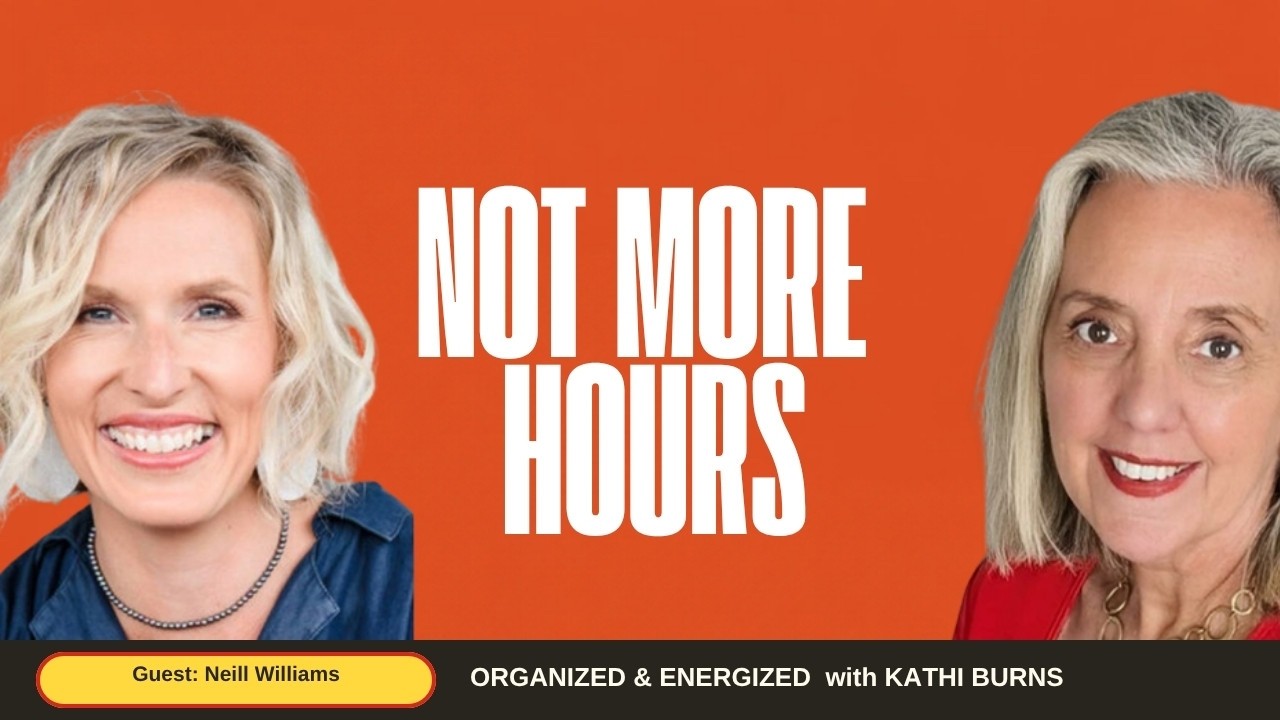
with Neill Williams, master certified productivity and performance coach and former actuary · March 27, 2022 · 16 min
Neill Williams was an actuary managing a big team and working 60 to 80 hour weeks when she decided that nobody cares how many hours something takes, only that it gets done.
She scaled her corporate job back to about 30 hours a week, then built a coaching business on the side in about 10 hours a week until it earned more than her corporate income.
Neill splits a schedule into two buckets: time in the employee hat doing the tasks, and time in the CEO hat solving problems, setting goals and selling.
Her favorite habit is taking time off the table as a solution: when a problem comes up, ask how you would solve it if working more were not an option.
Neill offers a free 30-day planner with a weekly 10-hour schedule and to-do list for building a coaching business.
Published · Updated
What is this episode about?
Kathi Burns, CPO®, Business FLOW Strategist, talks with Neill Williams, a productivity and performance coach who built a part-time coaching business in about 10 hours a week while still working as an actuary. Neill had been managing a large team and working 60 to 80 hour weeks. Everyone told her that going part-time meant earning less, so she worked out how to get the same results in less time and cut her job to about 30 hours a week. You'll hear how she uses scheduling to get full-time results on a part-time schedule, why creative work needs open blocks while checklist work can run back to back, how to tell when you are spending too much time doing and not enough time running the business, and why she takes more time off the table as the answer to a problem.
Nobody cares how long I spent on something. What matters to them is that it's done.Neill Williams
Jump to links and resources · Part of How do I grow my business without burning out? · All episodes · Every guest
What are the key takeaways?
- Neill Williams says nobody cares how long you spent on something; what matters is the result and the value created inside the time.
- She scaled her actuary job back to about 30 hours a week without accepting less pay, then built her coaching business in about 10 hours a week until it out-earned her corporate income.
- Neill uses scheduling as the tool to get full-time results on a part-time schedule, giving creative work open, spacious blocks and checklist work tighter blocks that can run back to back.
- Her litmus test for burnout is noticing that more and more of her time is going to doing, which leaves no time to work on the business.
- When a problem comes up, she pauses and asks how she would solve it if more time were not an option, instead of defaulting to working tonight or this weekend.
- Business coaches and mentors told her she had to quit her job to succeed; her answer was finding the right ratio of coaching time to sales, marketing and offer-building time.
- Her advice for new business owners is to list what you do as the employee and as the CEO and decide what share of your week each deserves, knowing the ratio will change as the business grows.

This episode is brought to you by the Business Logjam Session
A private 75-minute online session with Kathi Burns to find the one thing holding your business back and leave with your next steps. It is the same F.L.O.W. process Kathi uses with her own clients: Focus on your goals, Locate your logjams, Outline your solutions, Walk away knowing your next steps.
Find What's Holding Me BackInterested in sponsoring the show? Get in touch.Can you cut your work hours without cutting your pay?
Neill Williams did: she scaled her corporate actuary job back to about 30 hours a week while keeping her income. She had been managing a big team and working 60 to 80 hour weeks, and everyone told her part-time would mean less money. She refused that option and realized nobody cares how long something takes, only that it gets done, so she set out to do the same work in less time and taught her team to do the same.
How do you build a part-time coaching business?
Neill Williams built her part-time coaching business in about 10 hours a week while still working her corporate job. Cutting that job to about 30 hours gave her the space to start a business on the side. She grew it until it earned more than her corporate income, worked both for about two years, then left her job.
How do you get full-time results on a part-time schedule?
Neill says scheduling is the tool that makes it possible, and it is at the core of what she teaches. Many of her clients already run big businesses with inflated schedules of 40 or 50 hours a week. She helps them scale back to 30 hours or less, whatever their number is, by planning what gets done in the hours they want to work.
Does a schedule kill creativity?
No, a schedule doesn't have to kill creativity; Neill says its job is getting what you want done in the hours you want to work. Creative work gets open, spacious blocks of time. Checklist work, like ticking boxes and organizing, gets tighter blocks that can run back to back.
How do you know if you're working in your business instead of on it?
Neill's litmus test is noticing that more and more of her time is going to doing. She thinks of two hats in every schedule: the employee hat for tasks and projects, and the CEO hat for solving problems, creating vision and setting goals. When the doing crowds out the thinking, the business suffers and she feels overwhelmed and burnt out, so she notices it first and then pulls things back. Kathi adds that the idea is to delegate what you can so you can work on the big picture.
How do you stop working more hours to solve problems?
Take time off the table as a solution. When something comes up, Neill says most people decide to just work tonight, and soon they're working the whole weekend. Instead, pause and ask how you'd solve it if more time weren't an option. That pushes your creative brain to find a new way of doing it.
How do you split your time between doing the work and growing the business?
Find the right ratio between your employee time and your CEO time. With only about 10 hours a week, Neill had to decide how much to spend coaching clients and how much to spend creating and offering value, selling and marketing. Once that schedule clicked, her business made money and she could repeat it. Kathi links this to the 80/20 principle: asking which 20% of your work actually moves the business.
What is the best advice for new business owners?
Be discerning about your time and separate your employee role from your owner role. Neill suggests listing what you do as the employee and what you do as the CEO, then deciding what share of your week each deserves. The ratio depends on your business model and changes at three, five and ten years in. Kathi adds that anything below the CEO level is a candidate for delegating.
Where does each part of the conversation start?
- 0:00 Meet Neill Williams
- 0:31 From actuary to scheduling coach
- 1:54 A business built in 10 hours a week
- 3:29 Scaling back to 30 hours
- 4:17 Scheduling for creative work
- 5:53 When the schedule gets overloaded
- 6:42 The employee hat and the CEO hat
- 7:53 Take time off the table
- 9:33 Her biggest organizing obstacle
- 11:35 Know which role you're in
- 13:23 Delegate below the CEO level
- 15:28 Wrap-up
What resources were mentioned?
These episodes continue the same thread as this one: Lia Dunlap, Carly Church, Ginny Priem, Stephanie Wall Morrow also answer the question "How do I grow my business without burning out?", and the rest are the most recent conversations on the show.

 MotherhoodEpisode 147
How To Build a Village That Supports Your Business and Your Life with Carly Church


See every episode on the podcast archive or filter by topic on the How do I grow my business without burning out? hub.
How can I support the show?
- Subscribe on Apple Podcasts, Spotify or YouTube, or add the RSS feed to any app.
- Rate and review. A rating on Apple Podcasts helps new listeners find the show, and Kathi reads every review.
- Share the episode with one business owner who needs it; the share buttons are at the top of the page.
- Grab a free eBook: 6 Steps to Organize & Energize Your Home, 6 Steps to Organize Your Home Office or 6 Steps to Organize & Energize Your Life.
- Work with Kathi. The Business Logjam Session is a private 75-minute session to find what is holding your business back.
- Be a guest. Apply here if you have a story about clearing the obstacles in your business.
What did they say, word for word?
The transcript below is edited for readability: filler words and false starts are removed and speaker names are added. Nothing was added or summarized.
Read the full transcript +
Kathi: Hi everyone, I am back and I am with Neill Williams. Neill is a master life and scheduling coach helping busy, overwhelmed female entrepreneurs simplify their schedules to 20 to 30 hours a week for the rest of their careers. Don't we all want that? Yes, we do. Thanks, Neill, for being here. I can't wait to hear what you have to say.
Neill: Yeah. Thank you so much, Kathi, for letting me come on the show. I'm so excited to talk with you about this today.
Kathi: Okay. So, scheduling coach, I absolutely love that. What did you do prior to that? How did you come up with that career for yourself?
Neill: So I was in the corporate world. I was actually an actuary. If anyone knows what that is, great; if you don't, it's totally fine. It's a numbers job, and I was managing a big team and really struggling with the amount of time that that job and role was taking me. I was a mom, and I just got to the point where I didn't want to be working the 60 to 70, 80 hour work weeks anymore. But I wanted to still be making the money that I was making. And everyone was telling me, yeah, you could totally go part-time, but then you're not going to be able to make the money that you are. And I just refused to take that as an option. What I realized as I was going through this was that it's not the number of hours that anybody really cares about. Nobody cares how long I spent on something. What matters to them is that it's done: the accomplishment, the achievement, the value that's created inside the time. So I just set out on a journey to figure out how do I do the things I do more efficiently and get them done, but using less time to do them. And I was able to scale back my corporate job to about 30 hours per week throughout that. And so then I was teaching my team how to do those things as well. And then I decided to start my own business to teach other people how to do this.
Nobody cares how long I spent on something. What matters to them is that it's done.
Kathi: I was wondering that. So you didn't go cold turkey. You scaled back to halftime, and then you said you were teaching your team how to do it. Was it the team for your new business or your existing business?
Neill: So I was doing it as a manager in my corporate role. I was teaching them how to use their time and be efficient and all of that. And then because I had scaled back my work week so much, I had the space to be able to create a business on the side. And so I did that in about 10 hours per week, and I just built it to be much bigger than what I was receiving as my corporate income. So eventually I just decided to let that go.
Kathi: Good job. Congratulations on that. And how long have you been doing this now?
Neill: I've been in my own business about three years. So not all that long. And I really worked my corporate job for the first two at least, maybe a little bit more than that. So I haven't been out on my own as an entrepreneur full-time for all that long.
Kathi: Well, congratulations. And for those of you listeners who are out there who are thinking about making the leap, because I know we have the great resignation happening, it is possible, and Neill is proof of it right there, as well as myself and all the other guests that I have on my podcast. So we're all living images that yes, you can do it. You can quit your real job.
Neill: Yes.
Kathi: And create a fun real job for yourself where you're the boss.
Neill: That's right. Yes. And you don't have to have a lot of time to do it in, quite honestly. You can do it.
Kathi: Especially if you handle your schedule, which is what we'll talk about next. So how do you help your clients solve the time management, take control of your life schedule?
Neill: So many of my clients are already business owners who have big businesses, and their schedules are very big and inflated as well. So in that instance, I help them scale back their work week from the 40, 50, whatever it is, back to 30 hours or less, whatever their number is. And we do that through scheduling. I really believe scheduling is the tool that allows us to get a lot done, to create full-time results, but on a very part-time schedule. That is really at the core of what I teach. Of course there's a lot of techniques that go into that, but that is the idea.
Scheduling is the tool that allows us to create full-time results, but on a very part-time schedule.
Kathi: Now what do you do about the artistic, creative entrepreneurs, which we all have as clients? How do you get them to adhere to a schedule?
Neill: I think there's this connotation around a schedule that it's very restrictive and it's very time-blocky and back-to-back. And I don't believe that about scheduling. I believe the whole idea behind a schedule is getting what you want done in the amount of time that you want to work. And there's lots of ways to do this. We do want to honor the creative part of our brain, and so we want to give lots of space and time to that part of the brain when that's the part of the brain that we need functioning in order to accomplish the thing that we're doing. There's other times where we don't want to give as much space and time. That creative part of the brain is the right-hand side of the brain. The left-hand side of the brain is more of the check the boxes, take the things off, organize part of the brain. And for that one, having tighter time blocks and maybe scheduling things back to back is okay. It really depends on what it is that you're doing and what part of your brain you need to leverage in order to get the thing done. So a schedule sometimes looks very open and fluid, and sometimes it is more of that back-to-back.
The whole idea behind a schedule is getting what you want done in the amount of time that you want to work.
Kathi: I totally dig that. And it's good to think about what hat you're putting on. That's the way I say it. What hat are you wearing? Are you wearing the fireman's hat? Are you wearing the coach hat? What are you wearing? What part of the brain are you going to fire up? I love that. So this is an interesting question for me to ask you, because you're the time management queen here. When you get burned out or overwhelmed or you're just darn tired with your business, what do you do to recharge yourself?
Neill: I go away. Far away. I think really it's a matter of understanding. I've gone through this where it's kind of like a roller coaster. My schedule is beautiful and I love it and it feels so great and I feel so spacious and I feel so filled up. And then it's pretty easy to add too many things in, and then I'm like, oh, I notice that I'm feeling really resistant to it. I'm feeling overloaded a little bit. And then I have to start pulling things back. So I think it is an evolving thing, especially as businesses grow, because your schedule looks so different from one phase to the next. I like to think about what you talked about, hats, just a second ago. I talk about how in your schedule, you're going to have your employee hat and you're going to have your CEO entrepreneur hat. And we need time in both buckets inside your schedule. Sometimes you're doing the things. It's very task-oriented. It's very project-oriented. That's you being the employee. Other times you're solving problems, you're creating vision, you're creating goals, you're doing all the creative, high-level work, and we need space and time for that. So this is the litmus test for me, which might help your listeners: if I find myself spending more and more of my time doing, I know that I've lost the plot, because now I don't have the time and space to think about working on my business. And my business will probably suffer, and I will suffer energetically and feel overwhelmed and burnt out by that. So noticing it is number one, and then having the tools to be able to reverse it is number two.
If I find myself spending more and more of my time doing, I know that I've lost the plot.
Kathi: So are you in it or are you on it? Are you working inside of it? Because, yeah, we all have to work inside our business, but the idea is to delegate out the things that we can so that we can work on our business for the big picture. Absolutely. Okay. So what's your favorite hack for entrepreneurs who want to create more freedom and want to be able to do this and handle it and be all energized and organized within their business and have freedom?
Neill: My favorite idea here is going to be one your listeners probably haven't heard of. Instead of allowing time to be the solution to problems in your business or things coming up, take time as an option that's off the table. What I see so often is something comes up in someone's business and they're like, well, I'll just work more to solve it. And before automatically going to that, because that's the easy answer, that's always the answer that your mind is going to tell you is the only answer, just pause for a second and ask yourself: if I didn't use time as the solution here, what are some other ways that I could accomplish this? Just pausing long enough to ask yourself that question will stop you from defaulting to more time, where I'll just work on this tonight, and then it turns into I'll just work a couple hours this weekend, and then pretty soon you're working the entire weekend. It's just this snowball effect. So instead of letting time be the solution, come up with an innovation, come up with a new, creative way of doing this that you hadn't thought of before. That is where you create a business that's easy to run in a few hours per week: not relying on time for the solution, but coming up with the other solutions, where your creative brain actually has to go to work to find the solutions for you. So, not allowing time to be the answer.
Kathi: Oh, I absolutely love that. That's so smart. That's so smart. Love it. Okay. So if you had an organizing obstacle in your business, what is the obstacle that you had to really overcome within your own business?
Neill: I think it was my schedule and my time. Of course, I built my business very much on the side. And I had so many business coaches and mentors telling me that I had to quit my corporate job in order to be successful in this business. And I was like, that is just not the option for me right now, and I'm still going to create a successful business. So I really had to figure out, in the limited time that I had each week, which was about 10 hours per week, what is the thing that I'm doing in my time so that I'm moving my business forward? So it was really me figuring out the right ratios of time to be spent in my business as the employee, where I'm doing my coaching, versus being the CEO and the entrepreneur: creating the value, offering the value, doing the sales and the marketing. For me, it was figuring out the right organization of that schedule that then finally clicked, and then my business was making money and I understood it, and it was kind of like rinse and repeat. So that was really the biggest obstacle for me, and I think it is for a lot of people who are doing their business as a side hustle.
Kathi: Right. Absolutely. And even for people who are not doing it as a side hustle, it's knowing that 80/20 Pareto principle. What 20% of my stuff is going to actually do something? And I'm one who loves being busy. I'm a doer. I'm an action taker. So I think I need to use your advice to be more cerebral, more analytical, because I'm absolutely action, action, action. And I think as entrepreneurs, a lot of us are like that. I'm not alone, right?
Neill: You are not. I'm a doer too. I've just learned how to calm that down a little bit.
Kathi: More thought around what you're doing. Absolutely. So which leads us to the best pieces of advice. If you had to tell someone off the street, any of our listeners here, what piece of advice would you give them, people who want to launch into a new career or who have just started their career?
Neill: I would say be really discerning about your time and really look at it in those two buckets that I was talking about earlier. This is where I see the most overinflated schedules: they don't have these clearly delineated roles of your time being the employee versus your time being the business owner. When we start a business, we don't know what it means to be a business owner. We don't know exactly what it is we're supposed to do. And so we just don't even try and figure it out, because we don't give ourselves time and space to be that and figure it out. So be very clear with yourself, maybe even make a list: these are the things that I do as an employee, and this is my role and responsibility as the CEO and the business owner, and what proportion of my time makes sense to be doing both of those things. Depending on what your business model is, those ratios will vary. So it won't be the same for everybody. And it's not going to be the same when you start your business as when you're three years or five years or 10 years in. There's going to be an evolution that happens. But being clear with yourself on those different roles, I think, is the most important thing.
Kathi: And know what you're doing. I love that. Know: are you in it or are you on it? Oftentimes you just do, do, do. You're just doing it and not really realizing what part you're doing. And I'd like to put a feather in the cap of that: if you find yourself doing stuff that is below the CEO level, think about maybe delegating some of that stuff out, which I think everybody could use as well. So I love that. You're very insightful. I would love to be in your brain and see how you figure all this out as you're working.
Neill: I know. It's pretty scary in there.
Kathi: No, I love it. I love it. Okay. So, Neill, you probably have something for the listeners. What would you like to offer them?
Neill: So I have a 30-day planner to build a coaching business in 10 hours a week, which is completely free. You will get a weekly email from me with your to-do list and your weekly 10-hour schedule. And I take you through a couple of video trainings that teach you the ratio of your time: if your business model looks like this, you want the ratio of the time that you're working in your business versus on it to look like this, and here's how you might set up your schedule. I also give you to-do lists and how to accomplish those to-do lists inside of that schedule that I send you. So, totally free. I wish I would have had it when I was first starting out, just to have an idea, so I didn't have to make those decisions about what I should be doing. I've already made those decisions and created a schedule for you that will help you get those things done.
Kathi: Absolutely. And I know you also have a podcast.
Neill: I do have a podcast. Yes.
Kathi: Where should they go to find your podcast? And what's the name?
Neill: So the podcast and the 30-day planner are all available on my website at www.neillwilliams.com. Neill is N-E-I-L-L.

Kathi: Excellent. Excellent. Everybody tune into that as well. That's a really generous gift that you're offering, and I hope that everybody takes advantage of it. We could all use it no matter where we are in our business. It's always good to have more clarity around what we should be doing and what we should not be doing. That's always the ticket, right? What should we not be doing? Think about that. Well, I really appreciate your time, and I will definitely put the download for that down below. Join up with Neill and also listen to her podcast, see what she has going on there, and we will see you soon. And thank you, Neill, for your time.
Neill: Thank you, Kathi.
Kathi: Absolutely.
Where can I find the links and resources from this episode?
Connect with Neill
Organizations and companies
Inspired? Here Are Your Action Steps:
- Decide how many hours a week you want to work, and build your schedule around that number.
- Judge your work by what gets done, not by how long it took.
- Give creative work open, spacious blocks and put checklist tasks in tighter blocks back to back.
- Split your week into employee time and CEO time, and make sure the CEO bucket isn't empty.
- When you notice you're spending more and more time doing, pull things back.
- Before you decide to work tonight or this weekend, ask how you'd solve the problem if more time weren't an option.
- List what you do as the employee and what you do as the business owner, and set a ratio for each.
- Delegate tasks that sit below the CEO level.
- Revisit your time ratios as your business grows.
Frequently asked questions
Is a coaching business profitable?
+
In Neill Williams's experience, it can be, even on limited hours. She built her coaching business in about 10 hours a week while still working as an actuary, and grew it until it brought in more than her corporate income. That is her own story, not a promise of what any business will earn.
Can you really build a business in a few hours a week?
+
Neill did. Coaches and mentors told her she had to quit her job to succeed, and she refused. With about 10 hours a week, the key was figuring out how much of that time to spend doing the work and how much to spend selling, marketing and creating offers.
Doesn't a schedule kill creativity?
+
Not the way Neill uses one. Creative work gets open, spacious blocks of time, and checklist work gets tighter blocks, sometimes back to back. The schedule's job is to get what you want done in the hours you want to work.
How do you know your schedule is out of balance?
+
Neill thinks of two hats: the employee who does the tasks, and the CEO who solves problems and sets the vision. If you're spending more and more time doing, you've lost space to work on the business, and she says burnout follows.
What's the best advice for new business owners?
+
List what you do as an employee and what you do as the owner, then decide what share of your week each deserves. Neill says the ratio changes as the business grows. Kathi adds that anything below the CEO level is worth delegating.
Who is talking in this episode?

About the Host, Kathi Burns
Kathi Burns, CPO®, is a Business FLOW Strategist based in San Diego. For the last 20+ years, Kathi has helped clients create systems they can stick to. She is the author of How to Master Your Muck, Organizing With Tetris and Home Organization, The Smart Guide, and co-author of four more titles; all are in Kathi's shop. Kathi's business has been featured on Good Morning America, and her advice has been featured in Oprah Magazine, Martha Stewart Living, Better Homes and Gardens and Entrepreneur Magazine.
More about Kathi · Shop Kathi's books · Business Logjam Session · Apply to be a guest

About Neill Williams
Neill Williams is a master certified productivity and performance coach who works with women who run online businesses. She spent her corporate career as an actuary, managing a large team while working 60 to 80 hour weeks. Rather than take the pay cut that usually comes with part-time work, she figured out how to get the same results in less time, scaled her job back to about 30 hours a week and taught her team to do the same. She then built a coaching business on the side in roughly 10 hours a week until it earned more than her corporate salary, and left her job. Neill is also a yoga instructor and hosts the Success Genius podcast.
Want help putting this into practice?
Book a Business Logjam Session with Kathi
A private 75-minute online session to find the one thing holding your business back and leave with your next steps, using the same F.L.O.W. process Kathi uses with her own clients: Focus on your goals, Locate your logjams, Outline your solutions, Walk away knowing your next steps.
Prefer to start small? Download Kathi's free eBook 6 Steps to Organize Your Home Office.
Published · Updated
This episode page is for general information. Guests speak for themselves, and their opinions, statistics and examples are their own. Nothing here is legal, financial, medical or mental-health advice; talk to a qualified professional about your own situation. Some links go to the guest's own products or free offers; addSpace does not earn a commission from them unless stated.