
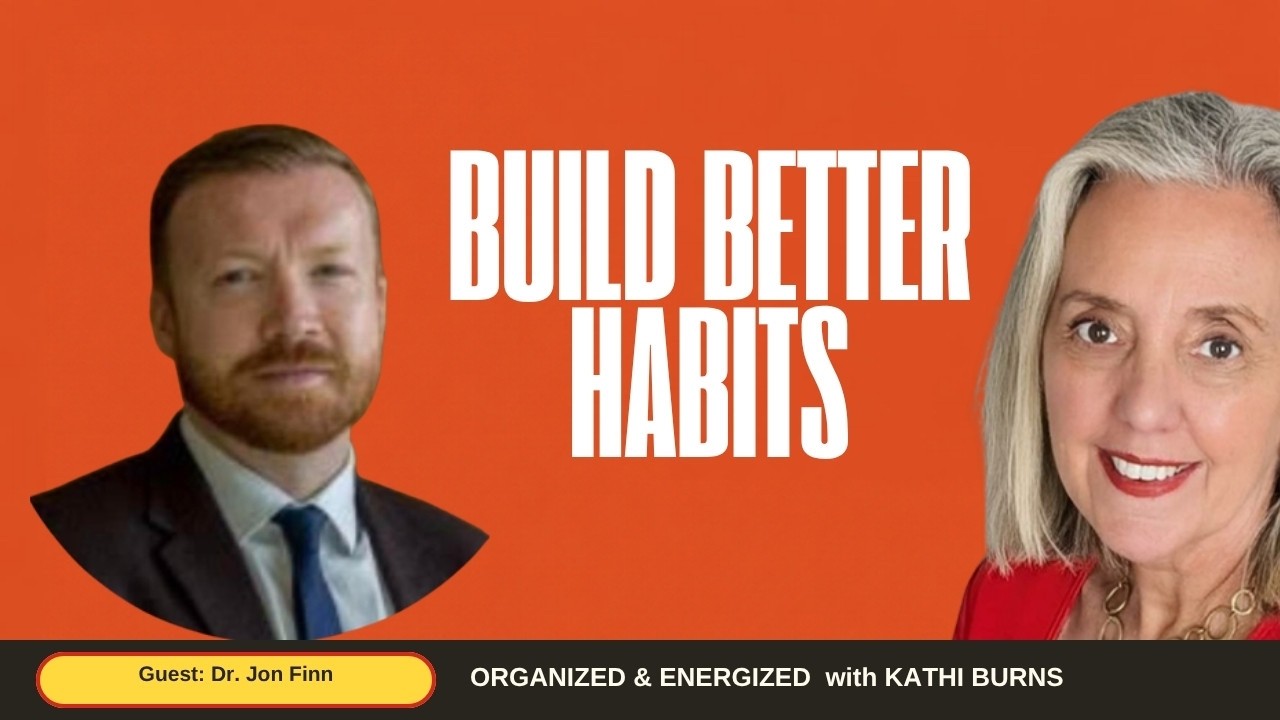
Episode 62
with Dr. Jon Finn, performance psychologist, founder of Tougher Minds and author of The Habit Mechanic · January 18, 2023 · 26 min
Performance psychologist Dr. Jon Finn says habits run at least 90% of what we do, including mental habits such as worrying too much or beating yourself up.
Jon cites a figure that only 9% of US businesses are happy with their performance management systems, and he helps leaders move from knowledge-based strategies to habit-based ones.
He describes a super habit, such as his morning run, as one with an outsized positive effect on the day, and a destructive habit, such as working too late, as one that spirals through the next day.
For people who don't run, Jon suggests starting with a five-minute walk around the block before work, done a little faster than a stroll.
His book The Habit Mechanic has over 30 habit-building tools, and his free Habit Mechanic University app teaches the Daily TEA Plan.
Published · Updated
What is this episode about?
Kathi Burns, CPO®, Business FLOW Strategist, talks with Dr. Jon Finn, founder of the Tougher Minds consultancy and author of the bestselling book The Habit Mechanic, about how to build better habits at work and at home. Jon has three psychology-related degrees, including a PhD, and more than 20 years in performance psychology, resilience and leadership science. He traces his career back to a high ball he missed on a cold, wet rugby pitch at 19. You'll hear why he says habits run at least 90% of what we do, why so few businesses are happy with their performance management systems, what business can learn from sports science, the difference between super habits and destructive habits, how a five-minute walk can start a new routine, and the advice from his father that you never lose an hour you invest.
We don't do what we know we should do. We do what we're in the habit of doing.Dr. Jon Finn
Jump to links and resources · Part of How do I grow my business without burning out? · All episodes · Every guest
What are the key takeaways?
- Jon Finn says habits run at least 90% of what we do, and that worrying or beating yourself up are habits too.
- He says most advice tells people what they should do differently but says very little about how to make change last.
- Jon names nine factors that drive behavior; belief and your why are two of them, and he says you also need to understand what the brain is designed for.
- He helps senior leaders move from knowledge-based strategies to habit-based strategies that ask which habits people need to adopt.
- His father's advice, that you never lose an hour you invest, gives him confidence as a business owner without a guaranteed wage.
- A destructive habit like working too late leads to eating late, sleeping badly and starting the next day behind, which Jon says spirals quickly.
- To start a habit, Jon suggests choosing something really easy, such as a five-minute brisk walk, and adding a little more over time.

This episode is brought to you by the Business Logjam Session
A private 75-minute online session with Kathi Burns to find the one thing holding your business back and leave with your next steps. It is the same F.L.O.W. process Kathi uses with her own clients: Focus on your goals, Locate your logjams, Outline your solutions, Walk away knowing your next steps.
Find What's Holding Me BackInterested in sponsoring the show? Get in touch.How did Dr. Jon Finn become a performance psychologist?
A missed catch and an injury on a rugby pitch sent him there. At 19, playing fullback for a student international squad against a men's professional team, Jon could only tell himself "don't drop it" as a high ball came down, and he missed it completely. Around the same time he ruptured a quad, which ended his high-level rugby. He decided that if he couldn't play, he would help other people be at their best, and went on to a master's and a PhD.
How much of what we do is habit?
Jon Finn says habits run at least 90% of what we do, and sometimes everything. He says outdated theories put the figure nearer 50% and only count things we do, but worrying too much or beating yourself up is just as habitual. We don't do what we know we should do; we do what we're in the habit of doing.
Why do performance management systems fail?
Jon says they fail because they aren't based on how people actually operate. He cites a figure that only 9% of US businesses are happy with their performance management systems, from peer reviews to annual reviews. He works with senior leaders to move from knowledge-based strategies, which map out what the business needs to do, to habit-based strategies, which ask what habits people need to develop and adopt.
What can business learn from sports science?
Businesses can use habit science the way sport uses the science of physiology. Jon says that if you asked professional sports teams whether they are happy with player fitness, over 95% would say yes, because they use science to get players fit. He sees neuroscience and behavioral science as the equivalent for our work and home lives, and wrote The Habit Mechanic to make that science simple to apply.
What does "you never lose an hour" mean?
It means every hour you invest in something comes back to you one way or another, even if not right away. Jon learned it from his father, a builder he worked with from the age of 12 or 13 on 12-hour days and 60-hour weeks. He applies it to running a business: nobody pays you a guaranteed wage, so you need confidence that what you invest in yourself will come back.
What are super habits and destructive habits?
A super habit has an outsized positive effect on your day, and a destructive habit has an outsized negative one. Jon's first super habit is a morning run, which he says readies him for his hardest work, helps him finish on time and sleep better. Working too late is destructive: it spirals into eating late, sleeping badly and starting behind.
How do you build better habits if you're not a runner?
Start with something really easy, like a five-minute walk around the block before work, done a little faster than a stroll. Jon says an hour-long walk is not sustainable if you don't exercise now. The aim is simply to get out the door, then add a little more over time, using a phone or watch to track your steps.
Where can you get The Habit Mechanic and the free app?
Jon says Amazon is the best place to get The Habit Mechanic, in print, ebook and audiobook, which he narrates. The book has over 30 habit-building tools and took him more than 20 years to write. His free Habit Mechanic University app, on Apple and Google Play, walks you through the Daily TEA Plan (Tiny Empowering Action) and has a community and challenges.
Where does each part of the conversation start?
- 0:00 Meet Dr. Jon Finn
- 0:33 Don't drop the ball: his rugby story
- 1:48 Why he became a performance psychologist
- 2:14 Seeing inside the brain
- 3:34 Habits run at least 90% of what we do
- 5:22 Why he missed the catch
- 7:16 The nine factors that drive behavior
- 9:05 Why performance management systems fail
- 10:35 What business can learn from sports science
- 12:03 Best advice: you never lose an hour
- 13:51 Super habits and destructive habits
- 15:54 How one destructive habit spirals
- 16:43 Not a runner? Start with a short walk
- 19:18 Advice to his younger self
- 20:11 Habits drive everything
- 21:28 Where to get The Habit Mechanic
- 22:28 The free Habit Mechanic University app
- 23:47 Wrap-up
What resources were mentioned?
- The Habit Mechanic by Dr. Jon Finn
- Habit Mechanic University app (free, on Apple and Google Play)
- The Daily TEA Plan (Tiny Empowering Action), chapter one of The Habit Mechanic
- Six Steps to Organize Your Amazing Life (Kathi's free download)
These episodes continue the same thread as this one: Lia Dunlap, Carly Church, Ginny Priem, Stephanie Wall Morrow also answer the question "How do I grow my business without burning out?", and the rest are the most recent conversations on the show.

 MotherhoodEpisode 147
How To Build a Village That Supports Your Business and Your Life with Carly Church

See every episode on the podcast archive or filter by topic on the How do I grow my business without burning out? hub.
How can I support the show?
- Subscribe on Apple Podcasts, Spotify or YouTube, or add the RSS feed to any app.
- Rate and review. A rating on Apple Podcasts helps new listeners find the show, and Kathi reads every review.
- Share the episode with one business owner who needs it; the share buttons are at the top of the page.
- Grab a free eBook: 6 Steps to Organize & Energize Your Home, 6 Steps to Organize Your Home Office or 6 Steps to Organize & Energize Your Life.
- Work with Kathi. The Business Logjam Session is a private 75-minute session to find what is holding your business back.
- Be a guest. Apply here if you have a story about clearing the obstacles in your business.
What did they say, word for word?
The transcript below is edited for readability: filler words and false starts are removed and speaker names are added. Nothing was added or summarized.
Read the full transcript +
Kathi: Hi everyone, this is Kathi, and today I am with Dr. Jon Finn. I'm so excited because we're going to talk a lot about resilience and how to beat that person on your back that's just talking to you about how you can't do it, and how we're going to bounce back. So welcome, Jon, to the show. I'm so happy to have you here.
Jon: Well, delighted to be here, Kathi. Thank you for having me.
Kathi: Absolutely. I know you have a lot of degrees in your background, but talk to me a little bit about the journey on what got you to where you are with behavioral science and resilience.
Jon: Yes. So when I was 18, I went to university to study sport science: physiology, psychology, nutrition, motor control. That's the science of how we learn. And I got really interested in the psychology side of it. I was a very good rugby player and I got selected to play in the international rugby student squad. We were playing in a warm-up game before an Australia test match, and I was the fullback. It was a cold, wet, windy day in the north of England. I was 19. We were playing against the men's professional team, and the ball went high up into the air. I was stood on my goal line. All I had to do was catch the ball, which I'd done thousands of times before, but all I could say to myself was, "Don't drop it. Don't drop it. Don't drop it." And of course, well, I didn't even drop the ball. I just completely missed the ball. They got a try. I got substituted. I didn't get selected for the match. I sustained quite a bad injury around then as well. I ruptured one of my quads. So I wasn't going to be playing high-level rugby anymore.
Jon: So I decided, if I can't play, I want to help people to be at their best. So I made it my goal to become a performance psychologist. I went on to study a master's, eventually a PhD, and just made it my mission to help other people to be at their best. And I was lucky: around the time I was doing my master's, a technology called functional MRI scanners, which was the first tech that allowed us to see inside people's brains in real time, became cheap enough for researchers to buy it and start to use it. And I was studying with a group of scientists that were really interested in the neuroscience of performance psychology. So I was on the cutting edge of that piece of work.
Jon: And what really rung home for me was that all the things that we'd been taught were very much about helping people to know what they should do differently. Very little about how do you actually help people to make sustainable change. And this is still the case. Most of the advice that's out there is based on theories and insights that are not based on how brains actually work. They're based on what we call black box theories. So I made it my mission to actually take insights from cutting-edge neuroscience and behavioral science and make them really simple for people to implement in their lives.
We don't do what we know we should do. We do what we're in the habit of doing.
Jon: And of course, what all that science shows is that most of what we're doing most of the time is mindless behavior. It's automatic or semi-automatic. In other words, it's a habit. So pop psychology has done a really bad job in educating people about how important habits are, because most of that work is based on black box theories. It's outdated theories that say habits are about 50% of what we do. We think of habits as things that we do. We don't think of a habit as beating yourself up, worrying too much. That's as habitual as anything else. So we have a tiny bit of consciousness. Habits are running at least 90% of what we're doing, and sometimes it's everything. So we are extremely mindless. A good example is most of us understand, and in fact we agree, that it's a good idea to eat five portions of fruit and vegetables a day and to walk 10,000 steps. We don't do what we know we should do. We do what we're in the habit of doing. So the key is to build better habits. And it's not a nice-to-have. It's driving you. It's driving your family. Habits drive your business. And yet we don't think about them, because they're invisible to us.
Kathi: Oh, sorry. I thought you were going to say that we know we're supposed to do the 10,000 steps, we know we're supposed to eat, but we don't know why. And that's probably true, too. It's just one of those things that we're supposed to be doing, but yet we don't do it. I had a quick question during that story when you said, "Don't drop the ball. Don't drop the ball. Don't drop the ball," and then you didn't even catch it. I thought that was interesting, because usually I think, with programming your mind, you would catch it and then drop it, it seems to me. But also, how long did it take you to figure out? Did you know immediately that that's where your disconnect was, or did you have to look back on that game and say, "Oh, okay. That was the deal"?
Jon: Yes. Looking back, that was an important point. But when you're 19, the parts of your brain that allow you to do the very conscious thinking are not properly wired, because for males, those parts of the brain are not properly wired until we're about 25. Females, about a year ahead. So we get written off when we're 16, 17, 18, 19, early 20s, but our brains are not properly wired yet. So in that story, I knew what I should do, but the habits didn't allow me to do that, because the brain's a threat detection machine. So it was about the threat of messing it up, looking bad, et cetera. And that took over, because the threat detection parts of the brain run the brain, ultimately.
Kathi: Yeah, that's quite interesting. So you've helped so many businesses and helped them with resilience. What do you think is the main lesson that you've learned through helping other businesses be resilient? Is there one factor? Do you think it's the beliefs and the habits, or what would you say about that?
Jon: Well, there are nine factors that drive what we do. So it's not just about belief. Belief is maybe one of those factors. The why, we said before, is another. So that's two. There's still seven more. So we've got to understand the behavioral science that drives what we do. We've got to understand what our brains are designed for. We've been around as a species for over 300,000 years, and our world has dramatically changed. Even in the last few years, our world's dramatically changed. So what we're designed to do isn't what we get asked to do every day. We're designed to walk about 12 miles a day, to move around and solve problems.
Kathi: Really?
Jon: That's what we think, anthropologically. And when we move around, it's easier for us to think cleverly, because we get this protein called BDNF released into our brain. So if we want to help people in businesses to be at their best, we first of all have to understand what their brain is designed to do and what are the factors that drive what they do, the behavioral science. And that's why I wrote the book, The Habit Mechanic, to make it really simple for people to understand these things and to help themselves and their people to build better habits.
Jon: So a lot of the work that I do day to day is helping senior leaders in businesses to move away from what we call knowledge-based strategies. So they're strategic plans that map out: this is what we need to do in the business to achieve our goals. And help them to move towards what we call habit-based strategies. That is, what are the habits our people need to develop and adapt and adopt in order to help the business to achieve? I saw an interesting stat recently that said only 9% of businesses, this is in the US, are happy with their performance management systems. Only 9% of businesses think their performance management systems work.
Kathi: Wow, that is amazing.
Jon: If you went to a professional sports team and asked them, "How happy are you with your player fitness and conditioning levels?" I think you'd get over 95% saying, "Yeah, we're really happy," because they use science to inform how they get their players fit.
Kathi: When it comes to performance management, I wonder how many companies really think about that. More and more, I know here in the US, they have a computer that'll beep at the top of the hour saying, okay, get up and move, and small little things like that, but nothing along the lines of what sports leagues do.
Neuroscience and behavioral science are the equivalent for us in our professional and in fact home lives.
Jon: Well, businesses are investing millions and millions of pounds into this. Most businesses have performance management systems. That's everything from the peer review structure to your annual reviews, and all that stuff is designed to get people doing the right things, and they're all saying it doesn't work. It doesn't work because it's not based on how people actually operate and the science that drives us. So for me, if we look at what sport science has done for professional sport in the last 20 years, where it's looked at what makes people physically fitter, what's the science of human physiology, and started to use that to inform how it helps players to get fitter: neuroscience and behavioral science are the equivalent for us in our professional and in fact home lives. We can use that science, what you might call habit science, to actually make it easier for us to do the kind of things that we'd like to do and know that we should do, to be healthier and happier and at our best more often, individually and collectively. So I think from a business perspective, if you want to help yourself and your people to build better habits, I'd start with The Habit Mechanic, because that's what it's written to do. Over 10,000 people use our approaches, and already people are saying the book has changed their life, and it's starting to change how people do in their businesses as well, in the hybrid workplace.
Kathi: I love it. I love it. And congratulations on your success. Everyone out there listening, this is a bestselling book and you should definitely grab a copy of it, and we'll have a link for you below the podcast here. So throughout your youth and growing up, what's the best piece of advice that you ever learned, maybe from one of your coaches or your parents or relatives? Is there something that sticks in your mind that was a really good takeaway?
Jon: I think one of the best pieces of advice is that you never lose an hour, which means every hour you invest in something you get back one way or another, even if it doesn't pay you back immediately. That was from my father. I worked with my father from maybe being 12, 13 years old, on building sites, et cetera. They would work 12-hour days, 60-hour weeks. Leave home at 4:00 on a Monday morning to travel down to London, get back at 7:00 on a Friday night. So hard work was drilled into me. But that's the thing with being a business owner, isn't it? Someone isn't paying your wage for you. If you're getting paid a wage every week, you're guaranteed a return on the energies you put in. When you're working for yourself, you don't get the same short-term guarantees necessarily. So it's having the confidence that what you invest, you're going to get back eventually. So you don't lose an hour that you invest in yourself.
You don't lose an hour that you invest in yourself.
Kathi: I love that. That's really, really good advice, and I've never heard it coined that way. So that's a great piece. Go, Dad. So he did construction? He built buildings, or is that what he did? Contractor?
Jon: Yeah. So he builds laboratories, and he has a factory now that makes the furniture for that, and all my siblings work for him.
Kathi: Awesome. And then you broke away and you said…
Jon: Escaped.
Kathi: Yeah. That's fantastic. So do you have a favorite hack that you use to keep yourself organized as you go throughout the work week?
Jon: Yeah. Well, I think the spine of becoming a habit mechanic is to work out what are your destructive habits and what are your super habits. And that's what The Habit Mechanic book is about. It shows you how to work those things out. So as part of my journey to becoming a habit mechanic, and still growing as a habit mechanic as I develop my habit mechanic intelligence and my chief habit mechanic intelligence, there's a backbone of what I call super habits to my day. So super habits have a disproportionate positive impact on my day. Destructive habits have a disproportionately negative impact on my day.
Jon: So the first super habit I do every day is I go for a run. It gets the right chemicals working in my brain so that when I come back from the run, I'm ready to do my work, to do my most challenging jobs of the day. Helps me to regulate what I eat. Helps me to be more productive. Helps me to finish work on time. Helps me to accumulate more exercise so I can sleep better at night. So just doing that one thing has all these other beneficial effects. Another super habit is called the Daily TEA Plan. And if you're interested in the Daily TEA Plan and learning how to do it, it's the first chapter in the book. It's also the core part of what we do in the Habit Mechanic University, which is a free app, which is on Apple and Google Play. So we have a community of habit mechanics. We just launched this, actually, and the core thing we do in the app is we share the Daily TEA Plan. So if you want to learn how to do that, that's in the app.
Kathi: Daily TEA Plan? Okay, that's interesting.
Jon: Daily TEA Plan. Tiny Empowering Action.
Kathi: I love it. What would be an idea of a destructive habit that would just compound your day and give you a bottleneck?
Jon: So one example: if we think of the current working context, hybrid work, people report they're working longer hours. People feel busier than ever. So I work too late. That's the destructive habit. Because I work too late, I eat too late. Because I eat too late, I'm very hungry, so I eat too much. Because I eat too much, I don't sleep very well. Because I don't sleep very well, I feel groggy and unproductive the next day. And now I start to gain weight. And the next day, I finish work even later. And you see how very quickly it spirals.
You see how very quickly it spirals.
Kathi: Yeah, that's interesting. So what are some ideas of ways to jump-start for people who are not runners? What would be other recommendations to start your day with? I love the running idea, but some people just don't run.
Jon: Yeah, just walking, just getting out and moving around, whether it's just for five minutes. So the key is to start with something that's really easy to do. If you don't do any exercise right now, if you don't go out of the house right now before you start work, giving yourself the goal of going for an hour walk isn't going to be that sustainable. Just walk around the block to start with. Just build that habit of getting out the door and moving around. So, I'm just going to go out for a five-minute walk, but do it with a little bit of intensity. You see people walking the dog and just ambling along. When you start to walk a little bit faster, the benefits really go up, and you'll feel better when you come back. I'm also on a workstation treadmill right now, believe it or not. So I'm stood on a treadmill, which you can hear beeping, so I can start to walk now. So you can invest in a workstation treadmill if you're that way inclined, or you can just go walk outside.
Kathi: And I love the walking. My mother always used to say, if you're going to walk, make it count. And she would always walk very fast. She was off like a clip.
Jon: Neurobiologically, we are designed to move around. Walk up to 12 miles a day, and that feels a far-away concept now. If you go back a hundred years in London, for example, people walked about 10 miles a day on average. We've really gone into this sedentary lifestyle, and the pandemic increased that further. So we're not saying you need to walk 12 miles a day. We're just saying, whatever your footsteps are now, how can you improve them a little bit, and a little bit more? We've got the tech now that makes it easy to do that.
Kathi: So if you had to look back in time and tell your 18-year-old self, probably before the incident at 19 happened, what advice would you give your younger self?
Jon: Yeah, I thought about this question, Kathi. I couldn't think of anything, because I wouldn't want to skew the space-time continuum, you know? I wouldn't want to mess anything up, because I'm pretty happy where I am. I think everything that's happened to me has stacked up to where I am right now. So maybe if I'd been given some advice, it might have knocked me off course. So I'm not sure how to answer that question.
Kathi: That's a good answer, actually. And other people have answered similarly. I think we are where we are. We are blessed to be where we are because of all the stuff that we've been through, for sure. So is there anything that I should have asked you that we haven't discussed here? Something that you really want to talk about? Definitely, everybody needs to check out the book, and we'll put the link there. But what have I missed in this conversation?
Jon: I think we could talk for a couple hours. But I think people know what habits are, or we think we know what they are. We just need to reinforce how fundamental they are for everything that we're doing. So your judgment of me at the start of this podcast wasn't formed by logical, conscious thinking. It's formed by habits. You make a judgment of someone within five seconds. You judge their entire life. That's not a conscious, clever idea. It's habits. How I'm breathing right now is habits. How I'm standing and moving my hands and speaking are habits. So habits are driving everything that we do. If you want to be healthier, you want to be happier, you want to give yourself the best chance of being at your best, it's about understanding your habits and getting better at building more helpful ones. And once you do that, you can then start to help other people to do that by becoming a chief habit mechanic.
It's about understanding your habits and getting better at building more helpful ones.
Jon: The key question to ask me, Kathi, was where do you get the book from? Amazon is the best place to get it. It's in all the formats: physical, ebook, audiobook. I narrate the audiobook, which, if you like my voice, that's good news. If you don't, that's bad news. And it's not a book that's got one idea in it repeated 10 times. This is a manual for life. It's a toolkit for success. It's got over 30 habit-building tools. Once you learn how to become a habit mechanic, it shows you how to become a chief habit mechanic, how to create a high-performance culture. I use this book every day, and I wrote it. It took me over 20 years to write. It's a real workbook. It's really well written, so it's simple to understand. It's based on really good science. It's packed full of examples and case studies and stories. So if you want to be healthier, happier and at your best, this is the book for you.
Kathi: Fantastic. Fantastic. Everybody, make sure to download it. Now, do you have a valuable free resource that you'd like to offer the people to get them initiated into it?
Jon: So I would recommend checking out the Habit Mechanic University app, which is absolutely free. You can get going straight away with creating your TEA Plan and learning more about the daily, weekly, monthly habit-building tools that we use. We've got a whole community of people in the app, and then we've got challenges that we're running there, the more sophisticated elements of the app. So go there, check it out, get it on your phone, get it to the front screen on your phone so it's nice and accessible. Just spend two minutes in there, minimum, every day creating your TEA Plan, and it will save you at least one hour every day. So if you want to save at least one hour every day, get the app.
Kathi: Hey, you're talking my language there. Everybody needs means to create more time. So absolutely, download the app. I'm going to do that. That sounds really interesting. And we can access it anytime we want, and we just start on our own?
Jon: Yeah, it's all in there. There are people from all over the world using it, so you'll see someone else in your time zone using it.

Kathi: Oh, perfect. Perfect. Well, thank you so much. It's been a really, really interesting conversation, and I'll sign off unless there's anything else that you would like to add. Everybody, make sure that you check out the book. Buy the book on Amazon. Twenty years' worth of research. I think you're going to learn a few things. Maybe just a little.
Jon: Yes. We'll put a link to The Habit Mechanic.
Kathi: Absolutely. Yep. It'll be right down below. We're going to put a link to the app, and we'll also put a link to the book. And congratulations on making that a bestseller, Jon. I really appreciate and really congratulate you for spending 20 years putting this book together. I know it's going to be super valuable for everybody.
Jon: Thank you, Kathi. Thank you for having me, and thank you to everyone for listening.
Kathi: Absolutely. Take care. We're signing off for now. And everybody, make sure to download that, and make sure to also download a copy of the Six Steps to Organize Your Amazing Life. So download all your freebies, get them while you can. And signing off for now. Thank you, Jon.
Jon: Thank you, Kathi.
Where can I find the links and resources from this episode?
Connect with Dr.
Organizations and companies
Inspired? Here Are Your Action Steps:
- List one destructive habit that has an outsized negative effect on your day.
- List one super habit that makes the rest of your day go better.
- Notice mental habits, such as worrying or beating yourself up, not just the things you do.
- Pick a new habit that is really easy to start, not an ambitious goal you won't keep.
- Take a five-minute walk around the block before work, a little faster than a stroll.
- Track your steps and add a little more each week.
- Set a time to stop work so a late finish doesn't spiral into a late dinner and poor sleep.
- Spend two minutes each day writing a Daily TEA Plan.
- If you lead a team, ask which habits your people need to adopt, not only what they need to know.
Frequently asked questions
Is it true that 45% of our behaviors that lead to habits are patterns in our daily activities?
+
Dr. Jon Finn puts the figure much higher. He says outdated theories hold that habits are about 50% of what we do, while he says habits run at least 90% of what we're doing and sometimes everything. He includes mental habits, such as worrying too much or beating yourself up.
How did Jon get into performance psychology?
+
At 19 he was playing fullback for a student rugby squad against a professional team. All he could think as a high ball came down was "don't drop it," and he missed it completely. Soon after, a ruptured quad ended his rugby career, so he decided to help other people perform at their best.
Why do so many business performance systems fail?
+
Jon cites a figure that only 9% of US businesses are happy with their performance management systems. He says they fail because they're built on what people should know rather than how people actually operate. He helps leaders shift from knowledge-based strategies to habit-based ones.
What's a super habit?
+
A super habit has an outsized positive effect on your day. Jon's first is a morning run, which he says helps him take on his hardest work, eat better, finish on time and sleep well. A destructive habit does the opposite: work too late, eat too late, sleep badly and start the next day behind.
What if you're not a runner?
+
Start with something easy, such as a five-minute walk around the block before work, and walk a bit faster than a stroll. Jon notes that people in London walked about 10 miles a day a century ago. The goal isn't 12 miles, just a little more than you do now.
Who is talking in this episode?

About the Host, Kathi Burns
Kathi Burns, CPO®, is a Business FLOW Strategist based in San Diego. For the last 20+ years, Kathi has helped clients create systems they can stick to. She is the author of How to Master Your Muck, Organizing With Tetris and Home Organization, The Smart Guide, and co-author of four more titles; all are in Kathi's shop. Kathi's business has been featured on Good Morning America, and her advice has been featured in Oprah Magazine, Martha Stewart Living, Better Homes and Gardens and Entrepreneur Magazine.
More about Kathi · Shop Kathi's books · Business Logjam Session · Apply to be a guest
About Dr. Jon Finn
Dr. Jon Finn is the founder of the Tougher Minds consultancy and the author of the bestselling book The Habit Mechanic, which he says took more than 20 years to write. He has three psychology-related degrees, including a PhD, and has worked in performance psychology, resilience and leadership science for more than 20 years. Jon studied sport science at university and played rugby in an international student squad until a ruptured quad ended his playing career. During his master's he studied with scientists using functional MRI to research the neuroscience of performance. Today he helps senior leaders move from knowledge-based strategies to habit-based ones, and offers the free Habit Mechanic University app.
Want help putting this into practice?
Book a Business Logjam Session with Kathi
A private 75-minute online session to find the one thing holding your business back and leave with your next steps, using the same F.L.O.W. process Kathi uses with her own clients: Focus on your goals, Locate your logjams, Outline your solutions, Walk away knowing your next steps.
Prefer to start small? Download Kathi's free eBook 6 Steps to Organize & Energize Your Life.
Published · Updated
This episode page is for general information. Guests speak for themselves, and their opinions, statistics and examples are their own. Nothing here is legal, financial, medical or mental-health advice; talk to a qualified professional about your own situation. Some links go to the guest's own products or free offers; addSpace does not earn a commission from them unless stated.