


Episode 55
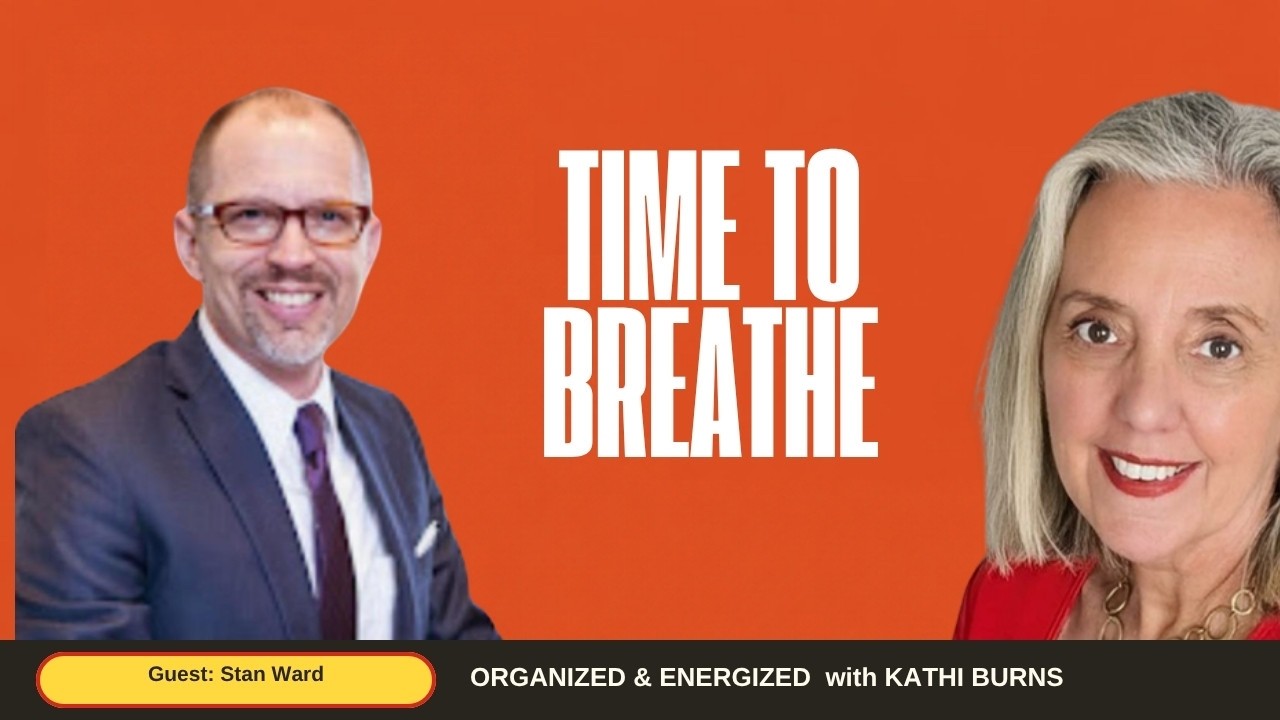
with Stan Ward, leadership coach and founder of Influence Coaching · November 30, 2022 · 20 min
Leadership coach Dr. Stan Ward made burnout a focus of his practice after a Mayo Clinic doctor asked him, during a 2015 health crisis, how he dealt with stress.
Stan defines physical margin as working within the limited hours in a day and the limits your body puts on what you can do.
He helps clients schedule the things that put energy back into them, because being intentional about energy in helps them manage energy out.
Stan says the stories we tell ourselves about what happens shape how much emotional margin we have.
His first step when you feel burned out is to breathe in through the nose to the belly and breathe out through the mouth for longer than you breathed in, two or three times.
Published · Updated
What is this episode about?
Kathi Burns, CPO®, Business FLOW Strategist, talks with Dr. Stan Ward, leadership coach and founder of Influence Coaching, about how to beat burnout, whether you run a company or work on your own. Stan was already coaching leaders in 2015 when a serious health crisis took him to the Mayo Clinic, where a doctor asked him one question: how do you deal with stress? That question reshaped his practice. You'll hear what Stan means by physical margin, how a physician client stepped back from serious burnout, why the stories we tell ourselves matter, and how one client stopped stressing over slow email replies. Stan also shares his family's habit of naming three successes each week, how he sorts his ideas with bullet journaling, Evernote and the 80/20 rule, why self-care is not selfish, and the simple breathing step he suggests first.
There's the thing that happens, and then there's how I interpret what happens.Stan Ward
Jump to links and resources · Part of How do I grow my business without burning out? · All episodes · Every guest
What are the key takeaways?
- Stan Ward's focus on stress and burnout began in 2015, when a Mayo Clinic doctor asked him how he dealt with stress after two weeks of tests.
- Stan used to handle stress by ruminating, internalizing it and carrying it in his gut.
- Physical margin means respecting the limited hours in a day and the limits your body puts on what you can accomplish.
- Stan helps clients schedule what puts energy back into them, and says being intentional about energy in helps them manage energy out.
- One of Stan's clients was frustrated by slow email replies until he realized he had put the urgency on himself by answering everything instantly.
- Stan's family shared three successes of the week at Sunday dinner, and he suggests listing three things that went well at the end of each day.
- Stan compares self-care to changing the oil in a car: it is the maintenance that helps you show up for the people and organizations you care about.

This episode is brought to you by the Business Logjam Session
A private 75-minute online session with Kathi Burns to find the one thing holding your business back and leave with your next steps. It is the same F.L.O.W. process Kathi uses with her own clients: Focus on your goals, Locate your logjams, Outline your solutions, Walk away knowing your next steps.
Find What's Holding Me BackInterested in sponsoring the show? Get in touch.Why did Stan Ward start focusing on burnout?
Stan Ward started focusing on burnout after a 2015 health crisis, when a Mayo Clinic doctor sat him down and asked how he dealt with stress. Stan was already working as a leadership coach. He says he used to ruminate, internalize stress and carry it in his gut. The experience led him to take stress much more seriously in his practice, which now centers on beating burnout, managing conflict constructively and creating sustainable positive change.
What does burnout look like for a business owner?
For one of Stan's clients, a physician who owns a clinic, it looked like a sense of overload that put her at risk of career-changing burnout. Between COVID, changes in the medical industry and the amount of paperwork, she was stretched thin. Together they got laser focused on what was causing the overload, helped her get into a healthier space emotionally and create more physical margin, and sorted what was worth addressing from what was just taking up mental space and could be let go.
What is physical margin?
Physical margin means respecting the limited hours in a day and the limits your body puts on what you can do. Stan Ward admits he'd like to get more done than his hours or body allow. He helps clients schedule what puts energy back into them, because being intentional about energy in helps them manage energy out.
Why do the stories we tell ourselves matter?
The stories we tell ourselves matter because there's what happens, and then there's how we interpret it. Stan Ward says the healthier that lens, the more emotional margin we have. One client was frustrated that people answered his emails slowly, then realized he had created the urgency himself by replying instantly, so he could give himself more breathing room.
How do you celebrate small wins?
Stan Ward celebrates wins by naming them out loud or writing them down. When everyone lived at home, his family shared three successes of the week at Sunday dinner, and he and his wife still ask each other about the day's successes. People he has worked with encouraged him to list three things that went well at the end of each day. Kathi adds that she teaches families a Sunday family meeting where everyone shares the great things and the lemons from their week.
How do you organize your ideas when your head is too full?
Stan Ward uses bullet journaling, Evernote and the 80/20 rule. He has so many thoughts running through his head that he started bullet journaling years ago, and he uses Evernote as a catch-all for ideas. He captures a lot of ideas but doesn't act on all of them; he focuses on the 20% that will bring 80% of the results and puts his time and energy there.
Is self-care selfish?
No. Stan Ward says self-care is not selfish, even though he has wrestled with the term himself. He doesn't blame his car for telling him to change the oil, because it carries him and his family. Self-care, as he sees it, is the self-maintenance that helps us show up for the people and organizations we care about.
How to beat burnout when you're stuck in fight or flight?
Stan Ward's first step is to recognize you're probably in fight or flight too often, then breathe. He suggests breathing in through the nose all the way to the belly and out through the mouth for longer than the in-breath, for example in for a count of three and out for six, and repeating it two or three times. He says that when tension shows up in the body, that's the signal to breathe. His free PDF, the formula for beating burnout, adds action items.
Where does each part of the conversation start?
- 0:00 Meet Stan Ward
- 0:38 The diagnosis that changed his work
- 1:02 "Tell me how you deal with stress"
- 1:31 How he used to handle stress
- 2:50 A physician on the edge of burnout
- 3:54 What physical margin means
- 5:15 Scheduling what gives you energy
- 6:16 The stories we tell ourselves
- 6:47 The client frustrated by slow emails
- 8:12 Celebrating three successes
- 9:55 His favorite organizing tools
- 10:33 The 80/20 rule for ideas
- 11:18 Advice to his 18-year-old self
- 12:12 When coaching helps at home too
- 14:22 Self-care is not selfish
- 16:02 His formula for beating burnout
- 16:25 Step one: breathe
- 18:10 Wrap-up
What resources were mentioned?
- The formula for beating burnout, Stan's free PDF (offered on his site)
- Evernote
- Bullet journaling
- The 80/20 rule
- Mayo Clinic
These episodes continue the same thread as this one: Lia Dunlap, Carly Church, Ginny Priem, Stephanie Wall Morrow also answer the question "How do I grow my business without burning out?", and the rest are the most recent conversations on the show.

 MotherhoodEpisode 147
How To Build a Village That Supports Your Business and Your Life with Carly Church

See every episode on the podcast archive or filter by topic on the How do I grow my business without burning out? hub.
How can I support the show?
- Subscribe on Apple Podcasts, Spotify or YouTube, or add the RSS feed to any app.
- Rate and review. A rating on Apple Podcasts helps new listeners find the show, and Kathi reads every review.
- Share the episode with one business owner who needs it; the share buttons are at the top of the page.
- Grab a free eBook: 6 Steps to Organize & Energize Your Home, 6 Steps to Organize Your Home Office or 6 Steps to Organize & Energize Your Life.
- Work with Kathi. The Business Logjam Session is a private 75-minute session to find what is holding your business back.
- Be a guest. Apply here if you have a story about clearing the obstacles in your business.
What did they say, word for word?
The transcript below is edited for readability: filler words and false starts are removed and speaker names are added. Nothing was added or summarized.
Read the full transcript +
Kathi: Hi everyone, I am back and I am with Dr. Stanley J. Ward. He is the founder of Influence Coaching, and we're going to talk today about how to avoid burnout. We all go through periods of burnout, and this is his game on how to teach us how to deal with burnout, conflict and that type of thing. So, welcome to the show, Stan.
Stan: Thank you, Kathi. I'm glad to be here.
Kathi: Absolutely. So, talk to me a little bit about your journey to get to where you are. I would expect we're going to go into the backstory of burnout, but talk to me about how you got to where you are right now.
Stan: Yeah. So, some of it is in 2015, I was presented with really a life-altering medical diagnosis, and it was pretty bleak. Some friends of ours heard about this. They have a connection with the Mayo Clinic. I went up to Mayo, and after two weeks of poking and prodding by the best medical minds in the country, if not the world, my doctor sat me down and he said, "Mr. Ward, tell me how you deal with stress." And so that was the beginning of a journey of learning to appreciate the power of stress, the importance of managing it. I was already working as a leadership coach at the time, but that really helped focus my practice to take stress much more seriously. And so that's why the emphasis on helping folks beat burnout, managing conflict in a constructive way and creating sustainable positive change.
Mr. Ward, tell me how you deal with stress.
Kathi: Yeah. So how did you used to handle stress?
Stan: Well, the reason I'm balding is there's so much going on up here, right? So a lot of ruminating, a lot of internalizing it, carrying it in my gut. Essentially what had happened is my digestive tract had just ceased functioning, and I was having trouble eating any solid foods. Chronic bacterial overgrowth in my gut. Lost a lot of weight, got really weak. The local prognosis was maybe having to do tube feedings and just some awful stuff. And come to find out, it was really self-induced. It was a physical problem, yes. There are mechanical issues there, but it was a stress response that I had created in my system.
Kathi: That's incredible. It's amazing, actually, that a doctor would actually say that. That was a huge blessing for you, I'm sure, for him to sit you down and say that. So now you've transitioned into someone who helps other clients do that. Can you talk to me about a story of one of your clients, a transformational story on where they were, what they worked themselves through and how they ended up after working with you?
Stan: Yeah. So one is coming to mind: a physician, a clinic owner. In her situation, of course, you can imagine right now with all that's going on, not just COVID, but the changes that the medical industry has seen, the amount of paperwork folks have to do, she really was at risk for some pretty serious burnout, possibly career-changing type stuff. And by working together, we were able to get very specific, laser focused on what was leading to that sense of overload that was causing some of the burnout. Helping her tap into things so that she was able to be in a healthier space emotionally, to help her create more margin as well, physical margin. And then helping her really just feel more effective by recognizing what was worth addressing, and then what was just taking up a lot of mental space that could be let go of.
Kathi: When you say physical margin, what does that mean?
Stan: Well, there's only so many hours in the day, right? And so figuring out how to spend that time and dealing with the constraints that your body puts on you. That's been part of my journey. There's a lot more things I would like to accomplish in a day than, A, there's hours for and, B, than my body will necessarily let me accomplish. And even saying that, it's like, oh man, I hate to admit it. But yeah, we are creatures who have limitations. And yeah, we can make amazing things happen, but part of that happens when we respect the raw material that we're working with. When we understand what keeps that raw material in a healthy state, so we can make our contribution to the world.
We are creatures who have limitations.
Kathi: Ah, I love this. This is a completely different shift of terminology than I've ever heard. So, your physical margins. Of course I talk a lot about the biological clock: when are you up, when are you down? But as far as the margins that you can protect your physical body with, I think that's really a cool thing to think about. I like thinking about it that way.
Stan: Well, you're an expert in organizing, right? So I would say part of this is helping people organize the things that put energy back into their system, and scheduling that. That's been one of the biggest shifts I've seen for folks: as they get intentional about the energy-in component, it helps them manage the energy out.
Kathi: Yeah. And giving time to create the energy. The more organized you are, the more time you have. And then you have time to actually nurture your body and honor your body and give your body some fun, some jumping up and down time, or basically some Z time, whatever the body needs to replenish. Yeah. I get it. Oh, that's really amazing. What's one lesson that your business has taught you? I know you went through your own journey, but I think our clients sometimes are our best teachers. What's something that was an aha moment for you, where you're like, "Oh, okay. I get that now"?
Stan: Wow, that's so good. So what I'm hearing really is a question about working with clients: what are some things I've learned from them? So the importance of the stories we tell ourselves is probably the biggest thing. There's the thing that happens, and then there's how I interpret what happens. And the closer those are aligned, or the more healthy the lens is through which we're seeing that experience, the more we're able to sustain ourselves, the more we're able to have emotional margin, possibly physical margin. I think of a client the other day. It's so funny. He was getting frustrated because people were slow to answer his emails, right? And he was frustrated because he was just constantly on email, answering things as quickly as humanly possible. And in part of that conversation, he realized, oh, wait a minute. I've put this burden on myself. So now I'm stressed out, feeling like I have to answer everybody's stuff, and that urgency is not being felt by these other parties. So maybe I can again have some more margin, where it's not as urgent as I felt like it was.
There's the thing that happens, and then there's how I interpret what happens.
Kathi: I think that's so funny, because I have a lot of clients who, actually, I teach them to do an email signature that says, "Hey, in order to help my clients more, I do not check my emails every minute. I check them twice a day. If you need something important from me, text me, call me, do something besides email me." So I think what happens is we're all trying to operate at the speed of life. Oh, quick, quick, quick, instant, instant, instant. And we can get so burned out doing that. So, good for your client that he came to you. People don't care as much as you care about your business, or even responding, so get light and happy with that. So when you have a success in your life or in your business, I'm asking this now for everybody: how do you celebrate? What's your little celebration routine, or how do you really say, "Yeah, go"?
Stan: I think the biggest thing is just highlight it. So one of the things we do in our family: we used to do this when everybody was at home, but on Sunday dinner we would basically say, okay, share three successes of the week. And so we still do variations of that periodically in the evening. Even if it's just my wife and I, we may talk about, okay, what were some of your successes of the day? So just verbalizing it alone can be very helpful. As well, people I've worked with have encouraged me to, at the end of the day, list three things. What were three things that went well? Just to get that feedback, to see it in writing or to verbalize it, and let yourself experience the endorphins.
Kathi: Yeah, exactly. Take the time to actually stop and consider what you've accomplished. When I work with families all the time, I talk about the family meeting on Sunday, which is exactly what you were doing. In the family meeting on Sunday, you're not only prepping for the week, but you're actually talking about what was the great thing. What are the three things that happened to you that you loved, and then what gave you lemons? Just have a dialogue between family. But I think the most important thing is what really great thing happened to you. And I love the idea, being a writer, of writing it down, because it's like you're making it more solid in your mind. Yeah, I did that. That's really cool. So cool. That's great. So, okay, being a professional organizer, I have to ask: what is your favorite organizing hack or program or something that you use that really supports you with your business, Stan?
Stan: Yeah, it's a great question. So, again, I joke that there's a lot going on up here. That's why there's this heat coming off this thing. And so the thing that sometimes I'm the least organized with is just, there's so many thoughts running through my head, and how do I sort all that out? So years ago, I started practicing bullet journaling. I found that to be really helpful. Migrating that with Evernote, or integrating that with Evernote. Evernote is just a catch-all for me. That helps me manage those ideas. And then just practicing the 80/20 rule. So yeah, I capture a lot of ideas, but I'm not acting on all of them. I try to really focus: what are the 20% of these things that are going to get me 80% of the results? Put the time and energy into that.
Kathi: Yeah. What's going to move the needle? And you're right. I'm so guilty of the 80%, just creating, creating, creating, and not really following up on the other stuff, the 20% that will actually move that creation down the road. And I love Evernote myself, for sure. It's a great tool, and the fact that it will transfer over all your devices is just a great thing. Good, good. Okay, so if you could turn back time and you could talk to your 18-year-old Stan, who probably had hair at that point, maybe, what would you tell him?
Stan: Oh, man. Beautiful hair. Beautiful hair. So, yeah, enjoy the hair while you got it. 18-year-old self, I would say, man, just relax. You're putting a lot of pressure on yourself, buddy. It's going to be okay. That's probably the first thing I would say.
Kathi: Yeah, I love that. That's so important. I don't know, I was so relaxed at 18, I wasn't paying attention. But I would tell my 27-year-old self that for sure. When I started trying to move and cruise and zoom, it's like, don't be so serious. It's all just a journey.
Stan: I'd also tell myself to buy stock in Apple. That would have been a good time.
Kathi: Ah, yes. Yes. I agree with that. Okay. So what's a memorable moment that you've celebrated in your career? What can you think of that was really your "Yay!"?
Stan: Oh, man. That's so good. Oh wow, there's so many. I like to write, as you talked about, and so anytime when those writing projects are done and that book is on the shelf, oh, that just feels so good. So cool. Conversations with people where they've talked about not only has a coaching item helped them at work, but it's helped them at home. That work-life integration for me is so important. And so those moments really impact me. Kind of like you, talking about the family meeting piece. Again, helping folks with skills that really help them show up both at work and home. Anytime that happens, for me, that's a jazz hands moment.

Kathi: Yeah, I'm with you on that. Oh, I like the jazz hands. That's good. That's good. It just feels good. Yeah, I agree, having the integration. I think as all of us that help our clients, we want it to transfer into all the other areas of their life. That way we know that it's been integrated and that they get it. They're like, "Oh, okay. I understand that now." And then it transfers over. And I also think that the more that you help the person in the family, the family benefits, and then the family grows and expands as well. The fact that your family had the Sunday meetings, I'm positive that when your children grow up, they're going to follow a similar pattern and incorporate some of that really gravy, groovy stuff that you taught them. So it's going to go on and on and on. And that's the way that we can affect lineage and have more lasting effect than just the one person that's sitting right in front of us as a coach or as a helper. That's good. Okay. So, what should I ask you? What should we talk about that we haven't really covered? Is there anything in your brain that you just want to tell these people?
Stan: Yeah. So it would be this idea of self-care: that self-care is not selfish. I know for me, I have struggled in the past with that term, and probably still have some little bit of wrestling with it. But once I realized that I don't blame my car for telling me to change the oil, right? And the reason that is, is because it's carrying me. It may be carrying my family. It helps me get back and forth to work. To see self-care really as the self-maintenance things we do that help us show up for the people and organizations we care about, right?
Self-care is not selfish.
Kathi: Yeah, I really like that, and it's so true. And oftentimes self-care is the last thing on our list. So I think putting self-care first is the least selfish thing that you can do. I'm in complete alignment with that. And I'm sorry, gang, for calling you these people. I just said, what am I doing? I'm saying these people. I really mean you listeners out there. Please accept my apologies for calling you these people. That was a little bit cray cray. Anyhow, so yeah, self-care is where it's at. I am in complete alignment. So I know that you probably have something that you're offering the audience, not these people, but you people out there that are listening. What can they download?
Stan: Well, I heard these wonderful people. That's what I heard you say. These wonderful people. Maybe the internet glitched when you said that, but that's what I heard.
Kathi: Thank you, Stan. I appreciate that.
Stan: Yeah, happy to help. I would encourage folks to go to coachingforinfluence.com/burnout, and there you can download the formula for beating burnout. It's a free PDF. It gives you not only a formula to help you predict where you're at on burnout, but it gives you action items you can take to help you stay in that healthy place.
Kathi: That's fantastic. And I'll put the link below in the show notes for sure, so you can just click and download it. What's the first thing that you would do if you're feeling burned out? What's the first step that someone could take, besides downloading the report, which you all should do? The one thing, what would be step one?
Stan: So it's going to be a little step one point five-ish, maybe. But that's this idea of, okay, recognize you're probably in fight or flight way too much, and so that's just wrecking you. And so just as simple as, take a second: inhale through the nose, exhale through the mouth, right? That inhale that comes all the way down to the belly, and an exhale that's longer than the inhale. So maybe I inhale for a count of three, exhale for a count of six. Just giving yourself that gift at that moment. Repeat it two or three times, and that's going to start helping you get back in that parasympathetic state where rest, healing and digestion can happen.
Kathi: What a fabulous tip. I love breath work myself. I do breath work all the time, and I think it's so important to just maintain that balance and equilibrium. And again, give your brain a break. Don't overwork your brain. Your brain is on its own just happy as a camper, going as fast as possible. And I do think that breath work really does help relieve that fight or flight. You actually have an understanding of where you were, like, "Oh, okay. I was in fight at that point," right?
Stan: Yeah. Our brains are processing way faster than we're able to recognize. And so when that tension comes up in the body, that's telling you it's time to breathe.
Kathi: Yeah. Breath work, breath work, breath work. I love it. Well, thank you so much for being a guest. I really appreciate your generosity of giving the audience a download, and I wish you much success. And thank you for your time, Stan. It's been a pleasure.
Stan: Thank you, Kathi. It's been a fun conversation.
Kathi: Absolutely.
Where can I find the links and resources from this episode?
Connect with Stan
Organizations and companies
Inspired? Here Are Your Action Steps:
- Ask yourself how you deal with stress, and notice where you carry it.
- List what is causing your sense of overload, and separate what is worth addressing from what you can let go.
- Schedule the things that put energy back into you, the same way you schedule work.
- Respect the limits of your hours and your body when you plan your day.
- When something frustrates you, separate what happened from the story you're telling yourself about it.
- Check whether the urgency you feel, like answering every email instantly, is pressure you've put on yourself.
- At the end of each day, write down three things that went well.
- Share three successes of the week with your family or team.
- Capture your ideas in one place, then put your time into the 20% that will bring 80% of the results.
- When you feel tension, breathe in through your nose to your belly and out through your mouth for twice as long, two or three times.
Frequently asked questions
How can I recover from burnout?
+
Stan Ward's starting point is to recognize you're probably in fight or flight too often and to take a few slow breaths, with the out-breath longer than the in-breath. From there he helps clients get specific about what is causing the overload, let go of what is only taking up mental space, and schedule the things that put energy back into them.
What is physical margin?
+
There are only so many hours in a day, and your body has limits on what it will let you do. Stan helps clients schedule the things that put energy back into them, because being intentional about energy in makes it easier to manage energy out.
Why do the stories we tell ourselves matter?
+
There's what happens, and then there's how you interpret it. One of Stan's clients was frustrated that people were slow to answer his emails, then realized he'd put the pressure on himself by answering everything instantly. Nobody else felt that urgency, so he could give himself more breathing room.
Is self-care selfish?
+
Stan Ward says no. He compares self-care to changing the oil in a car: you don't blame the car for needing it, because it carries you. Self-care is the maintenance that helps you show up for the people and organizations you care about.
What's the first step if you're feeling burnt out?
+
Recognize you're probably in fight or flight too often. Breathe in through your nose all the way to your belly, then breathe out through your mouth for longer than you breathed in, for example in for a count of three and out for six. Stan suggests repeating it two or three times.
Who is talking in this episode?

About the Host, Kathi Burns
Kathi Burns, CPO®, is a Business FLOW Strategist based in San Diego. For the last 20+ years, Kathi has helped clients create systems they can stick to. She is the author of How to Master Your Muck, Organizing With Tetris and Home Organization, The Smart Guide, and co-author of four more titles; all are in Kathi's shop. Kathi's business has been featured on Good Morning America, and her advice has been featured in Oprah Magazine, Martha Stewart Living, Better Homes and Gardens and Entrepreneur Magazine.
More about Kathi · Shop Kathi's books · Business Logjam Session · Apply to be a guest

About Stan Ward
Dr. Stanley J. Ward, PhD, PCC, is the founder and principal of Influence Coaching. A leadership coach, trainer and author, he has spent about a decade helping high-performing leaders do well in demanding, high-pressure environments. He works with leaders to reduce unnecessary conflict, beat burnout and create sustainable positive change, so they can succeed both at work and at home. Stan was already coaching leaders in 2015 when he received a life-altering medical diagnosis. After two weeks of tests at the Mayo Clinic, his doctor asked him how he dealt with stress, and that question led him to make stress and burnout a central focus of his practice.
Want help putting this into practice?
Book a Business Logjam Session with Kathi
A private 75-minute online session to find the one thing holding your business back and leave with your next steps, using the same F.L.O.W. process Kathi uses with her own clients: Focus on your goals, Locate your logjams, Outline your solutions, Walk away knowing your next steps.
Prefer to start small? Download Kathi's free eBook 6 Steps to Organize & Energize Your Life.
Published · Updated
This episode page is for general information. Guests speak for themselves, and their opinions, statistics and examples are their own. Nothing here is legal, financial, medical or mental-health advice; talk to a qualified professional about your own situation. Some links go to the guest's own products or free offers; addSpace does not earn a commission from them unless stated.