

Episode 85
with Judy Wong, transformation coach for people over 60 and founder of The Life List Activation · August 17, 2023 · 41 min
Transformation coach Judy Wong turned 60 in the middle of a busy international teaching career and found that everyone suddenly wanted to talk about her retirement.
Judy points out that someone who is 60 or 70 may have 30 to 40 more years, so she sees no reason to stop at a 20-year career.
She asks people who define themselves by their last job a simple question: if you did that for 20 years, what did you do with the other 50?
Judy suggests writing a life list instead of a bucket list, riding life's waves instead of fighting them, and scheduling downtime even when you love your work.
Published · Updated
What is this episode about?
Reinventing yourself after 60 is the subject Judy Wong knows from the inside. She was teaching and speaking around the globe when she turned 60, and suddenly all anyone wanted to discuss was her retirement. Judy, a transformation coach and certified life coach, tells Kathi Burns why she thinks "ages and stages" is a story we were taught, why someone who is 70 may have 30 to 40 years left, and why she'd drop the word "retired" even while taking the retirement money. You'll hear about a former teacher in her 70s who went back to singing and theater, a 55-year-old acting student who became a career actor and director, and the riptide lesson Judy learned from her lifeguard kids. She also shares how she stays focused on her big why, why she does everything at 300 percent, and why entrepreneurs need to schedule downtime.
We learned how to ride the waves instead of fight the waves.Judy Wong
Jump to links and resources · Part of How do I grow my business without burning out? · All episodes · Every guest
What are the key takeaways?
- Judy Wong says that if you are 60 or 70, you may have 30 to 40 more years, which she calls a lifetime.
- She believes the word "retired" carries a negative story people absorbed as children, and she suggests taking the retirement money without calling yourself retired.
- When people define themselves by their last 20 years of work, Judy asks what they did with the other 50 and looks there for skills and interests they forgot.
- Judy describes life as a set of waves: a wave that seems to crash is coming down to reset before it rises higher, so she suggests riding it instead of fighting it.
- To stay focused, Judy keeps asking what her big why is, because once the why is clear, the right small steps become obvious.
- Her rules for work are to do everything at 300 percent, accept imperfection as a sign of learning, and schedule downtime even when the work is fun.
This episode is brought to you by the Business Logjam Session
A private 75-minute online session with Kathi Burns to find the one thing holding your business back and leave with your next steps. It is the same F.L.O.W. process Kathi uses with her own clients: Focus on your goals, Locate your logjams, Outline your solutions, Walk away knowing your next steps.
Find What's Holding Me BackInterested in sponsoring the show? Get in touch.What does reinventing yourself after 60 look like?
For Judy Wong, reinventing yourself after 60 meant refusing to retire when everyone expected it. She was teaching and speaking around the world when she turned 60, and people only wanted to talk about her limited income. She told them she had a few dozen more careers to try.
How do you figure out what to do next in life?
Judy's advice is to stop defining yourself by your last job, career or relationship. If you're 70 and spent 20 years in one role, she asks what you did with the other 50 years. Most people, she says, have forgotten the interests and skills they had before that last stretch, and that's where the next idea often sits.
Why do some people stop calling themselves retired?
Judy says the word "retired" puts a negative story into your thinking absorbed in childhood. She compares it to severance pay: you'd take the money, but you'd never call yourself "severanced." She tells the story of a woman whose retirement book was nearing six figures and who was upset about it until she let go of the label.
What is a life list instead of a bucket list?
A life list, in Judy's words, is a list of the careers and dreams you still plan to pursue, rather than a list of things to squeeze in before the end. She works as a transformation coach to help clear old stories and then pull in the right people to make those life lists real. Judy says she plans to live to 122 and has a few more careers she wants to do.
How can your past skills help you start a new career?
Judy and Kathi both say that every past career and interest adds to the toolkit you bring to the next one. Judy describes a former teacher in her 70s who had loved singing and won competitions as a child. She now teaches again on her own terms, using music, singing and theater, and she writes plays and performs.
What does it mean to ride the waves of life?
Riding the waves means rolling with life's ups and downs instead of fighting them. Judy's children were lifeguards, and they'd tell swimmers not to fight a riptide, because you come back to the surface if you go with it. She sees careers the same way: a wave that seems to crash is resetting so it can rise higher.
How do you stay focused when you have too many ideas?
Judy keeps asking herself what's really important and what her big why is. She admits she gets distracted by shiny objects too. When she knows why she wants something, the little steps make sense and she can see which ones to take. Kathi notes that the answer to "why" often turns out to be freedom.
Why should entrepreneurs schedule downtime?
Judy says entrepreneurs need to schedule downtime because even work you love can burn you out. She used to work 24 hours a day because she was enjoying it, and she still burned out. Kathi adds that when you're having a blast, it's worth pausing, switching screens and doing something you don't normally do.
Where does each part of the conversation start?
- 0:00 Meet Judy Wong
- 0:22 Meet the over-60 transformation coach
- 1:23 Turning 60 mid-career
- 2:40 Ages and stages are made up
- 3:50 Her husband's take on her careers
- 4:25 Watching friends get put out to pasture
- 5:01 You have 30 to 40 more years
- 6:54 Advice for reinventing yourself
- 7:48 What did you do with the other 50?
- 8:47 Life comes in waves
- 9:37 Why call it retirement?
- 11:23 The retiree who made too much money
- 13:07 Clearing the retirement story
- 16:04 Breaking open the cocoon
- 17:34 Life lists, not bucket lists
- 18:41 Your past skills add up
- 19:54 A former teacher who found her voice
- 23:18 Older without getting old
- 25:28 Help us save the world
- 26:18 Ride the waves, don't fight them
- 28:13 Know your big why
- 31:02 Why can't work be fun?
- 32:28 The 55-year-old acting student
- 33:37 Do it 300 percent
- 34:38 Schedule downtime
- 35:54 Wrap-up
What resources were mentioned?
- Judy's free energy reset guide (a PDF workbook with a link to an audio energy clearing), on her website
- How to Master Your Muck by Kathi Burns (free copy offered in the episode)
These episodes continue the same thread as this one: Lia Dunlap, Carly Church, Ginny Priem, Stephanie Wall Morrow also answer the question "How do I grow my business without burning out?", and the rest are the most recent conversations on the show.

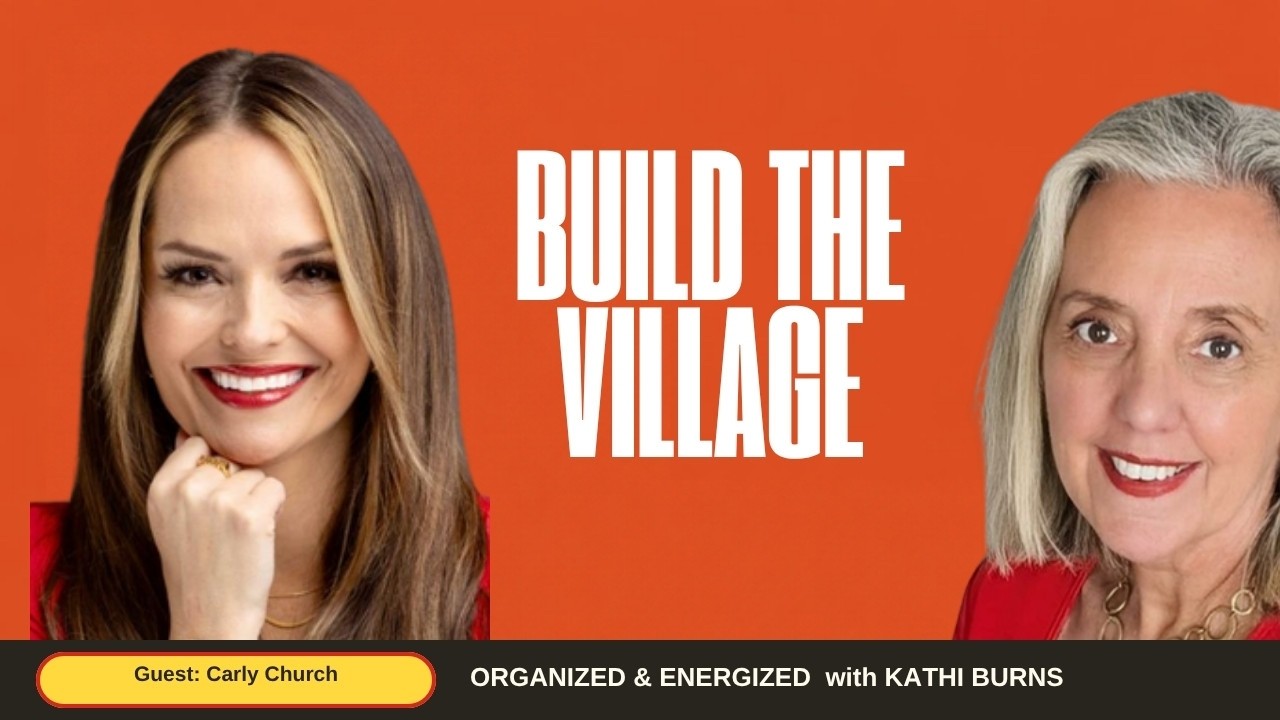 MotherhoodEpisode 147
How To Build a Village That Supports Your Business and Your Life with Carly Church

See every episode on the podcast archive or filter by topic on the How do I grow my business without burning out? hub.
How can I support the show?
- Subscribe on Apple Podcasts, Spotify or YouTube, or add the RSS feed to any app.
- Rate and review. A rating on Apple Podcasts helps new listeners find the show, and Kathi reads every review.
- Share the episode with one business owner who needs it; the share buttons are at the top of the page.
- Grab a free eBook: 6 Steps to Organize & Energize Your Home, 6 Steps to Organize Your Home Office or 6 Steps to Organize & Energize Your Life.
- Work with Kathi. The Business Logjam Session is a private 75-minute session to find what is holding your business back.
- Be a guest. Apply here if you have a story about clearing the obstacles in your business.
What did they say, word for word?
The transcript below is edited for readability: filler words and false starts are removed and speaker names are added. Nothing was added or summarized.
Read the full transcript +
Kathi: Hi everyone. I'm back and I am with my girlfriend Judy Wong. She's a transformative coach, and you're going to love hearing what she has to say, and she's going to give you some nuggets you can walk away with. So, welcome to the show, Judy.
Judy: Thank you. Good to see you.
Kathi: Good to see you again. I'm so excited about this podcast. So, everybody, meet Judy. Judy, will you please tell us a little bit about yourself and why I'm so excited to speak with you today?
Judy: Oh, well, first of all, I love all these wonderful people, especially entrepreneurs, women who are over 60 like me. And yes, I really am over 60. I totally get it. Everybody wants to know where the fountain of youth came from. No, no, no. It's just a Dorian Gray painting. It's in the closet. Don't look.

Judy: But yeah, I am a transformation coach. I started out actually, in my other former career before this newest and improvest (I always say I'm reinventing every time), as an international English educator. I was an international English educator, speaker. I was talking around the globe, teaching around the globe, and I turned 60, and here I was facing this great career, this amazing life, this wonderful business that I was doing. I was teaching, I was selling, I was talking, I was just having a good time. I had just got married. I was doing wonderful, and all of a sudden all anybody wanted to talk to me about was my retirement and what are my death plans and how am I living on my limited income. I said, "Are you kidding me? I'm not done yet. I've got a few dozen more careers I want to work on." And I was like, what are they talking about? These people are absolutely nuts. I was just, no, no, no. I'm not ready to roll over. And everybody was like, "But it's your age and your stage." And I sat there going, well, that's kind of crazy, because this whole BS, excuse me, of ages and stages was something we invented in the 1960s. So honestly, children, it doesn't exist.
Kathi: I love the fact that… because I'm in the same place. I've reinvented myself so many times, and that's why I think we resonate so much together, that it's never too late to change or do anything you want to do.
Judy: Heck no. No, no. And what I realized was, while these people were telling me all this crazy stuff, I was like, "No, this is nuts. I've never thought about it like that." I've had more careers in my lifetime than most people had in their families. Seriously, my husband is hysterical. He says, "I'm waiting for the day, honey, when you meet somebody and they tell you what they did for a living and you don't go, 'I remember when I did that.'" And I said, "Well, sweetheart, I'm not a doctor." He's a doctor. And I said, "I'm not a doctor. I'll never be a doctor. I'm not interested in being a doctor." And he said, "Yes, but sweetie, you're a holistic healer. It's kind of like a doctor." I went, "Good point."
Kathi: You married a good one on that one. The fact that he would understand that that's a thing. That's the kind of doctor I like to go to.
Judy: Oh, yeah. He's such a cool guy. And the funny part was, he doesn't look his age either. So I thought he was a kid when I met him. He thought I was a kid. Were we surprised?
Kathi: Love it.
Judy: But yeah. And then I realized, as I was watching all of my colleagues and friends being put out to pasture, and I was watching them, and they were freaking out just like I kind of did. Everybody said I was supposed to be old and whatever, and they were just really having a hard time. And I thought that doesn't have to be, because if you think about this, let's really think about this. I used to be a math teacher too at one time. So I do numbers, okay? And if you're 60 or even 70, you've got 30 to 40 more years to go.
Kathi: Yep.
Judy: It's 30 to 40, not 10 to 20. 30 to 40, that's a lifetime. In the 20th century, the human lifespan has doubled, which is outrageous, because it's more than it has in any other millennia. And I have a son who is a biomed engineer. He's like, "Mom, there's something called evolution and science." And he's right. He's totally right. So really, why are we walking and making bucket lists? It seemed to me the most absurd thing in the world, because you're complaining about having a 20-year career when you've got 40 more years to go.
Kathi: Yeah. It's ironic that we're talking today, because I've had a couple of friends talk to me about, "Yes, I'm retiring." And one of my best friends in the world, who I've known since seventh grade, is retiring early. And my question always is, "What are you going to do?" And she actually has a plan. And actually she's flaming out, because she's in the medical industry and dealt with the whole COVID. So a lot of people are flaming out. And that's why I wanted to have you on this show, because I feel that right now the people who are listening are looking at possibly transitioning into something else, and your message is strong and clear: it ain't over yet. Do whatever the heck you want to do. And I've always felt that way my whole life. So I think this is a really needed conversation for us right now. If you had someone in this situation who was looking at, let's reinvent, what would your advice be for them, if they know they need to get out and they want to do something?
Judy: Well, the first thing I always found that is really important, because I had a lot of people coming to me, and this was the thing: when they would come to me, they'd be like, "I don't want to roll over and play dead just yet," just like I didn't. But all of the messages we were getting were to the contrary. And I realized, because one of my other careers was I used to work on Madison Avenue, that you tell somebody something enough times, they're going to believe it. And then I also found that some of them were like, "Okay, I'm going to reinvent myself. I'm going to do something cool, but what do I do? I've been this or that." And they're defining themselves by the last 20 years of their life.
Kathi: Yeah.
Judy: Or the last job that they had, or the last career, or the last relationship. And I'm like, okay, I get that you're 70 years old. You did that for 20 years. But like I said, I used to be a math teacher. Do the numbers. You're 70. That was 20 years. What did you do with the other 50?
Kathi: Yeah.
Judy: In my book, 50 is a hell of a lot bigger than 20. So why are we sucking it up to the 20 years? It seems absurd to me. And what I found was that most of the people don't remember anything before that. Oh, there was so much going on. And they were thinking of ages and stages and closing doors. And I said, "No, no. It's like the waves. It's like the ocean." I like to think of it like the ocean. You know how waves come up and they rise, and then they're sort of falling, and you think they're falling and crashing, but they're really not. They're actually coming down, reassessing, re-energizing, and just rebooting so that they can rise even higher.
Kathi: Yeah.
Judy: That's really what life is about. When we were in our 20s, we never thought anything of it. If I was tired of a job, I'm sick of doing this, whatever I was doing, I'm done with it.
Kathi: Right. Right.
Judy: I'm done with it. I'm not retiring. I'm done with it.
Kathi: Right. I'm quitting. Find something better to do.
Judy: Right. Absolutely. I never understood why we have to call it retirement. Somebody said to me, "But I want the money." And I said, "Of course you want the money. Who the hell wouldn't want the money? I would want the money." So I'll say, I'll take the retirement money, but I don't have to call myself retired.
Kathi: Right.
Judy: I mean, if you took the severance pay, right? When a company shut down… You remember years ago, companies shut down, they kick you out. They're like, "Oh, I'm done with you. You're old. You're whatever." And they give you a severance package with great pay. You wouldn't walk away and say, "I'm not taking the pay." Hell, I'll take the money. So you take the money.
Kathi: You wouldn't say "I'm over" either. You're saying, "What am I going to do next?"
Judy: Okay. Right. You would never call yourself severanced. You took the damn severance, babe, but you'd never call yourself severanced. So why are you calling yourself retired?
You would never call yourself severanced. So why are you calling yourself retired?
Judy: What I found was, I was working with some people. There was this woman I knew, and she says, "But I'm going to have a better retirement." And she did very well with her life and her husband, and they bought a house in a retirement community free and clear and were living on their retirement money. She wrote a great book on having a better retirement, and she did this better retirement, except she came and she was very upset. And I said, "Why are you upset?" She goes, "Well, because the book is making money." I said, "That's great." She goes, "No, but the book is making so much money. They want me to talk about it, and I'm going to make more money." I said, "That's even better." She was upset because she was making too much money.
Kathi: Interesting.
Judy: Because it was rapidly approaching six figures. And I'm like, who on this planet actually complains about making too much money? And then she was like, "Well, you have to pay more tax, you've got to pay more bills." And I went, well, look, I have started more than my share of six-figure companies, literally when I had not even two nickels to rub together.
Kathi: Yeah. Exactly.
Judy: That seems to be a silly kind of concept, right? And then I said to her, "But I don't understand." She goes, "Well, you don't understand. I'm retired, and I'm living on limited income."
Kathi: Oh, no.
Judy: And I asked her, "Do you like living?" She goes, "Well, we're comfortable, because we did very well, so we're comfortable." I said, "But do you like being on limited income?" She goes, "Well, it's the way it is. I'm retired."
Kathi: Oh, yeah. So, security, right? She didn't want to make over a certain amount.
Judy: But I said to her, "Honestly, if you had six figures of money just flowing at you, would you honestly be worried about paying a bill?" She goes, "I never thought about it that way." And that's it. What I realized, because I'm an energy healer as well, and I'm an intuitive. I'm a psychic energy healer. And I realized that that silly word, retiree, retirement, was putting into your energy field a very negative vibration. And as soon as we stripped that away, boom, she was happy as all hell, making as much money as she can, and she just kept making more. I think half of the problem is that when we're doing that transition, nobody ever taught us how to deal with it. Because let's be honest, in our age group, in our generation, we were taught how to be born, how to grow up, how to go to school, how to get a good job, have a family, how to retire and die, right? So that's why that word retirement has such a negative attachment. No matter how much of a positive spin you want to put on it, it's already been embedded in your psyche since you were a child. A very negative…
Kathi: Oh, and all the stories of people who retire and then kick the bucket a year later because they have no life. They have nothing to do. They don't know what to do with themselves. That's why my first question is, okay, what are you going to do now?
Judy: Yeah. What I realized was that, especially if you've lived as long as we have, we have a lot of garbage and false stories and false labels we've accumulated over the years. And that beautiful light at that core, and you all know what it is, because we all had it when we came into this world. That beautiful light, that core, some people call it their source, their essence, whatever you want to call it. But when we came into this world, nothing was impossible, right? Everything was possible.
Kathi: We got what we wanted when we wanted it, immediately, right?
Judy: And the universe could give us anything we wanted, right? I mean, I wanted to go and be an astronaut, and we hadn't even figured out how to go to the moon yet. There were a lot of things, and we never thought of no. But here, fast forward, we're now 60, 70. We've had a wonderful career. We loved our career. We're tired of it now. We want to do something else, right? But now we have so many nos. And the truth is, it's all made up. And so what I've been doing is, I found that if I cleared… and that's what I do as an energy healer, I help clear that mess. Because when I opened up, I always call it the cocoon, the cocoon of all the garbage we've created over these years…
Kathi: Judy, that's a kind word, the cocoon.
Judy: Yes. But when you broke open the cocoon, just like a butterfly, right? When you broke open the cocoon, oh my God, people were telling me, "I forgot. I was great at this. I was great at that. I used to love this. I used to love that." And I'm like, so why the hell don't you do it? Why don't you do it? Now, there are a lot of healers out there. There are a lot of wonderful people out there who help us clear the garbage. But then what I found, and maybe that's the wisdom of age, what I found was every time we cleared it and we wanted to do all these wonderful, exciting things, nobody was there to help us know how to do it. And every time we tried to reach out to find out how to do it, people would tell us, "Well, I don't know. You're kind of getting on with your age. Why? Why do you want to do that?" No. Do it. Do it. So that's what I do now. I'm a transformation coach. I help clear the garbage. And then, because I've had so many bloody careers, and really, I've had a lot of crazy-ass careers, I actually know how to do things. So I know how to pull in the right people to make people's life lists, not bucket lists, life lists, a reality. Because I always believe, look, I've got another, what, at least 40, more than that, because I'm planning to go to 122. And I expect, Kathi, we're going to be dancing at my 122nd birthday.
Kathi: I'll be there.
Judy: I figure I've got a hell of a lot more careers I can do, and there are a few more that I really want to do, and I'm not done yet.
Kathi: Yeah, I'm with you on that. Reinvention, that is the one thing that's constant: change. And I think when we stop changing, it's just sad, because life's so full of possibilities. When you stop changing, you put that wall up: oh, there's no more possibility. There's nothing that I can do. I am who I am who I am. But if you embrace the I am, then you can do anything. You can be anything. You can reinvent as much as you want. We're two peas in the same pod. I've reinvented myself so many times. I think that if you follow your passion, your passion follows your skill set. Oftentimes, all the different careers that I've had all throughout my life have now culminated into this bucket of resources that I use with my new career, which is being an image consultant and an organizer, because all the things are in there. All the toolkits are there. And I think if you take the time to analyze what you've done in the past, what your skill sets are, they all culminate into what you're passionate about. People just don't take the time to see that. Don't you think so?
Judy: Yeah. I mean, when I asked people, okay, come on, let's talk about skill sets, they would give me the last 20 years.
Kathi: You start talking about what did you do when you were young?
Judy: That's why I always tell them, I go, 20 years, okay, what did you do with the other 50? And they were like, "Oh, well…" I said, "Yeah, but what did you do with the other 50?" I had this one woman. I love her to death. She was the most amazing person I have ever met. She was 72. And yet she still wanted something, but she didn't know where. And she was telling me she was a teacher. And this is how I got started: I used to talk about teaching, and slowly I pivoted from teaching to teaching wellness, because I realized so many teachers, especially in my age group, needed help. So I started teaching that. And she came to me, and it was cute, because she was like, "I don't want to stop teaching, but they told me I have to stop teaching." I said, "So then don't stop teaching." She goes, "But I don't like to do what I used to do." I said, "So then don't do it the way you used to." And what we found out, when we figured out that she actually had more skill set other than the last 20 years. Surprise. She loved to sing and she loved to perform. But when we were young, we were told, "Those are silly things to do. You can't make money doing that. You need to be serious, and you need to forget about that." And I asked her, she goes, "Oh, but I'm not very good." I said, "Really? When you used to sing as a child, where did you sing?" She goes, "Oh, I used to do competitions all the time." And I said, "And how did you do?" She goes, "I always won." I said, "Well, you obviously are not that bad if you always won." She goes, "Well…" Maybe you just need a little class, maybe some training, to just get your voice back into shape again, because a voice is like any other tool, any other instrument. You need to exercise it sometimes. And I said, "So what if… would you like to do that?" And she was like, "I'd love to." So recently I ran into her. I almost did not recognize this woman. She's running around all over town now. And she's teaching again, but she's teaching it on her terms. She's making money. And she's teaching using music, singing, theater. She's writing plays. She's performing. I'm like, "God bless you." And she's just glowing.
Kathi: Yeah.
Judy: And that's what I keep trying to explain to people. You can't just think about what was the last 20 years of your life. When they did longevity studies, the people who were in their hundreds, and there are a lot more these days in their hundreds, they never bought into retirement. They never bought into being old. George Burns used to say, "You're going to get older, but you don't have to get old."
Kathi: I love that. I love that. And it's so very true, if we keep challenging ourselves. What I love too about what you do, Judy, is that your people are now making the world better, because they're actually using their skill sets and their passions. And think of all the amplification of this one singing teacher. What she's done now, she's helped people unleash their voices, and she's probably counseling the same way: hey, if you love to sing and dance, you're not too old. Get out there and dance, or whatever. So it's a ripple effect of the work that we do in the world as change agents, to help people embrace change. And that's the beauty, I think, of helping people learn how to change and be less fearful of change.
Judy: And they need to. You know what I realized when I finally got put out to pasture during COVID? I realized, you know what, we have so much more to give. My generation, we're the baby boomers. We were never quiet. We were never roll over, play dead. So why were we allowing society to try and push us into invisibility? Because pretty much that's what people were coming to me with. They were so upset that the world was thinking they're invisible now, right? And I heard a great quote. You're going to love this one. I was watching this TED talk on longevity the other day, and it was talking about how, as we get older, we get happier. And this woman who does these longevity studies was saying how they were trying so desperately to disprove that, but they couldn't. And she had a great quote in there from her 92-year-old father, who said he wished people would stop trying to figure out how to save us and instead try to figure out how to get us to save the world. Because when you think about it, if you've lived as long as we have, 60, 70, 80, 90, think about the wealth, the insane wealth of knowledge, understanding that we have, and we have now the wisdom of age. So no, we don't get neurotically hysterical over things the way younger folk do, which is why they figured out we were happier. It's not that we were happier; it's just we learned how to deal with the bumps in the road. We learned how to ride the waves instead of fight the waves.
We learned how to ride the waves instead of fight the waves.
Judy: My kids were all lifeguards. And if you ever went to the beach, to the ocean, the lifeguard will always tell you, don't fight the tide, the wave, the riptide. When you fight it, you drown. But if you just roll with it and enjoy the ride, you will always come up, because that's what it's designed to do: bring you back to the surface, to life, to breathe, to find a new career, to find a new thing. And God knows, if you live this long, you've learned a lot of things. So there's a lot of great stuff you still can do.
Kathi: Yeah. Learned a lot of things. And we have huge toolkits that we don't even know that we have.
Judy: Exactly. Right. Like that young lady in her 70s who realized she still had a voice and she could sing. And the great thing is that her husband and her, they both met when they were young. She wanted to be an artist. He wanted to be a filmmaker, and he did the traditional route and started doing what he did to keep making money, right? And because of her, he's thinking of making films again, or just thinking of filming her, and that's making him feel better. So yes, it's like a trickle thing. A teacher used to say to me, "Oh, but I'm just one little person. Who am I going to affect?" And when you think about a teacher, especially young grade school teachers, even university teachers, how many students have crossed their path? And if they lit the candle of one, two, three, four, five, how many more did they light up?
Kathi: Yeah. Okay. So this is an organizing podcast, so I need to talk to you a little bit about how you keep your life organized and streamlined and simplified. Is there anything that you use in your day-to-day that helps keep you focused and linear and on task?
Judy: Two things I always have to remind myself. One, what is really important here? We get so… and I do it too. You know the squirrely thing, right? You want to do this, you've got to do that. You see the shiny object, you've got to do this, you've got to do that. But then the real thing is the why. Somebody told me once, what is your big why? Okay, you want this big cool career. Why? So that I can play. My husband said to me the other day, he's like, "Maybe I just want to play on the golf course." And I'm like, "Okay, that's great, but why?" "Well, because I really love golf." "Okay. Yeah, but why?" "Because I love doing things my way." "Yeah, but why?" "Because I have the freedom." And I said, "Well, that's great. You've got to keep in mind the big why, not the little steps." Because you know what? When you think about the big why, all the little steps make sense. And then you know which are the right little steps to take towards it.
When you think about the big why, all the little steps make sense.
Kathi: Doesn't it seem like freedom? Freedom seems to be the back end of everything. I want more money. I want more. Why? Because I want to be free. Why do you want to be free? So that I can do whatever I want to do. Which leads us full circle back around to the top of our conversation.
Judy: What do you want to do?
Kathi: Why are you not doing what you want to do? Because you are free to do whatever the heck you want.
Judy: Exactly.
Kathi: People don't feel like they are free to make choices. They don't think about that.
Judy: They don't think about that. And you know what? Somebody said to me, "Oh, but I can't do this, because this is that, and this is my parents." I said, "Excuse me, but you're like 71 years old. Do you really give two shits about what your parents think about it?" And that's what you've got to think about, is your why. So, like my husband. I said, "So, great. Doesn't mean you can't make money at it." The problem I always found was that we had this crazy embedded idea that fun equals no work, right?
Kathi: Yep.
Judy: Work equals no fun. Well, why the hell can't work equal fun? Why can't I be having a bloody good time and making a ton of money doing it? There is nothing against the law to do that. And I think that's one of the biggest mindsets. We, as our generation, have a hard time. You have to work hard.
Why the hell can't work equal fun?
Kathi: It has to be a thing.
Judy: You've got to be miserable. Why? Somebody said to me, I actually had a younger coach ask me, she said, "You had so many careers. Was that because you were trying to find your purpose and you were working towards something?" I said, "Actually, no. It's because I was having a bloody good time." And I'll tell you where that came from. When I was 18, I was supposed to be a junior, and my college career got derailed. And I was a professional actress at the time, and I saw all these young people who were my age having schools. So I said, "Oh, maybe I should get a school." And I got to school, and my first scene partner was this man who was 55 years old. And I looked at him, because to an 18-year-old, right, 55, that's older than the hills. And I was like, "Honey, why are you even here in this acting school?" And he goes, "I'm a retired fireman. I'm a retired cop. I'm a retired English teacher. I've always thought it would be really kind of cool to maybe be an actor someday, or a director. I'm going to do it." And I went, "Oh." And he says, "You know what? I plan on doing every bloody-ass thing I ever thought of, all the time, during my lifetime. And I'm going to keep doing them until I've done all of them that I want to do, just because I want to." And I thought that was the most brilliant idea anybody has ever said to me. And we were lifelong friends. And yes, he did become a career actor and director. And every time I did another thing, I was like, "Wow, that's going to be kind of cool to do. I'm going to do it." And like I always told my kids, don't ever do anything half-assed. Do it 300%. So anytime I go into a business or another career or another entrepreneurial thing, and whenever you do anything, I always say do it 300%. You know what? There's nothing wrong with making mistakes or being imperfect. Be perfect in your imperfection. That means you're learning. That means you're growing. And to me, that means you're going to be better than ever at what you're doing. And if you're better than ever at what you're doing and you're having a bloody good time doing it, you're going to make money. Just like that woman who was making money on her book and she didn't even want to make money. The money will flow.
Kathi: And I do agree with you. Perfection is overrated.
Judy: Yes. Yes. And my other big, big, big rule is, and this is one of the hardest things, entrepreneurs, we all have this problem: schedule in downtime.
Kathi: Yeah. We always forget to do that, because you have to revitalize. If you don't have downtime, you just burn out.
Judy: Even if you're doing something you love to do. And I used to do that. I'd be working 24 hours a day going, "But I'm loving it. I'm having a great time. I'm making art. I'm doing this. I'm doing whatever." But you're going to burn out. So you have to schedule some downtime, even if you're having fun.
Kathi: I love that. And especially if you're having a blast, you need to still curb it back and give yourself a pause, switch screens, go do something that you don't do normally. I'm all for that.
Judy: Or if you're lucky like me, have a nice husband who's wonderful, and when he sees that I'm doing something really stupid like that, he grabs me and he sticks me in front of him and goes, "Honey, repeat after me: No."
Kathi: I love that. Okay. Well, we need to do a wrap, because we've run a little bit late, but we could just chat forever, actually. So talk to the people who are listening, our lovely audience. What is it that you will offer to them?
Judy: Well, let me see if I can get the link here. I do have a free thing that you can do.
Kathi: And I'll put the link below in the show notes.
Judy: Okay, I will give you the link. It's something that I give because I really care. I'm determined to raise my whole bloody generation out of this stupid place of old. And I realized that the very first step to do that is a little guide, a PDF guide, kind of a workbook kind of thing, that just takes you through some thinking steps, simple things like figuring out some of the things you forgot. And at the end of the guide is actually a link to an audio energy clearing, because I realized sometimes we need a little more than just trying to do it on our own. Because our subconscious is busy trying to tell us to shut up and just pay attention to what our mother told us to do. And I love our mothers, but that was then. This is now. And as my son likes to say, there's something called science and evolution. So why are you trying to walk to your death? Stop making bucket lists. Keep making life lists.
Stop making bucket lists. Keep making life lists.
Kathi: Yeah. I love that.
Judy: And this will help get you started towards your first life list.
Kathi: I love that. That's fantastic. Is the link easy to say? Do you want to say it here, audio-wise, or is it one of those…?
Judy: It's one of those really long ones. It's on my website. It's a free energy reset guide.
Kathi: Thank you. And your website URL is…
Judy: livingoutloudaintoveryet.com.
Kathi: Love it.
Judy: We are not over yet.
Kathi: That's right. We're not over yet. We've got many, many more things to do in this world, for sure. I'm with you on that. Well, it's been a pleasure. I just love always speaking with you. And I'm sure that the audience out there… hey, if you're thinking about retirement, just ditch that word from your brain. In fact, even if you're 20, ditch the whole word. Just get it gone.
Judy: And I mean, reinvent. Somebody actually said to me, "I'm reinventing, and I'm going to do something different as a retiree." And they're going, "But why isn't it working?" I said, "Because you already decided you're a retiree."
Kathi: Yeah. So ditch it. Ditch it. I'm in reinvention mode, which, you and I, we've been doing that our whole life.
Judy: Or say you're reincarnating. I don't know. There you go. Reignite it. Have a great time. And always have fun, because if you're not having fun, find something else to do. There's a million things to do in the world.
Kathi: Yeah. And if you're not making money, it's probably because you're not having fun doing it.
Judy: Exactly. Exactly. Because the world knows. The world knows that you're not having fun. So why should you be doing it? Go have fun.

Kathi: Yay. Thank you so much. Until next week, you guys, go ahead and download Judy's free gift. Also, a free copy of my book, How to Master Your Muck, is available with the link below. So go ahead and download both of our free treats. And enjoy, and think about what you want to do next, because there's always something that you've been wanting to do forever. Think about it and see how you can make that a reality. So until then, gang, we will see you next week. Thanks, Judy.
Where can I find the links and resources from this episode?
Connect with Judy
Organizations and companies
Books and resources
Inspired? Here Are Your Action Steps:
- Count the years you may still have ahead, using Judy's 30-to-40-year math, before deciding you're done.
- Stop describing yourself as "retired" and say what you're doing next instead.
- List what you did, loved and were good at before your last 20 years of work.
- Start a life list of careers and dreams you still want to pursue.
- When a plan stalls, ask "why?" until you reach your big why, then pick the small steps that serve it.
- Pick one thing you'd enjoy and commit to it at 300 percent, accepting mistakes as part of learning.
- Put downtime on your calendar, especially when you're enjoying your work.
Frequently asked questions
Do people have a hard time adjusting to retirement?
+
In the episode, Judy Wong says she watched colleagues and friends being put out to pasture and saw them freaking out and having a really hard time. Her view is that it doesn't have to be that way. She believes much of the struggle comes from the word "retirement" itself and the story attached to it.
What is the best career to start at 60?
+
Judy doesn't name one career. She suggests looking back past your last 20 years of work to what you loved and were good at earlier in life. A former teacher she worked with went back to singing and performing, and now teaches through music and theater.
Why does Judy push back on retirement?
+
In her view, "ages and stages" is a story we were taught, not a rule. If you're 60 or 70, you may have 30 to 40 more years, so she sees no reason to stop at a 20-year career. You can take the retirement money without calling yourself retired.
What does it mean to ride the waves?
+
Judy's children were lifeguards, and they'd tell swimmers not to fight a riptide. A wave that seems to crash is coming down to reset before it rises again, and she sees careers and life the same way.
Can work be fun?
+
Judy says yes. Long ago, her acting school scene partner was a 55-year-old retired fireman, police officer and English teacher who planned to try everything he'd ever dreamed of, and he went on to a career as an actor and director. Her rules are to do everything at 300 percent and to schedule downtime, because even work you love can burn you out.
Who is talking in this episode?

About the Host, Kathi Burns
Kathi Burns, CPO®, is a Business FLOW Strategist based in San Diego. For the last 20+ years, Kathi has helped clients create systems they can stick to. She is the author of How to Master Your Muck, Organizing With Tetris and Home Organization, The Smart Guide, and co-author of four more titles; all are in Kathi's shop. Kathi's business has been featured on Good Morning America, and her advice has been featured in Oprah Magazine, Martha Stewart Living, Better Homes and Gardens and Entrepreneur Magazine.
More about Kathi · Shop Kathi's books · Business Logjam Session · Apply to be a guest

About Judy Wong
Judy Wong is a transformation coach and certified life coach who works with people over 60 who want their next chapter to count. She is also an energy healer, and her work combines clearing old stories with practical help making plans real. She has had more careers than she can easily list: professional actress, Madison Avenue, math teacher, and international English educator and speaker teaching around the globe. She is also a published poet. When she turned 60 and everyone wanted to talk about her retirement, she decided she wasn't done. Her website, Living Out Loud Ain't Over Yet, describes her as the founder of The Life List Activation.
Want help putting this into practice?
Book a Business Logjam Session with Kathi
A private 75-minute online session to find the one thing holding your business back and leave with your next steps, using the same F.L.O.W. process Kathi uses with her own clients: Focus on your goals, Locate your logjams, Outline your solutions, Walk away knowing your next steps.
Prefer to start small? Download Kathi's free eBook 6 Steps to Organize & Energize Your Life.
Published · Updated
This episode page is for general information. Guests speak for themselves, and their opinions, statistics and examples are their own. Nothing here is legal, financial, medical or mental-health advice; talk to a qualified professional about your own situation. Some links go to the guest's own products or free offers; addSpace does not earn a commission from them unless stated.