

Episode 130
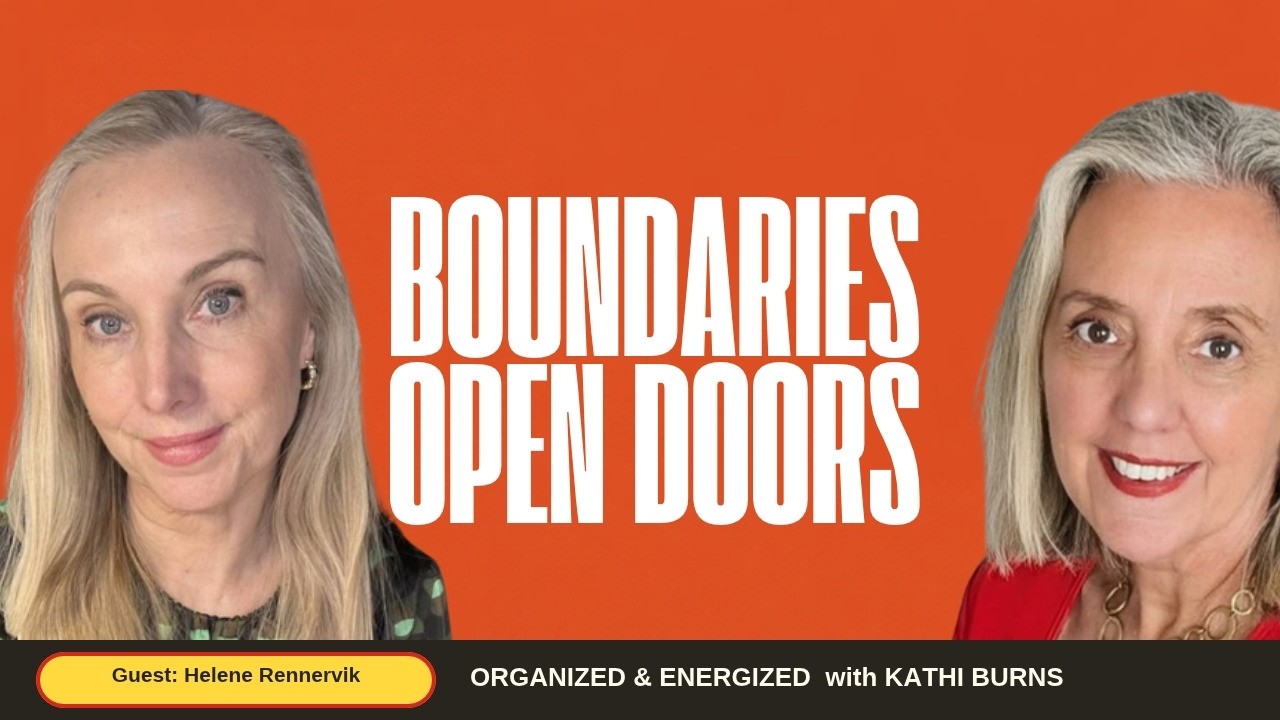
with Helene Rennervik, coach and consultant, creator of The Power of No Without Guilt · December 10, 2025 · 38 min
Coach Helene Rennervik created The Power of No Without Guilt, a program that helps high-achieving professionals set boundaries without feeling guilty.
Helene's first step is to pause before saying yes and ask whether the request will serve you, now and in five years.
Kathi Burns suggests answering a request with: Thank you so much for thinking of me. Can I look at my schedule and get back with you tomorrow?
Helene says boundaries are not restrictions but openings, because honoring your limits gives you the energy and space to be yourself.
She offers a free People Pleaser quiz that takes two to three minutes and shows where you fall as a people pleaser.
Published · Updated
What is this episode about?
Kathi Burns, CPO®, Business FLOW Strategist, talks with Helene Rennervik, a coach and consultant with more than 30 years of international experience in leadership and coaching, about how to say no without guilt and make room for what matters. Helene trained as an interior architect, spent 26 years in Abu Dhabi and Dubai, and was a country manager for a large company when, at 41, she realized her values no longer matched her work. A career coach helped her step away, and she moved into health and fitness before launching The Power of No Without Guilt. You'll hear why Helene pauses before every yes, the four questions she asks when something shows up, why she calls her body her best organizing app, why she would tell her 18-year-old self to live from three core values, and how boundaries create more joy.
Boundaries are not restrictions. They're actually openings.Helene Rennervik
Jump to links and resources · Part of How do I grow my business without burning out? · All episodes · Every guest
What are the key takeaways?
- Helene Rennervik says there is nothing wrong with being a giver, as long as you include yourself.
- Before saying yes, Helene pauses and asks whether the request will serve her and whether it will serve her in five years.
- Kathi Burns tells corporate audiences they have permission to say no and suggests asking for a day to check the schedule before answering.
- Helene left a country manager role after 15 years when, at 41, her values no longer matched her work; a company-provided career coach helped her find her next step.
- When something shows up, Helene asks four questions: What is this? What do I do with this? Can I change it? How do I change it?
- Helene plans her week on Sunday, picks about three things to focus on each day, and rests when her body tells her to.
- Her advice to her 18-year-old self is to narrow her values to about three and live from them; hers are honesty, trust and curiosity.
This episode is brought to you by the Business Logjam Session
A private 75-minute online session with Kathi Burns to find the one thing holding your business back and leave with your next steps. It is the same F.L.O.W. process Kathi uses with her own clients: Focus on your goals, Locate your logjams, Outline your solutions, Walk away knowing your next steps.
Find What's Holding Me BackInterested in sponsoring the show? Get in touch.Is it better to focus on one thing than to multitask?
Helene Rennervik thinks it often is, and she includes herself in that focus. She recalls a well-known Swedish finance speaker telling the women in his audience not to try to be perfect in everything and to do one thing well. Kathi points out that women have long been expected to multitask. Helene says she used to believe she should multitask, but with age she has learned to slow down instead of spreading herself across five people at once.
How do you say no without guilt?
Pause before you answer and ask whether the request will serve you. Kathi Burns suggests saying, "Thank you so much for thinking of me. Can I look at my schedule and get back with you tomorrow?" That buys time to decide. Helene adds that she can say no with kindness, especially to herself, because she counts too.
What should you do when your values no longer match your job?
Take a pause to work out what you want next, with help if you can get it. Helene had spent 15 years at a large company in the Middle East and was a country manager when, at 41, she felt her values no longer matched her work. The company gave her a career coach, who helped her start to see who she really was. Part of it was guilt: she sold products like cigarettes, and her mother had died of lung cancer.
Why does working outside your strengths drain your energy?
Because you can learn almost anything, but skills outside your strengths cost more energy. Helene's top Gallup StrengthsFinder strengths are positivity, empathy, woo, strategic and communication; she is strategic but not analytical. A finance course for non-finance managers taught her a lot and wore her out. She believes schools rarely let children work in their strengths.
What does it mean to live in the question?
Living in the question means asking a real question without already deciding the answer. When something feels wrong, Helene asks what's right about it that she isn't getting. Her four questions are: What is this? What do I do with this? Can I change it? How do I change it? Then she waits for the answer.
How do you stay organized by listening to your body?
Helene plans loosely and checks in with her body each day. She plans her week on Sunday and relies on calendar notifications, then each morning asks what she, her body and her business can do that day and picks about three things to focus on. If her body says she doesn't feel great, she rests. She calls her body her best app.
How do you find your core values?
Helene suggests narrowing them to about three and living from those. That is the advice she would give her 18-year-old self, because when you live from your values everything else falls into place. Her core values are honesty, trust and curiosity, and she has asked why ever since she was a little girl. She says real strength comes from inside, not from what other people say you're good at.
How do boundaries create more joy?
Boundaries create joy because they are openings, not restrictions. Helene Rennervik says that when you honor your limits, you gain the energy, presence and space to be yourself, and feeling like yourself again is where joy begins. Kathi adds that you don't have to spend the holidays with family; decide what's good for you and set it up.
Where does each part of the conversation start?
- 0:47 Meet Helene Rennervik
- 2:11 Saying no with grace
- 3:08 Don't try to be perfect in everything
- 5:37 Permission to say no
- 7:11 From interior design to Dubai
- 9:14 Losing everything and starting again
- 10:15 When your values stop matching your job
- 13:00 Working outside your strengths
- 14:57 Into health and fitness
- 18:47 Living in the question
- 22:01 Four questions to ask
- 23:19 Her body is her best app
- 28:08 Advice to her 18-year-old self
- 31:41 People Pleaser quiz and Helen AI
- 35:20 How boundaries create joy
What resources were mentioned?
- Helene's free People Pleaser quiz (ScoreApp)
- The Power of No Without Guilt program
- Helen AI, Helene's AI coach built on CoachVox (launching on LinkedIn and her website)
- Gallup CliftonStrengths (StrengthsFinder)
- Body Balance, yoga and Pilates
These episodes continue the same thread as this one: Lia Dunlap, Carly Church, Ginny Priem, Stephanie Wall Morrow also answer the question "How do I grow my business without burning out?", and the rest are the most recent conversations on the show.

 MotherhoodEpisode 147
How To Build a Village That Supports Your Business and Your Life with Carly Church

See every episode on the podcast archive or filter by topic on the How do I grow my business without burning out? hub.
How can I support the show?
- Subscribe on Apple Podcasts, Spotify or YouTube, or add the RSS feed to any app.
- Rate and review. A rating on Apple Podcasts helps new listeners find the show, and Kathi reads every review.
- Share the episode with one business owner who needs it; the share buttons are at the top of the page.
- Grab a free eBook: 6 Steps to Organize & Energize Your Home, 6 Steps to Organize Your Home Office or 6 Steps to Organize & Energize Your Life.
- Work with Kathi. The Business Logjam Session is a private 75-minute session to find what is holding your business back.
- Be a guest. Apply here if you have a story about clearing the obstacles in your business.
What did they say, word for word?
The transcript below is edited for readability: filler words and false starts are removed and speaker names are added. Nothing was added or summarized.
Read the full transcript +
Kathi: Hi there. I am back with the podcast, and my guest today is Helene Rennervik. We're going to have a great conversation, because we have similar messaging and similar thoughts. We were brought together for a definite reason. Helene is now on a path of talking about how to say no without guilt and how to create space for success. We talked about boundaries. We talked about how it's good to set boundaries, that it gives you freedom and joy. A little bit about Helene: she's a visionary coach and a consultant with over 30 years of international experience in leadership, coaching and personal transformation. Helene thrives on helping high-achieving entrepreneurs and professionals break free from perfection. She is a perfectionist that is no longer a perfectionist, and she's no longer a people pleaser. Although she does people-please from time to time, she chooses when and what to do it. It's not a thing that she does automatically. As I often say, hey, you have permission to say no. Helene's the creator of The Power of No Without Guilt, and her signature program is designed to help busy leaders reclaim their energy and focus on what truly matters. You're going to love this podcast. So stay tuned, and we'll be right back.
Kathi: I'm so happy to be here today with Helene. We're going to talk about something that I love: how to say no with grace and not feel guilty. Helene's been teaching people this for years. So welcome to the show, Helene. It's so nice to have you here.
Helene: Thank you. Actually, it's quite new. I launched The Power of No Without Guilt only in July. However, I have lived through this for a long time, being the perfectionist, being the people pleaser. However, there's nothing wrong with that. I love to give to people, but should I not include myself too?
Kathi: Absolutely. That's what we do, right? As women, we often say, okay, do this, and take care of yourself, and, oh, what about me?
Helene: Yes. And you can have that conversation to see yourself. Would you tell your best friend or your little sister the same things that you do? Oh yeah, of course I can do that. I was at an event last week about finance. It was mostly men, and the man there is well known here in Sweden in finance. He said, I would like to give the women here in the audience one piece of advice: don't try to be perfect in everything. Because it's really true. We fight ourselves. Just concentrate on one thing and do that really well. But again, I love doing lots of things.
Kathi: As you're saying that, Helene, I'm going, hmm, that sounds like such a man thing. Focus on one thing and do it well. That's the capacity and the inner being of a man. As women, sociologically, we've been bred to be multitaskers. We had to, right? He caught the beast, and we did everything else. We dealt with the beast once it got there. We prepared it. We cleaned. We set up a place to eat. We served it. We cleaned it. Blah, blah, blah. And all the while taking care of the little brood around us.
Helene: But when I was younger, I used to think that I should multitask. With age I have got the wisdom that maybe it's better to focus on one thing and also include myself in it. Yes, pause before you say that yes. Is this going to serve me? Because I know what I'm here for, my purpose, but is this going to serve me? Because this is what happens: we try to be there for maybe five different people and then do a little bit for all of them. So that's what I think maybe he meant: just focus on that thing at that time. Although sometimes, if we are a mother and a career woman, then we have to do so many things. But with age I have actually slowed down and don't feel guilty about that. If I say no, it's okay, and I can do that with kindness, especially to myself.
Kathi: Especially to yourself.
Helene: Yeah. I count too.
If I say no, it's okay, and I can do that with kindness, especially to myself.
Kathi: The universe aligned us for this podcast, I know, because something that I say all the time when I'm speaking to corporate environments is, hey, I give you permission to say no. If someone asks you to do something, this is the best response: Thank you so much for thinking of me. Can I look at my schedule and get back with you tomorrow?
Helene: Exactly.
Kathi: So it gives permission to pause and, like you said, Helene, figure out: does it serve you? Is it going to serve you to do this extra task that everybody wants you to do? Let's put it that way. Our propensity is always to say yes. So I absolutely love your messaging. Talk to me a little bit about your background. How did you get to this epiphany last July that you're going to start speaking about this topic?
Helene: So let me start. I do lots of different assessments, but one assessment that I really appreciate opened up a lot of different possibilities for me and helped me find my inner strength, which has always been there. From Gallup StrengthsFinder, my top strengths are positivity, empathy, woo, which is winning others over, strategic and communication. If I look at what I'm doing today, it stimulates my strengths, and that's how I can do more and more and more. Being positive doesn't mean, oh, she's happy all the time. No. Even when it's really hard and dark, I always look for more possibility.
Helene: How I started out my life is that I'm an interior designer. That's what I studied, and I worked in just a tiny, tiny frame of that. I'm from Sweden. I lived here until I was 16. Then I moved to Denmark, where I studied at an international school. All of a sudden I had to start to speak English, because in Sweden we speak Swedish, and a lot of things opened up. I found that my passion then was all these creative ways, mostly with form and colors and all these yummy things.
Kathi: Aesthetics.
Helene: Yes. And then I went to London and studied, and I became an interior architect. I met my then husband there, and we moved to America for six months. After six months I wanted to just go home. It was Christmas time, and I missed Sweden. Then when we came here, I didn't want to leave. Okay, what's he going to do here in Sweden? Anyway, we stayed here for two years. He's not from Sweden, so it's a little bit more difficult if you don't speak the language. Now everyone does speak English here too.
Kathi: Mhm.
Helene: And then we ended up in the Middle East, in Abu Dhabi and Dubai, and that's where I spent 26 years. I only returned to Sweden ten years ago. Not planned. Sometimes life happens. Everyone is talking about how you want to earn more and this and whatever. If you climb up the ladder in everything, in the way you live, it's easier, because you climb and you get more and more and more. But sometimes maybe you go down. What do you do then? Because if you're willing to lose everything and then start to build again, that's when you really, I think, find success. That's when you go deep. That's when you start saying, hmm, why am I here? What should I be doing?
If you're willing to lose everything and then start to build again, that's when you really, I think, find success.
Kathi: I'm a career reinventor myself. I've had seven different careers. And I think at each pause, that's when you really say, what did I like about that? What didn't I like? What are my strengths? What's funny to me is that finding your God-given gift, or your dharma, which I know you're following now, sometimes takes a pause. You can't find it otherwise. My original company was Add Space to Your Life, because I had a year off to reinvent myself. Without that, I would have never become a professional organizer. Without your pause, you might not have ever figured out your new messaging, right?
Helene: So I was 15 years in a very large company in the Middle East, and then all of a sudden I had turned 41. My values were different. I didn't really know then that it was my values, but they didn't match. I had no idea. You don't leave when you are the country manager of a country for this large company. You don't leave. But I didn't know what to do, and that's when I got a career coach from the company, which was very kind of them. All of a sudden I started to take off, and she said, now we can start to see who Helene is. The way I started dressing, because working in corporate you have to be a certain way, you have to speak a certain way. I couldn't really be me. I started there when I was only 23. Fifteen years later, it was great. I learned so much. I met so many wonderful leaders, I had wonderful bosses, and I had a fun job. But then all of a sudden I was steered in a direction that wasn't me, and I didn't know it. Of course, you get a bigger promotion, you earn more money and this and whatever. And I was a mother of four, and all of a sudden I'm like, what am I doing?
Kathi: Right. I call it following the money, chasing the money train, which I did for a while as well. And from 25 to 40 is a huge, significant change in you. I think it's very interesting. So your company actually assigned you, or gave you the option of having, a career coach because they wanted you to advance, or because they saw that you were not fitting where you were? That's interesting.
Helene: I think it was also a little bit because I had to sign a lot of forms, because I had done the five-year plan forward. I had served them really well. I had done really, really well. I had no idea what I wanted to do, because most of the time when you work in corporate, you go to a competitor, but that's not what I wanted to do. I really didn't know what to do. I needed that pause to see what I want to do, and then everything changed. It was also a little bit of guilt. I sold things like cigarettes, and my mom had died from lung cancer.
Kathi: Mhm.
Helene: And my sister had got cancer, and then all of a sudden: what am I doing?
Kathi: Right. What's the best piece of advice that the career coach gave you?
Helene: That I could find myself. I had not worked with interiors, and she could see this is what I really enjoy. And I love that, but there is more. I found that later again, because now I know my five strengths. Communication, strategic. I'm not analytical at all. However, I'm strategic, and I love to put strategies together, which served me when I worked there. But I'm not somebody who loves to sit with numbers. I know numbers. They sent me to great courses. I went to Belgium for a week for finance for non-finance managers. Oh my God. I was like, oh my God, my head. Because I needed to know, and you can learn that. But it took a lot of energy from me, because that wasn't really my strength. When you're not working in your strengths, we can all learn. And that's what I believe about school: they don't really let the children be in their strengths. Yes, we can learn. We can become good at a lot of things, but it will take a lot of energy from us. And that's what I felt I did. When I started in the career, I was in events and promotions, and that was so much fun. But then, when it started to get more serious, and I can be serious too, but…
We can become good at a lot of things, but it will take a lot of energy from us.
Kathi: Right. Then you don't get to do the events anymore. You manage the people who manage the people who do the events, and then you're five steps removed from the creative process of the events. I totally understand that. I think that's fabulous. So once you left that company, what did you do? What did you launch?
Helene: So then I took some time to be with my children. I had four children. I had a little baby. This was the hardest, because that last year I had my youngest son and I hardly saw him. I used to cry, and his father said, so quit your job if you're going to sit and cry. After three months, as a woman and your body, I wasn't ready, but I had to be thrown into that hustle, hustle, hustle all the time, and it took a toll on my body. My body actually said no, this is not what you want to do. So I was with this career coach for six months, and at the same time, I've always loved physical training. I did Body Pump, Body Balance and Body Combat every day, and I could take my son to the nursery there. It was Dubai Ladies Club, a beautiful club. And then one of the trainers there said, why don't you do this? I'm like, yeah, why don't I do this?
Kathi: Ah.
Helene: So that's where it started. I went into health and fitness. It started there because I'm like, yeah, I love this. And I love being on stage. I love talking. That's what you get to do there, but in a structured way, because you're actually teaching classes. I get to be with people, and it's all energy, and it was great. So I started with Body Balance and then group exercise. I went into yoga and Pilates, and actually now I'm doing my certification in pure Pilates, because Body Balance is a mixture of tai chi, Pilates and yoga, but not pure Pilates. I'm not teaching that, but I still want to keep the certification, because I have also invested in a Pilates brand.
Kathi: Pilates, that's my modality. I did yoga and hot yoga and tai chi for years, and then I found Pilates, and I just love it. So are you still doing that now? Are you running Pilates studios?
Helene: No, I don't. But since I have invested in the brand, and we have a line of workout clothes, I thought, okay, let's do that. To keep your certification, you need to do new modalities, so I thought that's what I want to do. Also, Pilates is a very grounded way. It's great for everyone, but especially for women when we come to an age, it's so important, because it's both strength and also mind. But yoga also. I have done different kinds of yoga modalities. Sometimes I just teach small groups, but it's not anything I do all the time. One of my friends said, why don't you come to our studio? But it's also a commitment to the people that you are training, because if you start as a trainer, then they want to see you there. So I will substitute for some people there, just to keep it up. And I love it myself, too.
Kathi: Yeah, we all have our favorite instructors, right? It's like, oh, where's Helene? Oh, Helene's just a sub. No, I want Helene. So talk to me about whenever you have an obstacle, like a change. What are your tactics? I would think stepping back and analyzing would be your number one go-to when you have an obstacle that you're trying to face.
Helene: Yeah. So I live from questions, but not to have the answers. A lot of the time, and that's what I did before, you sit and do something strategic, and then this is the outcome. But right now that doesn't work for me, because I cannot 100 percent get that answer. Whatever I predict, and then what happens? We get disappointed. So live in the questions: what else is possible now? That's one thing. And then you can add on: if something feels wrong, instead of going there, because then your mind goes there, ask, what's right with this that I'm not getting? Or, what's right with me that I'm not getting? Because then your mind will start to look for those possibilities and something that will be right for you. So be in the question, not knowing the answer, because a real question is one where you don't know what the answer is. Living from questions is very, very important.
If something feels wrong, ask, what's right with this that I'm not getting?
Helene: And also to stop and pause, and especially now with The Power of No, to just pause for a moment, not just to have the answer right away. Because when we pause: okay, will this benefit me? Will this serve me in five years? When we know how our body feels, because that's also very important, to be aligned with your body, to know what is right for me. Because what is right for me is not right for you, and how right feels for me is maybe not how right feels for you. So it's not just to be in your mind or your body, but the full you, to really know what is feeling right for me. Your intuition, which I was maybe made wrong for, but I can actually feel what is right for me before I have an answer. So go with that. I really believe that.
Kathi: Yeah. And I think that comes from pausing. When you pause more and then you see the results of your thought, then you're more confident to follow your intuition. I love what you said about stopping and being in the question. Oftentimes I'm like, well, isn't that interesting? I wonder why. I wonder what this means to me. So it's like being here now, being open. And I think a question is being open and receptive.
Helene: Yes. But again, that's maybe not easy to do right away, because we have been taught to have an answer. If you think back to when you were at school, they ask, okay, and you put up your hand: I have the answer. But this is just to trust yourself and to create clarity and ease. I can share these four questions. When something shows up, ask yourself: What is this?
Kathi: Mhm.
Helene: And wait for it. We are always in a rush. Just wait. And then, if you feel something, maybe you don't have the answer: What do I do with this? Whatever that is that you're feeling, or maybe you saw something or something came up. Can I change it? Okay, I can change it. How do I change it? Because then something will show up. It's just to have that little pause, and the patience to wait for it to arrive to you. Being open and receptive.
Kathi: Yeah. If you live in the open and receptive, then you do live in the question, which makes you live in the now, because you're like, okay, hmm, let's think about that. And I like, what can I do about it? And then I would say, do I do anything about it, or do I just watch it ride?
Helene: Yeah. Because some things maybe we want to just let go of. We have so many thoughts and feelings and emotions that come through us every day. Do we need to fill our head with more things? Maybe not.
Kathi: Yeah. Okay, I have to shift gears, because I have to ask you, as I ask all my guests: how do you stay organized? What's your favorite organizing hack or modality that you use to keep in alignment and keep focused on where you want to go?
Helene: I was quite organized before too, but now it's to be in the present. I usually plan on Sunday, so then I know more or less what I'm going to do for the week. And obviously, if I'm having clients or we are coming on here, I love my calendar. I get a notification: okay, this is what you are going to do in one day, and then one hour and half an hour. But it could get overwhelming. So in the morning, wake up and ask: what can I, this body and my business do today? Ask that and see it coming, and focus on maybe three things every day. That is really important. At the beginning of the week, on Sunday, because Monday my week will start, and it can be different in other areas of the world, I know this is what I would like to achieve this week, if that's important for me. Maybe it's not important. Maybe at times, if I feel in my body that I don't feel great, okay, maybe then I just need to rest. So I lean into my body. My body is actually the best app.
I lean into my body. My body is actually the best app.
Kathi: Your favorite organizing hack: your body.
Helene: But not in the head. So be in the question, because I don't know what will show up. Be in the question.
Kathi: I just love that. That's my favorite answer so far. Your favorite organizing hack: my body. And it does make sense. Many people are not trained to listen to how their body responds or what their body says. So I think that's a great response.
Helene: And the body will say. I will tell you one thing quickly before you go. Yesterday I went to a chiropractor, because I do believe it's very important when we move to also get adjusted, because the body, ribs, muscles, everything moves. I had not eaten, but I was feeling so bloated I could hardly breathe. I was drinking mint tea and all sorts of herbal things, and I felt so bad. When you're not feeling good in your body, you get a little bit agitated, and my son could feel it. We both went to our chiropractor, and she just pressed on my back, and then I was just, yes, I feel so great, because my body was not in alignment. So the body knows. Not everyone likes chiropractors, but I have a really great holistic chiropractor. All of a sudden I felt great, and that also had an effect. My son also felt it. My friend was there; she hadn't been there before, and she said, okay, she's so happy. Yes, I felt happy because my body felt so great.
Kathi: Uh-huh. Isn't it funny how one little push from a kinesiologist or a chiropractor could just shift things?
Helene: And that's in our business too. Maybe we are on the right target. Instead of a goal, we can have a target. Maybe we are on the right one, but maybe we just need to tweak it or pivot a little bit.
Kathi: Exactly. Exactly. One thing that I say all the time is that a small, seemingly insignificant shift will lead to larger-than-life results, always. And that's the same with getting organized, with a chiropractor or kinesiologist, with getting your mind in order. A small shift, five minutes of doing nothing, silence, has larger-than-life results all the time.
Helene: Yeah.

Kathi: Well, Helene, wow. You've lived all over the world. This is so fascinating to me. And you started with the big corporate job in your twenties. If you had to look back and talk to your 18-year-old self and give that young woman advice, what would you say to her right now?
Helene: I would tell her: Helene, what are your values? What are your values? We can have lots, but then just take them down to maybe three values and live from those. Because when we live from our values, then everything else will be correct for you. Your real strength, like I said, comes from the inside, not from what other people say she's good at. And people said I was good at things, and I just went along, because I didn't say, no, no, no, stop.
Kathi: Right. Right.
Helene: And then you're like, okay, I'm good at that. I'll go there.
Kathi: Yeah.
Helene: But when you discover your core values, and of course you can evolve over time, mine are honesty, trust and curiosity. It's always been that. When I was just a little girl, I used to ask why. I used to ask questions. People got so annoyed with me: she's always asking questions. But that's one of my biggest strengths.
Kathi: Mhm.
Helene: But then I was quieting that down, and that maybe didn't serve me in the best way, to think that I had to be perfect all the time. It's okay to be enough.
Kathi: It's interesting. When we're 18, what are our core values? We don't really think about that. We think about what people have put onto us. I'm with you on that. And I think it's amazing, as women, and those of you who are listening, that as we evolve and get older, we begin to give ourselves permission to really introspect and see what I really love and how I'm using my skills. It took me until 40 to figure out what I should do when I grow up, and I finally found this career that I've been in. It takes a while. And that's what I love about maturing: we have more time to not just react. And that's one thing about assessments in high school: they put us on these paths. It's like, oh, you're really good at that, Helene. You should do that. This is what you should be when you grow up. It's a crazy thing. It's good and it's bad. I just have mixed feelings about all the testing and the career paths that we're supposed to follow.
Helene: I think it's going to change. You can see different age groups, and there's good and bad in everything. In the age group we were growing up in, we had to perform, perform, perform, perform more. That was where you get the trophy, for delivering more, like you said before. Maybe it's just that pause, and just to do less.
Kathi: Mhm. Interesting. So I know that you have a valuable resource that people can download or take. Talk about that a little bit.
Helene: It's called the Score App, the People Pleaser. It's very easy. It takes two or three minutes, and then you can see where you fall within this people pleaser. I'm a recovering people pleaser, and I am a people pleaser at times, but at least I'm aware of it. Because maybe it's that word, or, I don't want to be that. I was just speaking to a young lady and I asked, so what do you think people pleasing is? Somebody said, oh, just be like this, but I can't. But there's nothing wrong with being that giver. Just include yourself, and if it doesn't serve you and if it doesn't do you well, then find something else.
Kathi: So you have the people pleaser quiz, and we will give the link down here.
Helene: And I have something new coming up.
Kathi: Let's hear about it.
Helene: So I am creating Helen AI. She's actually going live soon. It's through CoachVox. I have made this, and it's amazing. She answers everything. She's me. I programmed her, especially for The Power of No Without Guilt. But of course you can ask her other questions too, and that's how you sit and fine-tune it. It really is amazing, because I can't be there with everyone 24/7, and maybe not everyone wants to speak to me, but maybe they have a little bit of difficulty with boundaries and people pleasing and being the perfectionist, whatever that's going to be. So that's something that is coming out soon. It will be on LinkedIn. LinkedIn is a very great place to find me. I try to share everything there that adds value. It's lived values, from me or from my clients or from friends, so these are real stories. They're not just created out of nothing. Sometimes people reach out to me and say, what you were saying there, I see myself there. But some people don't feel comfortable reaching out, and that's why I thought, yes, AI can be good or bad or right or wrong or whatever, but as a coach moving forward, I need to be coming along with what is there. It's a great way, and everyone can go and make their own AI too. But mine is going to be there so they speak to me.
Kathi: Helen AI, fantastic. And that's going to be on LinkedIn, a link on LinkedIn?
Helene: Yeah, I will have it there or on my website.
Kathi: I love it. I'll make sure to put your LinkedIn in the show notes, as well as the link so that they can take the little quiz to find out how much of a people pleaser they are. I love that. Now, is there anything that I should have asked you that we didn't discuss that was on your mind?
Helene: Ah, yeah. What could that be? Maybe: how do boundaries create more joy?
Kathi: That's a good one. Okay. Inquiring minds want to know.
Helene: Because boundaries, that word, a lot of people react to that. And joy, for me, joy is a word that is like, wow. Because I see boundaries are not restrictions. They're actually openings. When you honor your limit, then you gain that energy and presence and the space to be yourself. And when you feel like yourself again, that's where joy begins.
Kathi: I love that. We're filming this as we go into Thanksgiving here in the United States, and I just wrote recently about boundaries. We're so much in alignment. We're going to be girlfriends.
Helene: We are girlfriends. Seriously, we are starting now.
Kathi: We are starting now. We are now friends. Yay. When I come to Sweden, I'm going to look you up. But I think that boundaries do create joy. I tell people you do not have to spend Thanksgiving with your family. You don't have to spend the holidays with your family. Decide what's good for you and set that up. And then, as you say, Helene, it does bring out joy. And when you're in joy, you're fun to be around anyhow, and you're going to be better serving those around you as well as yourself. So it is selfish to set boundaries, and it's self-goodness to set boundaries. I think there is a point where we have to learn to be selfish so that we can be better for those around us. So thank you. I'm glad you brought that up. It's such a pleasure to meet you, and I know the universe put us together, because it's so funny how the guests that I have on the podcast and I come from the same place and say different words and use different modalities, and that's what makes it better. So thank you so much for being a guest. It's a pleasure to meet you, Helene.
Helene: Thank you so much, Kathi, for having the space and for letting me share my story here. That's what I do believe: we all get together at the time that was perfect for us to meet, and then share the learnings that life throws at you.
Kathi: Yeah, absolutely. So for you listening out there, make sure to take the quiz and figure out how much of a people pleaser you are. Also, if you like this podcast, please give me a thumbs up. Please leave comments. It helps me greatly to grow the show. Until next time, I'll see you all then.
Where can I find the links and resources from this episode?
Connect with Helene
Organizations and companies
Inspired? Here Are Your Action Steps:
- Pause before you say yes and ask whether the request will serve you, now and in five years.
- Answer requests with: Thank you so much for thinking of me. Can I look at my schedule and get back with you tomorrow?
- Ask yourself whether you would talk to your best friend or little sister the way you talk to yourself.
- When something shows up, ask: What is this? What do I do with this? Can I change it? How do I change it?
- When something feels wrong, ask what's right about it that you aren't getting.
- Plan your week on Sunday and pick about three things to focus on each day.
- Check in with your body each morning, and rest when it tells you to.
- Narrow your values to about three and make decisions from them.
- Take Helene's free People Pleaser quiz to see where you fall.
Frequently asked questions
What is the kindest way to say "no"?
+
Kathi Burns suggests thanking the person and asking for time: "Thank you so much for thinking of me. Can I look at my schedule and get back with you tomorrow?" The pause lets you decide whether the request will serve you before you commit. Helene Rennervik adds that you can say no with kindness, including kindness toward yourself.
How to politely say no without offending?
+
Start with thanks and don't answer on the spot. Kathi's suggested response thanks the person for thinking of you and asks to check your schedule first. Helene says the pause lets you ask whether the request will serve you, so your answer comes from your own values rather than from automatic people pleasing.
How to feel less guilty?
+
Helene Rennervik says there is nothing wrong with being a giver, as long as you include yourself. With age she slowed down and stopped feeling guilty: if she says no, it's okay, and she can do it with kindness, especially to herself. She also asks whether she would talk to her best friend or little sister the way she talks to herself.
How do I know if I'm a people pleaser?
+
Helene offers a free People Pleaser quiz on ScoreApp that takes two to three minutes and shows where you fall. She calls herself a recovering people pleaser who still pleases people at times, but by choice and with awareness.
How do boundaries create more joy?
+
Helene says boundaries are not restrictions; they are openings. When you honor your limits, you gain energy, presence and space to be yourself, and that is where joy begins. Kathi adds that when you're in joy, you serve the people around you better as well as yourself.
Who is talking in this episode?

About the Host, Kathi Burns
Kathi Burns, CPO®, is a Business FLOW Strategist based in San Diego. For the last 20+ years, Kathi has helped clients create systems they can stick to. She is the author of How to Master Your Muck, Organizing With Tetris and Home Organization, The Smart Guide, and co-author of four more titles; all are in Kathi's shop. Kathi's business has been featured on Good Morning America, and her advice has been featured in Oprah Magazine, Martha Stewart Living, Better Homes and Gardens and Entrepreneur Magazine.
More about Kathi · Shop Kathi's books · Business Logjam Session · Apply to be a guest

About Helene Rennervik
Helene Rennervik is a Sweden-based coach and consultant with more than 30 years of international experience in leadership and coaching, and the founder of Helene Rennervik Consulting. She trained as an interior architect in London, then spent 26 years in Abu Dhabi and Dubai, including 15 years at a large company where she became a country manager. At 41, when her values no longer matched her work, she left with the help of a career coach and moved into health and fitness, teaching Body Balance, yoga and Pilates. In July she launched The Power of No Without Guilt, a program that helps high-achieving professionals set clear boundaries and protect their time and energy. She also offers a free quiz.
Want help putting this into practice?
Book a Business Logjam Session with Kathi
A private 75-minute online session to find the one thing holding your business back and leave with your next steps, using the same F.L.O.W. process Kathi uses with her own clients: Focus on your goals, Locate your logjams, Outline your solutions, Walk away knowing your next steps.
Prefer to start small? Download Kathi's free eBook 6 Steps to Organize & Energize Your Life.
Published · Updated
This episode page is for general information. Guests speak for themselves, and their opinions, statistics and examples are their own. Nothing here is legal, financial, medical or mental-health advice; talk to a qualified professional about your own situation. Some links go to the guest's own products or free offers; addSpace does not earn a commission from them unless stated.