

Episode 121
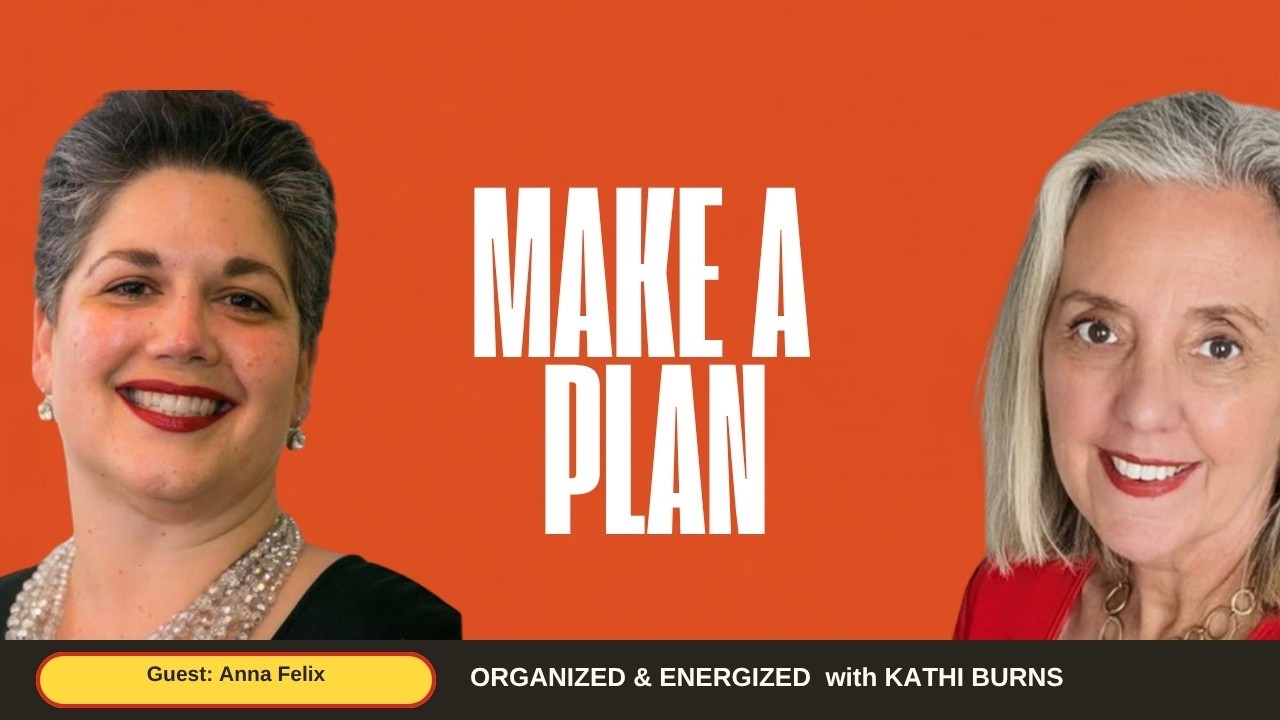
with Anna Felix, financial strategist who helps women and families prepare for the unexpected · September 3, 2025 · 25 min
Anna Felix was widowed while already carrying heavy medical debt from a car accident five years earlier, so she started her financial rebuild below zero.
Three financial advisers had nothing for her, and one told her to marry a rich guy, so she researched her options herself and built her own plan.
Anna now works as a financial strategist helping women and families prepare for the unexpected, and her goal is that every person she meets leaves better off.
Her advice to people who keep putting off money conversations is to put them on the calendar, and to start an emergency fund with one month of savings if six months feels out of reach.
Published · Updated
What is this episode about?
Kathi Burns, CPO®, Business FLOW Strategist, talks with Anna Felix about handling the unexpected in a financially responsible way. Anna never planned to work in finance. She was an educator and an interpreter in three languages until she was widowed while carrying medical debt from a car accident, starting, in her words, below zero. When three advisers had nothing for her, she taught herself and built her own plan, and other women started asking for help. You'll hear why Anna says to put the money talk with your family on the calendar, why she tells people who can't picture six months of savings to start an emergency fund with one month, and how a newly divorced client who canceled their first meeting twice ended up on a plan and running her own business. Anna also explains why she believes you don't need a lot of money to start a plan.
Often you're way better off than you think. But even if you're not, you've got to know what you've got to do moving forward.Anna Felix
Jump to links and resources · Part of How do I grow my business without burning out? · All episodes · Every guest
What are the key takeaways?
- When Anna Felix was widowed, she and her husband had already liquidated everything they had over five years of medical bills from a severe car accident.
- Anna says they didn't have enough life insurance and didn't have a plan with living benefits, which she now tells everyone about, because tapping the death benefit could have paid those bills without selling assets.
- Anna's approach to putting off money conversations is to put them on the calendar, and she invites people to use her story to open the conversation with a spouse or parent.
- She says many people go years without a plan because they don't know what to do, so in the absence of a plan they do nothing; her advice is to research as best you can and then move forward.
- Anna's approach to an emergency fund is to aim for at least six months, but to start with one month and add more instead of giving up.
- A newly divorced client who had never handled the family money didn't know the balance of accounts she had inherited; taking small steps, they found what she had and filled the gaps in her plan.
- Anna meets people wherever they are, and if there's nothing to do yet, she gives them a road map for when there is.

This episode is brought to you by the Business Logjam Session
A private 75-minute online session with Kathi Burns to find the one thing holding your business back and leave with your next steps. It is the same F.L.O.W. process Kathi uses with her own clients: Focus on your goals, Locate your logjams, Outline your solutions, Walk away knowing your next steps.
Find What's Holding Me BackInterested in sponsoring the show? Get in touch.How do you survive financially after the death of a spouse?
For Anna Felix, it meant learning her options herself and building her own plan. When she was widowed, she was already deep in medical debt from a car accident five years earlier, and she and her husband had liquidated everything they had. She met with three financial advisers who didn't listen, and one told her to marry a rich guy. Walking back to her car after that third meeting, she decided to research it on her own, the same way she had researched brain injuries when they came up in her life.
What financial plan should you have before the unexpected happens?
Anna says the plan she wishes she'd had would have included enough life insurance and a policy with living benefits. In her case, being able to tap into the death benefit could have paid the medical bills without liquidating assets. No one had ever mentioned that to her, which is why she now says you have to know this stuff and talk about it.
How do you start the money conversation with your family?
Put it on the calendar. Anna says most people know they need this talk, but it's easy to push it to next week until another year has passed. If you need a reason to raise it with a spouse or parent, she invites you to use her story: her life would have been so different had she done this sooner.
Why do people put off financial planning?
Anna says many people go years without a plan because they don't know what to do, so they do nothing. Her advice to her younger self is not to be afraid of the unknown and not to be paralyzed by fear. Do the best research you can for the moment, then move forward. Kathi adds that every small step lets you course correct along the way.
How do you start an emergency fund when you have little saved?
Anna's approach is to start with one month of savings and add more from there. She says an emergency fund should ideally cover at least six months, but many people give up because they have nowhere near that. Even if the money isn't in the best place yet, you've started, so you have something to move later.
What if you're too scared to look at your finances?
Start the meeting anyway and take one small step. A newly divorced client of Anna's canceled their first meeting twice, 15 minutes before it started, and admitted she had been throwing up from nerves. Anna suggested they begin and stop if it wasn't going okay. Twenty minutes in, the woman said she felt so much better, and each small step after that showed her worries she hadn't known were costing her sleep.
How do you find out what's in accounts you don't manage?
Anna's client did it by slowly unpacking each account with Anna's help. Her husband had always handled their inherited accounts, so she didn't know the adviser or even the balances. Together they worked out what she had, what she needed to do and what was missing from her plan. Almost five years later, she's on a plan and running her own business.
Do you need a lot of money to start a financial plan?
No. Anna says she meets people where they are, including women who, like her, were starting over. If there's nothing to do right now, she gives them a road map of what to do once they reach a certain point, so they have a goal to work toward. She says people are often better off than they think.
Where does each part of the conversation start?
- 0:00 Meet Anna Felix
- 0:43 From linguist to financial strategist
- 0:56 Starting over below zero
- 1:54 Advisers who didn't listen
- 2:18 Teaching herself the rules
- 3:38 Interpreting in court and surgery
- 5:41 The plan she wishes they'd had
- 6:40 Put the money talk on the calendar
- 7:49 Urgent versus important
- 8:30 Don't be paralyzed by fear
- 10:34 Start your emergency fund small
- 11:00 Saving with round-ups
- 11:42 A client too scared to meet
- 15:09 Knowing what you have
- 17:18 You can start with very little
- 19:38 A client who sleeps better
- 21:53 Wrap-up
What resources were mentioned?
These episodes continue the same thread as this one: Lia Dunlap, Carly Church, Ginny Priem, Stephanie Wall Morrow also answer the question "How do I grow my business without burning out?", and the rest are the most recent conversations on the show.

 MotherhoodEpisode 147
How To Build a Village That Supports Your Business and Your Life with Carly Church

See every episode on the podcast archive or filter by topic on the How do I grow my business without burning out? hub.
How can I support the show?
- Subscribe on Apple Podcasts, Spotify or YouTube, or add the RSS feed to any app.
- Rate and review. A rating on Apple Podcasts helps new listeners find the show, and Kathi reads every review.
- Share the episode with one business owner who needs it; the share buttons are at the top of the page.
- Grab a free eBook: 6 Steps to Organize & Energize Your Home, 6 Steps to Organize Your Home Office or 6 Steps to Organize & Energize Your Life.
- Work with Kathi. The Business Logjam Session is a private 75-minute session to find what is holding your business back.
- Be a guest. Apply here if you have a story about clearing the obstacles in your business.
What did they say, word for word?
The transcript below is edited for readability: filler words and false starts are removed and speaker names are added. Nothing was added or summarized.
Read the full transcript +
Kathi: Hi everyone. As promised, I'm with Anna Felix, and we're going to talk today about how to take control of the uncontrollable, how to handle the unexpected in a financially responsible way. So, welcome to the show, Anna. It's good to see you.
Anna: Thank you. Thank you for having me.
Kathi: Absolutely. So, I know you've had some ups and downs and life experiences, as we all have. Tell the audience a little bit about your backstory.
Anna: Yeah. So I will say that in this space of financial strategy, I would have never imagined that I would be here. So it's so funny how our life evolves and how we end up where we are today. I was always into languages, linguistics, intelligence. I was an educator and did a lot of interpreting over the years, and that was my space. So very different from financial stuff. But as you mentioned, when I became a widow about 14 years ago, there was a lot that came with that. And obviously there's many different chapters and things to unwrap, but what really kept coming up for me personally was, financially, I do not feel prepared moving forward. What should I do? Because we'd had a severe car accident five years prior to that and had a ton of medical debt, I really was starting below zero, like negative. And it was like, what do I need to do to figure this out? And in my experience meeting with different advisers, I just didn't feel like I was being heard. Because I didn't fit that traditional norm, there was really nothing they could do for me. And I literally had one tell me, "You don't need to understand this stuff. You really need to just marry a rich guy, and that's going to be your best…"
Kathi: The old MRS degree. Oh my gosh, it's still alive and well, huh?
Anna: So, I was like, okay, well, I'm not okay with that. And it was literally walking back to my car from that final appointment, that had been the third adviser that I was meeting with, that I just thought, I'm going to try to figure this out on my own. I'm going to really do a deep dive, as I had done with brain injuries and other things when things cropped up in my life. And that's what led me here, because as I put my plan together, as I learned about things that weren't really mainstream necessarily, and shared with others what I was doing, people kept saying, "I didn't know you could do that. I didn't know you could build money tax-free. I didn't know that you could shield yourself from the volatility of the market." And so it really just led me to, well, there's got to be a lot of other women that need this information, and maybe you could help other people. And so that's really how I landed here. And I feel like, a decade into this now, it really has given some purpose to all of my pain and difficulty, because my primary goal when I meet with someone is to just make sure that they're better off than when we started that conversation. And it might not even be that we end up working together, but that I can bring some value that's going to benefit them and their circle of influence. And so that's really what I love about what I do today.
My primary goal when I meet with someone is to just make sure that they're better off than when we started that conversation.
Kathi: Oh, that's fantastic. So, back up a little bit to the beginning of your story. How many languages do you speak?
Anna: I speak three, including English.
Kathi: Okay. And then you were an interpreter.
Anna: I was.
Kathi: For events, or how did that look?
Anna: Yeah. So for events, for attorneys. I did a lot of court cases, and I worked for several agencies, and it would just be something would come up that they would need. I did a lot of it telephonically. So I did a lot of work in Europe, because the hours I worked were midnight to 8 our time, so it was their time in Europe. And a lot of medical appointments as well. When I worked for some agencies, they would get any type of call. So it could be a 911 call. I literally interpreted during a brain surgery one time.
Kathi: Wow, that's interesting. Interesting. So then you had some disaster strike, and you said you were in a car accident and racked up a lot of bills, and that was prior to losing your husband. So then it all happened, and all that stuff hit the fan, right? And you started exploring financial liberation, or basically financial education. I totally agree that as women, we were kind of disqualified. I still can't believe back then that they were looking for the MRS degree. But at that point, you were on the path. Did you have investments already? Did you have assets, or how did it look for you when you started out?
Anna: Yeah, I did not. Over the process of those five years, we had liquidated everything that we had, and I was in quite a bit of medical debt. And I feel like we had some things in place, but man, it wasn't enough. It wasn't enough life insurance. We didn't have a plan that had living benefits, which today I tell everyone about, because in that situation, if we'd been able to tap into our death benefit, we could use it to pay those bills and to do those things and to not have to liquidate assets. And so there's just so many things that I wasn't aware of at that time. No one had ever mentioned that to me. And so that's my big platform: you've got to know this stuff and we've got to talk about it. Literally this morning, I did a presentation in front of business owners in my local area. I had created this prepare-for-the-unexpected checklist, and they were all saying, "We know this. We know that we need to have these conversations." But it's so much easier to say, I'll do it next week, I'll do it next month, and before you know it, another year has passed, and you just don't always get around to it. So I say put it in the calendar. Let's be organized, to your platform, right? Let's be organized, plan it, decide we're going to do it. And I always tell people, use my story. If you don't feel like you have a significant enough reason to say, let's sit down and talk, to your spouse, significant other, mom, dad, whatever it is, say, "Hey, I heard this story, and this lady's life would have been so different had she done this sooner. And I don't want us to have this situation." Sometimes it's just being able to tell a story and be like, "Do you think we could do better?" That can be the intro to it. So I encourage you, share it.
Kathi: Yeah, absolutely. I love that. And it's important that we speak about it. I did a recent talk myself. I love the fact that you backed up talk with the talk, and now you're on a podcast. You're all ready to go, right? That's time blocking for stuff. What was I going to say? Oh yeah, I was quoting President Eisenhower on the Eisenhower Matrix, and I love this quote. He's like, the priorities are never urgent and the urgent things are never priorities. And it's so very true, isn't it? Because the priority stuff keeps getting the back burner from all the little fires that we think we have to put out as entrepreneurs. It was a pretty cool quote, I thought.
Anna: Yeah, I like that a lot. Thanks for sharing.
Kathi: Yeah, similar to what you just said, right? So, looking back on your career and on your life, what would you tell little Anna when she was small? What advice would you give her?
Anna: Oh boy, lots of things. Where do I even start? But I think the biggest thing is, don't be afraid of the unknown, because I think I held myself back a lot in the beginning going through all of those things, because you just don't know, and you're always second-guessing: if I do this, it'll be that. I mean, yeah, it's good to be rational and to make the best decisions you can, but don't be paralyzed by the fear. And I feel like I did continue to plug forward, but I think in life you just have to do the best research you can for the moment, but move forward. And often I meet with people that for several years haven't put a plan together because they didn't know what to do. And so in the absence of having a plan, in the absence of knowing what to do, they did nothing. And I would say, had I learned that earlier in my life, it could have been helpful.
Don't be paralyzed by the fear.
Kathi: Yeah, absolutely. I think that happens to the majority of people: they overanalyze and they get stuck. And I love the idea of just taking a small baby step, because with every baby step you take, you're going to course correct anyhow. You're going to realize, oh, maybe not quite that way. Ziggy zaggy, because that's what life is: a zigzag around getting to the point of where you think you want to go, which could even be changed by the time you're done with it.
Anna: Yeah, that's so true, because you might take a few steps and then be like, "Oh, okay." And when it comes to money, if you're saving it, maybe you don't have it in the best place, but you're already starting, right? So when you do find a better place, you've got something to put in there. And just today, in that same conversation I was having this morning, I said I meet with people all the time and tell them you need to have an emergency fund. How many months? And we said, ideally, at least six months. But people say, "Oh, but I don't have anywhere near six months saved." Okay, well, you've got to start somewhere, right? Let's work on one. Start there, and then you can add more. So it's that whole idea: take those steps, and when you find something better, then go for that.
Kathi: Absolutely. Are you familiar with Acorns?
Anna: I don't know.
Kathi: It's something that I always wanted. I'm always like, why can't people round up and take that money and then just put it in savings? Why can't it just be a round-up? I buy $9.50, 50 cents goes to a savings account. Why doesn't that happen? And that's what Acorns does. So I was excited when they came out with that platform, because it's a way that you can save without even trying to save, actually. You don't even know you're saving. So that's pretty cool. So, how do you suggest people start when they approach you? Or you can tell me a story about one of your clients that wasn't sure where to start, and what happened.
Anna: Yeah. Well, this is a little bit of an extreme case, but I think it just shows, going back to that fear. A gal was referred to me that had been recently divorced, a very traumatic situation, and she had been the homemaker, raised the children, and so hadn't been intrinsically involved in all of the money stuff, and just felt absolutely paralyzed by not knowing what the next step was, feeling really inadequate, obviously, because of everything that had happened. And that's why there's a lot of emotion often involved in money. It isn't just the…
Kathi: Yeah, it's not just the physical thing.
Anna: But there's a lot of emotion involved. And so she was so fearful to meet. This was in the middle of COVID, and so we were meeting on Zoom, although I traditionally meet most people on Zoom. It just allows me to work with a greater sphere of people.
Kathi: Yeah.
Anna: And right before our first appointment, she called 15 minutes before and said, "I'm so sorry. I need to cancel. Can we reschedule for tomorrow?" And so I found some time and we rescheduled. And 15 minutes before, the next day, she called me again and she was like, "I'm so sorry, but I really need to reschedule." And I was thinking, there's a pattern here. And so I said, "If you really can't meet in 15 minutes, totally fine, we can reschedule. But I suspect that you're just fearful to have this meeting, and you just keep pushing it down, and you're making it worse for yourself, because you probably didn't sleep well last night anticipating this appointment." She goes, "Yeah, it's true." And I said, "So let's just meet. We'll start the meeting. If you hate it, if you don't feel like it's going okay, we can totally stop the meeting. But let's just do that first step." And so she agreed. We hopped on Zoom, and when we got on Zoom, she said, "I just have to be really transparent with you that last night, this morning, I was throwing up just in anticipation of this meeting." And so I was just like, "Oh my goodness," because I know what it felt like. The fear was just crazy for me. And I think that's another thing that people appreciate: because I've been through the things that I've been through, I can relate. Every situation is a little different, but you get the idea of, this is traumatic, this is stressful. And so we were probably 20 minutes in and she was like, "I feel so much better. This is going to be okay. I get the sense that you're going to really be able to help me." And it was all about, everybody moves at a different rate, right? For some people, you've just got to do one thing at a time, and that's fine. And other people, once they feel comfortable, are like, "Okay, I want to get everything in order. Give me the whole plan and let's do that." But we took very small steps, and every time we got something else done, she was just like, "Oh, I didn't even know that that was weighing on me. I didn't even realize that I was actually losing sleep about some of these things that I knew needed to get done." And the biggest thing was she had no idea what she had in leftover accounts. She and her husband had inherited some accounts, but she didn't know that adviser, didn't have a relationship with him, because the husband is the one that always handled that, right? And that happens in divorce, with death. There's a variety of situations that lead to that. But it was her not being connected, not knowing, not being able to pick up the phone and ask questions. She didn't even know what the balance was in her account. So how do you move forward creating a new life for yourself when you don't know these things? There's too many unknowns. And so we slowly unpacked that. I told her, "If the adviser is calling you every month, I imagine you have more than a million dollars in that account, because that's typically how they operate." And so she was like, "Oh, okay. I didn't even…" And so, just figuring these things out, figuring out what she was going to need to do, realizing that there were some things that were missing in the plan, and so we were able to get those in place. And I can say now, we're almost five years out, she's on a plan. She has a business. She is happy.
Kathi: Yeah.
Anna: So different. It's like she's a completely different person. Not just because of that. She's gone through a lot of other evolution on her own. But that is a big part of it: she knows she's going to be okay. She's confident in what she's doing. What she's building on her own now is going to significantly impact the life of herself and her children. And so it's just that confidence. It's being able to sleep better. It's just knowing you've put all the pieces together. And not everyone has that thing of, oh, she had a lot of money. I've worked with women that, like me, were pretty much starting over. And that's okay, too. But the sooner that we start… That's the thing. Often women will say, "Well, I don't have enough money to meet with you." We start where you're at. And so I like to meet people where they are. If there isn't anything that we can do right now, I can at least give you a road map of, once you're in this spot, then this is what we can do, and you have a goal to work towards. You're going to attain that much faster than if you're like, "Well, I don't know. I still don't know. I don't have enough. I don't…" So you really don't have a place to start. So often you're way better off than you think. But even if you're not, you've got to know what you've got to do moving forward. And that's what I can help with.
Often you're way better off than you think.
Kathi: Yeah. I get that. And every insignificant shift and change leads to ripple results. Just like your client: she didn't know where she was, she found out where she was. Now she's running a business. She's empowered. She's impacting other people because she's confident. And that's one small area of her life, which was actually a big area of her life, that now has rippled into all the other parts. She's probably a better mom. She's probably taken charge of her life more. Just taking charge of the game. And I think that's true for any shift that we make. But finances, you're right. I have a similar thing with organizing. People will feel like, I'm not ready. I don't know what to do. I don't know how it's going to happen. I'm afraid. Right? And that's the thing about change, too. And that's actually why I have this podcast: because we all have to go through changes. How do we change, and how do we move through with grace and with intention? And your story is a great case in point on that. For anybody out there who's listening, you don't have to have a lot of money to start making a plan.
Anna: Exactly. You've got to just start. How else do you plan? You've got to start somewhere. And I think the worst thing is the unknowing, or the whole fact that I know I need to be doing something, but I don't do it. It's that thing that's just in the back of your head, one more thing that you could just remove and be like, "Okay, we're starting here, and this is what we're doing."
Kathi: Yeah. One more thing that we're beating ourselves up about.
Anna: Yeah, for sure.
Kathi: Yeah, I absolutely agree with that. What's the most memorable moment in your career so far as a financial planner, as a financial advisor?
Anna: Oh, there have been so many. I'm so grateful for my clients, because they always share with me how they're benefiting. But I did get a card from a client, a handwritten note. Don't we love those these days, right?
Kathi: Yeah.
Anna: It said, "Because of you, I sleep better at night." And so I jokingly said, "I didn't know I was a sleep specialist, too." But it goes back to that whole thing of, there were things going on in her mind that she was worried about, and it was affecting her sleep, and she hadn't pinpointed what the exact thing was. And she was like, "I'm just sleeping better at night. I just know everything is good. My children are good if anything happens." I say I make women bulletproof. And that's really the thing. And so it just feels so good, because my whole thing is, if I can make it so that other families don't have the worries and the stress that I had, then it makes this so worthwhile. And so those things are close to my heart.
If I can make it so that other families don't have the worries and the stress that I had, then it makes this so worthwhile.
Kathi: I love that. And I think as women, we do beat ourselves up about not taking steps forward, because we are action takers. And when we don't know what we should be doing, but we know we should be doing something, we're not sleeping. I cannot tell you how many of my clients could not sleep well at night before we started working together. It's tidying up, right? Getting the loose pieces in your life patched together and sewed together and tied up in a nice little bow, and then you don't have those worrisome thoughts at night of things possibly falling through the cracks. So, that's a great story.
Anna: Absolutely.
Kathi: Now, I know that you have something that you can offer the listeners here, or the watchers, however you're watching it or viewing it or listening to it. What is it, Anna, that you're going to provide?
Anna: Yeah. So, I offer what I call a Smart Money Chat, and it's literally either a phone call or a Zoom call, whichever one you prefer, and we start a conversation and we get to know each other, and then we determine: are we a good fit? Is there something I can actually do to help you? Because that is something else that I love: I can tell you, you're great. Your plan is amazing. There's nothing else you need to do. Haven't said that too many times, but there have been times when there's really nothing more I could do. I'm not going to try to invent something so that we can force you to do business with me. But if there are things that we can do, then we will. And so that is a complimentary chat with me. Another thing that people use that for is, "Review my plan. I have this extensive plan." Most people have one or two advisors in their life. Is there anything that you see that's missing? Is there a gap that I am not identifying? And so it can just be one or two pieces that we can add, where you're like, "Oh yeah, that would be awesome."

Kathi: Excellent. That's great. And if you're listening out there, Anna's not intimidating. You don't have to say that you're going to work with her, but she will give you some candid advice, which will help you move forward in whatever way you want to move forward, whether it's pausing or saving or whatever it is, right? So there you have it. The link will be below in the show notes. And would that also be on your website? Do you want to say it aloud for those who are listening?
Anna: Yeah, it's just my name, annafelix.com. So that's Anna with two Ns, Felix dot com.
Kathi: Okay, Anna, I really appreciate your time and your energy. And until next week, you guys, we will see you later. Meanwhile, think about your finances. Take a little baby step. Get going. Even if it's just thinking about what you're going to do before you do it, that's actually a step forward. So go for it. Thank you, Anna.
Where can I find the links and resources from this episode?
Connect with Anna
Organizations and companies
Inspired? Here Are Your Action Steps:
- Put a money conversation with your spouse, partner or parent on the calendar this month.
- If you need an opener, tell Anna's story and ask, "Do you think we could do better?"
- Check how much life insurance you have and whether your policy has living benefits.
- Do the best research you can for now, then take one step instead of waiting for a perfect plan.
- Start an emergency fund with one month of expenses, then keep adding toward six.
- List every account in your name, including inherited ones, and find out each balance.
- Make sure you know who the adviser is on each account and can call them with questions.
- If you have little to work with now, write down what you'll do once you reach your next goal.
Frequently asked questions
How to survive financially after the death of a spouse?
+
Anna Felix can only speak from her own experience. When she was widowed, she was already in medical debt and had no assets left, and three advisers had nothing for her. She researched her options herself, built her own plan, and now helps other women and families prepare for the unexpected.
Why do people put off financial planning?
+
Anna says that without a plan, and without knowing what to do, many people simply do nothing for years. Her advice is not to be paralyzed by fear. Do the best research you can, then take a step, and adjust once you've started.
How do you start the money conversation with family?
+
Put it on the calendar. Anna says everyone knows they should talk about what would happen if something went wrong, but it's easy to push it to next week. She invites people to use her story to open the conversation: a woman whose life would have been very different if she'd done this sooner.
What if you don't have much saved?
+
Start anyway. Anna says many people are told to aim for six months of emergency savings and give up because they have nowhere near that, so she suggests starting with one month and adding more. If there's nothing to do yet, she gives people a road map for when there is.
What happened with the client who kept canceling?
+
A recently divorced woman who had never handled the family money canceled their first meeting twice, 15 minutes before it started. Anna gently suggested they start anyway, and 20 minutes in, the woman felt better. Taking small steps, they found accounts she didn't know the balances of, and today she's running her own business.
Who is talking in this episode?

About the Host, Kathi Burns
Kathi Burns, CPO®, is a Business FLOW Strategist based in San Diego. For the last 20+ years, Kathi has helped clients create systems they can stick to. She is the author of How to Master Your Muck, Organizing With Tetris and Home Organization, The Smart Guide, and co-author of four more titles; all are in Kathi's shop. Kathi's business has been featured on Good Morning America, and her advice has been featured in Oprah Magazine, Martha Stewart Living, Better Homes and Gardens and Entrepreneur Magazine.
More about Kathi · Shop Kathi's books · Business Logjam Session · Apply to be a guest

About Anna Felix
Anna Felix is a financial strategist who helps women and families prepare for the unexpected. Her background is in languages, linguistics and education. She speaks three languages, including English, and worked for years as an interpreter for attorneys and agencies, from court cases and medical appointments to 911 calls and, once, a brain surgery. When she was widowed, she was already carrying heavy medical debt from a severe car accident five years earlier. After three financial advisers had nothing for her, she researched her options herself and built her own plan. People kept asking about what she had learned, and that became her business, which she has run for about a decade. She meets most clients over Zoom.
Want help putting this into practice?
Book a Business Logjam Session with Kathi
A private 75-minute online session to find the one thing holding your business back and leave with your next steps, using the same F.L.O.W. process Kathi uses with her own clients: Focus on your goals, Locate your logjams, Outline your solutions, Walk away knowing your next steps.
Prefer to start small? Download Kathi's free eBook 6 Steps to Organize & Energize Your Life.
Published · Updated
This episode page is for general information. Guests speak for themselves, and their opinions, statistics and examples are their own. Nothing here is legal, financial, medical or mental-health advice; talk to a qualified professional about your own situation. Some links go to the guest's own products or free offers; addSpace does not earn a commission from them unless stated.