

Episode 66
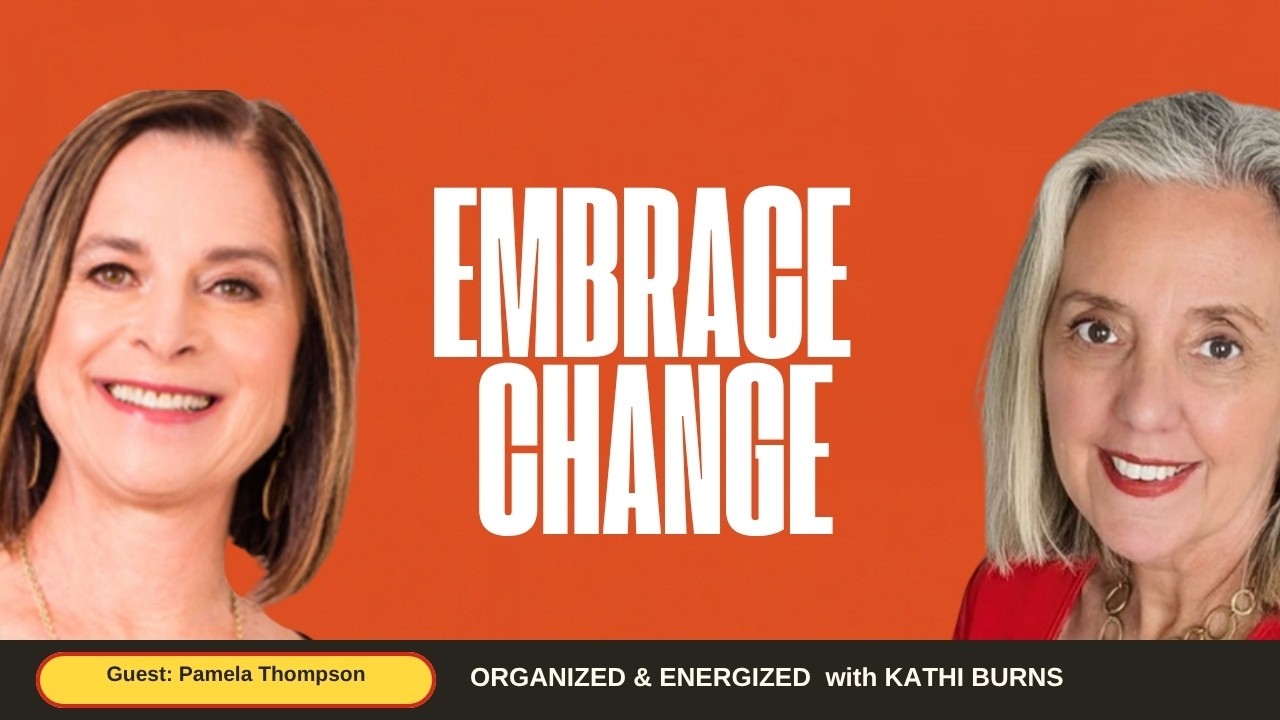
with Pamela Thompson, women's leadership and life transitions coach, creator of the Art of Change Framework · February 15, 2023 · 29 min
Pamela Thompson has lived and worked on five continents and started four businesses since the early 1990s.
Her five-step Art of Change framework draws on William Bridges's three stages of transition: an ending, a neutral zone and a new beginning.
Most leaders rate themselves nine or ten out of ten at handling change, but often drop to five or six when the change is imposed on them.
Pamela says fear is the biggest stumbling block, because we are physiologically hardwired to fear change, and she gives clients breathing and grounding tools to notice their body's reaction.
In Afghanistan she trained a ministry team that produced the ministry's first strategic plan within nine months, with agreement through all the policy layers.
Published · Updated
What is this episode about?
Kathi Burns, CPO®, Business FLOW Strategist, talks with Pamela Thompson, a women's leadership and life transitions coach who has lived and worked on five continents and started four businesses since the early 1990s. Pamela walks through the three stages of transition at the heart of her Art of Change framework, built on William Bridges's work: the ending, where you let go and name the lessons learned; the neutral zone, where you imagine what you want next; and the new beginning, where you act on it. You'll hear why confident leaders still struggle with change they didn't choose, why fear stops people in the neutral zone, how she helped a ministry in Afghanistan agree on its first strategic plan, how to handle conflict on a small team, and the end-of-day list that keeps her focused.
Embracing change is a creative process that opens us up to new possibilities.Pamela Thompson
Jump to links and resources · Part of How do I grow my business without burning out? · All episodes · Every guest
What are the key takeaways?
- Pamela's Art of Change framework is based on the metaphor that life's a dance and on the belief that embracing change is a creative process.
- The framework takes people through three phases drawn from William Bridges's work: an ending, a neutral zone and a new beginning, each with its own work.
- The work of the ending is letting go and identifying the lessons learned; the neutral zone is for envisioning what you want; the new beginning is for taking action.
- Leaders who rate themselves nine or ten at handling change often say five or six when the change is imposed, and sharing those scores helps a team support each other.
- Pamela says fear is the biggest stumbling block, so she helps people notice how their body is reacting, breathe deeply and ground themselves before deciding.
- When a team is in conflict, Pamela starts one-on-one with the leader and asks whether the person they struggle with reminds them of someone from their past.
- Each evening Pamela writes the next day's list, marks the must-dos, and does creative work before she checks email or social media.

This episode is brought to you by the Business Logjam Session
A private 75-minute online session with Kathi Burns to find the one thing holding your business back and leave with your next steps. It is the same F.L.O.W. process Kathi uses with her own clients: Focus on your goals, Locate your logjams, Outline your solutions, Walk away knowing your next steps.
Find What's Holding Me BackInterested in sponsoring the show? Get in touch.What is the Art of Change framework?
The Art of Change framework is Pamela Thompson's five-step process for moving through any life transition, based on the metaphor that life's a dance. It rests on the belief that embracing change is a creative process that opens us up to new possibilities. Pamela says it's about putting change on its head: embracing it instead of fearing it. People can apply it to a career change, leaping from a job to a new business, or a new relationship.
What are the three stages of transition?
The three stages of transition are an ending, a neutral zone and a new beginning, as identified by organizational theorist William Bridges. In the ending you let go and, Pamela adds, name the lessons learned. In the neutral zone you envision the life or career you want. In the new beginning you take action toward it.
Why do confident people struggle with change they didn't choose?
Because imposed change feels different from change we choose. Pamela asks leaders to rate how they handle change from one to ten, and many say nine or ten. Asked about change that comes out of the blue, they often drop to five or six. Kathi said ten, then five or six. Sharing these scores helps a team support each other.
Why are life transitions so hard?
Pamela says the main reason is fear, because we are physiologically hardwired to fear change. Our brain scans for anything different and puts us into fight, flight or freeze, which is no place to make rational decisions. She gives clients tools to notice their body's reaction, breathe deeply and ground themselves first.
How do you get a team to agree on a strategic plan?
Build ownership through the process. In Afghanistan, Pamela trained a ministry's planning team in facilitation, even though only the team lead understood English, and taught them to name what someone did well before areas for improvement. The team gathered input across the ministry's 74 departments, and within nine months the ministry had its first strategic plan with agreement through all the policy layers.
What should a business owner do when their team is in conflict?
Start one-on-one with the leader. Pamela asks the leader to describe the situation and how it feels in their body, then asks whether the person they're struggling with reminds them of anyone from their past, such as a teacher or someone with authority over them. When the leader sees the pattern, it's a relief: they don't have to change the other person, only themselves.
What is Female Wave of Change?
Female Wave of Change is a global movement, founded in the Netherlands in January 2017, that believes feminine leadership qualities like creativity, collaboration, inclusiveness and emotional intelligence hold the key to a better world. It is now in about 40 countries. Pamela was named ambassador for Canada in March 2020 and launched the nonprofit Female Wave of Change Canada that December. Its projects include the Mother Earth Ambassador Project, an outdoor education program for girls aged 9 to 12.
How does Pamela Thompson stay organized?
She writes the next day's list at the end of each day. If the list is long, she marks what's a must-do, what's moderate and what can be pushed, so she doesn't waste time deciding where to start. If she doesn't finish, she doesn't beat herself up; she starts a fresh list. She also does creative work like writing first, before email or social media.
Where does each part of the conversation start?
- 0:00 Meet Pamela Thompson
- 0:17 A life of transitions
- 1:19 Four businesses since the 1990s
- 2:16 The Art of Change framework
- 3:14 Endings, the neutral zone and new beginnings
- 5:43 How do you respond to change?
- 7:39 Why change scares us
- 10:38 Strategic planning in Afghanistan
- 14:50 When your team is in conflict
- 17:02 Trust your body's wisdom
- 17:52 Female Wave of Change Canada
- 21:19 Her end-of-day list
- 23:21 Her new book, Minerva
- 25:02 Wrap-up
What resources were mentioned?
- Pamela's free Art of Change Framework
- Female Wave of Change
- The Exploits of Minerva: Reflections of a Sixty-Something Woman by Pamela Thompson
- William Bridges's transition model (ending, neutral zone, new beginning)
- Wim Hof breathing (Kathi's practice)
- The Ivy Lee method
These episodes continue the same thread as this one: Lia Dunlap, Carly Church, Ginny Priem, Stephanie Wall Morrow also answer the question "How do I grow my business without burning out?", and the rest are the most recent conversations on the show.

 MotherhoodEpisode 147
How To Build a Village That Supports Your Business and Your Life with Carly Church

See every episode on the podcast archive or filter by topic on the How do I grow my business without burning out? hub.
How can I support the show?
- Subscribe on Apple Podcasts, Spotify or YouTube, or add the RSS feed to any app.
- Rate and review. A rating on Apple Podcasts helps new listeners find the show, and Kathi reads every review.
- Share the episode with one business owner who needs it; the share buttons are at the top of the page.
- Grab a free eBook: 6 Steps to Organize & Energize Your Home, 6 Steps to Organize Your Home Office or 6 Steps to Organize & Energize Your Life.
- Work with Kathi. The Business Logjam Session is a private 75-minute session to find what is holding your business back.
- Be a guest. Apply here if you have a story about clearing the obstacles in your business.
What did they say, word for word?
The transcript below is edited for readability: filler words and false starts are removed and speaker names are added. Nothing was added or summarized.
Read the full transcript +
Kathi: Hi everyone. I am back with Pamela Thompson, and we're going to talk about transitioning through change with ease and playfulness. Thanks, Pamela, for coming on the show.
Pamela: Thank you, Kathi. I'm excited to be here.
Kathi: Yeah, this is going to be a fun, fun talk for sure. So talk to me about your transitions and what has gotten you to this point in your life, where here we are talking about transitioning and change.
Pamela: Well, how much time do you have, Kathi? It's interesting, because since about age three I knew that I was going to travel around the world and work with different people, being of service in some way. I can still remember the moment. I was visiting with my parents at a friend's home, and this was a very good friend of my dad who was single, and she traveled extensively, and she was showing us slides of her most recent trip. And I remember thinking, when I get big, I'm going to travel around the world. And she had all these treasures around her place, and I thought, and I'm going to collect beautiful treasures too. So it all started years ago. And it's interesting because, as I mentioned before the interview, I actually have had four businesses since the early 90s. So I guess my whole life is about change. I guess I get bored fairly quickly. And before I started my own business, I averaged about three years in any one position, and then I would think, oh well, I'm not learning anymore. And either I would put it out to the universe to say, what's next? Or I would be in a social situation and someone would say, hey, we have this opportunity. Do you want to take us up on it? I'd say, oh, that sounds great. And I just jump in with both feet. So that's been my pattern throughout life.
Kathi: I love that. I love that. Yeah. I've had seven careers myself. So it's easily bored is what we are, but also easily ignited, I think. Don't you think?
Pamela: I do. That's a good way to put it.
Kathi: Yeah. We are easily ignited. So talk to me about what you help clients with. I know as a change agent we all help in our own way. So talk to me about the process of what you do with your clients.
Pamela: Okay. Well, I have a five-step Art of Change framework that is based on the metaphor life's a dance, and underpinned by the belief that embracing change is a creative process that opens us up to new possibilities. So Kathi, it's really about putting change on its head, and instead of fearing it, embracing it. This framework enables people to explore how they respond to change and why, and it gives them a particular framework they can apply to any life transition, be it a change in career, leaping from a real job to a new business, a new relationship, whatever it is. And so the process takes them through three distinct phases: an ending, a neutral zone and a new beginning. In part of this process I draw largely on William Bridges's work, and then I've modified it and enhanced it. He was an organizational theorist. You may have heard of him. So based on over 30 years of work with people in organizations, he identified these three phases, regardless of any transition you go through. And he said that there's work associated with each phase, and if we don't do the work, we keep repeating the same patterns often in our lives and remaining unfulfilled and unhappy.
Embracing change is a creative process that opens us up to new possibilities.
Kathi: Hence, people who get married three, four and five times and keep after the same person, right?
Pamela: Basically, yes. Some of the partners may even look similar, and after the honeymoon phase they keep repeating the same issues as the previous relationship, because they haven't taken time between them to find out who they are and what they truly want in their life. So this process really helps people to understand, okay, what's the work in the ending? It's letting go. And then I've added identifying lessons learned. What did you learn from that job? What did you learn from that relationship? What do you have to let go of to move forward? And then the work of the neutral zone is to envision that new life, that new relationship, that new career of your dreams. So that's a creative space, but that's also the scary space, because that's when you've taken the leap and you don't know where the net is. So many people go back and forth. So yeah, it's a scary place, and yet it's a very creative space, because you get to dream. And then in the new beginning, the work is taking action toward what you've envisioned in that neutral zone. So I really love taking my clients through this. And the cool thing about it is it's not only something you can use one-on-one with, say, coaching clients. You can also use it with leaders and their teams in businesses and organizations. Because if you're going to pivot, for example, it's really important to have everybody on the team say, okay, how do I typically respond to change and why? So, Kathi, put you on the spot here for a minute.
Kathi: Sure.
Pamela: Scale from one to 10, how do you typically respond to change? One being scares me to death, 10 being I thrive on it.
Kathi: 10.
Pamela: I would have thought. And many leaders are nine or 10. So now I'm going to ask you something a little bit different.
Kathi: Sure.
Pamela: What if a change comes out of the blue at you and is imposed? It's nothing that you chose. How would you rate yourself then on that scale?
Kathi: I give myself a five or a six, and I'd have to reframe it in my mind that I did it to myself or it was given to me as a gift, and then I could maybe move up the scale. But at first, anybody who imposes any kind of rules on me is not a good thing anyhow. So I'd probably be a four, five, six at that point, until I could lock it in.
Pamela: Well, I appreciate you sharing your vulnerability around this, because that's often the case. A lot of people who are leaders and rate themselves nine or 10, when I ask that second question, often say five or six. And the insights related to that are huge one-on-one, but it's also beautiful and powerful in a team, because you get to share, and, as Brené Brown would say, rumble about it. If I'm a nine and you're a five, that doesn't make me better. It just is. So then it gives the opportunity to say, okay, we're going through this change. How can we support you as a team? How can I support you? And then when we move through, we understand that person needs more sensitivity, more support. And then instead of people getting really reactive and resisting the change, which can have really negative impacts on your body, your mind, your relationships and your business, the person can be taken forward to embrace it, see it as an opportunity to be creative and to envision new things, and move forward in a positive way.
If I'm a nine and you're a five, that doesn't make me better. It just is.
Kathi: Yeah, I absolutely love that. And I love the idea that you're doing this with teams, by the way, because I think right now everybody's pivoting, so many pivoting all over the place, that having everybody congruent with what they're doing is always a good thing. But what do you think is the biggest stumbling block that you see once people are saying, okay, I know where I am with this, and now I want to go to phase two? What stops them from moving into the second part of it?
Pamela: Well, typically it is fear. And it's because, as you probably know, we're physiologically hardwired to fear change. The amygdala part of our brain is constantly searching our environments for things that are different, and as soon as it identifies something that's different, it sends stress hormones throughout our body and puts us into fight, flight or freeze. And none of those put us in a good place to make rational decisions. So part of it is mindset. So making people aware of this physiological response, and then giving people tools so that when the fear comes up, they can learn to deep breathe, breathing in through your nose really deeply and holding it and then letting it out. So giving people tools to notice how their body is reacting and responding to the change is the first thing. And then grounding tools as well, to say, okay, I'm okay, I'm safe. And then they can be in a better place to make that decision, or say, okay, why am I afraid? And then to really analyze, okay, is it really something for me to be afraid of? And how can I move forward? How can I let go? What do I need to let go of? What lessons have I learned from this previous way I've been, and how can I create something new so that I can move forward?
Kathi: Yeah, I think that's so important. And what you said earlier about your body actually doing it to you: be aware that it's not just your brain. Your body's going into fight or flight here, and it's normal to be a little bit freaked out about change, unless you're just the crazy person that loves change or thrives on change, but not very many people are. And I think it gives you the permission to know that it is physiological as well. I love the breath work. I was doing Wim Hof this morning. We do Wim Hof a lot in our house, and it's really good breath work. So talk to me about a story. Talk to me about a client story, something you can think of that really makes you smile every time you think of the breakthrough or whatever happened with them.
Pamela: I'm going to go with a team. I'm going to go with a team that I worked with in Afghanistan. I lived and worked for 13 months in Afghanistan, from October 2010 to November 2011, Kathi, and my role was as a senior technical adviser to help the ministry develop their first strategic plan and build the capacity of internal teams to do strategic and operational planning. And what happened initially is I was given this strategic planning team, and at the first meeting I realized that the only person who understood English and got 80% of what I was saying was the team lead. All of them spoke the local language, and I didn't have a budget for an interpreter or translator.
Kathi: Wow. Okay, there's some change right there.
Pamela: This wonderful doctor who was in charge of this EU-funded project gave me 15% of his time, this Afghan who was a really good interpreter. But anyway, the long and the short is, I trained this team, and initially I was teaching them facilitation, and I was teaching them how to use different skills to initially assess the current situation and get input, so people across the 74 departments of this ministry had ownership for the change. And so it started with people not speaking each other's language, and then it went to, I was teaching them how to observe one another, and I gave them this tool. And the first thing I noticed, typically in this group and in many countries, and even in the States and Canada, is that whenever somebody says or does something, instead of talking initially about what's positive, people go right for the jugular. Oh, that's so bad. All the negatives. So I had to really underscore for these people, when they were doing behavioral observations of someone's facilitated session, to say what's something this person did that was really, really good before they went to the areas for improvement. And I would specifically say areas for improvement, not what you did wrong. If you had something that you thought was wrong, then you focus on how you could suggest to them to make it right, rather than just poking holes in the discussion. So we moved from there to this process where I trained this group and then we trained other people. And within a space of nine months, Kathi, we created the strategic plan for this ministry. And the minister actually attended a national meeting, and she sat back and just listened. She didn't intervene. And at the end of the day, can you believe it? It would probably never happen in North America. We had agreement through all the policy layers for this plan, and it was because of the ownership that was built through the process. That was like a pivotal moment to actually see. We even had one of the other external donors pay to have the document translated and printed. But it was incredible to see the change in the people in terms of how they reacted and responded, and also to see them really listen to process, because it was all about the end point. And I'm a really process-oriented person, because I'm a facilitator as well as a coach. And so it was really interesting to see them understand that process and see them buy into it and see the changes that actually happened as a result of it.
We had agreement through all the policy layers for this plan, and it was because of the ownership that was built through the process.
Kathi: That's an amazing story, and congratulations for all of them and for you, and for the minister, who's probably fallen off her seat. I can't believe this is happening. Anytime you have a party of more than two, there's an issue. So, as regarding entrepreneurs, many women who are listening to this probably are small businesses. They have teams. If there's some type of dissension within the team, where would you suggest that they start? Would you suggest that they start one-on-one to see where they're at and then do a team meeting, or maybe just jump right into the team meeting with them and see who's saying what and who's feeling what?
Pamela: That's a really good question, and it's obviously tailored a bit to the situation. That said, I would always go one-on-one with the leader and really find out, is this something that they're projecting? Because a lot of times we do project. And a lot of times, I don't know whether you've noticed in your life, you probably have because you're very self-aware, but a lot of times we react to people based on them reminding us of someone in our past. So a teacher, someone who had a position of authority over us. And so we're not really reacting to them. We're reacting to that persona.
Kathi: Yeah.
Pamela: And so part of my discussion would be with the leader or the business owner of the team, to say, so tell me more about the situation and what's happening, and how does it feel in your body? And then I'd say, does this person remind you of anybody in your past? And then it's like, oh. And it's amazing, because if a person connects with that, it's such a relief, because it gives them so much freedom to realize, oh my goodness, that person, really, it's me. It's all about me. So I don't have to try to change them. I have to change me, and really go into the situation, take deep breaths, ground myself, and really observe and see in the next situation how things happen.
I don't have to try to change them. I have to change me.
Kathi: Yeah, that's fantastic. I always say it's never about them. It's always about you, and be the change you want to see. You start with changing yourself, and then everything around you just changes. It's magic like that.
Pamela: It's so magical. You're right on.
Kathi: Hey, so I have a question. If you were going to look back. When you were little, you said, I'm going to travel around the world. Okay, now you're 18. If you were to look back at yourself at 18, what advice would you give this girl?
Pamela: I would say listen to and trust in your body's wisdom. Don't listen to people outside you and what they're telling you to do. When an opportunity or a choice is given to you, really don't just think about, oh well, my dad would think I should take it, or this would be really good for my family. Really go inside and say, is this really what I want?
Kathi: That's good advice. And it seems like you've been a pretty good director of your life up to this point. You've done what you want to do. So what's on the horizon? What is your exciting new project? I know we have something in the room.
Pamela: Well, the most recent project, I hadn't done this before, so of course I had to do something new, is I launched a nonprofit in December of 2020, during COVID. Yes, of course I did.
Kathi: Yay.
Pamela: And it's called Female Wave of Change Canada. We believe that feminine leadership holds the key to creating a better world, a more conscious, equitable, just, sustainable and peaceful one. And when I speak about feminine leadership, I mean qualities like creativity, collaboration, inclusiveness, emotional intelligence, these qualities that are typically associated with the feminine. That said, men can have them and learn them as well, and we actually have men as part of our movement. And I also want to say that I did not found this movement. It was founded in January of 2017 by an amazing woman in the Netherlands. And now we're in about 40 countries, and I was named ambassador for Canada in March of 2020, after being interviewed and being offered it and thinking about it. Yeah, it's been an amazing journey. We're member-based. We have monthly meetings with featured guests, and we have projects in five pillar areas: economy, environment, education, health and humanity. We have collective wisdom circles where women get together once a month and share their wisdom around a certain topic, like dealing with change and uncertainty, for example. And we're always dreaming up new things to do.
Kathi: That sounds amazing. And do you have occasions when all of the different agencies around the world get together and do collaborations?
Pamela: That's a good question. What we typically do is we have monthly Female Wave of Change global leaders meetings that all the ambassadors and some of their wavemakers participate in. So we get to share what we're up to, and the opportunity is there. We have something called the Mother Earth Ambassador Project that we've created, which links the environment with the education pillars, and it's an experiential outdoor education project for girls age 9 to 12, to teach them about how to be Mother Earth ambassadors in their homes, schools and communities. So an example of that is to share it at a global team meeting and say, we're piloting it now, and after we get the bugs ironed out, do you think this is something you might want to do in Namibia or Germany or South Africa or wherever? So that's an opportunity. But also, typically, I think it's about every two years now, we have international conferences. Pre-COVID they used to be in person, so the last one was in South Africa, and they combine presentations and speakers from all around the world with music and dancing and all sorts. The last couple we've had were virtual, and each country got the opportunity to submit a proposal to speak for 10 to 30 minutes and present what was really on their hearts, or something that they were really excited about.
Kathi: Yeah, that sounds really, really powerful. I'm sure you'll get back to in person one time, but at the same time, we don't need to anymore, because we have the great capacity to have so many people together virtually. I just love the fact that we can still do that now. It's amazing. It really is, isn't it? So talk to me about anything that you use to keep yourself organized. What's your favorite organizing tactic or hack that you use to keep focused or in line with your business?
Pamela: The thing that I've found really helpful over the years is to make a list at the end of each day of what I want to do the next day. And if it's really, really long, then to set priorities on the list, like what's a must-do, what's maybe moderate, and what's a nice-to-have that can be pushed. And so the next day, I don't spend a lot of time mucking around deciding where to start. I start with the priorities at the top of the list. And at the end of the day, if I haven't done everything, I don't beat myself up. I'd rather check off the ones I've done and say woohoo, and then create another list. I sometimes have crossed off and added bits, but it's really not so good. It's better to just have a new list and do it all the same way again. And that's been really helpful.
At the end of the day, if I haven't done everything, I don't beat myself up.
Kathi: Yeah, lists are so important. It sounds like you're using something like the Ivy Lee method, where you have your five things, and the top three you've got to absolutely do, and then the last two get moved up to the top three the next day. You're using something similar. And lists are so important, because otherwise we walk into our office and we don't really know what to do first, second or third. And knowing it before you walk into the office, I think, is super important. Especially don't check your inbox in the morning. Not the first thing, ever.
Pamela: Yeah, that's actually another hack. If I have something creative, if I'm writing a blog, because I write quite frequently, or I'm designing something, do that first. Maybe take a couple hours and don't look at my email or my social media, because otherwise I get down the rabbit hole.
Kathi: Exactly. Out into the universe is where we go, and then we're looking for shoes. Okay. So what have I not asked you that I should have asked you? I know we have something exciting on the horizon for you. So let's talk about Minerva a little bit.
Pamela: Well, thanks very much for asking. Yes, I have a new book, my second book, that's actually launching December the 8th, called The Exploits of Minerva: Reflections of a Sixty-Something Woman. Do you want me to share a little bit about it?
Kathi: I think you should.
Pamela: Okay. It's all about six women who've been supporting each other for over 20 years in a women's circle through a variety of life transitions: burnout, separation and divorce, finding the love of your life, losing the love of your life, aging, retirement and such like. And it's told through the eyes of Minerva, who's quite playful and sensitive.

Kathi: That sounds wonderful. Okay. So when is this out? This is going to be out December 6th, you say?
Pamela: December the 8th is the official launch. It is actually on Amazon right now, but the official launch is December the 8th.
Kathi: Congratulations. I'm so happy for you. That's fantastic. Yay. Okay. So do you have a free resource that you would like to offer the listeners here? Anything that they can download or upload or have fun with?
Pamela: Yes, I do. On my homepage at pamela-thompson.com there is the Art of Change framework that I spoke briefly about before, and it's the more detailed white paper on it. So if people are interested in learning more about that and how you can apply it, it's right there. You just go to the homepage and sign up for it.
Kathi: Perfect. Perfect. And for those of you who are on a site where you can actually click a link, the link will be below as well. If you're watching this video, you'll see the link, so you can just click on that, or you can go to pamela-thompson.com, right?
Pamela: Yes.
Kathi: Yay. Okay, cool. Well, I really appreciate having you on the show. Oh, I know what I want to ask you. So do they have the women's organization in the United States?
Pamela: Yes, they do. However, it's not for the whole US. We're only now in several of the states. I believe California and Virginia. We used to be in New York, but that person left, and so there are opportunities for ambassadors in different states.
Kathi: So it's a state-by-state type of thing.
Pamela: It's a state-by-state sort of thing in the US.
Kathi: That's right.
Pamela: Although I was thinking Canada was pretty big. I thought they were going to make me ambassador for British Columbia, but no, no, no. At the end of the interview, they said, no, you get Canada.
Kathi: Oh, really? Okay. Wow. Okay, girl. So anybody out there in Canada that wants to start another area, like maybe a Vancouver branch, you'd be the girl to talk to about that.
Pamela: Yeah, because right now we do national meetings, but I'm encouraging people to develop hubs and have their own stuff.
Kathi: Well, you're doing great work, and I love the idea of the girls, putting ecology in with education and saving the earth with the youngins, because they're the ones that get to do it after we've done such a great job at it. So I love that.
Pamela: Well, thanks, Kathi.
Kathi: Absolutely. Thanks for being on the show. And for all of you, I'll see you next week. Go ahead and download, so you can see where you are with change and how you can deal with change better, with Pamela's download. I will see you next week. Bye.
Pamela: Bye-bye.
Where can I find the links and resources from this episode?
Connect with Pamela
Organizations and companies
Books and resources
- Learning to Dance with Life: A Guide for High Achieving Women by Pamela Thompson
- The Exploits of Minerva: Reflections of a Sixty-Something Woman by Pamela Thompson
- How to Master Your Muck by Kathi Burns
- Organizing With Tetris by Kathi Burns
- Home Organization, The Smart Guide by Kathi Burns
- Simple Family Organizing by Kathi Burns
- All of Kathi's books in her shop
Inspired? Here Are Your Action Steps:
- Rate yourself from one to ten on how you handle change you choose, then on change that is imposed on you.
- Name the transition you're in and decide whether you're in the ending, the neutral zone or the new beginning.
- Write down what you need to let go of and the lessons you learned from the last job or chapter.
- Use the neutral zone to describe the life or career you want before you jump into the next thing.
- When fear shows up, notice how your body is reacting, breathe in deeply through your nose, hold it and let it out.
- Ask your team to share their change scores so you know who needs more support.
- When giving feedback, say what someone did well before you name areas for improvement.
- If someone on your team gets under your skin, ask yourself whether they remind you of someone from your past.
- Write tomorrow's list at the end of today and mark the must-dos.
- Do your creative work first, before you open email or social media.
Frequently asked questions
What are the three stages of transition?
+
Pamela Thompson uses William Bridges's three stages: an ending, a neutral zone and a new beginning. The ending is about letting go, and Pamela adds identifying the lessons learned. The neutral zone is for envisioning what you want next, and the new beginning is for taking action toward it.
Who is William Bridges?
+
Pamela describes William Bridges as an organizational theorist who, from more than 30 years of work with people in organizations, identified three phases that any transition goes through. He said each phase has its own work, and if we skip it we keep repeating the same patterns. Pamela draws largely on his work in her Art of Change framework, which she has modified and added to.
Why are life transitions so hard?
+
Pamela says it is mostly fear. She explains that we are physiologically hardwired to fear change, and when the brain spots something different it puts us into fight, flight or freeze. The neutral zone is especially scary because you've taken the leap and don't yet know where the net is.
What is the Art of Change framework?
+
It's Pamela's five-step process, built on the idea that life's a dance and that embracing change is a creative process. It helps people explore how they respond to change and why, and walks them through an ending, a neutral zone and a new beginning. A more detailed white paper is free on her homepage.
Why do confident people still struggle with change?
+
Pamela asks leaders to rate how they handle change from one to ten, and most say nine or ten. When she asks about change that is imposed on them, the answer often drops to five or six. Knowing each other's scores lets a team support the people who need more help instead of resisting.
What should a business owner do when their team is in conflict?
+
Pamela starts one-on-one with the leader rather than with the whole team. She asks whether the person they're struggling with reminds them of someone from their past, because we often react to an old pattern rather than the person in front of us. Once the leader sees that, they can change their own response.
Who is talking in this episode?

About the Host, Kathi Burns
Kathi Burns, CPO®, is a Business FLOW Strategist based in San Diego. For the last 20+ years, Kathi has helped clients create systems they can stick to. She is the author of How to Master Your Muck, Organizing With Tetris and Home Organization, The Smart Guide, and co-author of four more titles; all are in Kathi's shop. Kathi's business has been featured on Good Morning America, and her advice has been featured in Oprah Magazine, Martha Stewart Living, Better Homes and Gardens and Entrepreneur Magazine.
More about Kathi · Shop Kathi's books · Business Logjam Session · Apply to be a guest

About Pamela Thompson
Pamela Thompson is a women's leadership and life transitions coach, a professional facilitator and the president of Creative Life Coaching & Consulting. She has consulted and managed across five continents and started four businesses since the early 1990s. From October 2010 to November 2011 she lived in Afghanistan as a senior technical adviser, helping a ministry develop its first strategic plan. In 2020 she was named Canadian ambassador for Female Wave of Change, a global movement founded in the Netherlands, and launched Female Wave of Change Canada. She created the Art of Change Framework and wrote Learning to Dance with Life: A Guide for High Achieving Women and The Exploits of Minerva.
Want help putting this into practice?
Book a Business Logjam Session with Kathi
A private 75-minute online session to find the one thing holding your business back and leave with your next steps, using the same F.L.O.W. process Kathi uses with her own clients: Focus on your goals, Locate your logjams, Outline your solutions, Walk away knowing your next steps.
Prefer to start small? Download Kathi's free eBook 6 Steps to Organize & Energize Your Life.
Published · Updated
This episode page is for general information. Guests speak for themselves, and their opinions, statistics and examples are their own. Nothing here is legal, financial, medical or mental-health advice; talk to a qualified professional about your own situation. Some links go to the guest's own products or free offers; addSpace does not earn a commission from them unless stated.