

Episode 124
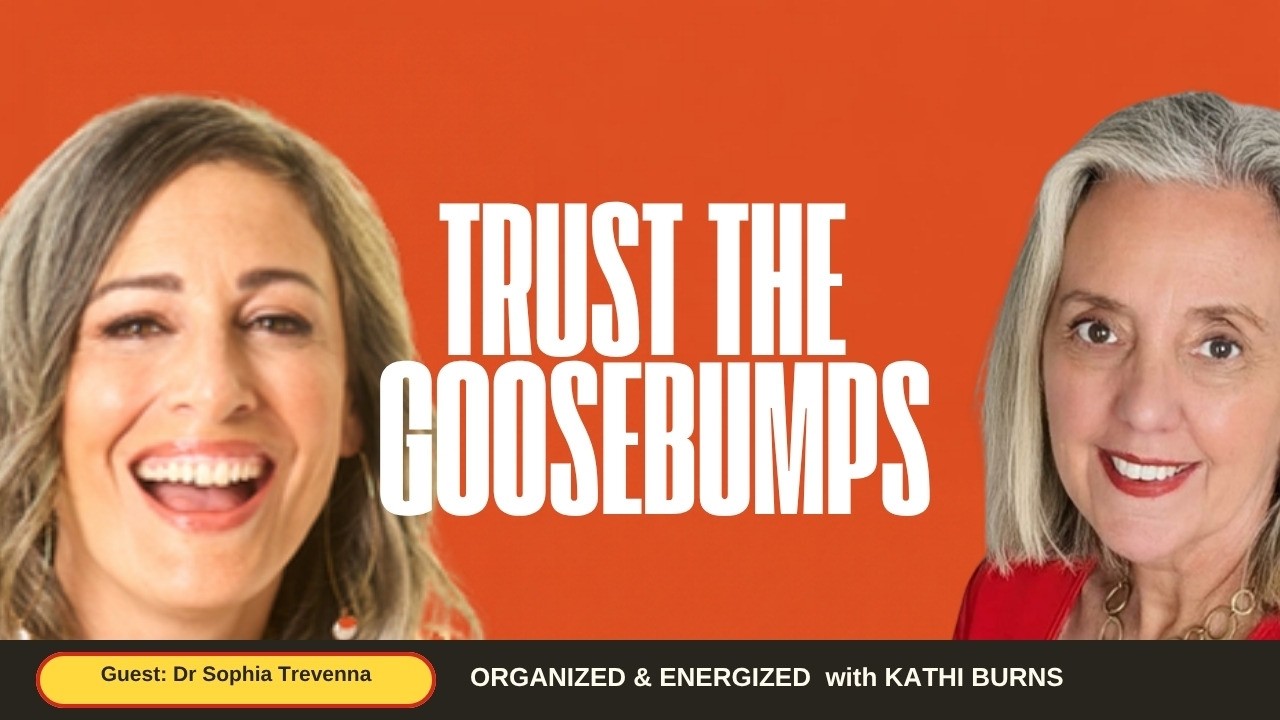
with Dr. Sophia Trevenna, intuitive executive coach, author and co-founder of Sofanya · September 24, 2025 · 29 min
Dr. Sophia Trevenna was a mechanical engineer at IBM with no spiritual practice when, she says, three different people mentioned her quitting her job in a single day.
She decided to live entirely by signs for three years, and after 20 people mentioned Hawaii to her in one week, she moved there, earned her PhD and became a professor of sustainability.
Her PhD research on B Corp leaders found they were all doing the same seven things, which she says grew their profits three to ten times.
For a first experiment with intuition, she suggests a low-stakes decision and asking to be shown, beyond a shadow of a doubt, in the next few days how your intuition works.
She has run her work through Google Calendar for 20 years, giving each task an hour-long event and keeping its notes, links and ideas inside that event.
Published · Updated
What is this episode about?
Kathi Burns, CPO®, Business FLOW Strategist, talks with Dr. Sophia Trevenna, an intuitive executive coach who started her career as a mechanical engineer at IBM. Sophia tells how a run of improbable signs led her to quit, move to Hawaii, earn a PhD and help build the state's green business sector, guided by what she describes as her spirit guides. For anyone curious about using intuition in business, she explains how to run a first, low-stakes experiment and which body signals she watches for. She also shares what her interviews with B Corp leaders around the world found, how her teams pick their own tasks from sticky notes, and how she has run everything from one Google Calendar for 20 years. Kathi adds a Google Contacts tip and why one calendar beats two.
If necessity is the mother of invention, then desperation is the midwife of miracles.Dr. Sophia Trevenna
Jump to links and resources · Part of How do I grow my business without burning out? · All episodes · Every guest
What are the key takeaways?
- Sophia left IBM after three different people mentioned her quitting in one day and a woman who had just quit IBM to teach physics told her to do it.
- She recommends testing intuition first on a decision that won't upend your life, such as whether to go to a party tonight.
- The signals she pays attention to include goosebumps, tingling arms, a flush in the face, and the spine straightening and chest lifting.
- In her research, B Corp leaders shared seven structural practices, including arranging all resources, human passion included, around the mission.
- Her teams write every project task on a sticky note, each person takes the ones that interest them, and leftover tasks go to people who want to learn that skill, with a mentorship plan.
- Her team meetings are for working through challenges, not status updates, because everyone is assumed to be doing their job.
- She keeps one Google Calendar event per task, adds every related note, link and email inside it, and moves anything unfinished to the next slot or the next week.
This episode is brought to you by the Business Logjam Session
A private 75-minute online session with Kathi Burns to find the one thing holding your business back and leave with your next steps. It is the same F.L.O.W. process Kathi uses with her own clients: Focus on your goals, Locate your logjams, Outline your solutions, Walk away knowing your next steps.
Find What's Holding Me BackInterested in sponsoring the show? Get in touch.Why did Dr. Sophia Trevenna quit her job at IBM?
She quit after seeing how IBM's overseas manufacturing plants treated the women they hired, and after a series of signs she could not explain. Sophia says the plants hired women because they would work longer hours for less pay. After she cried out for help, three different people mentioned her quitting in one day. Then, while she was telling a friend in a Toronto restaurant that no one her age quits IBM, a woman her age who had just left IBM to teach physics walked in and told her, "Do it."
Why did Sophia Trevenna move to Hawaii?
She moved because 20 people mentioned Hawaii to her in one week. That was near the end of three years she spent living entirely by signs, an experiment she describes in her memoir, Life Beyond What I Know. A waiter even handed her a book called Hawaiian Elders Speak. She lived in the jungle behind the university in Honolulu, off-grid, for her first two years, and stayed ten years in all.
How did intuition guide Sophia's business decisions in Hawaii?
Sophia says the guidance she received in meditation was specific, down to prices and dates. One example she gives: charge $10 instead of $12 and twice as many people will respond. Following that guidance, she owned a co-working space that became the hub for green business in Hawaii, ran an engineering sustainability consulting firm, hosted 300 events a year and advocated for policy such as the state's 100% renewable energy goal.
How do you know if your intuition is right?
Dr. Sophia Trevenna says you learn it by experimenting and noticing what a yes and a no feel like in your body. The signals she names are tingling arms, a flush in the face, goosebumps, and the spine straightening and chest lifting. She suggests trying on two options, such as two prices, and seeing which one feels expansive.
How do you start using intuition in business?
Start with a small, low-stakes experiment. Sophia suggests saying, "Show me beyond a shadow of a doubt in the next few days how my intuition works." Her clients have reported a dream that showed a decision going badly, or goosebumps whenever a certain thing is said. She says to play it out and build trust over time.
What do B Corp leaders do differently?
According to Sophia's research, they were all doing the same seven structural things. She interviewed leaders of certified B Corporations around the world for her PhD and distilled what they shared into seven guiding principles, which she says grew their profits three to ten times. One principle is to arrange every resource around the mission, including the passions of the people who work there, rather than around a hierarchy. She covers the full findings in her book The Power of the Divine Feminine in Business.
How do you let a team choose its own tasks?
Write every task on a sticky note and let each person take the ones that interest them. Sophia started this with her team of 10 in Hawaii on a project that trained 70% of the National Guard there to energy audit their own buildings. Leftover tasks go to people who want to learn that skill, with a mentorship plan, and she says nothing has ever been left on the table. The team then sets its own titles and meeting rhythm, and meetings are for working through challenges, not updates.
How do you use Google Calendar to stay organized?
Give every task its own calendar event and keep everything about that task inside it. Each week, Sophia schedules an hour for each to-do, then adds ideas, links, email addresses and call notes to the event. Anything unfinished moves to the next slot or the next week. She has worked this way for 20 years.
Where does each part of the conversation start?
- 0:00 Meet Dr. Sophia Trevenna
- 0:19 From IBM engineer to following the signs
- 3:49 Twenty people mentioned Hawaii
- 6:10 Desperation is the midwife of miracles
- 9:30 Entrepreneurship is a spiritual journey
- 12:37 Your first experiment with intuition
- 15:07 Eight billion doors
- 17:42 What B Corp leaders do differently
- 21:19 Letting the team pick their sticky notes
- 28:36 Running everything in Google Calendar
- 35:57 How her clients find her
- 36:49 Her books
- 40:53 Wrap-up
What resources were mentioned?
- Life Beyond What I Know by Dr. Sophia Trevenna (memoir)
- Living from Inner Clarity by Dr. Sophia Trevenna
- The Power of the Divine Feminine in Business by Dr. Sophia Trevenna
- The Power of the Divine Feminine in Intimacy by Dr. Sophia Trevenna
- Hawaiian Elders Speak (the book a waiter handed Sophia)
- Sofanya, the skincare brand Sophia co-founded
- Every Day Magic podcast by Sofanya
- Google Calendar
- Google Contacts
These episodes continue the same thread as this one: Lia Dunlap, Carly Church, Ginny Priem, Stephanie Wall Morrow also answer the question "How do I grow my business without burning out?", and the rest are the most recent conversations on the show.

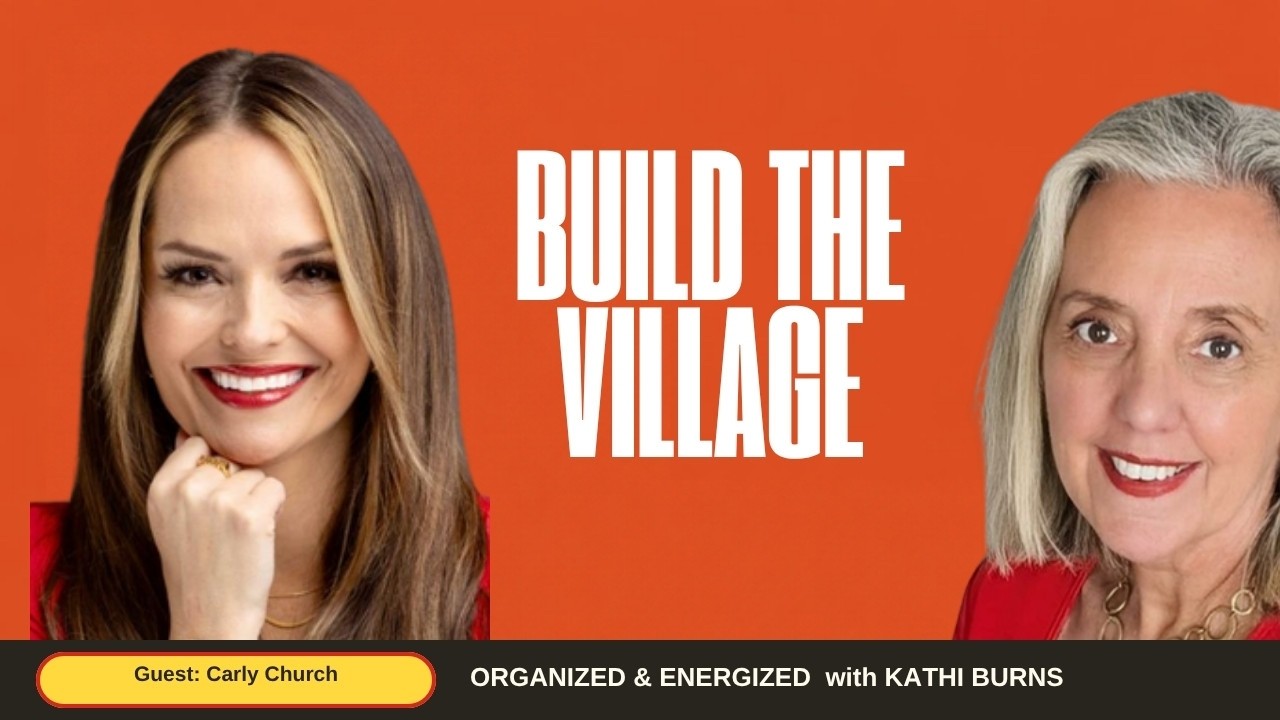 MotherhoodEpisode 147
How To Build a Village That Supports Your Business and Your Life with Carly Church

See every episode on the podcast archive or filter by topic on the How do I grow my business without burning out? hub.
How can I support the show?
- Subscribe on Apple Podcasts, Spotify or YouTube, or add the RSS feed to any app.
- Rate and review. A rating on Apple Podcasts helps new listeners find the show, and Kathi reads every review.
- Share the episode with one business owner who needs it; the share buttons are at the top of the page.
- Grab a free eBook: 6 Steps to Organize & Energize Your Home, 6 Steps to Organize Your Home Office or 6 Steps to Organize & Energize Your Life.
- Work with Kathi. The Business Logjam Session is a private 75-minute session to find what is holding your business back.
- Be a guest. Apply here if you have a story about clearing the obstacles in your business.
What did they say, word for word?
The transcript below is edited for readability: filler words and false starts are removed and speaker names are added. Nothing was added or summarized.
Read the full transcript +
Kathi: Hello, I'm here with Dr. Sophia, and I'm so glad that you're on the show. We're going to talk about a lot of really cool stuff, including how to call in your higher awareness to help you with your business. So thank you for being on the show, Sophia.
Sophia: Thank you so much for having me, Kathi. It's just a joy to be here.
Kathi: Absolutely. This is going to be a fun talk. So talk to me a little bit about your background. You've been in several countries. I know you're originally from Canada. Let's talk about your journey just a little so people can get to know you.
Sophia: Okay, wonderful. I would love to. I know that this is about entrepreneurship, and I have been an entrepreneur for 20 years, and I had, I think, a unique origin story for that. I started as a mechanical engineer at IBM in the late '90s, and I discovered that what we were doing, setting up manufacturing plants for computers in other countries, was really exploitative to people and the planet, especially the women they hired. For example, they only hired women because they were more docile and would work longer hours for less pay, and they were open about that. I left, and I had no spiritual connection, no religion, no intuition. I was a hardcore scientist, and yet I went into sadness and depression and anxiety, and I didn't know what to do. We didn't have resources back then like we do now, nor, basically, the internet. So in my breakdown, I was just crying for help with my heart. And the next day I started getting signs, really noticeable signs that my mathematical mind knew were so improbable: three times in one day, different people would mention the same notion of me quitting my job.
Kathi: Was that before you quit your job or after?
Sophia: Before I quit my job.
Kathi: Okay.
Sophia: And I was like, three times in one day people mentioned that I should quit. That's very improbable. Then I was in a restaurant. I lived in Toronto at the time. I'm from Canada. Three million people in this city, and we're sitting in a restaurant, and I told my friend the story. She's a reporter for the newspaper, the Toronto Star, and she's very pragmatic as well. And she's like, 'Do you think this means something?' And we're both like, no. And I said, 'No one my age quits. No woman got as far as I got, and no one quits.' And in that moment, a woman walked into the restaurant who was my age, who had quit two months previous to teach physics to kids. From IBM.
Kathi: From IBM or somewhere else?
Sophia: IBM.
Kathi: Wow.
Sophia: And I don't know if you know this, but the motto is 'You don't quit IBM.' It's literally a known motto, and it means that when you have a mothership that's going to take care of you like that, you don't leave it.
Kathi: Wow. Okay.
Sophia: A woman my age who had quit to teach physics to kids. And I had just said to my friend, 'No one,' except for that woman who just walked into this restaurant in Toronto. And I got up and talked to her, and she put her hands on my shoulders. She's like, 'Do it. It's the best thing I ever did.' And I did. And I had no idea what was going to come next. But I decided that something, some physics I didn't understand… I thought it was physics. Some physics of how reality works told me what to do, and it's going to keep telling me what to do. And so for the next three years, I decided to live entirely by signs and see what happened, because I had nothing else.
Kathi: Right, because you just quit.
Sophia: I had nothing else. So my whole memoir… I actually pulled out my books beside me. So this is my memoir, Life Beyond What I Know: What If You Decided to Live Entirely by Intuition? I just summed up the first three chapters, and then the whole next three years are summarized in this book. It had me do so many things. And one of them was to discover the word and notion of sustainability. And the second one was to move my entire world and life to Hawaii.
Kathi: Oh, okay.
Sophia: Twenty people in one week mentioned Hawaii to me by the end of the three-year journey. Twenty, two-zero. Including me being alone at a restaurant, and the waiter saying, 'While you're waiting for your food, why don't you read this book?' And it was a book called Hawaiian Elders Speak.
Kathi: I love it. I love it.
Sophia: Me too. And the elders were talking about getting signs, and I'd never heard of anyone getting signs. It's not like today, where you hear about things or we have memes or anything. I was a scientist just trying to survive and find my next step. And so I was like, 'Oh, these are the only people I've ever heard of that also have signs and use them to wander around the islands and go on big walkabouts.' And anyway, I went there, and I spent the next 10 years there. I ended up meeting my own spirit guides while I was meditating, living on the islands, and they guided me for the next 10 years to get my PhD, become a professor of sustainability and lead a sustainability movement for the whole state.
Kathi: That's awesome. From Toronto to Hawaii. What island were you on?
Sophia: I lived in Honolulu, because that's where the university was, but I lived way back in the jungle behind the university for the first two years, off-grid. And that's where I met my guides in meditation, when I was away from everyone and everything.
Kathi: Nature's best.
Sophia: Yes, nature. I had never been immersed in nature to that level before. I was the only man-made thing in sight. It was a five-minute hike down to the jungle floor, where I had a single-room little hallway house that had been built. And I had nothing else but nature in me. And that's when I was able to meditate and meet my guides, who specifically told me almost every day exactly what to do with the day. 'Wear a nice outfit. You're going to be pulled into an important meeting. It's going to be with people a lot older than you, but speak your heart and mind. Don't let them bend your mind. You're here to bend their minds.' So every day, my guides and angels told me what to do, for years.
Kathi: That's pretty incredible. And I think being immersed helps you hear better, but obviously you were open and receptive without knowing it when you were in Toronto.
Sophia: Yes. I mean, yes. I think in my memoir, what did I say? I said, 'If necessity is the mother of invention, then desperation is the midwife of miracles.'
If necessity is the mother of invention, then desperation is the midwife of miracles.
Kathi: That's a great quote.
Sophia: Yes.
Kathi: We'll have to put that one in the show notes for sure. I love it.
Sophia: Yeah, I haven't thought of that one for a long time. I became an entrepreneur after that. While I was a professor for those 10 years in Hawaii, I was also an entrepreneur. And I always say that I've never been comfortable enough to be away from my faith. And my middle name is actually Faith. Sophia Faith Trevenna. Literally, that is my legal name. And faith to me is, well, the actual definition of it is having proof from unseen sources. It's not just blind faith, not having proof. I had enough proof from following signs and dreams and synchronicities, and listening to these angelic beings that felt like an ocean, like a universe of love, that gave me specific guidance. It proved to me on a daily basis that that was the best next step for me, always.
Kathi: Well, that's such a blessing, to get specific guidance, like knowing that you need to get dressed up, knowing that you need to speak your truth. I mean, speak your truth, that's a universal thing, but 'Let's get dressed up on this particular day' is pretty earth-shattering, that you could hear that and then acknowledge it. I think we hear a lot of things, but we don't acknowledge them, or we don't act.
Sophia: True. I think that's true. And it was an experiential adventure, because I needed something to take me along the path, and it was so successful the first time that I needed to learn how to use it, because I didn't have anything else. I was at the mercy of miracles for my next step, continually. And that was 20 years ago. I was about 27, 28 when that started. I was 32 when I moved to Hawaii. I'm almost 52, so it's 20 years. And right after my 33rd birthday, I met my guides, and I worked with them exclusively for a decade. And in that decade, I got very specific guidance, like, 'Don't charge $12 for that, charge $10 for that. You're going to have twice the number of people respond to it.' Or, 'Don't do it on that date. Do it on this date.' And I ended up owning a co-working space that was the central hub for the entrepreneurial sector of green business that I pioneered there. I really believed in a third sector of the economy beyond tourism and military, and I said, let's make green business. And I became a professor, and I hired the best students into my internship program, and the best interns into my engineering sustainability consulting firm, and I created a whole ecosystem. And then we needed a home, and I realized all the green businesses needed a home, so I created the co-working space. We did 300 events a year to grow that sector. We all advocated for policy such as the 100% renewable energy goal Hawaii has now. I wanted a trail so that a five-year-old could say, 'I want to be a sustainability professional when I grow up,' and she would have a path through all of school. So there are academic trails now, classes she could take all the way through, and be supported into doing that. So I really was an entrepreneur, and I also set up the entrepreneurial sector, being guided. And I always say entrepreneurship is a spiritual journey.
Kathi: I do believe so. I am with you on that. So for those listening, if you've had numerous signs, the same thing coming to you over and over, please listen, because that is something that is prodding you to take some action, or to make a step, or to look a different way, or at least to listen.
Sophia: Right, absolutely. And experiment. I've coached so many people on this now, and I always say, do it in a benign situation. So you're not trying to use intuition to change your life like I did. That was probably the most intense, terrifying possible way of doing it. Do it like, 'Give me a sign whether I'm supposed to go to this party tonight or not.' 'Give me a sign whether this person who wants to come into my life as a closer friend is a good idea or not.' You're not going to be devastated when you find out the answer after you follow intuition. It's just going to be an experiment. Each chapter of my memoir is an experiment. 'Should I quit my job based on signs from the universe?' is one of the early chapters, and 'Are guardian angels real?' is one of the last chapters. But do your own experiment in a way that's smaller, and learn to trust what that feels like, what the yes feels like, what the no feels like. Play it out. And then all of a sudden you'll notice, organically, that you're starting to get that knowing: the tingles on the arms, or that flush in your face, or the spine straightening. That's a big one for everyone. Does your spine straighten and your chest lift? It's almost like the spine is an antenna for truth.
Do your own experiment in a way that's smaller, and learn to trust what that feels like, what the yes feels like, what the no feels like.
Kathi: Yeah. And your spine is health. So I can understand that. I know the more supple your spine is, the healthier you are throughout the rest of your life, right?
Sophia: And I love when we can try on two options. The arena will get bigger: take this contract or not take this contract, charge this much or that much, and see which one makes your spine straighten, your chest lift, maybe a smile on the corner of your mouth, like, 'Oh, that's the brightening. That's the expansive path. There's energy there.' And I believe that's the instinct animals feel when they're like, 'Oh, the water's that way. Oh, that's where the flock's going.' There's an energy stream there that's invisible, and that we have access to, because we're not the only animal that doesn't have instinct. We've just used the mind to override it rather than work with it.
Kathi: Right. Right. With all this monkey chatter going on.
Sophia: Yeah.
Kathi: I was in a store yesterday, and I was just noticing how much lack of energy there was, and I'm thinking, this store is going to close. I can feel it. There's no movement, no energy. It's interesting, because they had switched everything around. Everything was different, and everything was in different places, but it was just stale and stagnant, and I felt bad for the store, because I could tell immediately. What would be the first step for someone? I know you talked a little bit about it: start with something benign. So what do you suggest for people who've never done this, who don't necessarily even believe in it, but they want to just play?
Sophia: Yes. I love this, and it should be play. It is play. And I didn't believe it either, so I understand that. And I feel like you cannot do this without having your own experience, because it's such a subtle body knowing and a feeling, and you need to have an experiential win to gain the confidence and the trust. And you need to build it over time, like any relationship. A relationship with your intuition needs to begin somewhere. So you're kind of like, what does the first date with your intuition look like? I always say, just say, 'Show me beyond a shadow of a doubt in the next few days how my intuition works.' And all of my clients begin there. I've worked with a few hundred clients in 25 countries now, many ages, cultures, genders, mostly CEOs, from small entrepreneurs to the biggest companies in the world, director level. So I've got to see this a lot. And when people do that, within the next few days, something happens.
Kathi: Ah, okay. So, 'Show me in the next few days how my intuition can guide me.' Brilliant. Love it. Easy breezy.
Sophia: Easy breezy. Simple. And some examples: people have come back to me and said, 'I had this dream, and it so clearly showed me making this decision and regretting it. Is that it?' And I was like, 'Yes, and that's what you play out, and then you have the confidence with it.' And someone else would be like, 'I keep getting goosebumps every time someone says something like this.' And I'm like, 'That's the truth. So trust the goosebumps. Play it out and see what happens.'
Kathi: Wow, that's really good, everyone.
Sophia: At the top of my website, what I loved is I asked the angels, 'I want my website to be a journey for people, so they come into a world that feels different than a website, where they feel you the way I feel you. Show me what that would look like.' And what I saw was billowing curtains to a door, which is the top of my website, and it says there are 8 billion doors to the world of higher wisdom. Which one is yours? Because I feel that for eight billion people, there are eight billion doors to how you connect and how you know what truth is.
For eight billion people, there are eight billion doors to how you connect and how you know what truth is.
Kathi: Yeah. No one way, because I think we're all individuations. So we're all going to have our own little journey as such. And I think everybody believes in intuition. They might not believe in spirit guides or a source or that type of thing, but we've all felt that spidey sense, that gut instinct about things, whether we listen to it or not. That's a whole other thing.
Sophia: Fair. Fair. That's the biggest thing. And I feel like entrepreneurs have even more access to it, because they are creating the system. They're trailblazers. They're carving an unmapped path. And so there's a bit more reliance on that. In business it's called the gut instinct, and that sort of thing. But you have probably had more practice than someone in a nine-to-five job in a corporation who's told what to do. When you have to carve the path rather than follow the path, there's a reliance on it, and it becomes more intrinsic. And with most people, and you probably agree with this, we can say, 'Is there a time you knew it, but you didn't follow it? And how did that turn out? Is there a time you had that intuitive hit and you followed it? And how did that turn out?' And what if we really, literally asked our system, our nervous system, to notice more, to use that more?
Kathi: Yeah, that's good. I think I'm going to do that. I love being an entrepreneur because it is such a creative process, and I think that creativity is a spark from something. Whenever we create something new, we've got some kind of a spark from somewhere, and that's what it's all about. And that's why I love what I do, because I think our spark gets hidden when we get stuck in busyness and we get stuck with too much stuff. Like, you had to go to a little one room in the middle of a forest to tap in. We get so busy, and we get so strung out on our business and our busyness, that we forget why we were even doing what we were doing, let alone listening to spirit tell us this, that or the other, right?
Sophia: Yeah. Well said. Well said. Absolutely. I mean, how much of a seat at the table does intuition have in the business strategy process? And how much room is made for creativity, rather than plowing through the list? And these are all feminine qualities, right? So this is another huge discovery of mine. When I went into my PhD in Hawaii, I was leading this whole green business movement in the state and had businesses, the co-working center, the consulting firm. I wanted to focus on the power of business. What if it was used as a force for good? What if it's the opposite of what I experienced as an engineer, which was so exploitative to people and the planet? And then I discovered that there were many businesses doing this successfully, and they had all got the same certification, B Corp, which was the gold standard in the world for doing business this way. So I proposed that I interview B Corp leaders around the world and find out what they were doing, and why it was working, and what wasn't working. So I did that, and the result of all of that beautiful communication and conversation and heartfelt vulnerability from these great leaders was that they were all doing seven of the same things, and it was actually three- to 10x-ing their profits.
Kathi: Yep. Which is the title of this podcast.
Sophia: Really? I actually don't know that I noticed that.
Kathi: Yes, it is. You wrote it in. You had a three- to 10x.
Sophia: It's been a while. Yeah.
Kathi: Yeah. So that's exciting. And so most of them were doing similar things?
Sophia: Yes.
Kathi: However, probably in different ways.
Sophia: Very different ways. And I distilled it into a framework of seven guiding principles, so that your business would do right by people and the planet, and help business and humanity fit into the flow of nature, making the experience of being human better, and three- to 10x-ing profits, with very values-aligned, mission-driven businesses. They were surprising. You would think, okay, the obvious thing is to make sure each choice you make is considering climate change. That would be a very obvious one. The seven that came through were not obvious. They were very structural. For example, one was to actually gather the passions of everyone who works there and make sure that their passions are being woven in, with power around the mission rather than assembled into hierarchy.
Kathi: Mm-hmm.
Sophia: So one of the principles is: arrange all resources around the mission, and that includes human passion. And when leaders did that, they had engagement levels go up. And fascinatingly, on the stock market, if there is high engagement in your company, you perform 20% better on the stock market. That means over 60% of people said they're highly engaged at work. If you have less than that number, you're 40% lower on the stock market.
Arrange all resources around the mission, and that includes human passion.
Kathi: That's incredible. That's incredible. And it makes sense, because if you just tell people what to do, and they have the hierarchical management, but there's no real talk about the mission, and you're not hiring people who resonate with the mission, then you end up…
Sophia: Yeah.
Kathi: …losing 40%. That's a lot.
Sophia: It's a big number, and it translates into profits. And that's why, when you take that one principle… I work with people, of course. I do VIP days, all the way to months- or years-long consulting. And what we will do with a project, and I started this with my own team of 10 back in Hawaii, is we would sticky-note everything that needed to happen for the project. We trained 70% of the National Guard in Hawaii to energy audit their own buildings. And so we were like, this is what we need to do. We need spreadsheets. We need equipment. We need a schedule. We need a manager. We put it all there, and everyone grabbed the sticky notes that resonated with them.
Kathi: Ah, that's a great way to do it. Thank you for that. They chose, and they were invested, because they actually took it. And I like the physicality as well, because it's more of a commitment. Physically take the sticky note and then claim it. That's smart, girl. You're smart.
Sophia: It was really cool. And then with the ones that were left on the table, we were like, 'Which ones are you drawn to, but you don't have the skill set for, and you'd like to be supported in learning or practicing?' And then they all went away, and everything got done. And I've done this over 20 years with my companies and many companies. They all get taken up. Nothing's ever left on the table. Including one student saying, 'I want to just learn how bureaucracy works and how it stops things. So I just want to walk around and get things signed, and if I have to wait a whole day outside of an office, I want to find out why and how.' So even the most mundane task wanted to be taken on by someone, to learn something. And other people would say, 'I would love to manage, but I've never done it.' I'm like, 'Well, what would you need for mentorship for that?' And then we'd make a mentorship plan for them, whether it's me, or someone else on the team who said, 'I've managed forever, and I don't want to do it anymore, but I'd sure love to teach someone how to do it.' So the team self-organized into what support they needed. And then, when we looked at their sticky notes, we as a team came up with a cool title for each of them. 'I'm a taskmaster.' 'I'm the strategy accelerator.' Everyone came up with their own titles. So there was that, and then it was like, what kind of meetings and what kind of rhythm do we need to have? 'Well, that should be once a month. That should be called this kind of meeting.' That kind of thing. So we structured it all. I didn't need to motivate anyone. I didn't need to check on anyone.
Kathi: Or manage, right? No micromanaging.
Sophia: We had a team philosophy that if you started to feel insecure, overwhelmed or unequipped, that was what our meetings were for: to workshop the challenges and edges people were coming up against, whether it was personal development, all the way to 'I don't know how to do this important strategic thing.' We did not use meetings for updates: 'I did this, I did that.' We assumed you're doing your job. And if you're hitting a glitch in doing it, or within yourself, that's what we're together for.
Kathi: Wow. That is such a different way to think about things.
Sophia: Right. Right. And that's just one of the principles. I'll grab another book. That all got summarized in my book, The Power of the Divine Feminine in Business, because it's a feminine quality to care, to nurture, to work in a circle instead of competition, and in a network instead of a hierarchy, to organize power not around people but around the mission. So that's just one example. Everything I just shared is maybe part of one chapter, and it's a whole book on the findings from that research, all my examples, and the living example of my current company, which just started a year ago. It's with my best friend of 25 years, and we are taking these principles and starting a company in our middle age. My name is Sophia. Her name's Áine. The company's called Sofanya.
Kathi: I love it. And what are you doing with Sofanya?
Sophia: It is a beauty, wellness and wisdom company. So it's beautiful, clean, organic skin care, nutrition, blissful sleep gummies. Especially for those who qualify for this title of sensitive and intuitive: 20% of people are highly sensitive. And so the skin care is actually food. And so they're good for the sensitive ones, which makes them good for everyone.
Kathi: Right. Right.
Sophia: And each of them has a QR code to go to our Sacred Rituals, which is addressing burnout. Sixty, 70% of managers say they're in burnout. Fifty percent of the US workforce say they're in burnout. So we have Sacred Rituals for how to integrate these into a flow, from the morning, through breaks, through the shower, through coming home, with guided meditations and breathing techniques that go along with using each of the supplements or the Sacred Ritual body oil, these types of things. And that's the Sofanya beauty, wellness and wisdom brand. And it's so fun.
Kathi: Congratulations. I absolutely love that. And I can't tell you how many of my clients, when we begin work together, cannot sleep well.
Sophia: Oh, right. There are a lot of women who are not sleeping out there, especially with perimenopause, menopause, and even before. Before I hit perimenopause, it was happening. We're just holding way too much. It's just too much. And I've been doing the intuitive executive coaching for 10 years. I have not had a single client, not one, who doesn't talk about sleep challenges, and anxiety and depression less, but more nervous system charge. It's a beautiful supplement tonic in a protein shake.
Kathi: All right. We will definitely put the link in the show notes for people. I would love that.
Sophia: And we're launching exactly when this podcast is supposed to come out, so it'll be perfect timing. sofanyabeauty.com. And we have a podcast called Every Day Magic by Sofanya.
Kathi: Nice.
Sophia: And you're listening to two best friends of 25 years. Áine is a mom of two. I'm not. I've lived in 25 countries. She's lived in New York, Chicago and now LA. Two different lives. I was maid of honor for her 20 years ago. I have been mostly single. So we're these two very different women who've loved each other for decades, talking about sacred everything: sacred self, sacred business, sacred intuition, all the things two best friends talk about, and building a business with your best friend.
Kathi: I love that. That's fantastic. Excellent. Excellent. Okay, so I have to ask you. You've launched so many businesses, and you've run so many things throughout your life. What's your favorite tool to keep you on task, organized, anything? It could be tech, it could be not tech, whatever.
Sophia: I love this. Sure. And Áine would laugh so much right now. We have this thing where she loves Slack and I don't. That's not my answer. I figured out my way a long time ago. I use Google Calendar for everything.
Kathi: Yes.
Sophia: So what I do personally is, on my Monday, I start at midnight, and I have a calendar piece for everything I need to do that week. At the beginning of the week, I take everything: I need to follow up with this client, I need to send this invoice, I need to write this article. And each one is an hour, scheduled. I look at my week, and I put it where I think I'm going to do it. And then, in the notes, anything that happens that informs that, I add in there. 'Oh, I have an idea for that article.' I put it in the notes of that calendar…
Kathi: Oh, the notes of that calendar event. Right. Awesome.
Sophia: An article that inspired me, anything, I just keep plopping it in there. And then when I open it, I'm like, 'Oh, right. I wanted to read this article because it's inspiration.' I'll put the email of the person I need to email. I'll put some notes from our call. So even during the call, I'll put, 'Oh, I need to follow up in a week,' and I'll put all the notes in, and then I'll move it to where I'm going to follow up. So I basically move everything into where I want it, and if I don't get to it that day, I move it to where I think I'm next going to do it. And at the end of the week, I look at anything that didn't get done, and I move it to the next week and do it again. So I do it all through calendar.
Kathi: You're using calendar like a CRM. That's pretty funny. That's pretty cool.
Sophia: Twenty years, and I've never felt limited by it. So when people introduce other things, I'm like, 'You're just doing what I already do in one place.'
Kathi: Right. Right. Doing everything in one place is always the best idea of all.
Sophia: Absolutely. Maybe that's a little bit of a mechanical engineering way of liking things, and grids.
Kathi: Yeah. No, I love the idea. I call it a one-stop shop. Let's have everything here. And please don't use two calendars. Always use one. And you always have your calendar with you, because we always have our phone attached to our body now.
Sophia: Absolutely. Attached to my body, right? It's an extension of the hand. And I love it. And what I love about it, too, is I use intuition with it, because I've been doing it for so long. I started doing it when I was doing sales, before I moved to Hawaii. I would intuitively go to move the box of where I was going to do it, and I would feel whether I got that expansive feeling, my shoulders going back, until I plopped it. I had the whole region, all of British Columbia, with the people I was going to visit. Someone would want to make an appointment about three months ahead, and I would use intuition for where to put it. And I'd get to that week three months later, and everyone was on the same street, back to back, without me knowing it.
Kathi: That's amazing.
Sophia: Right? And it happened all over. So I've got such an intuitive way with my calendar of where to put things. If I have to have something done in the next two weeks, I'll intuit it. 'Oh, it's not this week. It's next week. Is it Tuesday? That doesn't feel right. Oh, it's Wednesday at three. That feels right.' Boom. That's 20 years of practice. Validation.
Kathi: And so you probably start with the week, moving things around, and then you just look at the day so that you stay linear, right?
Sophia: Yeah. Yeah. I even had a really important meeting before this podcast interview, and I really felt into whether to move it, and I said, 'Nope, that meeting's got to be succinct. I have to leave when I leave. They'll continue without me.' I check in and feel into every single one to make sure the day is set properly.
Kathi: Fantastic. I love that. I've never considered actually keeping all the notes about the topic of the task in the notes of the calendar event. That's smart.
Sophia: Yeah. Oh my gosh, I'm happy to share that. You know what's nice about it? Each of those little boxes is a dump. It's a dump, and it keeps it out of my brain, my sleep, my nervous system.
Each of those little boxes is a dump, and it keeps it out of my brain, my sleep, my nervous system.
Kathi: Yep. What I call a brain dump, for sure. I absolutely love that. I'm teaching a Google workshop coming up in September, probably right after this airs. And it's interesting, because every time I teach all the different things about Google, and I love the calendar part of it, I always learn something new. Like, you taught me something new. I've been putting stuff in notes, but I haven't been keeping notes about the notes. I've been putting links and that type of thing in, but notes about the notes, in the notes for that particular thing, is so smart.
Sophia: It's so great. It's so great, because when I get there, I have this whole world I get to enter that I created over time.
Kathi: Right. And if you want to go back, it's still there.
Sophia: Well, what's beautiful is that in the calendar, I can search for something, too. I can remember some of the key words, and it pops up. And when I leave it in the calendar, I remember when it happened as well, and what part of the day I was in. It's just really helpful.
Kathi: Absolutely. I love it. Thank you. That's a good little win. I love it.
Sophia: And I don't even know that I've shared it with more than one or two people in my entire life. I've never thought of it as something that's valuable or interesting, but as I share it, I'm like, 'Oh, that's a gem I should share more often.'

Kathi: Super. Yes, it's super, because just like all things Google, everything's being underused, underutilized. A lot of people don't use the description box. They don't use a lot of what they could be using, and that's just in calendar alone. They don't see the different time zones they can see, or that type of thing. So there's so much to learn, and it keeps getting better and better.
Sophia: Right. Right. And when we don't have to go between systems, we don't have that transaction. It's like, 'Oh, it's time for this,' and everything's right there.
Kathi: Right. Right. Yes. That's fabulous. Absolutely loving it. And then, do you use Google Contacts?
Sophia: No, not really.
Kathi: Because Google Contacts relate completely to Gmail and to the calendar, and you can also have notes in the contacts, and you can put their birthdays in there, and then they pop up on the calendar.
Sophia: Oh, I love this. This is fascinating. I'm always managing or connected with very few people at a time. I have my business partner, Áine. We have a constellation of consultants, but we have a manager to manage them. And I have a dozen clients at a time, and they're five- to six-figure clients. So I can only handle so many of them, and I only need so many of them, because of the revenue they generate. That's it. I'm only really handling fewer than 20 people in my field at any one time, because I go so big with each of them, and they're all in my calendar for the meetings we have. So I'm not really needing to hold a huge amount. I'm not looking at a pipeline of everyone I'm supposed to connect with. I get guided about what kind of coaching container I'm supposed to create. It started at single readings and sessions, and then it went to six, then it went to 12. Now it's at 15. And I get guided: 'Now you're doing 15 sessions for $25,000. Now you're doing a year for $150,000.' And two people have already signed up for that. So I get told what to do, and then those people show up, and all of them show up IRL. They're not from my pipeline. They're not from my posts.
Kathi: Nice.
Sophia: I have the same people-management needs, like my social and things like that, to introduce people to my books and the resources on my website that are waiting there for them, but most of them won't become my clients. I've only met my clients when I'm guided to switch airplanes at the last minute and I sit beside them, or when I've been at a hairdresser and it's the woman beside me.
Kathi: Just like that. Life just flows.
Sophia: Absolutely. The flow always has my clients for me, and these other things that I do are for the larger community.
Kathi: Yeah. When you're open and receptive, things will flow. Okay. I know that you have something people can grab. First off, go to the website. And when they go to the website, what can they find about you?
Sophia: It makes me happy, because I really put a year in with a really beautiful, sacred woman who really got me. We really put time and heart into this, to make it more of a journey than just another thing you go and look at and breeze through. So it's really an invitation to go on an exploration of what would serve you, what would nourish you. So the resources are just waiting there for you. There are five books. I've mentioned a few of them. But one I'd love to mention is called Living from Inner Clarity: How to Clear Your Energy, Access Your Truth, and Live Your Freedom. It's a small, few-hour read. It's my smallest book on this: the potent tools to access your intuition and to clear yourself of other people's energy that might confuse you or block you, or make you have thoughts or do things that are not really yours. And so really, you get access to your golden GPS and get to move from it. So that little nugget I gave you before about asking for your intuition, all my nuggets are in there. And it's actually boiled down to seven succinct rituals. I talk about the actual neuroscience and quantum physics behind it too, for anyone who needs that kind of scientific basis, because I did. You can also skip that part. I talk about my most potent stories of how I use the tools for myself and with clients, so you get really pragmatic examples of how to use it. And like I said, it's a few-hour read that gives you the best of what I learned in 20 years, in a few tight things you can do daily, that really changes the lives of everyone who reads it. So I'm really happy to share that book. There's the memoir about where this journey began, because the single first question I get when anyone realizes my gift is real is, 'How did this begin?' And I'm like, 'Here's my memoir. Here's the answer.'
Kathi: Yeah.
Sophia: The Power of the Divine Feminine in Business is the handbook for creating a business that 3- to 10x's by incorporating these feminine ways to be with the masculine. And they're also the pillars of our company, Sofanya. Every decision consults intellect and intuition. Every strategy has planning and emergence. Everything consults logic and creativity. So these are the pillars of our company, and we're always like, 'Well, that's what logic says. What does intuition say? Well, that's what we can plan. Where's the space for emergence?' This is how we do everything. And that's all contained in The Power of the Divine Feminine in Business. And then the last one I published is called The Power of the Divine Feminine in Intimacy. I published it on Valentine's Day of 2025. And this is because, with all the leaders I work with, we also end up having to get into how they're holding intimacy with themselves, with their creator and with their partner, and sex, sacred sexuality, sacred sexual energy. When they release all of those into a harmonious inner world, a harmonious relational world, and the sexual energy is flowing, that's when their business magnifies. So I ended up having to write this one, about all I had learned in 20 years about how this actually matters, and how we have to break a lot of the codes from patriarchy. I go back to the beginning of patriarchy 12,000 years ago, and how it imbued how we hold ourselves and each other in our businesses, and how we can break all those codes to let it really be unleashed and flow, and how that creates fulfillment and profits. So that's my last one. So those five books are waiting there.
Kathi: I love it. Make sure you go to the website. We'll put it below in the show notes, and we'll look forward to your launch, which should be very soon.
Sophia: Yeah, it'll be either happening or soon to happen. And then the last thing on the website is that there are actual programs you can join. There's a guided meditation series. There's a mastermind series. There's the 12-week program with me one-on-one. So, lots of resources.
Kathi: Beautiful. Thank you. That's very generous. And I'm so happy to have met you, through the EBC. It's a pleasure. We will play together more, I'm sure.
Sophia: I look forward to it.
Kathi: This has been an absolute delight.
Sophia: Say hi to all your community.
Kathi: Thanks for being with us, and I wish the best for you.
Sophia: I'm really thankful. This has been lovely, Kathi. Thank you.
Kathi: Oh, absolutely. Okay, you guys, until next week, join me. Enjoy. Download stuff from Dr. Sophia, and let's start using our intuition. Let's start feeling into things instead of just moving our feet.
Sophia: Yeah, let's do it.
Kathi: That's your goal for this week, at least, and further and beyond. I'll see you then.
Where can I find the links and resources from this episode?
Connect with Dr.
Organizations and companies
Books and resources
- Life Beyond What I Know by Dr. Sophia Trevenna
- Living from Inner Clarity by Dr. Sophia Trevenna
- The Power of the Divine Feminine in Business by Dr. Sophia Trevenna
- The Power of the Divine Feminine in Intimacy by Dr. Sophia Trevenna
- How to Master Your Muck by Kathi Burns
- Organizing With Tetris by Kathi Burns
- Home Organization, The Smart Guide by Kathi Burns
- Simple Family Organizing by Kathi Burns
- All of Kathi's books in her shop
Inspired? Here Are Your Action Steps:
- Pick one low-stakes decision this week, like whether to go to an event, and use it as your first intuition experiment.
- Ask to be shown, in the next few days, how your intuition works, and write down what you notice.
- Notice what a yes and a no feel like in your body: goosebumps, tingling, your spine straightening, your chest lifting.
- Try on two options, such as two prices, and see which one feels expansive.
- Think of a time you followed a gut feeling and a time you didn't, and compare how each turned out.
- For your next project, write every task on a sticky note and let each team member take the ones that interest them.
- Offer leftover tasks to people who want to learn that skill, with a mentorship plan.
- Use team meetings to work through challenges instead of giving status updates.
- Give each task its own calendar event and keep its notes, links and contacts inside that event.
- Use one calendar only, and move anything unfinished to the next slot or the next week.
Frequently asked questions
What is intuition in business?
+
Dr. Sophia Trevenna says that in business, intuition is usually called gut instinct. She believes entrepreneurs rely on it more than people in nine-to-five corporate jobs because they are carving an unmapped path instead of following one. She suggests asking yourself about a time you had an intuitive hit and followed it, and a time you didn't, and how each turned out.
Can you really trust your intuition?
+
Sophia says you can't trust it until you have your own experience with it. She calls it a subtle body knowing that needs an experiential win to build confidence, like any relationship. That's why she recommends starting with low-stakes decisions, where you won't be devastated by the answer.
How do I know if my intuition is right?
+
In the episode, Sophia describes the signals she watches for: goosebumps, tingling arms, a flush in the face, and the spine straightening and chest lifting. She suggests trying on two options and noticing which one brings an expansive feeling, then playing it out to see what happens.
What did Sophia's B Corp research find?
+
She interviewed leaders of certified B Corporations around the world and found they were all doing the same seven things, which she says grew their profits three to ten times. One is to arrange every resource around the mission, including the passions of the people who work there.
How does Sophia stay organized?
+
She has run everything through Google Calendar for 20 years. Each task gets an hour-long block, and notes, links and ideas go inside that calendar event. Anything not done moves to the next slot or the next week.
Who is talking in this episode?

About the Host, Kathi Burns
Kathi Burns, CPO®, is a Business FLOW Strategist based in San Diego. For the last 20+ years, Kathi has helped clients create systems they can stick to. She is the author of How to Master Your Muck, Organizing With Tetris and Home Organization, The Smart Guide, and co-author of four more titles; all are in Kathi's shop. Kathi's business has been featured on Good Morning America, and her advice has been featured in Oprah Magazine, Martha Stewart Living, Better Homes and Gardens and Entrepreneur Magazine.
More about Kathi · Shop Kathi's books · Business Logjam Session · Apply to be a guest

About Dr. Sophia Trevenna
Dr. Sophia Trevenna is an IBM-trained mechanical engineer turned intuitive executive coach. She left IBM in the late 1990s after seeing how its overseas manufacturing plants treated the women they hired, and later spent ten years in Hawaii. There she earned a PhD in Political Science focused on B Corps, taught sustainability and entrepreneurship at the University of Hawaii, and helped build the state's green business sector, including founding Impact Hub Honolulu. She has worked with hundreds of CEOs in more than 25 countries. Her books include her memoir, Life Beyond What I Know, Living from Inner Clarity and The Power of the Divine Feminine in Business. She co-founded the skincare brand Sofanya with her best friend.
Want help putting this into practice?
Book a Business Logjam Session with Kathi
A private 75-minute online session to find the one thing holding your business back and leave with your next steps, using the same F.L.O.W. process Kathi uses with her own clients: Focus on your goals, Locate your logjams, Outline your solutions, Walk away knowing your next steps.
Prefer to start small? Download Kathi's free eBook 6 Steps to Organize Your Home Office.
Published · Updated
This episode page is for general information. Guests speak for themselves, and their opinions, statistics and examples are their own. Nothing here is legal, financial, medical or mental-health advice; talk to a qualified professional about your own situation. Some links go to the guest's own products or free offers; addSpace does not earn a commission from them unless stated.