
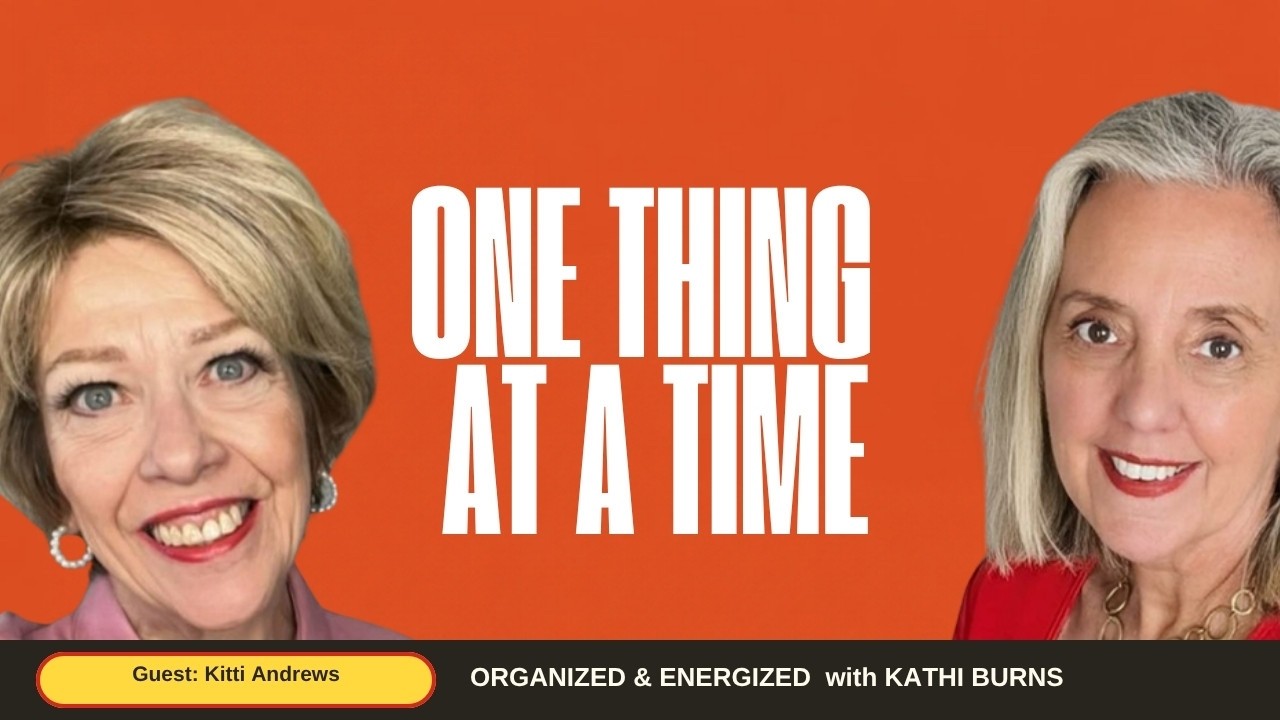
Episode 86
with Kitti Andrews, your Thought Organizer at Declutter the Brain, helping entrepreneurs clear physical and mental clutter · August 23, 2023 · 40 min
Kitti Andrews, known as Your Thought Organizer, helps entrepreneurs declutter their space and their brain, mostly over Zoom, after an 18-year real estate cleaning business.
She says clearing physical space changes other areas of life: one client who could barely reach her front door started a fitness program within about six weeks and later accepted $800 for her first commissioned stained glass work.
Her ONE system is one room at a time, one area of that room at a time and one thing at a time, which she says trains your brain so the clutter does not come back.
For mental clutter, Kitti picks one category or one quick win, such as a 45-second email, and often starts by asking her assistant what she needs.
She gives each communication app one job: Voxer for clients, WhatsApp for three people, and her assistant handles business messages on Facebook Messenger.
Published · Updated
What is this episode about?
Kathi Burns, CPO®, Business FLOW Strategist, talks with Kitti Andrews, known as Your Thought Organizer, about how to declutter your mind by starting with your space. Kitti has always been the organizer, from her first job as a file clerk to clearing the walk-in fridge as a waitress to an 18-year real estate cleaning business, and she now declutters with clients over Zoom. You'll hear how clearing one client's sun porch led to a fitness program, a fresh look at her marriage and her first paid stained glass commission. Kitti explains her ONE system (one room, one area, one thing at a time), how she uses it on mental clutter, and why she gives each communication app its own job. She also shares her Wednesday kitchen counter habit, how she is learning to celebrate small wins, and why done is better than perfect.
Decluttering the space actually helps you to declutter your mind.Kitti Andrews
Jump to links and resources · Part of How do I organize my home and closet? · All episodes · Every guest
What are the key takeaways?
- Kitti finds that as a client's space gets cleared, changes show up in the other life pillars she names: health, habits, relationships and head.
- Kitti says every person she has asked finds mental clutter harder to deal with than physical clutter, because it can be paralyzing.
- The ONE system is one room at a time (preferably a small one), one area of that room at a time, and one thing at a time; it is slower, but Kitti says it keeps the clutter from coming back.
- On a foggy day, Kitti gets one quick win first, then works by category, such as email or who needs something from her.
- Kathi likes the Ivy Lee method: list six tasks, prioritize them, work from the top, and carry the rest to the next day.
- Kitti gives each app a purpose so she knows who needs her when a notification appears.
- Clearing and wiping the kitchen counter on Wednesday evening in 15 to 30 minutes is Kitti's favorite specific hack; she says it clears her head for Thursday and Friday.
This episode is brought to you by the Business Logjam Session
A private 75-minute online session with Kathi Burns to find the one thing holding your business back and leave with your next steps. It is the same F.L.O.W. process Kathi uses with her own clients: Focus on your goals, Locate your logjams, Outline your solutions, Walk away knowing your next steps.
Find What's Holding Me BackInterested in sponsoring the show? Get in touch.Can a professional organizer help you declutter over Zoom?
Yes. Kitti Andrews moved to virtual decluttering over Zoom after someone suggested it, and she says people love it. It is less intrusive than having someone in your home, you don't have to clean for the cleaning lady, and it is a more focused way to get through something like 30 years of Christmas decorations. Kathi adds that she doesn't want clients to organize for the organizer; she wants to see where things land so the system fits how they use the space.
How does physical clutter affect your mind?
Kitti says decluttering your space helps declutter your mind, and other areas of life start to shift. One client who had to sidle past clutter to reach her front door started a fitness program about six weeks after they cleared her sun porch, began noticing things in her marriage, and later accepted $800 for her first stained glass commission.
Is mental clutter harder to deal with than physical clutter?
Kitti says every person she has asked says yes. With physical clutter, people know what to do and are just overwhelmed or don't want to; mental clutter is all in your head and can be paralyzing. She felt it herself when unpacked boxes sat in her living room after a move: once she unpacked some and put the rest in the spare bedroom, she felt much more energetic by Monday.
What is the ONE system for decluttering?
Kitti's ONE system is one room at a time, one area of that room at a time, and one thing at a time. Start with a small room for a quick win, stay in one corner, and deal with each item properly. It is slower, but she says it trains your brain so clutter stays away.
How do you declutter your mind when you feel overwhelmed?
To declutter your mind, Kitti picks one thing or one category and gets a quick win, even a 45-second email. Then she works by category, such as email, or by who needs her, starting with her assistant. She says focusing on what someone else needs can ground you and point you to the important things.
How do you manage too many communication channels?
Give each channel a job instead of trying to use one app for everyone. Kitti's clients reach her on Voxer between consultations, only three people are allowed on her WhatsApp, texts are the grab bag, and her assistant handles the business messages on Facebook Messenger. Kathi, who also uses Skype with her husband and her team, agrees that parceling out the types of communication is the way to go.
What is a quick organizing hack that clears your head?
Clear and wipe your kitchen counter on Wednesday evening. Kitti says to spend no more than half an hour on it, and 15 minutes should do it; she always feels energized for Thursday and Friday afterward. Kathi had the same lift that morning when she came downstairs to a counter her husband had cleared.
Why is done better than perfect?
Because perfecting things that don't matter wastes mental energy. That is the advice Kitti would give her 18-year-old self: a peanut butter sandwich does not need peanut butter to the exact edge, so make it, eat it and move on. She still proofreads her newsletter several times, while Kathi says a reader pointing out a typo shows they are paying attention and gives her a chance to respond.
Where does each part of the conversation start?
- 0:00 Meet Kitti Andrews
- 0:29 Declutter your space and your brain
- 1:12 From file clerk to organizer
- 2:51 Decluttering over Zoom
- 4:09 A client's ripple effect
- 7:46 Finally making stained glass
- 8:58 Stop saying "should"
- 9:17 Clutter starts in the brain
- 11:18 Clutter's best friends
- 12:08 What mental clutter costs you
- 15:22 The ONE system
- 15:40 One area, one thing at a time
- 17:31 Using ONE on mental clutter
- 20:42 The Ivy Lee method
- 21:44 Taming your communication channels
- 25:09 Her favorite organizing hack
- 26:07 Clear the kitchen counter on Wednesday
- 28:05 Celebrating small wins
- 32:51 Done is better than perfect
- 37:12 Wrap-up
What resources were mentioned?
- Kitti's free guide: Seven Easy Steps to Conquer Your Physical and Mental Clutter
- Voxer (walkie-talkie app)
- The Ivy Lee method
- Peter Walsh's four Ds (quoted by Kathi)
- How to Master Your Muck by Kathi Burns (free book)
These episodes continue the same thread as this one: Donna Zalter, Amy Stone, Adele Bernard also answer the question "How do I organize my home and closet?", and the rest are the most recent conversations on the show.



See every episode on the podcast archive or filter by topic on the How do I organize my home and closet? hub.
How can I support the show?
- Subscribe on Apple Podcasts, Spotify or YouTube, or add the RSS feed to any app.
- Rate and review. A rating on Apple Podcasts helps new listeners find the show, and Kathi reads every review.
- Share the episode with one business owner who needs it; the share buttons are at the top of the page.
- Grab a free eBook: 6 Steps to Organize & Energize Your Home, 6 Steps to Organize Your Home Office or 6 Steps to Organize & Energize Your Life.
- Work with Kathi. The Business Logjam Session is a private 75-minute session to find what is holding your business back.
- Be a guest. Apply here if you have a story about clearing the obstacles in your business.
What did they say, word for word?
The transcript below is edited for readability: filler words and false starts are removed and speaker names are added. Nothing was added or summarized.
Read the full transcript +
Kathi: Hi everyone, this is Kathi, and we are back. Today we're talking to Kitti Andrews, and the reason that I wanted to have her on the show is we're going to talk about mental clutter and decluttering your mind space. So welcome to the show, Kitti.
Kitti: Thank you for having me, Kathi. I'm so excited.
Kathi: I know this is going to be fun. So, for people that don't know you, let's start there. Talk a little bit about what you do, how you came upon this. What's your backstory?
Kitti: Well, the official tagline is I help entrepreneurs to organize their space and streamline their thoughts so that they can focus on being profitably productive. What that means in real language is I help people to declutter their space and their brain so that they get the right things done as opposed to busy work, and then they make more money.
Kathi: Oh yeah, baby. Stuck in busyness, right?
Kitti: Absolutely. Absolutely.
Kathi: What brought you to this type of career? What's your backstory on what you did before you became a clearing specialist?
Kitti: I've pretty much always been the organizer in whatever workspaces I've been. I don't know if there's a touch of autism in me, but I've always had to have things structured, and I was pretty extreme at one point, but I mellowed out. My first job was as a file clerk, back when we all went to work in offices, right? And I got promoted to the accounting department. A couple of months later, one of the ladies where I used to file said, "Could you maybe work for us part-time, because we can't find anything anymore?" And fast forward to waitressing in restaurants. I always got voted the one to clear out the walk-in fridge, because at the end of the day the chefs just want to go for a beer. So they throw everything in the fridge and you can't find the yogurt. I loved doing that. I was quiet in my own space and I could make everything beautiful. And then in my 18-year real estate cleaning business, I always felt compelled to move things around just a little bit. Not totally reorganize the place, but staging, if you will, a form of staging. I was lucky; the clients always liked what I did. And then someone suggested virtual decluttering, doing it via Zoom as opposed to going into people's homes. And lo and behold, people love it, because it's less intrusive. You don't have to clean for the cleaning lady. It's a more focused way to get rid of 30 years' worth of Christmas decorations, that kind of thing.
Kathi: Yeah. I love the fact that we can organize over Zoom now and that people are open and receptive to that. I think it is less intimidating. I always say don't organize for the organizer. I want to see where things land and how you're using your space and whatnot. So yes, absolutely. It's like the Columbo approach, for those who are old enough to remember Columbo.
Kitti: Yeah, right. Yep. Let me see the lay of the land first, because then you can organize for them, because one size does not fit all. Wouldn't you agree?
Kathi: Oh, absolutely. That's what keeps me juiced about my career: it's never the same. I get to use the artistic, creative aspect of myself to create the system for them and the way that they're going to use it, because as we know, it needs to be sustainable. If it's not sustainable organizing, then it's just going to fall right back into disarray.
Kitti: That's right. That's right.
Kathi: Tell me a story about one of your clients. One of your favorite client stories. What happened?
Kitti: Let me count the ways. Before I answer that, I find that decluttering the space actually helps you to declutter your mind, the layers of it. As their space is getting cleared, clients always start to get transformed in the other areas, the other four life pillars: their health, their habits, their relationships and their head. Hence my company name, Declutter the Brain. And my best example of that is a client who has been with me for three years. We started with her sun porch. She had to sidle in to even get to her front door. We started clearing that, and in about six weeks she said, "You know, I've been thinking about doing a fitness program, and I'm finally going to do it." I thought nothing of it. Oh, that's great. I didn't attribute it to the physical decluttering at all. But then shortly thereafter, she said, "You know, my husband said something to me I'm not sure I really liked." And she told me what it was, and it wasn't that bad. They'd been married for 25 years, so a lot gets said. And I said, "Well, that's interesting. Is this new?" She thought about it and said, "No, come to think of it, he's been saying that kind of stuff for 25 years. I just never noticed it before." Another example of decluttering opening her eyes to other things that were amiss that should be fixed. I've been credited with saving three marriages, by the way, just by decluttering. It sends ripple effects.
Decluttering the space actually helps you to declutter your mind.
Kathi: Yeah, that's where I was going. Ripple, ripple, ripple. I always say the smallest and most insignificant change leads to larger-than-life results. And I think that's the beauty of what we do: we see that transformation and get that aha moment, sometimes even before our clients do. Like your client, after she figured it out, it's like, yeah, this is great. Love it. That's a good story. And she's probably able to move more now. I think that whenever you're in a physical environment where you're just surrounded, you shut down opportunities. You shut down thoughts of differentness, because you just can't think of anything besides it, or you're trying to ignore all the stuff around you.
Kitti: Yes. Yes. And doing that takes mental energy that you could be putting towards something else. For example, she never met a hobby that she didn't like. This is the crown jewel of that story. She never met a hobby that she didn't like, but her biggest interest has always been stained glass art, which isn't easy. And I'm proud to say that she has just accepted $800 for her first commissioned stained glass work. She's finally decluttered all the other areas of her life, so she said, yes, I can finally do it now. I asked her, "Do you think you could have done this when we met?" And she said, "Oh, no. No way. I couldn't think that clearly to be able to progress this far." So there you go.

Kathi: That's fantastic. And don't you think it has to do a lot with guilt too? I hear the word guilt coming up. I can't spend time doing my stained glass, because I really have to get to this other stuff that I've been ignoring for 30 years. Guilt is a big player in what we choose to do, and in our fun, right? Do we have time for fun? I don't know. There's too much other stuff that I haven't done. All these uncompleted projects.
Kitti: Yeah. I should, dot dot dot.
Kathi: Yeah. Should. How many times do we say that? Don't should yourself out there, listeners. Just stop saying the should word.
Kitti: Yep. You have to replace it.
Kathi: Just say I could. I have a choice.
Kitti: Or I will, or I am considering. Yes. Positive language. Because really, I believe that clutter starts in the brain. What do you think of that?
I believe that clutter starts in the brain.
Kathi: Yeah, I totally agree, because when your brain starts shutting down, then you're not able to handle your physical environment. But I think what we do in our work in the world, we're sneaky like that. You come face forward and talk about mental. I don't really talk about it as much. I know they're going to have that shift. I know they're going to have that transformation, but let's start where it's easy. Like your client: let's start with the front porch. Let's see what we can clear, so that whenever you walk into your house… think about that, right? You have a porch that you can hardly get through, and then you show up at your house and you can walk straight in. What do you think happens to your brain?
Kitti: Yeah. More clarity, or at least a little bit more energy. Because before, before this woman could even walk onto her porch, her energy was zapped, right? All the things, the stuff left undone. You get the shoulders sagging. Got to do this sometime. People are embarrassed about their clutter, but I think they don't realize all of the other effects that it's having on them.
Kathi: I know. And embarrassment is just silly anyhow. Embarrassment, I think, is self-judgment. I always say you never have to be embarrassed about anything. Life happens. Half the time the crap, so to speak, has accumulated because it's been given to you. Especially as girls, we inherit all the stuff. The boys are like, I'm not taking anything, and then it ends up on our doorstep. I mean, life happens. Clutter's best friends, the four Ds, right? Divorce, dependence… oh my God, now I went dead. Okay, help me with this. Divorce, dependence. Oh, disease, and… I just went blank. I'm sorry. Yeah. Oh, sorry. That's what happened. Those are clutter's best friends, right? That's a Peter Walsh quote. I always say if you have more than two of them, you're in trouble. If you have death and disease but you don't have divorce and dependence… if you get three, you're in trouble, and that's when you need to call on a pro. Anyhow, I digress. Let's get back to you, Kitti. What's been the one life lesson that you've learned through doing this as a career for so many years? What have you learned from this experience of helping people declutter?
Kitti: I've learned, again coming back to mental energy, how much mental energy physical clutter can take up. And I've got a personal story for that, if I can share it very briefly. Moving into my new apartment here, I was doing a lot of speaking, moving, as busy as it is, and a lot of boxes were piled in my living room. I thought I should go easy on myself. It's going to get done, it's going to get done, it's going to get done. But it was eating me up. And one weekend I just finally said, okay, either it goes into the spare bedroom where I can't see it, or it gets unpacked. And a little of both happened. I felt so much more energetic come Monday. I didn't have that eating up my brain. And mental clutter, when you're mentally getting prepared for your day and you're thinking, what did I write down that I have to email that person? Oh my God, I didn't phone that person. I didn't send that message. These things start to build up and build up, and that little battery icon at the top of your head, like on your iPhone… well, there's your mental clutter that's happening as well. In fact, I've asked people about this, and every single one of them will say the mental clutter is more difficult to deal with than the physical clutter. We know what to do with physical clutter. We just get overwhelmed, or we just don't want to. But the mental, it's all there in our heads. How do we niche it down so that it's not overwhelming? Because it can be paralyzing. And I speak from personal experience about how mental clutter can be just paralyzing.
Every single one of them will say the mental clutter is more difficult to deal with than the physical clutter.
Kathi: Yeah, there are too many categories to deal with. And I even experienced that today, because way too many things happened over the last couple of days. All good things, but they take their toll on you, and you just think, what do I start with?
Kitti: Exactly. And that happened to me yesterday.
Kathi: We all have times of no clarity at all. Today I'm crystal, which is, thank God, because you can't be mucky the whole time. But yeah, it happens to everybody. So, I know we're going to talk about the three strategies, or three steps, that you use. Can you talk about those a little bit, to clear your mental clutter?
Kitti: I can. Before I do that, it's called my ONE system. I developed it for physical clutter, but it can be applied to mental clutter. I'll explain it quickly, and then you'll see why. The ONE system is one room at a time, one area of that room at a time, and one thing at a time. Notice the word one. Exactly how many? One, right? And what I mean by that is one room. Just decide on the one. You want to get some quick wins. You want to get some dopamine happening: okay, yes, I can do this. Because many people just don't even try, because they don't think that they can, or they've been told that they can't, or they've tried before but they tried to do too much. So pick one room, preferably a small room. And then the next part: one area of that room at a time. Same deal, but smaller. Pick one area. It's very tempting to do a little bit over here, and then some on my desk, and then some over here. No. You will see quicker results by sticking with one small area. "Yeah, but if I do it all over the room, I'll see lots of results." No, you won't, because your brain is basically multitasking. You'll get more when you look at that one corner that you've stuck with. Wow, I got all that done. Yay me. Let's go. Momentum, right? And then one thing at a time. Is it tedious? Yes. Is it time-consuming? Yes. Is it also the number one way that you're going to train your brain so that the clutter does not come back? Because you even said this earlier: it goes back into disarray if you don't do it right the first time.
One room at a time, one area of that room at a time, and one thing at a time.
Kathi: Right. If it's half-baked and not done, then it's not done.
Kitti: That's right. That's right. Now, how does this apply to mental clutter? It's exactly the same thing, what I was just saying about the little battery icon and using up your mental energy. I had to apply this system. There were some family problems; there were just way too many things happening, and running a business at the same time and all that involves. And I started having those moments in the beginning of the day that I just described: did I write down to email this person? All of these things. And I said, all right, physician, heal thyself. Pick one thing, one category. When I was feeling like this earlier this morning, like how you were feeling yesterday: I've got to do something. All right, good, I got one quick win. It took me about 45 seconds to do. I just sent off a really fast email, which I don't. I take time to compose. Sometimes you just have to say good enough is good enough. Send it off. It was to a colleague who's a good friend, so if there was a typo in it, it was okay. Just do it. Get that quick win. And I felt more energetic. I thought, yeah, okay, got that done. What's next? And sometimes I will say, all right, let's do it in categories. Email is a category. Or, who needs me? Who, meaning a person, needs me? Is it my partner? No, I don't have one. Is it my assistant, who's waiting for something from me so she can do her job? She usually comes first. I text her every morning, Monday to Friday, unless we already know what we're doing, and say, "Is there anything you need me to do so that you can do your job to your standard?" And she'll say, "No, we're good," or, "Yeah, I've been asking you to look at that spreadsheet for a couple of days now." Okay, yes. But sometimes just focusing on what somebody else needs can really help you to focus on the important things and ground you a lot. People can be very grounding. They can be very scattering as well, but they can be grounding. So, for me anyway, it's niching it into some sort of category. Have I answered your question?
Kathi: Yeah, absolutely. It's the one thing, right? That's what I was doing yesterday when I was so foggy. I'm like, I'm just going to do this one thing. And I finally got it done. But it was horrendous, because it took me way longer than it should have. But so what? I got it done, right? And even on the clear days, I like the Ivy Lee method. I don't know if you've ever used that. He was working with a corporation, trying to bring more productivity, actually to Buick, I think it was. With the Ivy Lee method, you have a list of six, and those are the six things that you're going to get done. You prioritize them, and then you start at one. Sometimes you only do one, two or three, and then what happens the next day? Four and five become one and two. So it allows you to keep that thing going and keep focused on what's the next step. So it's a variation of your ONE, because you're going to start with one and you're not going to do anything until you finish that one, then you go on to two. But I think we all need that, especially in today's age. There's so much stuff coming at us. Your inbox, Zoom, Skype, texting, Facebook Messenger. Oh my gosh, there are so many different forms of communication. It's driving me bonkers, actually. And you have to choose. I think back to one. How do you feel about that, as far as all the different types of communication? What have you chosen to use? Because I'd like to not choose some things that I have to do.
Kitti: Yeah. What has helped me a lot is, as opposed to narrowing it down to one means of communication with everybody, like Facebook Messenger or text or whatever, I've designated different apps for different purposes. For example, all of my clients get Voxer access to me, the walkie-talkie app. That's part of the perk of the program, so that they're never alone in between our consultations. They can always either rant or ask me a question, because sometimes you feel stuck and you feel alone, and this way they don't feel alone. So Voxer is only reserved for that. If I see the little notification on it, then, oh, somebody needs me. Okay, I'm prioritizing that. My WhatsApp, there are three people on that. Nobody else is allowed on there. It's my best friend, my assistant and my aunt. Only three people. And even my aunt came on there by accident.
Kathi: She found you.
Kitti: Yeah, well, pretty much. And then the texts, that tends to be the grab bag. And Facebook Messenger, I wish I could slice and dice that. I can't, but I've gotten pretty good. My assistant handles a fair bit of that, any of the business ones that look like she should handle, and she leaves what's obviously personal, a friend in Alberta or something like that, for me. That's how I handle it. Anybody who can handle more than that, God bless them.
Kathi: I love that you do it that way. Specific people for specific things. My straw broke when my husband would only speak with me on Skype. He's like, "Why are you not on Skype all the time?" I'm like, oh my gosh. Okay, here's another method of communication that I need to use. And I love Voxer for clients, though. I think Voxer is just the coolest thing. You don't have to worry about typos or anything. You just chitchat and answer questions. I absolutely love that. I think it's one of the best tools I've started to use in the last couple of years, for sure. But now I'm on Skype, so now other people are on Skype, and actually my team's on Skype, so that actually makes sense. But yeah, I think parceling out the different types of communication is definitely the way to go. Okay, so you're a professional organizer. I have to ask you this. What's your favorite organizing hack that you use personally? Hack, whatever.
Kitti: Okay. Well, I help people to organize their thoughts so that they can organize themselves. I know that you are a professional organizer, so we're in the same field, but a little bit different. What is my favorite hack? Really, the ONE system: niching it down to one, whatever it is you're doing. That's really my favorite. If it comes to something specific, then giving your kitchen counter a tidy or a clean on Wednesday, in the middle of your week, can be a real boost, a real refresher. I don't know about you, but I live alone, so there isn't anybody else to wipe the counter. I also don't have to wipe the counter after anybody else. But I find that… don't take more than half an hour on it on Wednesday night. Fifteen minutes should do it. But giving it a clearing also clears your brain as well. And I tell you, I always feel energized for the Thursday and the Friday. It just gives that little pick-me-up, a little self-care.
Kathi: That's a fantastic tip, a fantastic hack. Kitchen counters are the biggest source of arguments that I find between husbands and wives. You've probably seen the same thing. It's like, why is there all this stuff? The guy's saying, I don't know, you put it there, that's where you dropped the mailer. I had to laugh when you said that, because I walked downstairs this morning to find an impeccably clean, organized, cleared countertop in the kitchen that my husband had done this morning for me. My energy just soared. I got a big old smile on my face, and I got more ramped up for jumping into work, because I walked down and it was clear and spacious. Oh my gosh. That's back to the one thing that has completion, right? It's a sense of yes.
Kitti: Yes. Yes. Huge.
Kathi: Yeah. And I am blessed to have someone who would do that for me. He did it for himself as well, I know, because he hates clutter. But it was a huge revitalization. So I love that. I always like to ask this: when you have a success, what do you do to celebrate your successes? Do you have any type of little ritual or anything that you do for yourself?
Kitti: It depends on the size of the success. I've been learning, too, because I tend to be a real head-down-working, just-plow-through-everything type. Type A, type double A, type triple A. Go, go, go. What? I don't have time to smell roses. All this kind of stuff. So I've been learning to celebrate small successes, like, okay, that social is posted, or the newsletter is done for tomorrow. Yay. Okay. All right. A little bit of dopamine. Celebrating small successes, just something as simple as that. That's really a good question. Do you mean like having a glass of wine, taking yourself on a trip? Help me out here. What do you do?
Kathi: Well, I'm asking this because this is my year of celebration. When I published my first book, I didn't even stop to celebrate at all. I'm just like, okay, now I've got to do marketing. So you and I are so much alike on that. I'm like, what do I do to celebrate success? Okay, so it depends again on the size. I have a new member for my organizers club, and I haven't even really launched, and she joined me yesterday. How did I celebrate that? I actually shut my laptop, went outside, soaked in some sun and said thank you. And I ask all my guests this, and I want all the listeners to hear: we don't stop to celebrate. What does celebration mean? Now, if it's a momentous thing, I will get a bottle of champagne, I will pop the cork, and I will just sit down with some friends and say, yay. Things like that. But just the small little things are so very important for us to recognize, acknowledge, appreciate and say thank you for, because gratitude is what makes things happen, right?
Kitti: Gratitude is key. Say thank you for every little gift. We are blessed and surrounded 24/7 by gifts. Waking up in the morning is a gift, because you have another day to make an impact on people's lives. And it's too easy to be negative. I'm sure you'd agree it's too easy to focus on the negative things, like, oh, I have to take my car in for servicing. No, you get to take your car in for servicing, because you have a car, you've got money to put gas in the car. You get to, not you have to. That strategy has changed my life, to be saying, all right, no, I am fortunate. Is life going to be absolutely perfect and smooth? No, it isn't. But it isn't, for a reason: so that you can teach yourself, all right, how do I fix this challenge? And then you get through that challenge, and maybe you can help somebody else, or it just makes you stronger all the time.
Kathi: Yeah. I bring up the celebration because it's really an homage to me, to remind myself that I need to stop and celebrate, and I want to remind everybody, all my guests, all the listeners: stop and celebrate. Wayne Dyer is one of my favorite guys, God bless him. Every morning when he would wake up, he would put his feet on the ground and say, "Thank you for this day." That was his morning ritual. And I think having rituals of gratitude and celebration is important. So that's why I bring that one up. It's just a reminder. We all need to do that. And it's really for me; I'm self-centered. Just a reminder to myself to pause and celebrate. So let me ask you, Kitti: if you had to tell your 18-year-old self something, give yourself a piece of advice, what would you tell little Kitti?
Kitti: Oh, something similar to what I said before: done is better than perfect. How much mental energy are you wasting on making something that really isn't that important absolutely perfect? The peanut butter does not have to go to the exact edge and be exactly artistic. It's a peanut butter sandwich, for heaven's sake. Just make it, eat it and move on. Yeah, just prioritize what's important.
Done is better than perfect.
Kathi: The peanut butter sandwich does not have to be perfect. I love that. It's true. I have a mantra for every year, and one of my mantras is perfection is overrated and simply not worth it. It's just not worth it. And nothing's ever perfect anyhow. So get over yourself.
Kitti: Yeah. Yeah. Pretty much. Pretty much. Oh, but somebody will see a typo. They're going to see. So with my newsletter, I go over it three, four, five times just before I send it out. I could schedule it, but no, I just want to make sure. Because people will see a typo, and that can look like sloppiness, and I don't want people to think that I'm sloppy, because maybe my work is sloppy as well. So I'm pretty much a perfectionist about that. But you know what? Sometimes a typo will still slip out. Oh well.
Kathi: Well, you know what? I love it when that happens on my newsletters, because I always get someone that responds and points it out, and it gives me a chance to interact and say, oh my God, thank you so much for reading my newsletter so closely that you realized I had a typo. I absolutely love this. Now, what gift can I give back to you? I actually like it when that happens, because it allows me to interact, and it lets me know that they're actually paying attention.
Kitti: Well, there's that about it, too. That's huge.
Kathi: It's huge. They're reading my newsletter. They're reading tips. They're actually inspired and motivated and taking action, to actually give me the grace and give me the gift to respond and point out where I've made my error. I mean, that's their time. I'm like, wow, this is a cool little thing here. So that's how I got over that a long time ago, because it's a gift to me. And that's what it is. When people actually respond, no matter whether it's good, bad, ugly or disgusting, they're actually interacting, which means they're paying attention.
Kitti: And you're making an impact.
Kathi: Exactly. Making an impact. Even if they're like, what did she spell it that way for? It's like, okay, cool, let me know. How did I botch that one? Because we're not perfect. Okay, so I know you have a valuable free resource that you're going to offer the people, and I know that they're clamoring to see what it is and download it. So let's talk about that a little bit.
Kitti: Unfortunately, I thought I had the physical copy with me. That's why I was looking around on my desk. But what it is, is seven easy steps to conquer your physical and mental clutter. It's intended as a grounding tool for your declutter journey and beyond, because, as we have said, what's the point in decluttering if you can't keep it that way? And it really is seven easy steps that you can apply to all five pillars of your life.
Kathi: Yeah, that's seven to five. Love it. Okay, we're going to put the link down below so you can grab it. Go ahead and grab that download; it's going to help you. The way I feel about it is the more modalities and the more different people we can learn from to do the same thing, the better, because we're going to find that one little thing that sticks, and then our life's going to be made better. That's what it's all about: learning, expanding and grabbing the information as it comes to us. And this is a gift from Kitti to you, so go ahead and download it. Same thing, I have my free book. You can go ahead and download How to Master Your Muck: Get Organized, Add Space to Your Life and Live Your Purpose. You can grab that free book with the link below as well. So I really appreciate your time, Kitti. I love talking to fellow organizers. It always makes for a great podcast, and I know my audience loves hearing about us and what we do and hearing our client stories. So thank you for your time and your energy. You're a delight.
Kitti: Thank you for having me.
Kathi: Yeah, absolutely. Thanks, Kitti. And until next week, make sure to download Kitti's gift. Go forward. Think of one thing you can do right now to make your life better, and do that one thing. And in the morning, think of the one thing you can do as well. It's a great tip. Until then, we'll see you next week.
Where can I find the links and resources from this episode?
Connect with Kitti
Organizations and companies
Books and resources
Inspired? Here Are Your Action Steps:
- Pick one small room to declutter first so you get a quick win.
- Work in one area of that room until it is done instead of moving around the room.
- Deal with one thing at a time and finish it properly so the clutter doesn't come back.
- When your head feels full, do one task you can finish in under a minute, like a short email.
- Sort mental to-dos into categories, such as email or who is waiting on you.
- Ask the person who depends on you most what they need from you today.
- Give each communication app one purpose and decide who is allowed on it.
- Clear and wipe your kitchen counter on Wednesday evening in 15 to 30 minutes.
- Replace "I should" with "I could", "I will" or "I am considering".
- Celebrate small wins, like a posted social update or a finished newsletter.
Frequently asked questions
How do you declutter your mind?
+
Kitti Andrews applies the same ONE system she uses for physical clutter: pick one thing or one category and get a quick win first. That might be a 45-second email, or asking her assistant what she needs that day. She says clearing physical space also clears your head.
How does physical clutter affect your mind?
+
Kitti finds that as a client's space clears, other areas start to change too. One client who could barely reach her front door started a fitness program within about six weeks, began noticing things in her marriage she had ignored, and later accepted her first paid commission for stained glass art.
What is Kitti's ONE system?
+
One room at a time, one area of that room at a time, and one thing at a time. Pick a small room for a quick win, stay in one corner instead of hopping around, and deal with each item properly. It's slower, but Kitti says it trains your brain so the clutter doesn't come back.
How does Kitti manage so many ways to communicate?
+
She gives each app a job. Clients reach her on Voxer, only three people use her WhatsApp, and her assistant handles the business messages on Facebook Messenger.
What's Kitti's favorite quick organizing hack?
+
Clear and wipe the kitchen counter on Wednesday evening, in no more than 15 to 30 minutes. She says it clears her head too and gives her energy for Thursday and Friday.
Who is talking in this episode?

About the Host, Kathi Burns
Kathi Burns, CPO®, is a Business FLOW Strategist based in San Diego. For the last 20+ years, Kathi has helped clients create systems they can stick to. She is the author of How to Master Your Muck, Organizing With Tetris and Home Organization, The Smart Guide, and co-author of four more titles; all are in Kathi's shop. Kathi's business has been featured on Good Morning America, and her advice has been featured in Oprah Magazine, Martha Stewart Living, Better Homes and Gardens and Entrepreneur Magazine.
More about Kathi · Shop Kathi's books · Business Logjam Session · Apply to be a guest

About Kitti Andrews
Kitti Andrews, known as Your Thought Organizer, runs Declutter the Brain and helps entrepreneurs organize their space and streamline their thoughts so they can focus on being profitably productive instead of doing busy work. She has always been the organizer. As a file clerk, the accounting department asked her to work part-time for them because they couldn't find anything; as a waitress she was voted the one to clear out the walk-in fridge; and in her 18-year real estate cleaning business she staged homes as she cleaned. She now declutters with clients over Zoom. Kitti has written, directed and performed over 800 online videos on decluttering what she calls the five life pillars, and has presented at Stanford and Harvard.
Want help putting this into practice?
Book a Business Logjam Session with Kathi
A private 75-minute online session to find the one thing holding your business back and leave with your next steps, using the same F.L.O.W. process Kathi uses with her own clients: Focus on your goals, Locate your logjams, Outline your solutions, Walk away knowing your next steps.
Prefer to start small? Download Kathi's free eBook 6 Steps to Organize & Energize Your Home.
Published · Updated
This episode page is for general information. Guests speak for themselves, and their opinions, statistics and examples are their own. Nothing here is legal, financial, medical or mental-health advice; talk to a qualified professional about your own situation. Some links go to the guest's own products or free offers; addSpace does not earn a commission from them unless stated.