

Episode 79
with Natalie Ledwell, co-founder of Mind Movies and host of The Inspiration Show · June 8, 2023 · 36 min
Natalie Ledwell grew up one of eight kids in an Australian country town and became a serial entrepreneur before co-founding Mind Movies, which has now reached 10 million people.
A mind movie is a movie version of a vision board: each slide pairs an affirmation with a photo, set to a song, and you watch it every day.
Natalie says feeling your future matters more than seeing it, so she picks one specific moment that will show success and imagines what she would see, smell, taste, touch and feel in it.
She and her business partner Glenn launched Mind Movies in September 2008, during the financial crisis, after running up about $120,000 on credit cards building it.
At 50, Natalie started a program for schools that helps kids understand and manage their emotions, even though she left school at 15 and did not feel qualified.
Published · Updated
What is this episode about?
How to visualize your goals so they feel real is the heart of this conversation between Kathi Burns, CPO®, Business FLOW Strategist, and her longtime friend Natalie Ledwell, co-founder of Mind Movies. Natalie grew up one of eight kids in an Australian country town and spent her 30s as a serial entrepreneur, from a nightclub to coffee franchises. In 2008 she and her business partner Glenn moved to the US and launched Mind Movies in the middle of the financial crisis. You'll hear what a mind movie is, why Natalie says feeling a future moment matters more than seeing it, how the launch went when almost everything went wrong beforehand, how she started a program for kids at 50 without feeling qualified, how she celebrates a win, and the handwritten to-do book and shared Google Calendar that keep her organized.
What's more important than what you see in your mind is what you feel.Natalie Ledwell
Jump to links and resources · Part of How do I grow my business without burning out? · All episodes · Every guest
What are the key takeaways?
- Natalie calls a mind movie a movie version of a vision board: a set of slides, each with an affirmation and a photo, set to a song you choose.
- In her view, visualizing works best when you picture one specific moment that stands for your success and imagine every sense in it, not a vague idea of a successful business.
- She sees the song as the emotional anchor of a mind movie, and uses songs with positive lyrics.
- Before the 2008 launch, their email provider shut down their account and PayPal froze half a million dollars for six months; Natalie treats a no as a normal part of running a business.
- When she didn't feel qualified to build a program for kids, she teamed up with a friend who has two master's degrees in child psychology and owned what she brings: her platform, her team and her knack for making information teachable.
- Natalie celebrates a win by calling the people involved and then sitting with the moment, on her balcony or on a walk.
- She keeps a handwritten book of to-do lists and a shared Google Calendar, and fills short gaps with a task from the list she can finish in that time.
This episode is brought to you by the Business Logjam Session
A private 75-minute online session with Kathi Burns to find the one thing holding your business back and leave with your next steps. It is the same F.L.O.W. process Kathi uses with her own clients: Focus on your goals, Locate your logjams, Outline your solutions, Walk away knowing your next steps.
Find What's Holding Me BackInterested in sponsoring the show? Get in touch.How did Mind Movies start?
Mind Movies started in 2007, when a friend showed Natalie and Glenn a slideshow of affirmations, photos and music he had made as his own vision board. They put a little video on YouTube and set up a website, and within months emails were coming in from people saying it was changing their lives. They moved to the US in 2008, joined a mastermind group, worked for six months and launched that September, just as the financial crisis hit, with about $120,000 already on credit cards.
Is it too late to start a business at 40 or 50?
Natalie's own story says no: she started Mind Movies at 40 and a program for schools at 50. At 40 she knew how to use Word and little else on a computer, so she had to learn to edit videos and write emails and websites. At 50 she went into education without knowing what she was doing there either. She says entrepreneurs have skills that apply to many businesses, so the question at this age is what you really love to do.
How do you find what you're good at?
Follow the breadcrumbs: ask what you're good at, what you like to do and what people compliment you on. Natalie says the nuts and bolts of running a business apply to any business. She also calls ignorance a gift: because she doesn't know the usual rules in education, she does it her own way and starts with the schools most open to the program.
What is a mind movie?
A mind movie is a movie version of a vision board. Each slide pairs an affirmation, such as "I have an outrageously successful business," with a photo of you living it, all set to a song you choose. Natalie calls it a visualization tool you can put on your phone or tablet and watch every day.
How to visualize your goals so they feel real?
Picture one specific moment that will show you've succeeded, then imagine everything you would see, smell, taste, touch and feel in it. Natalie says feeling it matters more than seeing it. For someone who helps people, that moment might be a client thanking them. The song in a mind movie helps you get to that feeling.
What if you don't feel qualified to start something?
Natalie's answer is to believe you can do it without believing you have to do it alone. She left school at 15 and doesn't have children, yet she built a program for kids with a friend who has two master's degrees in child psychology. She owned what she brings: her platform, her team and her skill at making information teachable.
How do you celebrate success as an entrepreneur?
Natalie calls the people who were part of the win, then sits and marinates in the moment. That might be on her balcony with a cup of tea or a glass of wine, or on a walk, being grateful at every step. She also makes herself credit her own effort, not only the team's, after a meditation told her she was the secret sauce.
How does Natalie Ledwell stay organized?
She uses a handwritten book of to-do lists and a shared Google Calendar. Items stay on the list until they get done, with no deadline for finishing it all in one day, and when she has 20 minutes between interviews she picks something she can finish in that time. Payments and anything that must happen go on Google Calendar, which her podcast manager and team can see so they can book her for videos.
Where does each part of the conversation start?
- 0:00 Meet Natalie Ledwell
- 0:30 From a country town to serial entrepreneur
- 2:24 How Mind Movies began
- 3:22 Launching in the 2008 crisis
- 4:13 Starting over at 40, and again at 50
- 6:09 Follow the breadcrumbs
- 8:26 When everything goes wrong
- 10:44 What is a mind movie?
- 11:57 Feel it, don't just see it
- 15:30 Thoughts, emotions and actions
- 18:58 Bringing it to kids
- 21:14 When you don't feel qualified
- 22:57 The first day of the launch
- 24:55 Marinating in the moment
- 27:44 You are the secret sauce
- 28:51 Her to-do lists and calendar
- 30:24 Just take the next step
- 33:49 Wrap-up
What resources were mentioned?
- Mind Movies
- Six free pre-made Mind Movies (offered in the episode)
- Google Calendar
These episodes continue the same thread as this one: Lia Dunlap, Carly Church, Ginny Priem, Stephanie Wall Morrow also answer the question "How do I grow my business without burning out?", and the rest are the most recent conversations on the show.

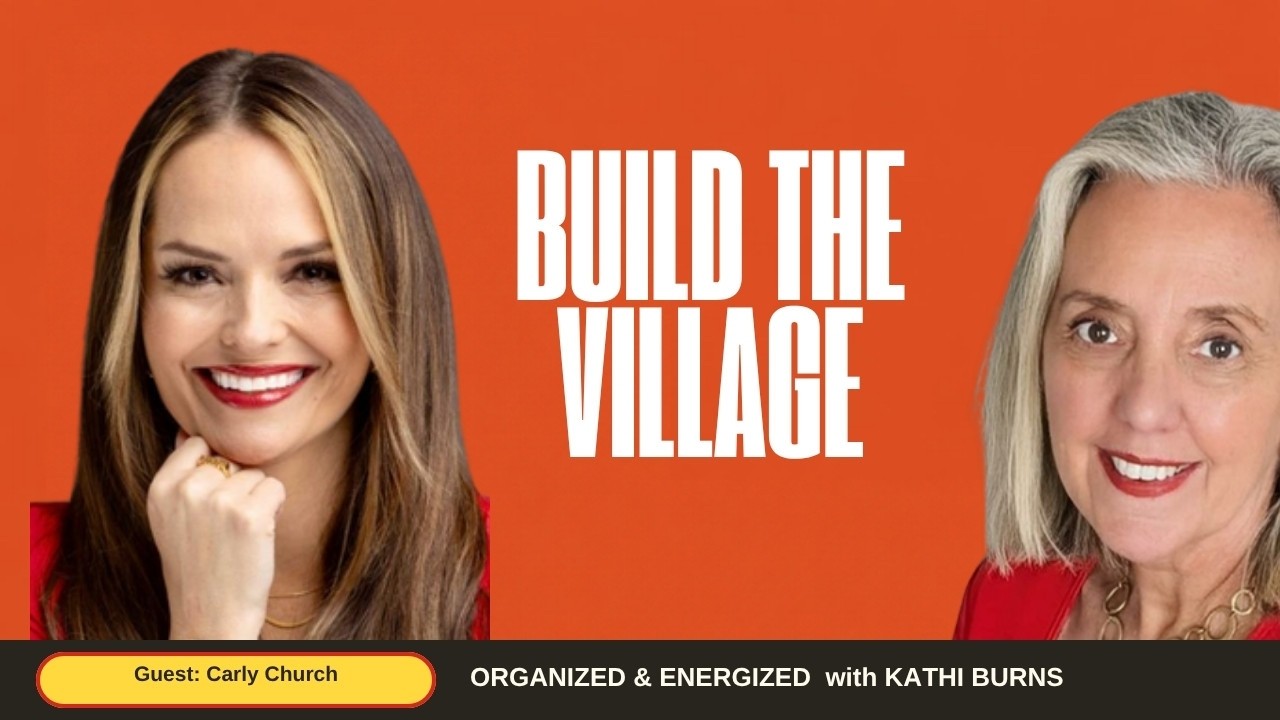 MotherhoodEpisode 147
How To Build a Village That Supports Your Business and Your Life with Carly Church

See every episode on the podcast archive or filter by topic on the How do I grow my business without burning out? hub.
How can I support the show?
- Subscribe on Apple Podcasts, Spotify or YouTube, or add the RSS feed to any app.
- Rate and review. A rating on Apple Podcasts helps new listeners find the show, and Kathi reads every review.
- Share the episode with one business owner who needs it; the share buttons are at the top of the page.
- Grab a free eBook: 6 Steps to Organize & Energize Your Home, 6 Steps to Organize Your Home Office or 6 Steps to Organize & Energize Your Life.
- Work with Kathi. The Business Logjam Session is a private 75-minute session to find what is holding your business back.
- Be a guest. Apply here if you have a story about clearing the obstacles in your business.
What did they say, word for word?
The transcript below is edited for readability: filler words and false starts are removed and speaker names are added. Nothing was added or summarized.
Read the full transcript +
Kathi: Hi everyone. I'm back and I am with my friend Natalie Ledwell. She is an Aussie that's an outlier in the whole world, and she's done amazing things with her life and for the world. And today we're going to jump into how to manifest according to your wildest dreams, beyond imagining. So welcome to the show, Natalie.
Natalie: Thank you for having me, Kathi. Kathi and I have been friends for a really long time, so it's great that we have one of our conversations and we get to share it with other people. It's pretty cool.
Kathi: Yeah, I absolutely love it. And this will just be a girlfriend's conversation. So, for those who don't know Natalie, why don't you give a little backstory, Natalie? Besides the fact that you're obviously Australian. Talk a little bit about your background and what brought you to where you are now.
Natalie: Yeah. Well, like we said, I'm Australian. I actually grew up in a country town and I'm one of eight kids, so I come from very humble beginnings. When I was 18 and old enough, I was the hell out of my hometown, and I moved to Sydney, which was the biggest city near where I was. And from the age of 21, I started managing fitness clubs. I just talked my way into that job and went, I'm sure I could do a pretty good job of this. But it was great, because my first 11 years of my career, I was practicing my entrepreneurial muscle on other people's business with other people's money, which was really good. And then I met my husband, and our first business was a nightclub. So we bought the nightclub, and two weeks later we got married. So it was just crazy, crazy times. After we sold the nightclub, after having it for five wild and crazy years, we went through a whole series of different businesses. We were the poster child for being a serial entrepreneur. We did bathroom advertising, we did property development, we had coffee franchises, we had health food businesses. I mean, you name it, we were doing it. And it was really interesting, because that time was my 30s. I call it my beige years, because we were just going through the motions. Glenn would come home and go, "Look, I've got this idea for a business." I'd go, "Great." And he goes, "No, no, no. You're supposed to be the voice of reason." I'm like, "Well, what's the worst that can happen? We lose some money. We'd just make some more, big fat deal." So we were just going through the motions. And then in 2007, we had a friend approach us with this really cool idea. The Secret had just been on Oprah, and everyone was talking about visualizing and the law of attraction, and he created this little slideshow that was affirmations and photos and music. It was his version of a vision board, and it was super cool. So he's like, let's start this, let's set up a website and let's sell the instructions so people can make these movies. And Glenn could hardly turn on a computer. I hadn't even heard of YouTube at this stage, and this is 2007. And we had four businesses that we were already trying to operate at that time. So it's like, dude, I don't know if we need another business. But to be honest with you, we put a little video on YouTube, we set up the website, and then within months there were so many emails coming through from people going, "This is changing my life." I'm like, "All right, boys. How do we figure out this internet thing?" And so that started our journey. We came over here to the US in 2008, went to a seminar, joined a mastermind group, worked our butts off for six months and launched our little cool idea to the world, which happened to be in September 2008, when the economic crisis was happening. We had already racked up about 120 grand on credit cards, so I was like, "Please work. Please work." And we ended up doing a $700,000 launch. Tens of thousands of customers. It's really what launched us and put us on the map. And then from there, we just kept going. And now, during the pandemic, we reached our milestone of 10 million people that we've reached.
Kathi: Amazing. People needed that big time during the pandemic.
Natalie: Yeah. Big time. And we really started doing that at 40. So at 40, I'm trying to learn how to… I knew how to use Word. That was it. And MYOB. That's all I knew how to use on a computer. And I'm having to learn how to edit videos and write emails and websites, so it was way outside my comfort zone. And then of course, when I get to 50, where I could possibly be slowing down, I'm like, "No, I'm going to get into education, and I'm going to put together a program that's going to help kids increase their emotional intelligence and have a fulfilled and happy life." And I started that at 50, and I didn't know what I was doing there either. But I think that as entrepreneurs, that's what we do. You just go, "Where can I help?" Because I think as entrepreneurs, we have a ton of different skills that really can be applied to many different businesses. But especially at this age, it's like, what blows your hair back? What is it that you really love to do? Because you've got all these skills and experience. It's like, well, why don't I funnel that into something that I love that's actually helping to make a difference?
Why don't I funnel that into something that I love that's actually helping to make a difference?
Kathi: And I think a lot of people right now, with the great resignation, are realizing at this point in their life, 40, 50, even 60, this is not what I want to do. I want to create my own thing. I mean, you and I have been serial entrepreneurs forever, our whole lives, but a lot of people don't have that in them. But I think the good nugget of what you're saying is that it doesn't matter if you've never done it. Because, and tell me if you agree with this, whatever skills you have in your toolkit lead to your passion. The reason that you have those skills is because it was something that you were really interested in at that point in your life, and you learned it. And so bringing that to market is a win-win, because it's going to be your passion.
Natalie: Well, I call it the breadcrumbs. You go back and you follow the breadcrumbs and go, "Well, what am I good at? What is it that I like to do? What is it that people compliment me on, that I know I do well?" And it could be applied to many different things. But when it comes to the nuts and bolts of how to run a successful business, I think those skills apply to any business. But I've got to be honest with you, one of the gifts that I've realized, both with starting Mind Movies and starting this personal growth studies, this program for schools, is ignorance. Maybe there were some rules, and there certainly are in education, rules and ways that people normally do things. Well, I don't know what they are, so I'm just doing it the way that I think I should do it, which is a blessing sometimes. Because I could absolutely go, "Oh my god, there's so much happening in politics, and everything's going on in education, and teachers are resigning," and all these kinds of things. And I'm like, "Well, I can't focus on the negative. I've got this little thing that I've got going on here. I've got to focus on what it is that I can do. Let me start reaching out to the low-hanging fruit first. Let me reach out to the people who are really open and willing for this." Honestly, if I could say, look, every inner-city school that's struggling with kids with attendance and behavior issues, let's focus there, I would love to do that. But I have to go, no, let's start where we can make the difference first, and then from there branch out. I'm sure that there are certain protocols and everything, but I don't know what they are, so I'm just doing my own thing.
Kathi: Well, I'm a big believer in do it, don't ask, don't ask for a yes. And that's actually how things are created here in the United States anyhow. We have the trailblazers. We just trailblaze through, do what we want to do, and then maybe we'll get a no, but usually you just go right past things. And that's how innovation happens as well, right?
Natalie: Absolutely. And that's the thing. We're talking about getting the no. The no is just a normal part of operating a business. It's not like you go, "Oh, I have this idea, and I put it into practice, and then, ta-da." Even when I was telling you about the launch of Mind Movies and the $700,000, everything that could go wrong went wrong leading into that launch. From our email delivery system shutting down our account because they thought we were doing something illegal, to PayPal freezing half a million dollars in the account for six months for no reason. There were so many things that went wrong. But that's also part of the process, and I think to be a great businessperson and entrepreneur, resilience has to be part of the mix. Getting a no, you go, okay, great, next. It's not a hands-on-head situation. It's a, okay, well, that's not right. I've learned from that. What do I do better next time?
The no is just a normal part of operating a business.
Kathi: Speaking of that, if you had to tell your 18-year-old self something, who had just left the nest and went from a small town to the biggest city she could find, what would be your advice to her?
Natalie: Well, to be honest with you, 18-year-old me had more front than Kmart. Seriously. I think I was young and I didn't really know, and I was always very confident. I did talk myself into some jobs that were way beyond my capability, but I was quickly able to figure it out. I was kind of lucky for that. And I don't have it as much now as I had back then. I could have it a little bit more now, I think, because as you get a little bit older, you mellow a little bit or whatever. I was probably a little too confident back then. But no, my 18-year-old self, she conquered the world.
Kathi: Well, that's really good. You can't say don't have so much confidence. I mean, the more confidence the better, especially as an entrepreneur, for sure. So talk a little bit about Mind Movies. Explain to the crowd here what exactly it is. I love vision boards, so explain what it's all about.
Natalie: Well, a mind movie is like a movie version of a vision board, and it's a way to organize your thoughts and your feelings about the future that you want to create. And you get to articulate this future using affirmations. So in a mind movie, you've got all these different slides, and on each slide is an affirmation and a photo. Let's just say your first affirmation is, "I have an outrageously successful business," and then you have a picture of you doing what it is that you do best. So not only are you describing in words what it is that you want, but you're backing it up with an image, because in essence, a mind movie is just a visualization tool. And what we know is, if you can't see in your mind that you're already living this future, you are never going to create it. You have to see it in your mind. It has to be a thought, and it has to be a consistent visual. But what's more important than what you see in your mind is what you feel, because we know that our emotions are the frequency that we send out into the unified field, or into the universe. And so we want to be able to feel what it's going to be like when we get there. I was talking to some friends last night, and they said, "Look, we're in this challenge right now. We're trying to get this funding, and it's really hard to stay positive when the reality is that everything's challenging." And I said, "All you've got to do is go to the future. Don't go esoterically, 'I've got this amazing business.' Think of the moment that you're going to experience when you have that success." And for a lot of people, especially if they're helping other people, it's being in a moment where you're sitting across from someone, or you're standing across from someone, and they are expressing their gratitude for what your service or you did for them to help them change their life. There you can feel the emotion of pride and accomplishment, or feeling really good about yourself. Those are the feelings that you want to be feeling. Maybe it's that you close a big deal on a real estate sale, when you see the money in the bank, and then what are you feeling? What are those emotions that you're feeling at that time? Or you're helping a family move into their new home. So you've got to think of a moment that you will experience which is a symbol of the success that you're creating. And then when you're in your mind and you're visualizing or imagining it, you want to really think about, what am I seeing? What am I smelling? What do I taste? What am I touching? What am I emotionally feeling in this moment? And the more real that you make that, the easier it is for you to create it. So with a mind movie, you're describing those moments, right? But what helps you to emotionally get there is the music, or the song that you choose to attach to your mind movie. It becomes this anchor. When I attracted my partner during COVID, I used a love song for that mind movie. And for me, I'm all about the lyrics. I like to use songs that have got really positive lyrics and so forth, because it becomes the soundtrack of your life. And so if you choose the right song that really elicits that emotion, you've got this really powerful little visual thing that you can download onto your phone, onto your tablet. You can watch it every day, and it helps you to have these mental vacations in the future that you're starting to create now.
What's more important than what you see in your mind is what you feel.
Kathi: Yeah. I'm a firm believer in thought, word, deed, right? And as we go through this conversation, it's occurring to me. You think the thought, you speak it, and I always thought deed is like doing it. But I think deed is not really doing it. I think deed is feeling it, smelling it, touching it. That's the deed part, and that's what Mind Movies does, I believe, because it's all about the emotions, like you say. I think the deed part is the emotional. You're actually feeling it within yourself. So that put a new spin on it, because I truly believe in thought, word, deed, but I think it's thought, word, emotion, because that then creates the action.
Natalie: Yeah. For me, to become this homing beacon for everything that we need to make it happen, the trifecta that I look at is our thoughts, our emotions and our actions. Now, every thought that we have has an emotion attached. So when you're thinking yourself in this future, you're feeling the emotions of already being there. And the thing is, when you do this on a regular basis, what you're doing is creating these new neural pathways in your brain. Now, along these neural pathways, we have different thoughts that are traveling. These new thoughts are connected to this visual that you keep seeing in your mind, that your subconscious mind thinks is what's happening now, because it doesn't really know the difference.
Kathi: Right. Right.
Natalie: And what that does is it automatically starts to affect your actions. So let's say that you have a health and fitness goal. If I'm watching my health and fitness mind movie, in the beginning I might be dragging my sorry butt out of bed every morning, and it's, I've got to exercise. But after a while, you actually look forward to it.
Kathi: Right? Yeah.
Natalie: And you don't realize why. It's because you've got these new neural pathways, because one of the affirmations in your mind movie is, "I enjoy getting up and exercising every morning." And next thing you know, you do. It's like magic.
Kathi: It's crazy like that. It's such an easier way to manifest things. And for those who are listening, if you haven't ever tapped into a mind movie, we're going to give you an opportunity to do that for sure at the bottom of the show. It's just a phenomenal tool for you to see your way to whatever you're creating and see you being there. And I agree totally that it's the emotional part. It's hard to feel it and smell it. That's one of the more difficult things, and I think that's what Mind Movies really helps you get into. The auditory brings around that emotion as well. If you can't really feel it, maybe the song will make you feel it. Like you say, you anchor into the lyrics, and the lyrics will take you there. For some it's an instrument. For some it's a specific genre of music. And I think that's all at your fingertips within Mind Movies.
Natalie: Absolutely. I used to work with a gentleman by the name of Dr. Joe Dispenza, and he used to use Mind Movies in his week-long programs. What he would do is have people watching this kaleidoscope, which got them into a trance, which means you're in a suggestible mind. So you watch a kaleidoscope, and there'd be hundreds of people at this thing, and then he goes, "Okay, watch your mind movie." So people would have their device and their headphones in. And the first time this happened, I just remember being so overwhelmed, because all I could see was people's faces lit up from the device, and people crying. When you make your own mind movie… what we'll do is give you access to six pre-made Mind Movies, so you get an idea of what a mind movie is. But if you make your own, I've had so many people that I've personally helped make a mind movie who were just in tears and went, "Oh my god, this is the life I want. This is my life." And when you see it tangibly like that, it's like, okay, I've just built my belief tenfold that this can actually happen, because now I see it in a format that helps me to believe.
Kathi: Yeah. I remember when that happened, you coming back saying, whoa, I can't believe this happened at this event. Mind-blowing. And is that what sparked you to want to bring it into the schools, when you saw that transformation?
Natalie: I had a passion to want to help children for a long time, and I made a Mind Movies platform for under-12s and for teenagers. The category is a little different, the photos are a little different in there. But I didn't really know how to help, how to reach them. And I remember one morning reading a news article about an 11-year-old girl who had taken her own life because she was bullied at school. I'd heard about the suicide rates and everything, but this particular story, 11, it broke my heart. I'm like, okay, I've got to do something. And I was really lucky. I had a girlfriend of mine who's got two master's degrees in child psychology, and she's worked with kids in trauma all over the world. She reached out within a few days of that happening, going, "Come on, let's do this together." So we were able to put together a whole program that's based in psychology and science, that's really helpful for teachers because they just have to play the video. We've got ways for the students to tap into their own meditations and wellness check-ins, and we've got this really cool technology where they just speak into their phone and we can measure their emotions, so they know how to course correct and how to self-regulate. The pandemic has definitely accelerated a lot of the mental health issues that were already there. It really brought them to the surface. So like I said, I've been working on this for a number of years, but now seems to be, unfortunately, the perfect time for a program like this.

Kathi: Yeah. I didn't realize you had added all those elements to it. That's pretty cool, because I think a lot of times kids are not self-aware of what they're feeling, or how to describe what they're feeling. So that's really cool.
Natalie: Well, the other thing too with this project, and this is something for anyone listening to the podcast right now who goes, look, and this was my story, I want to help kids, but I'm not qualified. I mean, I left school when I was 15, and I don't have kids, but I want to help kids. So what I would do is go, okay, how do I want to do this? And I would sit in the visualization of what I want, how I wanted to help. And then, like I said, my girlfriend, who I hadn't spoken to for a year or something, out of the blue calls me and goes, "Let's do this together." I'm like, "Okay." And for the longest time, I had to fight my own inner voice that was telling me, "I'm not qualified. I'm not good enough. Who do you think you are? You don't really know anything about this. You're crazy." But I had to overcome that in a couple of ways. Number one is obviously having belief that I can do it, but not that I have to do it by myself. You can always team up with people that can help you. And number two, I had to own what I bring to this project. The platform that I already have has been an immense help. The fact that I have a team that can build the technology to deliver this. And my gift is being able to take information, like my girlfriend's information, and put it into a teachable format. I'm really good at that. So owning what I am good at, not listening to that little voice, and then really going, if I can't do it myself, who do I need to attract, or what do I need to attract, to be able to get me past this next step? And don't think that you have to do it all alone, right?
If I can't do it myself, who do I need to attract, or what do I need to attract, to be able to get me past this next step?
Kathi: None of us can do it all alone anyhow. Even if you think you can, you're going to burn out and flame out, and it won't matter anyway.
Natalie: But why do it alone when you don't have to?
Kathi: Yeah, that's true. That's true. So you and Glenn, you guys have accomplished so much. What's your most memorable moment in this journey of yours since you've been in the US?
Natalie: There were so many. But I think honestly, if we go back to that launch in the beginning, in 2008, we worked 12-hour days from our bedroom. We put everything on the line. We had no money. We were accumulating all this money on credit cards. And even when we got to the morning of the launch, we just weren't sure how it was going to go, because we didn't realize until a day or two beforehand what was happening economically in the world. We were so focused on what we were doing, we had no idea. And I remember the first hour. Our program was $97. It was pretty cheap. We did $100,000 in the first hour. I'm like, "Okay, well, credit cards are sorted. That's cool." But we ended up on $288,000 that first day. Imagine, when you think it's only 100 bucks, how many people that is coming through as customers. And I remember we invited everyone over that helped us, that were friends, and we got some vodka and some wine and everything, and we had this hit-the-refresh-button party, because every time we hit the refresh button, more money would appear in the account. I'd go, "Okay, your turn to press the button." And you press the button again. It was like that. It was the most successful week of our entire lives. I mean, we've earned money before, and we've lost money before, but this was something else. And to be able to share that with everyone was like, okay, now you press the button, it's your turn.
Kathi: So these days, what do you do to celebrate your success? I'm asking this to every guest on my podcast, because I think a lot of us forget to celebrate success. So what is your ritual, if you have one, or what do you do whenever you're like, yeah, I did it, accomplished it?
Natalie: Yeah. I have a lot of people to share the news with and to be grateful for and to thank. Every time a new bonus thing happens with the kids program, I call Glenn, who's still my business partner. I call my partner. I call the people on my team. And then I have a moment where I just sit and marinate in the moment and just feel the feels that come with it.
Kathi: That's important. I found with myself that I don't take the time to stop and marinate. It's like, okay, now I've got to do this. So that's why it's a big question that I am asking everybody on the podcast, because everybody has different ways to celebrate, and a lot of people forget how to celebrate. I know I have done that in the past, so now I'm making a conscious decision about that, for sure.
Natalie: Yeah. When you GSD, it's very difficult. GSD is just get stuff done. So you've got that done. You're like, okay, tick. Now what happens? And when I'm marinating in the moment, I could just be sitting out on my balcony with a cup of tea or a glass of wine. I could be going for a walk and just, in every step, being grateful, and realizing and appreciating how far everyone that's worked on this project has come to get it to this point. And most of all, to really appreciate the efforts that I've put in as well, because it's very easy to go, it was the team, and it was this person. I remember, it was only last year, I did this meditation, and I was asking about the kids program, because I've been working on this for like five years. So there are moments where I've been a little impatient, and I'm like, what's happening with the program? And I remember what came through my meditation is, "Don't you understand? It's you. It's your personality. It's who you are. It's how you show up. You are the secret sauce here." And I'm like, oh, okay. Because I can get caught in the I'm-not-qualified type of role. So I have to sit down and go, you did it, and appreciate how I did it and acknowledge how I stepped up into it, because it's easy for me to go, it was the team, it was everybody else.
Kathi: Right. Right. Not me. But you are the secret sauce, because it wouldn't have happened without your thought. And all of you who are listening out there who have created your own businesses, or are thinking about creating your own business, you are the secret sauce. You are the special sauce. You're the only person that's going to create the company that you're creating or have created. It's all your own unique blend, right?
Natalie: Absolutely. Because there are a lot of people that teach what I teach. I mean, what I teach is not rocket science, and it's not original. But there are certain parts of the community that are going to resonate more with me because they can identify themselves in me. They might identify more with me as a middle-aged woman than they would with a young 25-year-old guy, or whatever else. A lot of people go, "You've got to find your tribe." I'm like, no, no, no, no. You show up as you, and your tribe will find you.
You show up as you, and your tribe will find you.
Kathi: Yes.
Natalie: You don't have to do anything special. You just have to be authentic and real and show up as you, and your people will find you.
Kathi: Yeah, that's awesome advice, Nat. Okay, so one question I have to ask, of course, is how you keep yourself organized. What is your favorite organizing hack, tactic, program?
Natalie: I knew you were going to ask this question. So I've got my to-do list there. A whole book of to-do lists. And I handwrite it, because there is technology that you can use to keep on top of all of that, but I'm still old school. I like to do the handwriting thing. And I have it sitting next to me. So for me, I'll have the list. I don't have any expectations of when I'm going to get everything done, or that it has to be done in one day. As long as it's on the list, I know it's going to get done when it gets done. Sometimes that list will be sitting there for a few days, and I add some and I take some off or whatever. But sometimes I'll have 20 minutes in between interviews or something, and I'll go, "Right, what could I fit in in 20 minutes? Oh, I could get that done." Or, what am I feeling creative about right now? What could I get accomplished? And the calendar is also really big, too. If I need to get something done, or do payments, or things like that, it all goes on the calendar.
Kathi: What calendar do you use?
Natalie: Google Calendar. Because a lot of the people that I work with, like my manager for the podcast, can access my calendar, so she can see it, and the rest of my team. So when they're trying to organize me to do videos and different things, they can look at my calendar and go, "Right, we can slot this in for that."
Kathi: I love the Google Calendar, for sure. I put all my clients on that. It's an amazing resource. Okay, so to wrap up, is there something that we should have talked about that we didn't? Something that I should have asked you that we've not discussed?
Natalie: Well, I think that Mind Movies is definitely one part of the manifestation process. It's definitely very helpful, especially if you're looking to start a business. And you don't even have to be super clear when you begin. You could go, look, I just want a successful business that I love, that I feel passionate about, where I get to help people. You could start from there, and then start to take some action and do some research and go, what am I good at, and what would I like to do? So you don't have to be too clear to begin, but the idea is to begin. And I think, especially for people like us who have lists, there's a lot of stuff to get done. You can get overwhelmed with the mountain of things in front of you to get done, especially if you're starting a business. Don't focus on the mountain. And you don't even have to have a plan. All you need to know is what the next step is. That's it. And then what's the next step up after that, and what's the one after that? One step at a time. That's how you get stuff done.
Kathi: And you can build your mind movie as you go, right?
Natalie: Absolutely. You can go in and edit it and add to it and everything that you want. But that's how you get anything done, because you get immobilized and overwhelmed when you look at the mountain.
Kathi: Yeah. We don't want to be there. We just want to look at one step. That's doable. We can do that one little thing. Small, specific action steps. You're talking my language, girlfriend. Okay, and I know that you have something that you're offering the audience here. There's a treat, you guys. You've got to make sure to take advantage of this. So let's talk about that, Natalie.
Natalie: Yeah. So as I said, I'm going to offer you six pre-made Mind Movies. These are free. The link is MindMovies.com/organize. When you go there, you can download the movies, and they're on specific subjects: creating wealth, career, relationships. Once you start watching these Mind Movies… these are pretty generic in general, but the great thing about them is they give you an idea of what you would put in your own mind movie, or what you want for yourself. And it helps you get into that feeling of, well, this is what it feels like to be wealthy, and I can see myself in this movie, and I can see myself doing these things, and these are the things that I specifically want. So they're really great to motivate you, to help you get clear about what it is that you want specifically, and what wealth represents for you or what health represents for you. You can save them to your phone or watch them on your computer. They're just an awesome way to get your thoughts organized on, well, what is it that I really do want?

Kathi: Yeah. What do you resonate with? Just play all of them, guys out there. Play all of them and see which ones really resonate. And then if you want to take it a step further, you can customize it. Put your face in there. Put on your groovy music. Whatever floats your boat, and really make it your own. So it's a really good gift, Natalie. Thank you so much.
Natalie: My pleasure.
Kathi: Okay, this is it. We're wrapping it for this week. Thank you for listening. Thank you so much, Natalie. It's good to reconnect with you again. We don't see each other now that you moved far, far away. Not as the bird flies, as the car drives. You're very far. Anyhow, take care, gang. We will see you next week. And make sure to download that at MindMovies.com/organize. The link will be there as well. Take care.
Where can I find the links and resources from this episode?
Connect with Natalie
Organizations and companies
Inspired? Here Are Your Action Steps:
- Follow your breadcrumbs: list what you're good at, what you like to do and what people compliment you on.
- Pick one specific moment that will show you've reached your goal.
- Imagine what you'd see, smell, taste, touch and feel in that moment.
- Write affirmations for your goals and pair each with a photo of you living it.
- Choose a song that brings up the feeling you want and attach it to your mind movie.
- Watch your mind movie every day, and edit it as your goals get clearer.
- When you don't feel qualified, team up with someone who has the expertise and own what you bring.
- After a win, call the people who helped, then take time to sit with the moment.
- Keep a running to-do list and use short gaps between meetings for a task you can finish in that time.
- Don't look at the whole mountain; just work out the next step.
Frequently asked questions
What is a mind movie?
+
A mind movie is a movie version of a vision board. Each slide pairs an affirmation with a photo, set to a song you choose, and you watch it every day on your phone or computer to keep your future in front of you. Natalie Ledwell, co-founder of Mind Movies, calls it a visualization tool.
How do I create my own mind movie?
+
Write affirmations for the future you want, pair each one with a photo of you living it, and set the slides to a song that brings up the feeling. Natalie likes songs with positive lyrics because the song becomes the anchor. You can edit and add to your mind movie as you go.
How do I train myself to visualize?
+
Natalie's method is to pick one specific moment that will show you've succeeded and imagine what you would see, smell, taste, touch and feel in it. In her view, the feeling matters more than the picture. Watching a mind movie daily, with music that brings up the emotion, is how she keeps that moment in front of her.
What is a mind movie Joe Dispenza?
+
Natalie says she used to work with Dr. Joe Dispenza, who used Mind Movies in his week-long programs. Participants watched a kaleidoscope to get into a suggestible state, then watched their own mind movies on their devices with headphones. She remembers hundreds of faces lit up by screens and people crying.
How did the Mind Movies launch go?
+
Almost everything went wrong beforehand: their email provider shut down their account and PayPal froze half a million dollars for six months. On launch day, with a $97 program, they made $100,000 in the first hour and $288,000 on the first day. Natalie says the launch came to about $700,000 in total.
What if you don't feel qualified to start something?
+
Natalie left school at 15 and doesn't have children, yet she built a program for kids. She teamed up with a friend who has two master's degrees in child psychology and owned what she brings: her platform, her team and her knack for making information easy to teach.
Who is talking in this episode?

About the Host, Kathi Burns
Kathi Burns, CPO®, is a Business FLOW Strategist based in San Diego. For the last 20+ years, Kathi has helped clients create systems they can stick to. She is the author of How to Master Your Muck, Organizing With Tetris and Home Organization, The Smart Guide, and co-author of four more titles; all are in Kathi's shop. Kathi's business has been featured on Good Morning America, and her advice has been featured in Oprah Magazine, Martha Stewart Living, Better Homes and Gardens and Entrepreneur Magazine.
More about Kathi · Shop Kathi's books · Business Logjam Session · Apply to be a guest
About Natalie Ledwell
Natalie Ledwell is the co-founder of Mind Movies and, according to her website, host of The Inspiration Show. She grew up one of eight kids in a country town in Australia and left for Sydney at 18. With her business partner Glenn she ran a nightclub, then bathroom advertising, property development, coffee franchises and health food businesses. In 2007 a friend showed them a slideshow of affirmations, photos and music, a movie version of a vision board. They moved to the US in 2008 and launched Mind Movies that September, as the financial crisis hit; it has since reached 10 million people. At 50 she started a program for schools that helps kids understand and manage their emotions.
Want help putting this into practice?
Book a Business Logjam Session with Kathi
A private 75-minute online session to find the one thing holding your business back and leave with your next steps, using the same F.L.O.W. process Kathi uses with her own clients: Focus on your goals, Locate your logjams, Outline your solutions, Walk away knowing your next steps.
Prefer to start small? Download Kathi's free eBook 6 Steps to Organize & Energize Your Life.
Published · Updated
This episode page is for general information. Guests speak for themselves, and their opinions, statistics and examples are their own. Nothing here is legal, financial, medical or mental-health advice; talk to a qualified professional about your own situation. Some links go to the guest's own products or free offers; addSpace does not earn a commission from them unless stated.