


Episode 88
with Cindy J Holbrook, the Visibility Wiz, online business strategist for coaches, speakers and authors · September 6, 2023 · 46 min
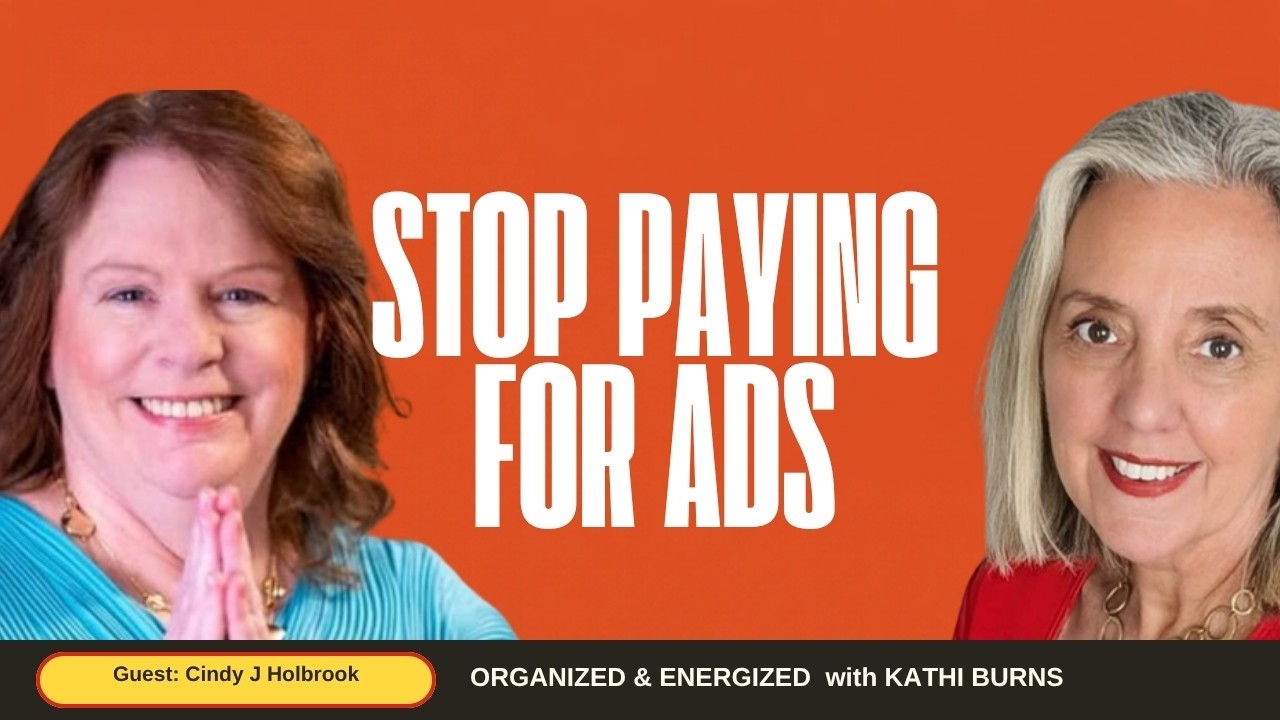
Cindy J Holbrook, The Visibility Wiz, started her first business at 10 by selling golf balls she fished out of a Los Angeles riverbed.
She lost an online affiliate business overnight when Google changed its algorithm in 2008, and then found coaching.
Cindy made $500 in her first coaching year without a niche and $20,000 the next year after she started as a divorce coach.
She says she has spent maybe $4,000 on ads since she started coaching in 2009 and teaches only free visibility strategies.
Her rule is that every strategy works for the right person at the right time with the right mindset, so pick the one you enjoy and master it first.
Published · Updated
What is this episode about?
Kathi Burns, CPO®, Business FLOW Strategist, talks with Cindy J Holbrook, The Visibility Wiz, about building a business that is both fun and profitable. Cindy has been an entrepreneur since she sold golf balls at age 10, lost an online business to a Google algorithm change in 2008, and went from $500 in her first coaching year to a growing visibility business. She explains how she helps coaches get clients without ads by choosing visibility strategies that fit who they are, why she never tries to overcome objections, and why she let go of clients who drained her. You'll also hear how a supervisor taught her that her life, and her business, is her choice, how she runs everything from one Word document called My Systems, and why she says visibility plus influence equals profits.
Every strategy will work for the right person at the right time with the right mindset.Cindy J Holbrook
Jump to links and resources · Part of How do I get more clients? · All episodes · Every guest
What are the key takeaways?
- Cindy made $500 in her first coaching year without a niche and $20,000 the following year after she started as a divorce coach.
- A client of Cindy's spent $8,000 on Facebook ads, added 500 people to her list and got no clients; with a plan built on strategies she enjoyed, she added more than 2,000 people for free in three months and signed three high-end clients totaling over $15,000.
- Cindy's rule is that every strategy will work for the right person at the right time with the right mindset, and she says not to add a second visibility platform until the first one is down pat.
- She calls aligning yourself with other experts the very best strategy to be visible and known as an expert.
- Cindy doesn't try to overcome objections, and she let go of two draining clients; after she dropped one of them, she says better clients and opportunities came in.
- She keeps one alphabetical Word document called My Systems with step-by-step how-tos, and her virtual assistants add their own processes to it.
- Her formula is visibility plus influence equals profits, where influence means guiding people to take action, not pushing them to buy.
This episode is brought to you by the Business Logjam Session
A private 75-minute online session with Kathi Burns to find the one thing holding your business back and leave with your next steps. It is the same F.L.O.W. process Kathi uses with her own clients: Focus on your goals, Locate your logjams, Outline your solutions, Walk away knowing your next steps.
Find What's Holding Me BackInterested in sponsoring the show? Get in touch.Why does choosing a niche matter for a new coach?
For Cindy J Holbrook, choosing a niche was the difference between $500 and $20,000. In her first coaching year she refused to pick a niche and made $500. She was talked into starting as a divorce coach, made $20,000 the next year and kept growing. Because she lived hours from any speaking venue, she used what she'd learned running online businesses to get featured on eHarmony, Huffington Post, Prevention, Fox and AOL, and people began asking her to show them how.
What does "your life is your choice" mean for your business?
Cindy says that if your life is your choice, your business is your choice too, so decide what a business and a life of your choosing look like before you build one. She learned the idea at 35 from a supervisor she calls her first coach. She couldn't change her circumstances, but she could change her perception of them and rewrite her past from another perspective. She asks clients the same question, because many people go into business without considering it and wind up creating a business they hate.
How do you get clients without ads?
Cindy's way to get clients without ads is to stop paying for ads and use free visibility strategies that match your strengths, beliefs and values. One client spent $8,000 on Facebook ads and signed no clients. With a personalized plan, she added more than 2,000 people to her list in three months and signed three high-end clients.
How do you choose the right visibility strategy for your business?
Pick the one strategy that lights you up and get good at it before adding another. Cindy says every strategy works for the right person at the right time with the right mindset, and trying to be everywhere is one of the biggest mistakes. Repurpose your content for other platforms and align yourself with other experts.
When should you fire a coaching client?
Cindy lets a client go when the relationship drains her or they aren't a fit, because she says those clients hold you down energetically. One early client yelled at her about how she pronounced words; her coach told her to fire that client, and the client found a coach who suited her. Years later, a client texted her business questions while she was in intensive care with COVID. She dropped him after she recovered, felt better almost at once and started attracting clients who valued her.
How do you decide which programs and opportunities to say yes to?
Know your core message first, then ask whether each opportunity aligns with it; if it doesn't, Cindy says don't do it. That goes for programs, summit invitations and podcast invitations. For courses, she also asks whether it's something she needs and will use right now, and she says she has never bought a course over $500 that she didn't play full out in. Her rule for clients is to spend four hours implementing for every hour of learning.
How do you create a systems document for your business?
Cindy keeps one long Word document called My Systems, in alphabetical order, with step-by-step directions for every task she might forget, written like recipes. Because everything is in one document, she never hunts for instructions. Her virtual assistants get a copy, which cuts training time, and they add their own processes so anyone can step in.
What is the difference between lead-generating and money-making activities?
Cindy says many business owners spend their time on visibility or lead-generating activities without realizing that one small tweak can turn them into money-making activities. Her free guide lists seven money-making activities and suggests doing one a day, even for 15 minutes. It also helps you find the five things that bring in 80% of your income. Her formula is visibility plus influence equals profits: get in front of your ideal audience, then guide them to take action rather than pushing them to buy.
Where does each part of the conversation start?
- 0:00 Meet Cindy J Holbrook
- 0:22 Selling golf balls at age 10
- 1:30 Her first online store
- 2:28 The Google slap
- 2:38 Finding coaching and choosing a niche
- 5:08 Advice to her 18-year-old self
- 6:00 Your life is your choice
- 8:05 Rewriting your past
- 13:57 The 8,000-dollar lesson in ads
- 16:22 Every strategy works for the right person
- 19:12 Master one platform first
- 20:09 Align with other experts
- 20:43 Why she doesn't overcome objections
- 22:36 Firing a client
- 25:17 Letting go of a draining client
- 28:13 Know your core message
- 29:24 One hour learning, four hours doing
- 29:48 Her systems document
- 34:28 How she celebrates
- 37:12 Zip lining and a cargo net
- 39:11 Money-making activities
- 41:11 Visibility plus influence equals profits
- 44:14 Wrap-up
What resources were mentioned?
- Cindy's free guide: 7 Money-Making Activities
- Biz Success in 15 Podcast
- Overcoming DARK Family Secrets: Journey From Worthless to Worthy by Cindy J Holbrook (the memoir she mentions writing)
- WorkFlowy (mentioned by Kathi)
- How to Master Your Muck by Kathi Burns (free copy mentioned by Kathi)
These episodes continue the same thread as this one: Sue Kirchner, Yvonne McCoy, Louise McDonnell, Allan Ngo also answer the question "How do I get more clients?", and the rest are the most recent conversations on the show.


 Social MediaEpisode 144
How To Use Social Media More Strategically In 2026 To Find New Customers with Louise McDonnell

See every episode on the podcast archive or filter by topic on the How do I get more clients? hub.
How can I support the show?
- Subscribe on Apple Podcasts, Spotify or YouTube, or add the RSS feed to any app.
- Rate and review. A rating on Apple Podcasts helps new listeners find the show, and Kathi reads every review.
- Share the episode with one business owner who needs it; the share buttons are at the top of the page.
- Grab a free eBook: 6 Steps to Organize & Energize Your Home, 6 Steps to Organize Your Home Office or 6 Steps to Organize & Energize Your Life.
- Work with Kathi. The Business Logjam Session is a private 75-minute session to find what is holding your business back.
- Be a guest. Apply here if you have a story about clearing the obstacles in your business.
What did they say, word for word?
The transcript below is edited for readability: filler words and false starts are removed and speaker names are added. Nothing was added or summarized.
Read the full transcript +
Kathi: Hi everyone, thanks for joining me. I am with my girlfriend Cindy J, and we're going to talk about visibility. We're going to talk about how to make more money and have more fun. So welcome to the show, Cindy.
Cindy: Oh, thank you, Kathi. It's a pleasure.
Kathi: Absolutely. So we've been going around and circling around each other and playing together for a long time now. So I know a little bit about you, but let's talk about your background and why you're doing what you're doing now. What was your progress towards being a wizard?
Cindy: I always like to say I was a born entrepreneur. My first business was when I was 10 years old. I used to go to the Los Angeles riverbed, collect golf balls, take them home and wash them, take them back to the golf course and sell them to the golfers so I had money to spend at the park.
Kathi: Fantastic.
Cindy: And so my whole life I always knew that I wanted my own business, and I probably sold everything you can think of. Mary Kay, Avon, Tupperware, Princess House crystal, all those good old party days that they used to have all these parties for. I even sold life insurance. Didn't like that too much, but always trying to find something. So when the internet came out, I was like, hey, this is it. There's something on the internet where I can really have my own successful business that I don't have to work a day job with. And so I opened up my first business online on September 10th, 2001. It was a Yahoo store, and I utilized a drop shipper. I was selling pewter figurines, and I kept that for quite a few years. The only reason I ever left it was because the drop shipper went out of business. But then I started really getting more into the online world with different ways you could make money online. And I started affiliate marketing with Google Ads. So I created a 200-plus website where I interviewed all the diets. Back in the early 2000s, there were tons of diets online, and so I reviewed them all with affiliate links, and I placed Google ads to draw people to my site, and I was actually earning about four to 5K net a month. So I was really doing quite well with it. Then in 2008, Google changed its algorithm, and they call it the Google slap, and it killed my business overnight.
Kathi: Yeah.
Cindy: And that's when I found coaching. Now, I had been working in social services. So I thought, wow, this is really cool. I get to work with people who actually want to be helped versus being told they have to be helped. And coaching is definitely my forte. I fell in love with it. When I first began coaching, like many people, I did not want to choose a niche. So my first year, I made a whopping $500. And then I was talked into starting a niche. I started as a divorce coach, and my second year I made 20K, and then I've just continued to grow it ever since. But that can be the power of actually choosing a niche. And everybody kept telling me that to get clients online, I had to go speak in person. I lived in a very remote area. So if I were to go somewhere to speak, it would be a minimum four-hour round-trip drive. So working 50 to 60 hours a week in social services, it just wasn't plausible to drive that long to speak. But I had a lot of knowledge based on the other businesses that I had run online. So I started utilizing a lot of what I had learned to get visible online. What happened was people started coming up to me going, Cindy J, how did you get on eHarmony? How did you get on Huffington Post? How did you get on Prevention? How did you get on Fox? How did you get on AOL? Can you show me how? So for a while I was coaching both entrepreneurs and divorced women. And then in 2017, I dropped the divorce part, and since 2017 I've been 100% focused on being the Visibility Wiz and helping entrepreneurs step into who they are with outrageous confidence for more visibility, influence and profits.
Kathi: That's a fantastic story. Now, I know a lot about you, and I knew the golf ball story was fantastic. When I was little, I would sell food to my neighbors right out of the basement, a little restaurant that I had set up. So I think we're two peas in a pod. But I didn't realize all the other stuff that you had done. That's quite the artillery for knowing how to help people now, for sure. I love that backstory. So, back on that, if you had to tell your 18-year-old self something, what advice would you give her?
Cindy: My 18-year-old self, for lack of a better word, was broken. I was abused as a child. At 18, I got married. So I was always told what to do, how to act, who to be. I really did not realize that my life was my choice and that I had choices. I didn't find that out till I was 35. When I was 35, it was actually my supervisor, but I call her my first coach. I was crying to her, telling her, my ex told me he's going to leave me and the kids penniless. How can I survive? How can I raise my kids when they're used to his income? And she looked at me and she goes, Cindy, do you know your life is your choice? And I thought, woman, you are nuts. Nobody but nobody would choose the life I'm living right this minute. At that point in time, in the two years prior to that day, I had eight people in my family die. So there was a lot of grief surrounding that. I was suicidal. I was depressed. I felt very lonely and didn't see that I had a place anywhere.
Kathi: Wow. Bless you.
Cindy: So I thought nobody in their right mind would choose my life. What are you talking about, my life is my choice? But she took me under her wing, and the first thing she did was she bought me Tony Robbins tapes. And then she told me books to read. And not that I knew what she was doing at the time, but she would ask me, what would you do if your husband left you? Where would you live? How would you take care of your kids? What type of car would you drive? Who would fix your car? Who would fix the things that went out in your house? And I didn't realize she was getting me to visualize, but now I do. So I started really getting more momentum, and it really dawned on me that my life was my choice. Even though I could not change all these circumstances, and I had more than my share of circumstances at that point in time, I could change my perception about them, and I could change the way that I thought of my past. You can never change your past, but you can rewrite it from another perspective. So a lot of what I started doing was rewriting my past, really discovering who I am, and I wrote myself a little bill of rights. I have the right to be loved. I have the right to my own opinion. I have the right to be respected. We all have these rights, but especially after you've been in an abusive situation, you feel like you have no choice. So this was huge for me. And then over time, I thought, well, my life is my choice. Also, my business is my choice. And so I always help my clients. I'm like, what is a business of your choice? What does it look like? What does a life of your choosing look like? Because so many people go into business without considering all these things, and they wind up creating a business they hate.
You can never change your past, but you can rewrite it from another perspective.
Kathi: Yeah.
Cindy: So it was maybe a long answer there, but for my 18-year-old self, I really think that I might go back and tell her that her life was her choice.
Kathi: Yeah. No, I think that's a great answer. As you were telling me the story, I was thinking, well, life was opening up all the possibilities for you. Even though there was a lot of tragedy and a lot of death, it was opening you up for expansion. It was paving the way for you to emerge less fettered. Let's just say it that way. Not unfettered, but less fettered.
Cindy: Yeah. I used to call those three years my hell years. And last year I wrote a book about my life, and it really dawned on me, and I think it was even before I started writing the book, that actually they were my healing years. And even my husband, especially when we first started dating, he'd always go, I wish you didn't have to go through so much. I told him I would not be me had I not gone through what I went through. It just is what it is. I have no feelings about it, good or bad or indifferent. This is everything that I went through. Good and bad and evil have all brought me to where I am today.
Kathi: What an amazing coach you had, too. That was such a brilliant thing for you to have a coach at the time when you needed one. I think a lot of people need to reach out and hire someone. If you feel like you just can't get there, definitely call upon someone to help you.
Cindy: And that's it. She really wasn't a coach. She was my supervisor, but I always call her my first coach, my first mentor. She really took me under her wing. This was in 1994. I don't think coaching was around then, but she saw something in me that I just absolutely could not see. And where I worked in social services, she was, like I said, my supervisor, and we had over a hundred people that worked in that office, and I'd say probably 80% of them hated her because she was very wealthy. She drove a Jag. She worked because she wanted to work. She didn't have to work. Her husband owned a car dealership. She was really well off, and people always thought that she was this stuck-up snob, but she was such a lovely, generous, sweet person. And like I said, she took me under her wing. And I always say, I am where I am today and I am who I am today because she did take me under her wing.
Kathi: And I think that's a good point to be made, that we all can be coaches to someone for something, always. You're right, the coaching industry is so full right now, but we do provide guidance to people all the time. We are coaching our friends, we're coaching our loved ones, we're coaching those around us. That's what I love about life, too, because all of us know something a little bit more than the other person knows about something, and that's when coaching comes in. So let's switch.
Cindy: Just going back to that, with mentorship and even sometimes with therapy. Now, I had been seeing a therapist that didn't help me at all. That was really dragging me down more than helping me, because all they ever wanted to do was keep me in the past. Like, well, yeah, this is why you do that, because that happened. And I can't tell you how many times I've been told that because I was sexually abused as a child, I'm just totally messed up for life. That's what the psychiatric world did to me personally. But she just cut across it. It's like, who do you want to be? Where do you want to go? What can you do to get there? And it was such a different focus. In a different time period, she probably would have been a top coach, just because of who she was. But she did it because she loved me, like I said. But when you're talking about who we touch, we never know what lives we touch, even in a roundabout way. So with everybody I have helped, which is thousands of people, they've never heard of my supervisor, but actually I would not have been able to help them had she not helped me. And that's where it goes around, sort of like It's a Wonderful Life. I love that show. But if you start thinking about the trickle effect, you help one person, they help one person, they help one person, how many lives are you really affecting? There's this saying out there that alone we cannot change the world, but together we can change the world one life at a time.
Kathi: Absolutely. It's a recurring theme. I was just speaking on a podcast last week with another guest. We were talking about the same thing, the ripple effect. Everything that we do and everything that we say, it's for real. So that's a perfect segue into the question I was going to ask you. Tell me a story about one of your clients and what happened with their transformation. Where were they? What did they become? Tell me a little story.
Cindy: No problem. One client became a life coach, and she knew that she wanted to work with divorced women. Whoever coached her first told her she had to place Facebook ads. So she was placing Facebook ads to build her list and get clients. She had spent $8,000 on Facebook ads.
Kathi: Oh, yeah. Easy.
Cindy: She added 500 people to her list, and she had zero clients. So she was really doubting herself. Can I even do this? Am I crazy? What happened? She was really doubting herself, really thinking she had wasted so much money. So she came to me. The first thing I had her do was stop paying for ads. All of the visibility strategies that I teach are free. I have been in business forever, but I've been coaching since 2009, and I have maybe spent $4,000 in ads, if that. I don't place ads. There are so many free ways to get out there. And first of all, to even build your list, I would never place ads just to build my list, especially not if you don't have a proven system. So we created a personalized plan for her based on her personal strengths, beliefs and values. What would be the best visibility strategies that she would actually enjoy? Because there are too many people, as I said, out there creating businesses they hate because they're using strategies that don't align with who they are.
Kathi: Yeah.
Cindy: And so within three months, she had added over 2,000 people to her list for free, and she got three high-end clients totaling over $15,000. I always like her story because so many people think they have to place ads, or they think they have to do that one thing to succeed. And one of my quotes, I say this all the time, is every strategy will work for the right person at the right time with the right mindset, because it's so true. But we hear these people talk and they go, you have to be on Facebook. You have to be on Instagram. Hey, you have to be on Threads now. It's all this stuff, and we get lost, and we're trying to do everything, so nothing's working, instead of saying, what's the one thing that I really enjoy doing, and how can I go deep and really make this work for me? So that's the hugest thing that I really like helping people do: find the strategies that align with who they are, so they don't create a business they hate.
Every strategy will work for the right person at the right time with the right mindset.
Kathi: Yeah. Doing the stuff they want to do. I think many of us, and I've gone down the path of following the guru to do exactly everything that they say, and then I'm like, I don't even like this. This is stressing me out. Not even my cup of tea. But they said that that's the way to do it. So I think a good tip from this podcast is listen to your gut when people are telling you what to do, when you've hired someone. I don't know about you, but I've thrown tens of thousands of dollars to the wind trying to…
Cindy: Yeah, exactly.
Kathi: I'm pushing a hundred myself, of stuff that didn't gel, that wasn't me. Just watch who you pay attention to. But I think the most important thing is watch how you feel when they say, okay, now you're going to do step one, step two, step three. And you're like, oh my god, step three and four, I ain't even going there. Well, then you have a half-baked system anyhow.
Cindy: What happens, too, with that? So many people think, okay, I'm going to follow Mr. Guru because he's got a seven-figure business, and I'm going to follow his steps exactly, but I have to be like him. I have to write like him. I have to talk like him. And it doesn't work, because you're not them.
Kathi: Yeah.
Cindy: And I tell people all the time, I know seven-figure business owners that don't use social media at all. I know seven-figure business owners that only use speaking. I know seven-figure business owners that only use Twitter. Even today, they only use Twitter. And seven-figure earners that only use Facebook or any of the other social media platforms. So it's not saying you have to be everywhere, which I think is one of the biggest mistakes people make, trying to be everywhere. You want to choose that strategy that lights you on fire. If it lights you on fire, then you want to nurse it and you want to get good at it. You should not go to a second visibility form until you've got that first one down pat. And it's just a rinse-and-repeat system, so you're not having to constantly think or reinvent the wheel. That being said, as well, I help my clients when they have content with repurposing the content. So if you're on multiple platforms, it's knowing the different platforms, but don't try to create separate content for each platform. When you know what type of content each of the platforms wants, then you're creating it for the one that you love, and preferably you have a virtual assistant that can dig out the content and repurpose it on other platforms. This is the best way to be in different places. But the very, very best strategy to be visible and to be known as an expert is to align yourself with other experts.
Kathi: Yeah. Yep. Play together, play in the same ponds. You and I have been doing that for a while, and it works. And find people that you're in alignment with. People that you would want to hang out with and go have a glass of wine or go have a dinner with. Those are the people you want to do business with, because they're going to be of a similar mindset.
Cindy: Yeah. Something I'm asked a lot, and I talk about how you have to do it your way, but I'm asked a lot, how do I overcome objections?
Kathi: Okay.
Cindy: And I go, I just don't. I'm a soft sell. If somebody says, hey, I don't have the money, I'd love to do this if I had the money, I might say, hey, do you want me to help you figure out how you can earn the money? But I'm not really trying to overcome. I'm really asking them. So some of them say yes, some of them say no. But every time I have tried to overcome the objections, I have had a miserable experience with a client. For instance, one of my very first clients as a divorce coach, every single time we spoke, she would yell at me because of the way that I pronounced things. I always say that I was a confused child. My mother was from New York. My dad was from the South. So I was inundated with these two very distinct accents by families. And then I went to speech therapy through seventh grade. So her yelling at me about the way I pronounce things was really getting to me. After every call, I would cry, because I still have a lot of crap from my past from the way that I pronounced things. And I do try to learn, and sometimes I get things, sometimes I don't. But it just is who I am. Now, one of my coaches actually helped me. She was my coach at this time, and first of all, she told me, fire that client. Because I was telling her, I hate this. I don't know if coaching's for me, because this girl is really attacking one of my vulnerabilities, something that really hurts me. And my coach is like, fire. I go, really? I can fire her? But this coach really helped me accept me for who I was. Like, hey, if you don't like the way I talk, don't listen to me. I do the best that I can, but if I sat there and was hyper-focused on every word I said, trying to make sure it was pronounced correctly, I would go nuts.
Kathi: Yeah. You wouldn't be your authentic self.
Cindy: Exactly.
Kathi: I think that was such great advice. Something I learned during my career is the most professional thing you can do is say no. No, I don't think we're quite a good fit. Or, no, I can't really do that. Give everybody out there permission to say no. If you're listening and someone's asking you to do something, you do not have to say yes. Follow Cindy's lead and say, no, I don't think we're really that good of a fit, or I don't think I can really meet that obligation, or whatever it is.
Cindy: It was very mutual. And she went on and found a coach that helped her, so I was very happy for her. It wasn't like we hated each other, but we definitely were not a fit. And what I understood, too, is she was so hung up on the way I pronounced things, I wasn't helping her. There's no way I could help her, because we weren't connecting. So it's so important. I always say your business is your playground. You get to choose who you're playing with, both your collaborative partners, other experts, and your clients, and whoever you want to learn from. It's 100% your playground. And so you create it your way. And with clients, when you start releasing clients that don't fit you, so much magic opens up, for lack of a better word, because they really hold you down energetically, even though you're not realizing it. I had this client for many years. It was a male client, and I hated every week talking to him. I wouldn't plan anything after I talked to him, because he always drained my energy. And I had some of my coaches telling me, you need to let this guy go, because you're not helping him. But he says I am, and he keeps paying me, and blah, blah, blah. And I don't like conflict. I have a really hard time sometimes setting down the rules. And when I had COVID last year, I was in ICU for three and a half weeks and almost died. But the first couple of days I was in ICU, this guy was texting me business questions. I sent a text to my daughter with his phone number and said, tell him to stop texting me. I mean, I'm half dead here. The doctors were preparing my family for me to die. So I was that close to death, and this guy is texting me business questions, like I was even in the right state of mind to answer. But it really hit me how much he did not value me as a person. He just wanted what he wanted. And when I recovered from COVID, I still had a hard time dropping him, but I did drop him. And I could not even believe, almost instantaneously, how much better I felt energetically. And I started getting more perfect clients. It's so interesting, because when I had COVID, I lost most of my clients, because I couldn't work for six months. But once I let him go and I started working again, a lot of opportunities opened up, and I started attracting a lot better clients who really value me as a person as well as what I'm coaching. So it's so important that you align with everybody you're playing with.
Your business is your playground. You get to choose who you're playing with.
Kathi: Absolutely. And I give you kudos, because at that point, to let someone go when you didn't have clients, that was a scary thing and a big, bold move. But then you add space, and the new people come in and fill it. Another takeaway that I had from your story is that you've hired many coaches. And I think that coaches hire coaches to do what we can't do. And the most successful people in the world will have helpers that know how to do a little bit more of what they're trying to get towards. That's what mastery is all about, to have ongoing coaches all the time.

Cindy: Yeah. Well, it's part of my ideal client avatar. They're definitely a continuous learner, because you can always learn more. What I noticed, too, is when you're first starting out, you buy everything, and you're like, oh, I've got to have this, got to have this. This person says I have to be on Facebook. This person says I have to be on LinkedIn. This person says I have to speak. This person says I have to do a course. This person says this. And you're inundated, and you're not getting very far, because you're trying to learn everything. It's like this crash course. But when you start settling down and you really know what it is you want to teach, I always say, first of all, you have to know what the core message of your business is. What's the core message that you want to share with the world that's laid on your heart? And then when all these other opportunities come up, whether that's purchasing a program or accepting an invite to speak on a summit or a podcast, you ask yourself, does this align with my core message? If it doesn't, don't do it. And also with these programs, is this something I need and will utilize right this minute? Because I can proudly say I have never purchased a course of any type for more than $500 that I did not play full out in. If I am purchasing a course, I'm playing full out in it.
Kathi: Yeah.
Cindy: And a lot of people purchase courses, feel behind, and don't do something. But if you make that commitment at the very beginning, I'm going to play full out in this course, you're going to find success. But if you buy 10 courses that you're trying to play full out in at the same time, there aren't enough hours in the day. I always tell my clients, for every one hour that you learn something, you need to implement four hours.
For every one hour that you learn something, you need to implement four hours.
Kathi: Ah, I love that. Love, love, love. Great advice for sure. Okay, so you get a lot done, girl. You are a doer and a tasker, and you get so much done. I don't know how you do it all, because I see you everywhere. What's your favorite organizing hack? What tactic or program or hack do you use to keep yourself in alignment and cruising on down the road?
Cindy: I started this years ago. There are a lot of things that we do that we might only have to do once a month or once a year, but we forget how to do them. So if we don't remember how to do them, and then you're trying to research it again, you're utilizing a lot of time and energy. So when I learn something, I have a Word document. It's a very long Word document, and I put it in alphabetical order. So it's like, after a webinar, do steps A, B, C, D, and I write it down like the directions, just like my recipe book. And this way I have one document. I don't have to try to remember which document I put what task in, because it's all in one document. And I actually call it my systems. So it's my Word document called My Systems. It has everything in there, all of my how-tos. And the beauty of it is, once I started utilizing VAs, they have my systems. I give them my systems. So now it cuts down on the time that I need to train them, because I have all these recipes. Naturally, there are always questions that come up, but it's definitely time-saving, and it's efficient. And any time my VAs do something that I don't do, like my one VA does everything regarding my podcast, like everything. I record it and she does it. But she put in my systems exactly what she does. So if something happens to her, I can have another VA do it, or I could do it if I needed to, because I have them put their systems into my systems.
Kathi: I love that. I love having the one Word doc. I haven't ever thought about that before. I was thinking of a couple of other things. WorkFlowy is a cool little list, too, where you only have to look at one thing at a time. You can toggle and see everything, and you can toggle and turn it off. But I love having everything in one place, and standard operating procedures, SOPs, gang, we all have to have them. In fact, I needed one for my phone. My phone keeps not working in my car, and I figured out about six weeks ago how to fix it. Why did I not write that down? So I'm back to the same old thing, having to discover it, and it's some stupid little switch. Why didn't I write down how I figured out that thing?
Cindy: Yeah. It definitely helps and saves time, and makes your life a lot easier. And I think I started that because when I worked in social services under the supervisor that I call my first coach, I was an admin for social services before I became a worker. And she had me do an SOP for every single admin position there was. And this started because my brother died, and something that I did gave people benefits, and it had to be done on the last working day of the month for the people to get their benefits on the first. My brother died the night before, and she could not find anybody that knew how to do that. So the day after my brother died, I went into work so I could get the benefits out, because nobody else knew how to do it. But that was such a big light bulb moment for her that she had me sit with everybody, and it was like 3,000 pages long, of all the jobs. I had to be so precise so anybody could pick them up and do it. But it was really good practice for me when I got my own business.
Kathi: Yeah, it's so smart. And it's things that we often just go, we're doing this, we're doing that, we're doing the other, we're chasing squirrels. And do we stop to pause and say, how did I figure that out? It's like, no, I figured it out. Yay. And then we're on to the next task, and then we forget how we figured it out, if you're like me.
Cindy: Right. Exactly. How did I figure that out?
Kathi: It's not like reboot your phone. It's some stupid little thing that's not normal, and why my phone does not work. So, yeah, it's kind of funny. But okay, so let me ask you this. This is my year for celebrations, because I have spent my life not celebrating enough. I have a lot of fun. I have a lot of partying. But I don't stop and smell the roses. I don't stop and give myself kudos. So what do you do, Cindy, to celebrate your successes when you have them, big or small?
Cindy: I don't know personally that I actually do anything like that. There are a couple of things. After being so sick with COVID, it definitely taught me how to put me first, because I was so sick I had to. So every single day, I'm very grateful for every breath that I take. The whole time I was in ICU, I kept saying to everybody, I am so thankful I quit smoking 20 years ago, because I couldn't even imagine being in the condition I was in if I smoked. But at the end of every day, I don't always do it, but I really try to make it a practice at the end of every day to write down what I did, because now I'm focusing on my wins instead of focusing on, oh, I should have done this and this and this. Because when you do that, you are devaluing everything you did. Focusing on your wins helps you see more wins. So that is one thing that I do. But after COVID, and especially when I started working again, my husband was like, we are going to have a date day every Sunday. So every Sunday I don't work. He really started this.
Kathi: Yeah.
Cindy: I love wildlife. We live within 10 miles of four lakes. My favorite lake is Goldwater Lake. It's up in the mountains. There are all the pine trees in the forest, and we go up there and look for wildlife, because I love seeing all the wildlife. So we see deer and javelina and lots of squirrels, a few rabbits. I even saw a bear once. My husband didn't see it because he was driving, and by the time he turned around, the bear was gone. But it's fun to me, and it's relaxing, and it really helps me to rejuvenate for the next week, because I do take that one day a week where I'm not working and I'm really enjoying my husband. It's deepened our relationship, and it's just been a win-win-win all the way around.
Kathi: I love the idea of having a done list. What did I do? These are my accomplishments for the day. That's a really good ritual. And I'm a big Sunday Funday. I never work on Sunday. Sunday's my fun day, and I'm always trying to figure out something to do that I've never done before. So not only is it a fun day, it's a day of exploration. I think that's fantastic.
Cindy: Okay, so I love that, the fun days, and you said something you've never done before. It was in 2019, just before COVID, we went on a family cruise, and I'd always said, one day I'm going to try ziplining, because ziplining sounded cool to me. We had this one stop, and my daughter goes, Mom, if I can put the zipline on my room card, will you go ziplining with me? I'm like, sure, not thinking that naturally she could do that, because the cruise line owned the island we were on. And so first I went through all the training, got from point A to point B, and I absolutely fell in love with it. Then I went from point B to point C, and from point C to point D there was a 50-foot cargo net bridge that you had to walk up. So I'm standing there thinking, oh my god, I don't want to do this. And that was so scary. But I did, and it was sort of fun, because the guy at the next station was really cheering me on, like, you can do it, because I struggled a whole lot with that thing, both physically and mentally, looking down. And when I finally walked up it, we ziplined to the last point. But I asked my daughter, did you know that cargo net bridge was there? And she's like, yeah. And I'm like, dang you, because I never would have gone on it had I known. But that was such an exhilarating experience, of being so terrified of something and managing through it, and having somebody I didn't even know cheer me on through the process. So any time you can do something that you're a little bit afraid of, celebrate yourself, like you just said. To this day, that was one of the most exhilarating moments, because I would not have done it had I known that that cargo net bridge was there. I'll still do ziplining any day of the week, but don't give me cargo net bridges.
Kathi: Well, there you go. But now you're an expert, and you know how to do it, and you did it already. So it's not even a thing for you. You've got it, girl. So I know you have a valuable free resource that people can download, as your gift to them. What is it that you're going to offer? We will put the link below in the podcast, by the way.
Cindy: Yeah, it is money-making activities.
Kathi: We all need that. We all need to figure out what our value-added activities are. The most important thing, like what can we do to move the needle. And actually, that's what this podcast is about. And Cindy is a visibility wiz, so she knows what to tell us to do. And again, the link will be below in the show notes, so you don't have to have the link perfect. But let's talk about it.
Cindy: What it is is a little guide, and there are seven money-making activities that you can do in there. But one of the big things is you're going to understand the difference between lead-generating versus money-making activities, and even visibility. It shows you one tweak for visibility versus lead generating versus money-making. And so many business owners go more for the visibility or the lead generating and don't understand that with one little tweak, they can make it a money-making activity. So I have a list of a lot of activities inside this guide, and I suggest you do one a day, even if you can only do it for 15 minutes, because once you start doing a money-making activity each day, you're going to start seeing more profits. Something else you're going to discover with the report is you're going to identify five things that provide 80% of your income. So when you focus on these five things, this is 80% of your income, and it's easier for you to build it. I have a formula. I always say visibility plus influence equals profits. And it's not necessarily income. You want to keep more money in your pocket. But first, you need the visibility. You need to know how to get in front of your ideal audience. Stop trying to find clients and just get in front of them and let them find you. It's much easier that way. And then you need to know how to influence them. You need to know how to influence them to take action. You need to influence them to empower them. You're not trying to manipulate them, telling them they have to do something. You're just actually guiding them and influencing them to take some sort of action, whether it's with you or not. Something I tell a lot of people, I can't even count how many times I have said this: if I'm not right for you, I really think you should find a coach to help you. And if it's not me, fine. I know that I'm not the right coach for everybody, but I do believe there is a right coach out there for everybody. And you need to find that person that you align with, that you feel good with. Because otherwise, like me and my client that I was talking about earlier who couldn't stand the way I talked, we were not a good fit. But by my openness and letting her go forward, the one thing I do know that I did good for her was that I empowered her to find the right coach for her. And so remember, when influencing, you're not influencing them to buy your stuff. You're influencing them to empower them so they can change their lives. This will always be my favorite testimonial on Facebook. I had become the Visibility Wiz by that time, but somebody posted on Facebook, thank you so much, I never could have managed my divorce and moved on to create my own happy life after the divorce had it not been for you. And why I love this testimonial so much is I never once spoke to this person. Never once did I speak to her. She got all of that from my blog posts, from my emails, from everything. So when you're talking about influencing people, you want to influence them to take action. You don't want to influence them to purchase your product. There's a difference. And when you're influencing people, you're going to draw the right people. And so when you have the visibility plus the influence, you're going to start to see profits.
Stop trying to find clients and just get in front of them and let them find you.
Kathi: Very well spoken, girl. That's very well spoken. You're such a professional.
Cindy: Thank you.
Kathi: Yeah, I love that. We touch a lot of people without even knowing. Love letters from people, it's like, how do they even know about me? It's fantastic. So that means you're visible, you visibility wiz. Well, it's been a pleasure. We have to now break and say adieu and bye-bye and ta-ta for the week. And gang, I'm going to see you next week. Make sure to download Cindy's free gift, because you're going to learn a lot of stuff. You're going to get more clarity. And if you want to figure out how to master your muck, you can also download a free copy of my book with the link below as well. And until then, we will see you next week. And thanks again, Cindy, for being a guest.
Cindy: Thank you, Kathi. It's been my pleasure.
Kathi: Absolutely.
Where can I find the links and resources from this episode?
Connect with Cindy
Organizations and companies
Books and resources
Inspired? Here Are Your Action Steps:
- Write down what a business of your choosing and a life of your choosing look like.
- Choose a niche instead of trying to serve everyone.
- Pick the one visibility strategy you enjoy most and get good at it before adding a second.
- Repurpose content from your main platform for the others instead of creating separate content for each.
- Find other experts you'd enjoy having dinner with and collaborate with them.
- Let go of clients who drain your energy or aren't a fit.
- Write down your core message and check every program, summit or podcast invitation against it.
- For every hour you spend learning, schedule four hours to implement.
- Start one systems document with step-by-step how-tos and have your assistants add their processes.
- At the end of each day, write down what you got done.
Frequently asked questions
Do you need paid ads to get clients?
+
Cindy J Holbrook says no. One of her clients spent $8,000 on Facebook ads, added 500 people to her list and got zero clients; with a plan built around strategies she enjoyed, she added more than 2,000 people for free within three months and signed three high-end clients worth over $15,000. Cindy says she has spent maybe $4,000 on ads since she started coaching in 2009.
Which visibility strategy should you use?
+
Cindy's rule is that every strategy works for the right person at the right time with the right mindset. Pick the one that lights you up, get good at it, and don't add a second until the first is running. Repurpose your content for other platforms, and align yourself with other experts.
Why did choosing a niche matter so much?
+
In her first coaching year, without a niche, Cindy made $500. After she started as a divorce coach, she made $20,000 the next year and kept growing.
When should you let a client go?
+
When they drain you. Cindy fired a client who criticized how she pronounced words, and later dropped a client who texted her business questions while she was in intensive care with COVID. Once she let him go, she says better clients and opportunities came in.
How does Cindy keep her business organized?
+
She keeps one Word document called My Systems, in alphabetical order, with step-by-step instructions for every task she might forget how to do. Her virtual assistants add their own processes, so anyone can pick up a task if someone is away.
Who is talking in this episode?

About the Host, Kathi Burns
Kathi Burns, CPO®, is a Business FLOW Strategist based in San Diego. For the last 20+ years, Kathi has helped clients create systems they can stick to. She is the author of How to Master Your Muck, Organizing With Tetris and Home Organization, The Smart Guide, and co-author of four more titles; all are in Kathi's shop. Kathi's business has been featured on Good Morning America, and her advice has been featured in Oprah Magazine, Martha Stewart Living, Better Homes and Gardens and Entrepreneur Magazine.
More about Kathi · Shop Kathi's books · Business Logjam Session · Apply to be a guest

About Cindy J Holbrook
Cindy J Holbrook, known as The Visibility Wiz, guides coaches, speakers and authors from being the best-kept secret to trusted, in-demand experts, using visibility strategies that fit their personality. She started her first business at 10, selling golf balls she collected from a Los Angeles riverbed, opened a Yahoo store in 2001 and ran a diet-review affiliate site until Google's 2008 algorithm change wiped it out. She began coaching in 2009 as a divorce coach and since 2017 has focused entirely on visibility. Cindy has been featured on Huffington Post Live, Women's Speaker Association TV, Every Day Women TV, eHarmony and Prevention. She hosts the Biz Success in 15 podcast and wrote the memoir Overcoming DARK Family Secrets.
Want help putting this into practice?
Book a Business Logjam Session with Kathi
A private 75-minute online session to find the one thing holding your business back and leave with your next steps, using the same F.L.O.W. process Kathi uses with her own clients: Focus on your goals, Locate your logjams, Outline your solutions, Walk away knowing your next steps.
Prefer to start small? Download Kathi's free eBook 6 Steps to Organize Your Home Office.
Published · Updated
This episode page is for general information. Guests speak for themselves, and their opinions, statistics and examples are their own. Nothing here is legal, financial, medical or mental-health advice; talk to a qualified professional about your own situation. Some links go to the guest's own products or free offers; addSpace does not earn a commission from them unless stated.