


Episode 104
with Robert Butwin, networker, connector and host of the Better Change podcast · November 19, 2024 · 27 min
Robert Butwin, host of the Better Change podcast, was expected to run the high school award and cheerleading jacket business his family started in 1938, but left it after a Wayne Dyer cassette series, How to Be a No-Limit Person, showed him he had to change his own mindset.
When he first started in business Robert went deep into debt, and he and the woman he went on to marry paid off every one of those debts together.
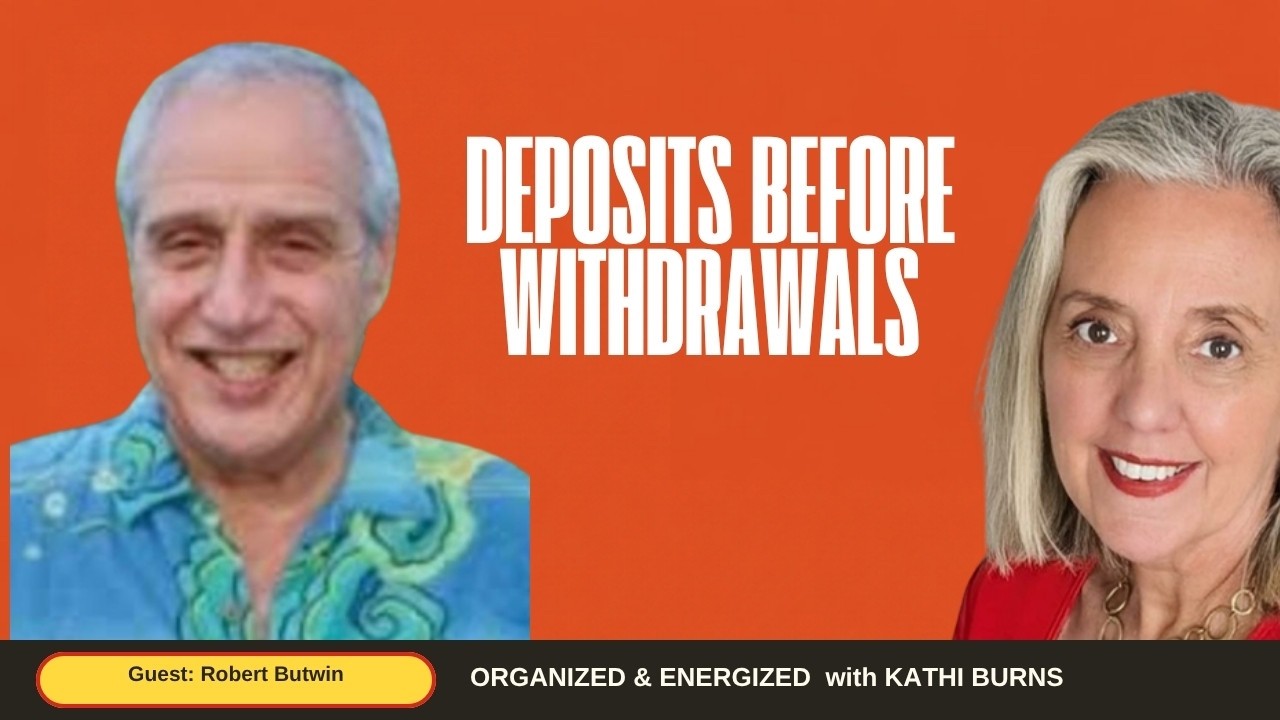
Robert compares networking to a bank account: you make deposits, like referrals and introductions, before you make withdrawals.
He says almost every entrepreneur is looking for one of three things: visibility, credibility or connectivity.
Robert keeps his business organized with Calendly, Grammarly and Perplexity, and he sees AI as accelerated innovation that still needs the human touch.
Published · Updated
What is this episode about?
Kathi Burns, CPO®, Business FLOW Strategist, talks with Robert Butwin, a networker and connector who hosts the Better Change podcast, about networking for entrepreneurs and building relationships that last. Robert was the oldest son in the third generation of a family business started in 1938, and he explains why he walked away from it and how a Wayne Dyer cassette series changed his mindset. You'll hear how he and the woman he married worked their way out of his early business debt, why he calls himself a situational extrovert, why he treats networking like a bank account, and the three things he says almost every entrepreneur is looking for. Robert also shares how he handles self-talk on stage next to famous speakers, why he works only in his zone of genius, how he celebrates with travel, and the tools he relies on, from Calendly and Grammarly to Perplexity.
One of the things I learned about networking: it's like opening a bank account. You need to make deposits before you can make withdrawals.Robert Butwin
Jump to links and resources · Part of How do I get more clients? · All episodes · Every guest
What are the key takeaways?
- Robert left his family's business because there was too much family in it and too much resistance to change; he says change is inevitable and the key is how you recognize and embrace it.
- A Wayne Dyer cassette series taught him that he was responsible for his own results, and he started listening to cassettes, reading books, going to seminars and working with a mentor.
- Robert says the struggles you go through in business let you look other people in the eye, empathize and help them break through theirs.
- His networking advice is to build meaningful relationships, be authentic and make deposits, such as referrals and introductions, before you make withdrawals.
- He says almost every entrepreneur is looking for visibility, credibility or connectivity, so ask questions and find out which one the other person needs.
- Robert calls the six inches between your ears the biggest obstacle, and he manages it by watching his self-talk, surrounding himself with the right people and staying in his zone of genius.
- For organizing, he uses Calendly for appointments, Grammarly for writing and Perplexity for quick answers, and he writes his own drafts before asking ChatGPT to improve them.

This episode is brought to you by the Business Logjam Session
A private 75-minute online session with Kathi Burns to find the one thing holding your business back and leave with your next steps. It is the same F.L.O.W. process Kathi uses with her own clients: Focus on your goals, Locate your logjams, Outline your solutions, Walk away knowing your next steps.
Find What's Holding Me BackInterested in sponsoring the show? Get in touch.Why would you leave a family business?
Robert Butwin left because there was too much family in the family business and too much resistance to change. His grandmother decided who got paid what so the grandchildren earned about the same, and his dad believed what worked in the past would keep working. A Wayne Dyer cassette series, How to Be a No-Limit Person, showed Robert that he had to change his own mindset and take responsibility for what he wanted to create. He says change is inevitable; what matters is how you recognize and embrace it.
How do you recover from debt when starting a business?
For Robert, it started with facing the numbers with someone he trusted. He says he was "ignorance on fire" when he first started in business and dove in without knowing what was going on. The woman he went on to marry asked to see his books, and together they worked on paying off all of his debts. He says struggles like that are what let you look other people in the eye, speak from the heart and help them through theirs.
How do you network if you're shy?
Focus on building meaningful relationships, not on being outgoing. Robert calls himself a situational extrovert, a term he and BNI founder Ivan Misner came to while talking about introverts and extroverts. He says the key is being authentic and asking good questions, and he points to Bob Burg's book Endless Referrals for a list of quality questions to ask people.
What is the best advice on networking for entrepreneurs?
Treat your network like a bank account and make deposits before you make withdrawals. Robert learned from Harvey Mackay that your net worth is in direct relationship to the value of your network. He says to think about collaborations, not transactions: refer the right people to your best business relationships, so you show up to be of value.
What are entrepreneurs looking for when they network?
Robert says almost every entrepreneur is looking for one of three things: visibility, credibility or connectivity. Once you've asked the right questions and understand what someone is doing, you can introduce them to people or point them to resources such as ChatGPT, Perplexity or suno.com. He says to take the focus off "me" and flip it into "we," because helping the other person speeds up the connection.
What is the biggest obstacle entrepreneurs face?
Robert says the biggest obstacle is the six inches between your ears: your mindset. On stage with speakers like Jim Rohn, Wayne Dyer and Les Brown, his self-talk told him he was a duck out of water. He manages it by feeding his mind, surrounding himself with the right people and working only in his zone of genius.
What tools help entrepreneurs stay organized?
Robert relies on Calendly, Grammarly and Perplexity. As a networker he is always making appointments, so Calendly keeps him congruent with his commitments, and Grammarly checks his written communication. He uses the free version of Perplexity for quick questions, from whether an email is a scam to which washer and dryer is best for the money. He writes his own drafts and asks ChatGPT to make them better, keeping only the changes he likes, and Kathi adds that she uses the paid version of Merlin.
How do you learn from things that don't work out?
Ask yourself what the lesson was, because Robert says life will keep tripping you up until you learn the lesson you're supposed to learn. He quotes Jim Rohn on measurable results in a reasonable period of time: one year in first grade is enough, which is why the desks are so small. His advice is to stay focused on your vision and keep your daily actions consistent.
What resources were mentioned?
- Robert's free 30-minute call (book on his Calendly)
- The Better Change podcast, hosted by Robert Butwin
- How to Be a No-Limit Person, cassette series by Wayne Dyer
- Dig Your Well Before You're Thirsty by Harvey Mackay
- Endless Referrals by Bob Burg
- The E-Myth, cassette series by Michael Gerber
- The Big Leap
- Calendly
- Grammarly
- Perplexity
- ChatGPT
- Suno
- DALL-E
- Merlin
These episodes continue the same thread as this one: Sue Kirchner, Yvonne McCoy, Louise McDonnell, Janelle Anderson also answer the question "How do I get more clients?", and the rest are the most recent conversations on the show.


 Social MediaEpisode 144
How To Use Social Media More Strategically In 2026 To Find New Customers with Louise McDonnell

See every episode on the podcast archive or filter by topic on the How do I get more clients? hub.
How can I support the show?
- Subscribe on Apple Podcasts, Spotify or YouTube, or add the RSS feed to any app.
- Rate and review. A rating on Apple Podcasts helps new listeners find the show, and Kathi reads every review.
- Share the episode with one business owner who needs it; the share buttons are at the top of the page.
- Grab a free eBook: 6 Steps to Organize & Energize Your Home, 6 Steps to Organize Your Home Office or 6 Steps to Organize & Energize Your Life.
- Work with Kathi. The Business Logjam Session is a private 75-minute session to find what is holding your business back.
- Be a guest. Apply here if you have a story about clearing the obstacles in your business.
What did they say, word for word?
The transcript below is edited for readability: filler words and false starts are removed and speaker names are added. Nothing was added or summarized.
Read the full transcript +
Kathi: Hi everyone, this is Kathi, and I am back with my friend Robert Butwin. I cannot wait to get into this conversation. This man is a man of change. As you see, it says Better Change podcast. He's also a fellow podcaster, and I just wanted to introduce you to him. So thanks for joining me, Robert.
Robert: Good to be here. Kathi, I'm really looking forward to our conversation, so I can help whoever of your entrepreneurs might be having whatever struggles or challenges they might be having.
Kathi: Yeah, that's what we're all about. We all go through those ups and downs, don't we? And that's why I actually have the podcast: to give some tips and tricks that you can walk away with and actually implement into your daily life to make life a little bit easier and more joyful. So, Robert, let's talk about your backstory. You have an interesting backstory. So talk to me about where you came from. I know you're from a lineage of a lot of entrepreneurial people. So let's start there.
Robert: You know, you're right. Our family started the high school award cheerleading jacket business in 1938. Oldest son, third generation, always expected to run that family business. The first challenge was too much family in the family business. Even though my dad was running it, my grandmother, even though she was never there, was really dictating who got paid what. She wanted to make sure all of her grandchildren got paid approximately the same amount. My dad would always tell me, it worked in the past, it's going to work in the future. Well, that's not the way it is. A cousin of mine, and I don't think you even know this, wrote a song approximately 65 years ago. In the lyrics of the song: you better start swimming or you'll sink like a stone, times are a-changing, my friend. And that was Bob Dylan, a third cousin of mine. Now, for your listeners, I never met him. But one of the key things I've learned is that change is inevitable. It's how you recognize and embrace it in a way that will allow you to create the things you're looking to create.
Change is inevitable. It's how you recognize and embrace it in a way that will allow you to create the things you're looking to create.
Kathi: Yeah, absolutely. I always say you need to embrace change because it's going to happen anyhow. But that's really quite interesting. We had a family business. We started a family business. We brought in mom and brother, and that didn't quite work out. So I understand completely what you mean by family businesses. I love being a solopreneur with helpers. It works for me. So how did you get out of that? How did you exit gracefully, if it was graceful? How did you leave that?
Robert: It was very graceful. Let me tell you part of what happened. Two things. Number one, I ended up meeting a lady right about the time that I realized I needed to get out. But I came across a cassette tape series, for your listeners that remember what a cassette series was, by Wayne Dyer. I love Wayne Dyer. It was called How to Be a No-Limit Person. So I realized for things to change, I needed to change my mindset, because realistically, I took the path of least resistance. I was forced to go to college. I didn't necessarily like going through that process, but it was expected of me, because I always figured I knew where my path was going to go. So in the meantime, when I came across that cassette tape series, I realized I was responsible for what is, so that I could take responsibility for what would be. But unfortunately, most people are in a state of denial. And I love the acronym of denial, which is: don't even notice I am lying. They're lying to themselves by not taking responsibility for what they need to create as it relates to whatever they want to do.
Kathi: Yeah, Wayne is so brilliant. So I love that. So you exited. But you said you always knew what you were going to do, and you knew it didn't have to include college. What did you know you were going to do?
Robert: Well, I got a degree, but I really didn't get the education. I knew I was going to be successful. I didn't necessarily know what I was going to do. And so I started changing my mindset. I started listening to cassettes, reading books, going to seminars, and then I came across my first in-person mentor. Anytime I had a challenge or a question, I could pick up the phone and call him. And by the way, when I first started in business, I ended up creating $12,000 in debt. Now, you don't necessarily need to go into debt to be successful. I was ignorance on fire. I didn't really know what was going on, but I just dove in, because I knew that I was going to be successful. I knew if other people could do it, I could do it. And so ultimately I came across my mentor, and I met the lady that I ended up marrying. The first thing that she wanted to do is she wanted to know where I was financially. She grabbed my books so that she could find out. And so I had like 42 debts, $102,000. But she liked me, thank goodness. And so we just worked on paying off all those debts. Because every entrepreneur is going to go through whatever challenges and struggles. And one of the pieces of advice that I quite often will tell people is that part of why this is happening to you is so you can look other people in the eyes, speak from the heart, empathize and explain to them. First of all, you can tell them that you can see that they're going to break through, and you can relate some of your struggles in a way that will help other people.
Kathi: Yeah, absolutely. And that's why I'm doing this podcast, and probably why you're doing the podcast. There's hope, and we all go into debt. Most of us go into debt at some point. And I love what you said about just being ignorant of what could possibly befall you, but it doesn't matter, because all things happen. Things happen, and then the whole key is: how do you get out of it? How do you move forward? How do you see your way clear? For you, you met a woman who is a backbone.
Robert: Yep.
Kathi: Love that. We all need partners of some sense. And I think even as a solopreneur, I have many, many partners in my business that help me and that I count on and that count on me. As people say, it takes a tribe to build a good company, some kind of tribe or other, right?
Robert: Yes.
Kathi: So now you're the networking king, right? You know about the mind game of networking. If someone was going to break into getting out there in the world, maybe they're shy, maybe they have a stutter, maybe they just don't feel confident networking. What advice would you give them if they're just starting to break into the game of spreading the news about their business and meeting other entrepreneurs?
Robert: Well, first of all, the advice I'll pass on was the advice I got from a 70-year friend of our family, which was Harvey Mackay, who wrote the book Dig Your Well Before You're Thirsty. And what he told me is your net worth is in direct relationship to the value of your network. So the key is focusing on developing meaningful relationships. Now, if you're saying shy: I was listening to Ivan Misner speak one time, and even when I was speaking to my wife, we were talking about introvert and extrovert, and she said, I'm an introvert. And Ivan Misner, who was the founder of BNI, when he was talking to his wife, she said, you're an introvert. And we came to the realization: he was a situational extrovert. I'm a situational extrovert. Because the key is how you develop that connection, that human understanding of people. And one of the people that I've met, and I could send you so you could pass it on to your listeners, is Bob Burg, who wrote Endless Referrals. He's got a whole list of quality questions to ask people. But the key is being authentic. Figure out what you can do. And one of the things I learned about networking: it's like opening a bank account. You need to make deposits before you can make withdrawals. So if you're really interested in understanding the other person, don't think about transactions. Focus more on collaborations. I take a look at the best relationships that I've got in business, and I realized who they were, and I started to refer other right people to them. So again, it's how you can show up to be of value to other people.
You need to make deposits before you can make withdrawals.
Kathi: Yeah, I love that. And it's so very true. Make deposits before you make withdrawals. And you know what's funny? I think with the people that you resonate with, it's so much easier to make deposits. If you find yourself not being able to make a deposit, perhaps that's not the right networking colleague anyhow. Maybe you're just not resonant. I go a lot with the feeling of: is this someone that I want to hang out with? Is this someone that I like to play with, to have interactions with that's just not business? And I think those are the best relationships, for sure.
Robert: I agree. Well, and let me play off of that, because the key is how you leverage resources. Now, resources come in a variety of different forms. Today, with everything that's out there, you've got ChatGPT, you've got Perplexity, you've got suno.com, which is for people that are into music. So you can either introduce them to people, or you can guide them to things that would benefit them, if you've asked the right questions and understand what they're doing. Because realistically, almost every entrepreneur is looking for one of three things: visibility, credibility or connectivity. Connections to something that will help them elevate and accelerate their pathway as it relates to where they're going. You've got to take the focus off of you. Take it off of me, and flip that M-E upside down into W-E. So the more that you can focus on the other person and figure out what you can do that will be helpful to them, it's going to help you accelerate that connection.
Kathi: Yeah, I love that. Well, we've all had ups and downs. So talk to me about one of the obstacles that you faced at some point in your long-lived career. What were you up against, and how did you find your way out of it?
Robert: The biggest obstacle that I feel most people face, and I had to face it at some level, and I'll explain how I faced it, is the six inches between their ears: their mindset. I found myself, because of the success that I created, on stage with some of the iconic speakers, people like Jim Rohn, Wayne Dyer, T. Harv Eker, Les Brown, because of the success, and they were keynote speakers. And so I'm sitting back with self-talk, saying, man, I'm a duck out of water, whatever the case is. And part of the key is understanding your self-talk. It was like when I listened to Michael Gerber's cassette tape series, The E-Myth, and he says four out of five businesses are going to fail in the first five years. And I'm listening to him, and I said, that's not me. I listen to my self-talk. And it's continually feeding the mind, associating and surrounding yourself with the right people, and understanding what your zone of genius is. There's a great book, The Big Leap, about staying in your zone of genius. I've got collaborations with people that do the things that I don't want to do. I haven't totally embraced AI, but one of my business partners is an AI concierge. He's like in the 12-step program. For example, when I'm going to promote your show, I don't do it, but I've got other people that do it for me, because my zone of genius is, number one, networking and, number two, having meaningful conversations with quality people.
Kathi: Yeah, I get that a lot. Absolutely. And that's something I talk about all the time: delegate what you hate. Delegate what you shouldn't be doing anyhow. Especially things you hate; there's no way that you should be doing that. And things that aren't in your zone of genius. There are so many other people that you can collaborate with that will benefit from you handing that off to them. And then it becomes a win-win-win for all parties concerned.
Robert: Yeah.
Kathi: And we can stay in our zone of genius, which for me is not the back end of websites, that's for sure. I tried that in the beginning of my career. I was in tears and crying and kept getting the bomb. Remember the bomb that Apple used to have, that used to pop up when you'd blow up your computer? I got the bomb so many times, it was just ridiculous. And then we learn we shouldn't be doing that kind of stuff. It's definitely not my zone of genius. So those are really great tips. Let's see. So I'm in a year of celebrating my successes, and I think it goes back to self-talk, right? How do you talk to yourself about what you've done? And I think, really, your mind creates reality. So I've been on a journey of celebrating any little milestone that happens in my life. So I want to ask you: when you have something that you're going to celebrate, how do you celebrate your success?
Robert: My wife and I take a trip. Our next trip is to Asia, where we've got six different countries that we're going to in November, and I'm going to be booking the airline tickets today. We're going to go to Vietnam, Cambodia, Laos, Thailand and Kuala Lumpur. Next year, we've already got it planned out. She's done all the research. We've got six different countries in South America: Uruguay, Paraguay, Brazil, Chile. I can't remember them all, but I got a plaque from United telling me I went through two million miles. At this point in where I'm at in my life, wherever my wife wants to go, I'm there. She plans it out. So my celebration is taking her where she wants to go.
Kathi: I love that. I love that. A true professional husband. And Asia is definitely on my short list, so I will be living vicariously as I watch you travel. Hopefully you'll be posting about that.
Robert: Definitely.
Kathi: Okay. So before we end, of course: do you have an organizing tactic or strategy that you love, that supports you daily in your business endeavors?
Robert: I've got two of them I'm going to share with you. First of all, you've got to be congruent with your commitments, and as a networker, I'm always making appointments. So, Calendly. And the other one, because everything's based on your communication: you've got your verbal communication, but you've got your written communication, and my business partner introduced me to Grammarly. It's like an OMG experience. Beforehand, my wife graduated valedictorian of her class. Now, there were only 10 people in her class, but it was still valedictorian, and she is really good at grammar. So anytime I was writing something, I'd call her over, and she would correct my grammar. Now with Grammarly, it's like, wow.
Kathi: Yeah. Get rid of all those extra spaces. They love adding commas all over the place. The comma thing is what really gets me. I'm a wicked editor. I'm always editing everybody's stuff, but Grammarly gets me with the commas all the time. So I think that's a great tool. If any of you haven't loaded up Grammarly, please load it up into your computer. It's going to help you a lot. And of course Calendly. How else are we going to keep our busy life together unless we have a calendar system that supports our emails and our life and keeps it all together?
Robert: One more. Let me add one more.
Kathi: Okay.
Robert: That's perplexity.ai. Anytime you've got a question, no matter what the question is. You don't need the paid version; the free version. I get emails quite often from people, and I'll send it to Perplexity: is this a scam? Yeah, it's a scam. We needed to buy a washer and dryer just recently. I asked Perplexity, what's the best washer and dryer for the money? It gave the five best, one way or the other. It's embracing AI. We talked about change. A lot of people are fearful of AI. I look at AI as accelerated innovation for your business differentiation. So embrace it and use it. It still has the human touch; you don't want to lose the human element. But there are many different things. My chameleon right there on the stage was done with DALL-E, in minutes. So anyhow, that would be the other thing I'd suggest.
Kathi: Is it really up to date? Because I know that the regular chat is a couple years behind the times. Do you think Perplexity is more up to date than some of the other AI platforms?
Robert: Well, on the AI, you want the paid version of ChatGPT. It's changing at light speed. Every day there's a change going on, one way or the other. So that's why my business partner has joined the 12-step program for AI. Anytime I've got a question, I just ask him. It's great.
Kathi: Yeah, I'm using Merlin, the paid version, now, and Merlin's like a wizard. But I hadn't heard of Perplexity, so I'll check that out. But we all have to do it. We have to jump into it if we're going to stay current, and hopefully not use it word for word, but use the structure of it to help us.
Robert: Yeah. A couple things. For example, I'll write the things myself, and then I just put it into ChatGPT and say, can you make this better? Now, if I like the changes, great. If I don't, not a problem; I don't need to use them. It's just recognizing the changes. A lot of people fear AI, and I like the acronym of fear, which is: face everything and rise. Might as well embrace it. It's going to be here.
Kathi: Yeah, it's here. It's here to stay. So jump onto it right now. Okay, so another question for you. If you had to look back and talk to your 18-year-old self, what advice would you give him?
Robert: Yeah. Well, pay attention to the signs. Again, in the beginning stages, I wasn't too into education. I take a look at the things that I missed, one way or the other. And enjoy life. Life is short. Ben Sweetland, I think, said it the best: success is the journey, not the destination. You might as well enjoy the journey. And you mentioned hope, and I love the acronym of hope, which is: helping other people every day. If you focus on just showing up, being authentic and contributing. Quite often the media focuses on the differences. Us as human beings have got more similarities than differences. So focus on helping other people. My purpose, ultimately, in life is to live a life of meaning based on helping other people.
Kathi: I love that. I love that. So maybe tell yourself that back in the day, right?
Robert: Yeah.
Kathi: Okay. Well, in parting, I know there's so much we could talk about. Oh my gosh, we could sit here for days and talk. I love speaking with you. What have I not asked you? What do you want to tell the listeners out there that I've not asked?
Robert: We all have different lessons based on things that happen. And one of the things I learned early on, and again, there are so many things I could say: life will continually trip you up until you learn the lesson you're supposed to learn. The other thing I loved is what Jim Rohn said: measurable results, reasonable period of time. As he relates back, he asks the question: how long would you like your son or daughter to be in first grade? He says one year is enough. That's why they make the desks so small. So again: measurable results, reasonable period of time. Stay focused on your vision and continually have consistency with your daily actions, knowing that ultimately you will end up arriving wherever it is that you want to arrive.
Life will continually trip you up until you learn the lesson you're supposed to learn.
Kathi: Yeah. With consistency and with dedication. I agree. Stop jumping off the rails, kiddos. Stay the course, because we can all create anything we want to create. And back to the top of the conversation, where your mind can create where you're going to go. So let's keep your mind focused on where you want to go, and use consistent actions; as Robert says, consistent actions over time will get you to where you think you want to go.
Robert: And one last thing. Even when things don't work out, whatever that might be, ask yourself: what was the lesson that I learned, because it didn't work the way I wanted it to work?
Kathi: Absolutely. And life will keep giving those lessons over and over until you do get it. So you might as well try to get it sooner rather than later, and get out of first grade and into second grade. I think that's funny, why they make the desks so small. You crack me up. Okay. So I know that there's something that you would like to offer the audience. What is it that they can download or get or click?
Robert: If they want to book a time on my calendar, I will give them a half an hour of my time, complimentary. And what I can guarantee them is that within a 30-minute conversation, based on what's going on in their life, I will be able to help them elevate and accelerate what's going on as it relates to what is happening in their life, in their business.
Kathi: Wow. Fantastic. That's huge. Everybody needs to jump on that. Your calendar is going to be full. Absolutely take advantage of that. You will get all sorts of nuggets of wisdom and forward momentum for your business just by a quick 30-minute talk. So wow, that's hugely generous. Thank you.
Robert: You're welcome. I appreciate it. You know, again, my name's Robert Butwin. I really want your listeners to remember: with Robert, you'll do nothing but win.

Kathi: I love it. All right, let's win with Robert Butwin.
Robert: Yeah, let's do it.
Kathi: Okay, signing off for now, gang. Thanks so much for joining me on this episode. We will see you next time, same bat channel. Until then, have fun, enjoy your journey, make success, and actually celebrate every time you do make a success. Super important. Okay, till then, gang. We'll see you then.
Where can I find the links and resources from this episode?
Connect with Robert
Organizations and companies
Books and resources
- Street Smart Networking by Robert Butwin
- Dig Your Well Before You're Thirsty by Harvey Mackay
- Endless Referrals by Bob Burg
- The Big Leap
- How to Master Your Muck by Kathi Burns
- Organizing With Tetris by Kathi Burns
- Home Organization, The Smart Guide by Kathi Burns
- Simple Family Organizing by Kathi Burns
- All of Kathi's books in her shop
Inspired? Here Are Your Action Steps:
- Name one thing in your business you keep doing because it worked in the past, and decide whether it still works.
- Take responsibility for where you are now so you can decide what you want to create next.
- Find a mentor you can call when you hit a challenge or have a question.
- If you have business debt, sit down with someone you trust, look at all of it, and make a plan to pay it off.
- Before your next networking conversation, write down a few quality questions to ask about the other person's business.
- Make a deposit this week: refer someone or make an introduction for one of your best business contacts.
- Ask the people you meet whether they need visibility, credibility or connectivity, and help with that one thing.
- List the tasks outside your zone of genius and delegate the ones you hate first.
- Use a booking tool like Calendly for appointments and a writing tool like Grammarly for anything you send.
- When something doesn't work out, write down the lesson you learned from it.
Frequently asked questions
How to network if you're shy?
+
Robert Butwin says the key is developing meaningful relationships and being authentic, not being the loudest person in the room. He calls himself a situational extrovert and suggests asking quality questions, like the ones in Bob Burg's book Endless Referrals, so you understand the other person.
Can introverts be good at networking?
+
In the episode, Robert explains that he and BNI founder Ivan Misner both came to see themselves as situational extroverts. He says networking depends on how you build a human connection and understand people, and on making deposits, like referrals and introductions, before you ask for anything.
Why did Robert leave the family business?
+
As the oldest son in the third generation, he was expected to run the business his family started in 1938, but there was too much family in the family business and too much resistance to change. A Wayne Dyer cassette series, How to Be a No-Limit Person, showed him he had to change his own mindset and take responsibility for what he wanted to create.
How did Robert recover from early debt?
+
Robert says he was "ignorance on fire" when he first started in business and ran up debt without knowing what he was doing. The woman he went on to marry asked to see his books, and together they paid off every debt. He says struggles like that let you look other people in the eye and help them through theirs.
What's the biggest obstacle entrepreneurs face?
+
Robert says it's the six inches between their ears: their mindset. On stage with speakers like Jim Rohn, Wayne Dyer and Les Brown, he had to manage his own self-talk. He now works in his zone of genius, networking and meaningful conversations, and collaborates with people who handle what he doesn't, like AI and promotion.
What tools does Robert rely on?
+
Calendly for appointments, Grammarly for his writing and Perplexity for quick answers, from checking whether an email is a scam to researching a new washer and dryer. He sees AI as accelerated innovation and says to keep the human touch while you use it.
Who is talking in this episode?

About the Host, Kathi Burns
Kathi Burns, CPO®, is a Business FLOW Strategist based in San Diego. For the last 20+ years, Kathi has helped clients create systems they can stick to. She is the author of How to Master Your Muck, Organizing With Tetris and Home Organization, The Smart Guide, and co-author of four more titles; all are in Kathi's shop. Kathi's business has been featured on Good Morning America, and her advice has been featured in Oprah Magazine, Martha Stewart Living, Better Homes and Gardens and Entrepreneur Magazine.
More about Kathi · Shop Kathi's books · Business Logjam Session · Apply to be a guest

About Robert Butwin
Robert Butwin is a networker and connector who hosts the Better Change podcast. He comes from a family of entrepreneurs: as the oldest son in the third generation, he was expected to run the high school award and cheerleading jacket business his family started in 1938, but there was too much family in the business and too much resistance to change, so he chose his own path. He started in network marketing part time and has worked in it full time since 1990. He is the author of Street Smart Networking. Robert says his zone of genius is networking and having meaningful conversations with quality people, and he offers entrepreneurs a free 30-minute call.
Want help putting this into practice?
Book a Business Logjam Session with Kathi
A private 75-minute online session to find the one thing holding your business back and leave with your next steps, using the same F.L.O.W. process Kathi uses with her own clients: Focus on your goals, Locate your logjams, Outline your solutions, Walk away knowing your next steps.
Prefer to start small? Download Kathi's free eBook 6 Steps to Organize Your Home Office.
Published · Updated
This episode page is for general information. Guests speak for themselves, and their opinions, statistics and examples are their own. Nothing here is legal, financial, medical or mental-health advice; talk to a qualified professional about your own situation. Some links go to the guest's own products or free offers; addSpace does not earn a commission from them unless stated.