


Episode 105
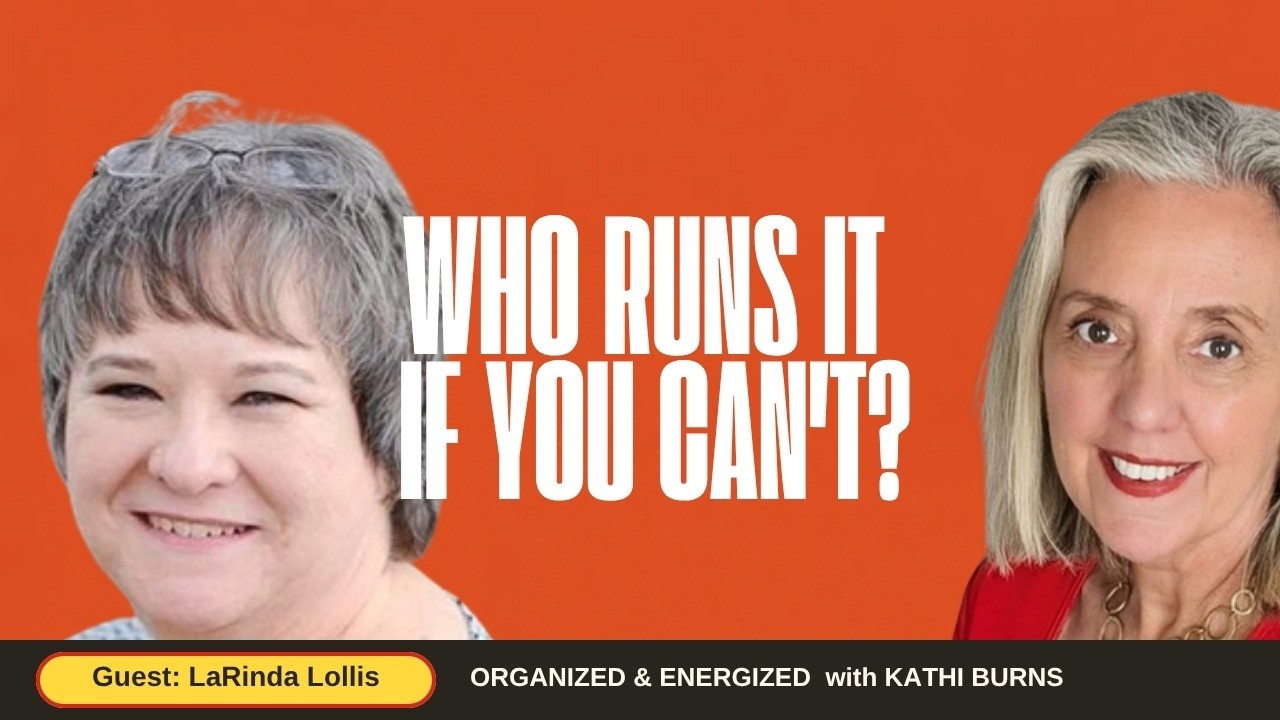
with LaRinda Lollis, certified Virtual Expert® and owner of Expert Virtual Services · November 19, 2024 · 28 min
LaRinda Lollis, owner of Expert Virtual Services, started creating ICE (In Case of Emergency) SOPs after her late husband died in 2018, leaving a key in his wallet that no one could identify and nothing about their accounts written down.
An ICE SOP puts passwords, bank accounts and client contacts in one place so someone can keep your business running if you are suddenly in the hospital and can't communicate.
LaRinda says that without a financial and a medical power of attorney, you have no say in your partner's care, even after decades of marriage.
She tells new virtual assistant clients to list everything they do each day, circle the tasks with the most impact on the business and hand over the rest.
Her free ICE SOP template explains the six parts of an SOP and can be reused for other SOPs.
Published · Updated
What is this episode about?
Kathi Burns, CPO®, Business FLOW Strategist, talks with LaRinda Lollis, a Certified Virtual Expert® and owner of Expert Virtual Services, about the ICE SOP: an in-case-of-emergency standard operating procedure that works as a business emergency plan when you can't show up. When LaRinda's late husband died in 2018, she found a key in his wallet that no one could identify, didn't know whether he had life insurance and couldn't get into his Facebook account. She now helps business owners get passwords, accounts and client contacts into one place. You'll hear why a power of attorney matters even if you're married, what to hand a virtual assistant first, how a music degree and years in office jobs shaped her work, why she thinks women forget to celebrate their wins, and how she protects her time by working Monday to Thursday, 9 to 4.
If I can help one person not have to worry about something like that during a time that you're trying to grieve, I've done my work.LaRinda Lollis
Jump to links and resources · Part of How do I grow my business without burning out? · All episodes · Every guest
What are the key takeaways?
- LaRinda Lollis built her ICE SOP work after her late husband died with nothing in place: no record of what a key in his wallet opened, whether he had life insurance, or how to get into his accounts.
- An ICE SOP answers who will contact your clients, where your passwords are, and which bank accounts exist, including separate accounts a partner may not know about.
- LaRinda says a financial and a medical power of attorney are needed even in a long marriage; without them you have no say in your partner's care.
- Her delegation starting point: list what you do daily and what you should do but don't, circle the highest-impact tasks, and hand everything else to a virtual assistant.
- She advises new business owners not to wait for perfect, to expect the business to change, and to let go of clients who drain them.
- LaRinda works Monday to Thursday, 9 to 4, and says clients respect firm boundaries more, even if some push back at first.
- She suggests celebrating milestones with something that isn't food, like a new outfit or a show, because those become memories.

This episode is brought to you by the Business Logjam Session
A private 75-minute online session with Kathi Burns to find the one thing holding your business back and leave with your next steps. It is the same F.L.O.W. process Kathi uses with her own clients: Focus on your goals, Locate your logjams, Outline your solutions, Walk away knowing your next steps.
Find What's Holding Me BackInterested in sponsoring the show? Get in touch.How did LaRinda Lollis become a virtual assistant?
She trained as a VA after leaving her corporate job in the year after her late husband died. Her brother asked her to sell their 20 acres, quit her job and live with his family until she worked out what she wanted. A month after leaving the job she found VA training, and a month into it she had her first client. Working from home also lets her help family.
Why did LaRinda Lollis create an ICE SOP?
Because when her late husband died, they had nothing in place. He carried a key in his wallet, and after calling banks and the bus station she still doesn't know what it opened. She didn't know if he had life insurance. They had been married five and a half years and thought they were still young enough not to need a plan.
What should a business emergency plan include?
A business emergency plan should put everything in one place so someone can keep your business running if you end up in the hospital and can't communicate. LaRinda Lollis lists who will contact your clients so they don't think you've ghosted them, your passwords, and every bank account, including separate ones your partner may not know about.
Do you need a power of attorney if you're married?
Yes, in LaRinda Lollis's view: without a financial and a medical power of attorney, you have no say in your partner's care, even after a long marriage. Her husband learned this when his late wife died after 35 years of marriage. She was in hospice, but LaRinda says that otherwise he could have had no say at the hospital.
What should you delegate to a virtual assistant first?
List everything you do each day and everything you should be doing but isn't getting done, then circle the tasks with the most impact on your business. LaRinda Lollis has new clients hand her everything else. She manages email, calendars, teams and processes, and learns each client's software quickly by seeing it as a puzzle.
Why do women forget to celebrate their wins?
LaRinda thinks women love celebrating others but don't think to celebrate themselves, and that doing it more often would help them see their worth. She admits she mostly tells others about a success instead of celebrating it. Kathi didn't pause to celebrate her first book in 2009. LaRinda suggests choosing a reward that isn't food, like a new outfit or a show, because those are memory builders.
What advice does LaRinda Lollis have for new entrepreneurs?
Don't wait until everything is perfect, because everything can be built on. You don't have to know everything up front, and it's fine if your idea changes two months in; most businesses evolve. She also says not to keep clients just for the money: if they rub you the wrong way, let them go.
How do you set boundaries with clients on work hours?
Decide your hours and hold to them. LaRinda Lollis works Monday through Thursday, 9 to 4, and doesn't work weekends because that's family time. Some clients will push, but she says that when you push back they respect you more, even if it doesn't seem that way at the time. Kathi adds that it shows clients you'll do what you say.
What resources were mentioned?
These episodes continue the same thread as this one: Lia Dunlap, Carly Church, Ginny Priem, Stephanie Wall Morrow also answer the question "How do I grow my business without burning out?", and the rest are the most recent conversations on the show.

 MotherhoodEpisode 147
How To Build a Village That Supports Your Business and Your Life with Carly Church


See every episode on the podcast archive or filter by topic on the How do I grow my business without burning out? hub.
How can I support the show?
- Subscribe on Apple Podcasts, Spotify or YouTube, or add the RSS feed to any app.
- Rate and review. A rating on Apple Podcasts helps new listeners find the show, and Kathi reads every review.
- Share the episode with one business owner who needs it; the share buttons are at the top of the page.
- Grab a free eBook: 6 Steps to Organize & Energize Your Home, 6 Steps to Organize Your Home Office or 6 Steps to Organize & Energize Your Life.
- Work with Kathi. The Business Logjam Session is a private 75-minute session to find what is holding your business back.
- Be a guest. Apply here if you have a story about clearing the obstacles in your business.
What did they say, word for word?
The transcript below is edited for readability: filler words and false starts are removed and speaker names are added. Nothing was added or summarized.
Read the full transcript +
Kathi: So let's jump into this and see what she can do for you and what she does for other people, because everybody needs a good VA. So hi, LaRinda, thanks for joining me on the show.
LaRinda: Hi, Kathi, thanks for having me.
Kathi: Absolutely. So let's talk about your backstory. How did you come to be what you are as an expert virtual service provider? Let's talk about your backstory.
LaRinda: Back in 2018, my late husband passed away, and we had just bought 20 acres of land six months earlier.
Kathi: Wow.
LaRinda: And when he passed away, my brother came to me and he said, you can't keep the property, you can't do the upkeep. And I was like, I know, but I really don't want to have to deal with this right now.
Kathi: Yeah, no doubt.
LaRinda: And he was like, I want you to quit your job for six months after you sell the property and come live with us until you figure out what you want to do with the rest of your life.
Kathi: Wow.
LaRinda: I had always been a caretaker, and he says, it's time for someone to take care of you. And so it took me four months to let go of the house, to get it sold, and then another three months to let go of the security of the job, because that was the last bit of security I had left.
Kathi: Yeah.
LaRinda: And I moved in with my brother. Well, I traveled an hour and a half from where he lived to where I worked for that three months. I'd come in to Tulsa, which is where I worked, Sunday nights, stay with friends, and then go back to his place Friday evenings. And I did that for the three months, and I finally decided, I'm done, I don't want to do this anymore.
Kathi: Yeah.
LaRinda: And I let go of that job. Well, a month after I let it go, I found training to become a VA. I had wanted to work from home for many years because I was tired of the corporate rat race, but I didn't know how to break into it. And so I spoke to her, and once I started her training, a month after I started it, I had my first client. And I love it. I love being able to work from home, and I can still help people, because I've been able to help my aunts. And then in November of 2020, the friends I had stayed with when I was still working called and asked if I would come back to help take care of her. So I came back, and she passed away in January of '21, on my birthday.
Kathi: Wow.
LaRinda: And she told me before she passed, she says, I want you and her husband to get together. And I was like, not going to happen, I like my life the way it is. So never say never, because he and I did get married in May of '21.
Kathi: That's funny. Oh my God.
LaRinda: Yeah. And her family outnumbered our families combined at the ceremony.
Kathi: Interesting.
LaRinda: So they've just kind of folded me into the family.
Kathi: Aw.
LaRinda: So when my late husband passed, he had a key in his wallet.
Kathi: Yeah, I want to hear about this key. I want to hear about this key.
LaRinda: I still don't know what it went to.
Kathi: Oh.
LaRinda: I mean, I called banks, I called the bus station, I tried everything. No one knew that shape of the key. No one had seen it. And if a man usually carries something in his wallet, it usually means something.
Kathi: Absolutely.
If a man usually carries something in his wallet, it usually means something.
LaRinda: And I still don't know what it went to. So that started me on my path of the in case of emergency, the ICE SOP.
Kathi: Right, right.
LaRinda: Because we had nothing in place. I didn't even know if he had life insurance. We'd only been married five and a half years.
Kathi: Okay.
LaRinda: And we didn't think we needed anything in place yet. We were still fairly young. I mean, I was mid-50s when he passed. And so my mission now is to help others be able to have everything in place, in one place, so that if, let's say, you end up in the hospital tomorrow and you can't communicate, how do you keep your business ready? Is there someone that can contact your clients so they don't think you've ghosted them? As well as if, heaven forbid, you either pass away or your spouse or significant other does, do you know, or do they know, where the information is?
Kathi: Yeah.
LaRinda: Do they have passwords? Because my late husband had a Facebook account. I didn't know how to get into it. His daughter fortunately knew how to get in, and so we were able to have it shut down. Bank accounts: do you know each other's bank account information?
Kathi: Right.
LaRinda: Do you share all your bank accounts? Are there separate bank accounts? Because what happens if someone has a separate bank account and they pass?
Kathi: Yeah.
LaRinda: And if they have a separate one, do you have access to it? Do you even know about it?
Kathi: Right. Yes.
LaRinda: Stuff like that. So if I can help one person not have to worry about something like that during a time that you're trying to grieve, I've done my work. I've done my job.
Kathi: Yeah, that's amazing. I think about that sometimes with my husband, because, thinking, okay, so I know his login, I know all that. But quite honestly, if I'm not on the bank account, I can't withdraw the money anyhow.
LaRinda: Exactly.
Kathi: Because it's illegal, right? So there's all that going on. There's so many bits and bites of piecemealing our life together. So I think it's an amazing thing. What you're going to find, for those who are listening, is you'll see a link below this where you can actually get a template for the ICE SOP from LaRinda, so that you can start thinking about it, because it's something that we should all think about. No one wants to think about it in our 50s, our 60s, whatever, and we should probably be thinking about it in our 30s, if it comes down to it.
LaRinda: Exactly.
Kathi: I mean, I work with a lot of clients, and trying to find stuff that's been issued to the state, because of things that were not cashed, things that were not claimed. It just goes to the state because it wasn't accounted for from anybody else. So there's all that.
LaRinda: And another thing that you need to make sure of is that you have a power of attorney for both financial and medical. Because even if you've been married for a long time, if you don't have that power of attorney, you have no say in the care of your partner.
Even if you've been married for a long time, if you don't have that power of attorney, you have no say in the care of your partner.
Kathi: Wow, I didn't realize that.
LaRinda: Yeah.
Kathi: Wow. And that's, I mean, that's panic right there.
LaRinda: And my husband now discovered that when she passed. She was in hospice, fortunately, but if she hadn't been, there's nothing he could have done at the hospital to have any say in her care.
Kathi: Even if you're married.
LaRinda: Even if you're married. And they'd been married 35 years.
Kathi: Wow. Yeah, so this is all good stuff, gang. If you're listening, make sure that your affairs are put in order. I know I'm going to do a few things for sure. So what did you do in corporate? What was your backstory with that?
LaRinda: I worked in… well, I have a teaching degree.
Kathi: Okay.
LaRinda: I can teach K through 12 vocal and instrumental music with emphasis on voice, and K through 9 regular classroom, and then also K through 9 minor in Spanish, so I can teach Spanish. And when I graduated, there were no teaching jobs, because there was a glut of elementary teachers and they were starting to take music out of schools.
Kathi: Yeah, sadly.
LaRinda: So I thought, all right, I know I can get a job in the office. So I went back to working in an office, and I have worked almost every aspect of an office, from accounting to technical publications, purchasing, you name it. I've probably touched it.
Kathi: That gives you a lot of skill set as an entrepreneur, and for launching your own business it probably was second nature in a lot of ways to think about things in your own business. So I commend you for starting your business. First off, kudos to your brother. That's just an amazing thing, to have time off to regroup. I had a year off. I had never had a year off in my life either, when we lost our company after 9/11, and it's a godsend to have clarity and time to get clear and time to heal and mourn loss, so that you can move on.
LaRinda: You need it. You need it for sure.
Kathi: And many people don't get it. So if your brother ever listens to this, congratulations and good work, bro.
LaRinda: He rocked it. He was great.
Kathi: I love it. And then who was it? It was your aunt who wanted you to hook up with her husband?
LaRinda: No, it was the friends that I stayed with.
Kathi: Oh, okay. Oh, interesting. Okay. I know that when my mother was dying, her big mandate was, make sure your father gets married again, because men don't do so well on their own. They don't know how to be on their own.
LaRinda: Yeah, especially of a certain age.
Kathi: Of a certain age. I think under 30 they might be a little bit more self-sufficient, but when over a certain age, they're just not. I remember trying to teach my dad. The only thing I ever taught him to cook after my mother passed was an egg, and everything else was a fail. Well, at least I know he won't starve. He could do eggs for his whole life if nothing else happens, right?
LaRinda: It's something, isn't it?
Kathi: So talk about what you do as a VA, because I know that there's a lot of women listening, a lot of listeners listening, not just women, that need the services of someone to do what they either cannot do, what they should not do, or what they hate to do. What do you offer as your services as a VA?
LaRinda: I bring peace out of chaos in your back-end systems by managing your emails, your calendars and your teams, and then getting your processes in place. Because if you've been in business, let's say, for about five years, you are probably still doing everything yourself, and you shouldn't be, because you are wasting your time and energy on doing stuff that you can delegate to someone else.
I bring peace out of chaos in your back-end systems.
Kathi: Yeah.
LaRinda: And leave you more time and head space to be able to work with your clients better and to pull more clients in.
Kathi: Right, which is your zone of genius.
LaRinda: Your zone of genius.
Kathi: I know my clients' zone of genius is not going through their inbox. In fact, they go off into la-la land.
LaRinda: Yeah. And what I tell new clients is, make a list of everything you do on a daily basis, and everything you should be doing on that daily basis but isn't getting done. Circle the ones that are most impactful for your business, then you turn everything else over to me and I will take care of it. I will get it sorted, I'll get it organized, so that it's stuff you're not having to worry about.
Kathi: Yeah, I love that. Love, love, love. And do you do any back-end tech stuff?
LaRinda: I learn software really easily, and it has appeared that most of my clients… I'm trying to think if there's… there may be two clients that have had the same software. Otherwise they're all new, and I learn them very quickly because I can see them as puzzles. All right, I know where the pieces go.
Kathi: It's that musicality coming out in you, girl. That musicality.
LaRinda: Yes.
Kathi: I love the fact that you have the background as a teacher as well, because I'm absolutely sure, knowing what I know of you, that you empower your clients by educating them at the same time, right? That's huge.
LaRinda: And I like training people. I like getting them to where they're not so afraid of the tech, and they're more comfortable with it.
Kathi: Yeah, that's very important. Absolutely. So if you had to look back on your life and tell your 18-year-old girl self, what would you tell her? What advice would you give?
LaRinda: Don't be afraid to try stuff, whether it seems completely out of the realm of possibilities. Because I had a chance to go further in my singing, and I didn't take it. But things happen for a reason. I still use my singing in church, and I still lead children's choirs where I can.
Kathi: Yeah.
LaRinda: But there's always that thought in the back of your mind: what if? What if I had taken this path instead of this one? But then I also think I wouldn't be who I am today without the experiences I've gone through.
Kathi: Of course. Absolutely. If you wouldn't have gone into corporate, you wouldn't have had as much of a skill set to become a solopreneur or an entrepreneur.
LaRinda: Exactly.
Kathi: So I agree with you. Everything happens for a reason. So when you have a success, how do you celebrate?
LaRinda: I tell others about it. I'm really bad at celebrating myself, because I don't do it near enough.
Kathi: Me too, honey. That's why I'm asking. This is my year of asking people how do you celebrate. Because when I launched my first book in 2009, I didn't even pause to celebrate. I didn't even stop. It's like, okay, now we got to market, now we got to market. I didn't even stop to say, hey, I'm a published author. Silly, right?
LaRinda: Well, and I think that's a downfall of being a woman. We don't think to celebrate ourselves. We love celebrating others. We don't always think to do ourselves, and we really need to do that more often.
Kathi: Yes.
LaRinda: Because if we did it more often, I think we would be more prone to seeing our worth, because as women we don't see that very often.
Kathi: Yeah, I'm with you on that. And seeing our worth, and actually just taking a pause, because I think celebration requires a pause. And I'm one to just barrel on down the road, just keep on keeping on. I've called it Energizer Bunny, right? You just keep on keeping on. But you have to pause to figure out how you're going to celebrate.
LaRinda: Yeah, you really do.
Kathi: Yeah. On the run.
LaRinda: Try to choose a celebration that's not food-centered. If you achieve a certain milestone, then determine that you're going to go out and get a new outfit, or you want to go see a show. Choose stuff like that, because those are memory builders, and you can always look back on those.
Kathi: I agree wholeheartedly with you on that. Yeah, for sure. So what would you say to someone that's starting a company? Do you have any advice for early entrepreneurs, any tips that you would give them?
LaRinda: If you have determined that you want to start a business, you don't have to know everything up front. First, do not be a perfectionist, meaning don't start until you are certain everything's perfect, because everything can be built on.
Kathi: Yeah, it'll never be perfect anyhow.
LaRinda: No, not at all.
Kathi: That's great, great advice. When I published my first book, it took me three and a half years. I do a mantra every year, I have a saying, right? And for that one it was, perfection is overrated and simply not worth it. So I'm with you on that. It's never going to be the perfect time to launch your business. You're never going to launch in the perfect way. It's all going to work out.
LaRinda: It does. And the thing is, when you first start out, you may have an idea, and then two months later it's like, well, I think I want to try this. And that's okay. Because a lot of entrepreneurs, and I have a hard time with that word, they never settle on the first thing they start with. It always evolves.
Kathi: Absolutely.
LaRinda: And it's okay.
Kathi: Absolutely. In my profession as an Operational Architect, we all start as generalists, and we all do everything for everybody until we figure out what we like to do, what we're good at doing, what kind of clients we want to help. And then we fine-tune into specializations. And I think the same way as business owners, you end up finding out who do you want as your client, who do you get joy from working with, who gives you the bristles, what type of work do you like doing, and what type of work should you not be doing. And when you find things you shouldn't be doing, we're going to job it out to LaRinda here.
LaRinda: Yeah. And also on clients: don't keep them just because of the money.
Kathi: Yes.
LaRinda: If they are rubbing you the wrong way, bringing the bristles out, so to speak, let them go, because that's a weight you don't need.
Don't keep them just because of the money.
Kathi: Yeah, I'm with you on that. Amen, sister. If they break your heart or they antagonize you, or if you're getting ready to go on to an appointment with them and you're like, oh my God, that's a good indication to just move.
LaRinda: Exactly. Move them on.
Kathi: Yeah, I'm with you on that. Okay, is there anything that I should have asked you that I didn't, as we wind this down?
LaRinda: How do you balance personal life and business to ensure long-term success and well-being? And my answer to that is, you set boundaries as to work hours. I only work Monday through Thursday, between nine and four. Don't work weekends, because that's family time. And you need to set those boundaries with the clients, because otherwise some of them will push them. And some of them may still try to push them, but when you push back, they're happier for it. It may not seem it at the time, but they do. They respect you more.
When you push back, they're happier for it.
Kathi: They respect you more. It's a level of professionalism that you instill in the client. And I love that you say that, LaRinda, because I feel that it gives them more confidence in your abilities as a true professional, that you're going to do what you do when you say you're going to do it, and you ain't going to do it when you say you're not going to do it, basically. And yeah, I think that's fantastic advice. I'm glad you brought that one up. That's really, really good. Very good. So in closing, I know that you have a free download, and I talked about it a little bit at the beginning, but why don't you explain what that is for the people?
LaRinda: It is the ICE SOP template, and it basically tells you everything you might need. But keep in mind it's not going to be all-inclusive, because there's going to be stuff that different people will need. So keep that in mind as you're making a list of what you need. And it also tells you what each part of the SOP includes, because there's six parts to an SOP, and it will explain exactly what you need for it. And you can use the template for other SOPs as well.
Kathi: Okay. So for those of you listening, ICE means in case of emergency, SOP means standard operating procedures.
LaRinda: And I keep forgetting to let people know that.
Kathi: That's okay. I talked about it a little bit in the intro, and we all should know what an SOP is at this point. Anyone listening, anyone who even is thinking about a business, you got to know what an SOP is. But I like the in case of emergency thing, because a lot of us, including myself, don't think of that. What if I kick off tomorrow? Then what happens with my agency, my clients?
LaRinda: Exactly. All my accounts.
Kathi: All that good stuff. So it's important stuff. It's not something that's fun to think about.
LaRinda: No, it's not. But it's drudgery that has to be done.
Kathi: And I would expect, as an expert VA, that you would assist people in doing this too if they didn't want to deal with it.
LaRinda: I do, yes indeed.

Kathi: Yep. All right, make sure to…
LaRinda: So yeah, I was just going to say, if you have questions, let me know.
Kathi: Yeah, absolutely. Reach out to LaRinda and get it done. Make sure to do the download, make sure to at least think about it and implement even one of these things that you need to do as a professional. Cover your butt. So have at it. It's been a real pleasure, LaRinda. I'm so happy to have you on the show. You're a huge asset for the people listening, and I love your story too. So thanks for being a guest.
LaRinda: Thank you, Kathi, for inviting me on. I've enjoyed it.
Kathi: Yeah, absolutely. This is fun. Okay, until next time, gang. I'll see you then.
Where can I find the links and resources from this episode?
Connect with LaRinda
Organizations and companies
Inspired? Here Are Your Action Steps:
- Download LaRinda's free ICE SOP template and start filling it in.
- Write down who should contact your clients if you are suddenly in the hospital.
- Put your passwords and account logins in one place someone you trust can reach.
- List every bank account you and your partner have, including any separate ones.
- Set up a financial and a medical power of attorney, even if you're married.
- List everything you do daily and everything you should do but don't, then circle the highest-impact tasks.
- Hand the tasks you didn't circle to a virtual assistant.
- Pick a non-food reward for your next milestone, like a new outfit or a show.
- Set your work hours and tell clients what they are.
Frequently asked questions
What is an ICE SOP?
+
ICE means "in case of emergency" and SOP means standard operating procedure. LaRinda Lollis's ICE SOP puts your passwords, accounts and client contacts in one place, so someone can step in if you can't. Her free template explains the six parts of an SOP and can be reused for other SOPs.
Why does a power of attorney matter, even if you're married?
+
LaRinda says that without a financial and a medical power of attorney, you may have no say in your partner's care, even after decades of marriage. Her husband found this out after 35 years of marriage to his late wife.
What should I give a virtual assistant first?
+
List everything you do each day and everything you should be doing but aren't. Circle the tasks with the most impact on your business, and hand over the rest. LaRinda says owners who have been in business about five years are often still doing everything themselves.
What's LaRinda's advice for new business owners?
+
Don't wait until everything is perfect. You don't have to know everything up front, and your business will change as you learn what you like doing and who you like working with.
How does LaRinda protect her personal time?
+
She works Monday to Thursday, 9 to 4, and keeps weekends for family. She says clients respect firm boundaries more, even if some push at first.
Who is talking in this episode?

About the Host, Kathi Burns
Kathi Burns, CPO®, is a Business FLOW Strategist based in San Diego. For the last 20+ years, Kathi has helped clients create systems they can stick to. She is the author of How to Master Your Muck, Organizing With Tetris and Home Organization, The Smart Guide, and co-author of four more titles; all are in Kathi's shop. Kathi's business has been featured on Good Morning America, and her advice has been featured in Oprah Magazine, Martha Stewart Living, Better Homes and Gardens and Entrepreneur Magazine.
More about Kathi · Shop Kathi's books · Business Logjam Session · Apply to be a guest
About LaRinda Lollis
LaRinda Lollis is a Certified Virtual Expert® and the owner of Expert Virtual Services, where she manages clients' email, calendars, teams and processes and creates ICE (In Case of Emergency) SOPs. She holds a BA in Music Education from St. Mary of the Plains College and can teach music and Spanish, but when she graduated there were no teaching jobs, so she went to work in offices, handling almost every area from accounting to technical publications and purchasing. After her late husband died in 2018 with nothing about their accounts written down, she trained as a virtual assistant and had her first client a month into the training. She works Monday to Thursday and keeps weekends for family.
Want help putting this into practice?
Book a Business Logjam Session with Kathi
A private 75-minute online session to find the one thing holding your business back and leave with your next steps, using the same F.L.O.W. process Kathi uses with her own clients: Focus on your goals, Locate your logjams, Outline your solutions, Walk away knowing your next steps.
Prefer to start small? Download Kathi's free eBook 6 Steps to Organize Your Home Office.
Published · Updated
This episode page is for general information. Guests speak for themselves, and their opinions, statistics and examples are their own. Nothing here is legal, financial, medical or mental-health advice; talk to a qualified professional about your own situation. Some links go to the guest's own products or free offers; addSpace does not earn a commission from them unless stated.