
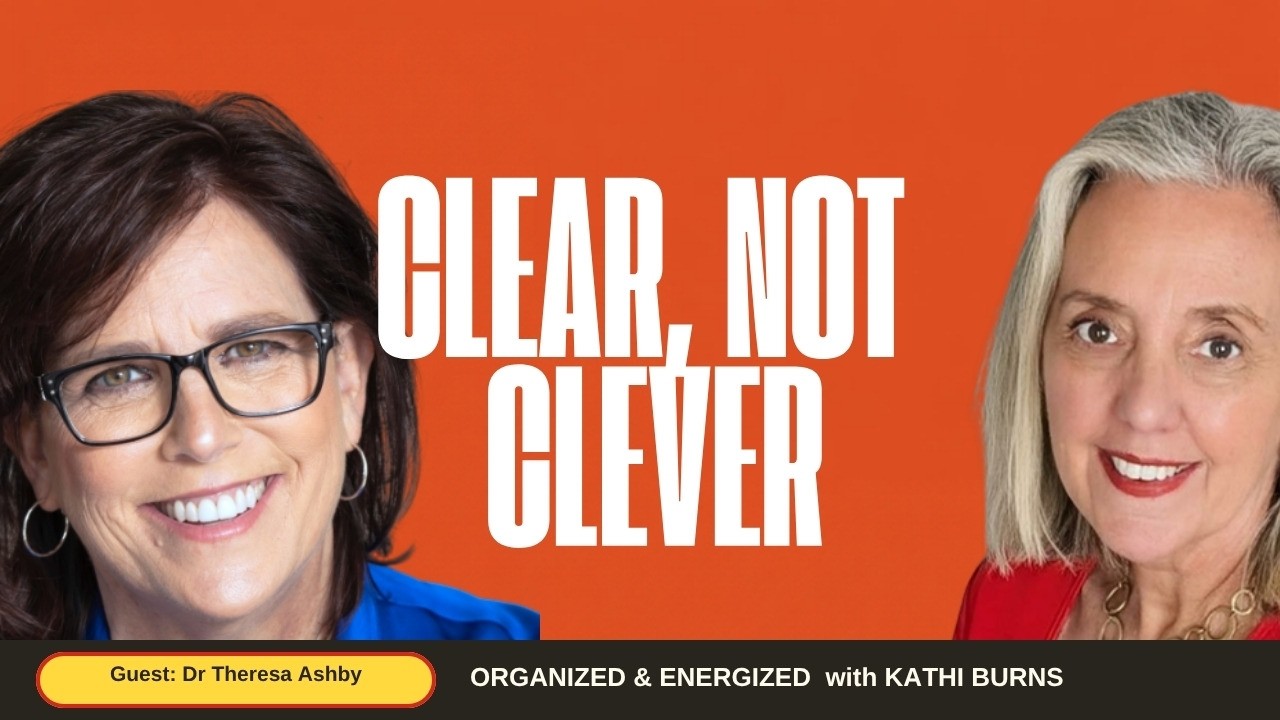
Episode 69
with Theresa Ashby, advisor, speaker and author known as The Business Oracle; co-founder of Kaleidoscope Media Services · March 15, 2023 · 26 min
Theresa Ashby went from vice president of operations over two hospitals to co-founding Kaleidoscope Media Services, which helps consultants and companies add digital products to their businesses.
One of her consulting clients replaced five of the ten hours spent with each executive with an online course taken in advance, charged the same fee and saved five hours per engagement.
Theresa advises asking people who have done what you want to do, very successfully, three clear questions instead of taking advice from whoever speaks loudest.
Before building a digital product, she says to decide why you want it and where it fits in your sales cycle, and to name it something clear, not clever.
Published · Updated
What is this episode about?
How do you create digital products that save you time without turning your service business into a course business? Kathi Burns, CPO®, Business FLOW Strategist, talks with Theresa Ashby, PhD, MBA, known as The Business Oracle and co-founder of Kaleidoscope Media Services. Theresa calls herself a recovering corporate executive: she was vice president of operations over two hospitals before she left to consult and started a company that helps businesses grow with e-learning. You'll hear how one consultant cut ten hours of in-person work with each executive in half while charging the same fee, why Theresa now takes advice only from people who have done what she wants to do and asks them three clear questions, where a free or low-priced product fits in your sales cycle, how to think about price, platform and name, and when it's time to stop offering something.
We are not helping people build a digital business. We help people build their business by adding digital products.Theresa Ashby
Jump to links and resources · Part of How do I get more clients? · All episodes · Every guest
What are the key takeaways?
- Theresa Ashby starts every digital product conversation with one question: why do you want it, since everyone else doing it is not a reason.
- A consultant client turned five of ten in-person hours into an online course with notes and downloads, charged the same fee and met executives who arrived prepared.
- Theresa learned to stop following the most confident or loudest voice and instead ask very successful people three specific questions tied to where her business is going.
- She says every service business needs a product, either a free one that builds know, like and trust or a low-priced one for people who can't afford the bigger packages yet.
- Don't set a price until you know what you're offering, don't pick a platform until you know everything the course includes, and give it a clear, not clever, name.
- Theresa separates building a digital business from building your business by adding digital products, which differ in what you create, how you price and the outcome.
- When an offer keeps bugging you, clients aren't loving it and it isn't bringing in revenue, Theresa says to stop and let it go.
This episode is brought to you by the Business Logjam Session
A private 75-minute online session with Kathi Burns to find the one thing holding your business back and leave with your next steps. It is the same F.L.O.W. process Kathi uses with her own clients: Focus on your goals, Locate your logjams, Outline your solutions, Walk away knowing your next steps.
Find What's Holding Me BackInterested in sponsoring the show? Get in touch.How does a hospital executive become a digital products consultant?
Theresa Ashby left her job as vice president of operations over two hospitals because she wanted to consult and help companies grow. In healthcare she worked on processes and systems designed backward from the patient, and she says the same applies to any business: figure out the end first. When she saw how much venture capital was going into platforms that let people create digital products, she joined forces with a business partner and started Kaleidoscope Media Services about five years before this conversation.
How can a digital product save a consultant time?
A digital product can replace part of the time you spend teaching clients in person. One of Theresa's clients spent ten hours with each executive. They built five hours of online lessons, with notes and downloads, that executives took first, then met for five hours. The client charged the same fee and saved five hours per engagement.
Whose advice should you take as an entrepreneur?
Take advice from people who have already done what you want to do, very successfully. Theresa found she was following whoever spoke last, loudest or most confidently. Now she gets clear on where her business is going, then asks those people three specific questions, because they have time for three questions, not a long chat.
Do you ask every mentor the same three questions?
No. Theresa changes her questions for each person and for each stage of her business. Early on there are basic questions to answer; later there's the tipping point of whether to hire, where she first gets clear on why she needs someone and what they'll do. When her company planned to launch several new products, she asked people who had launched products in the current market how they succeeded and what their barriers were.
How do you create digital products for a service business?
Start by deciding why you want one, then decide where it fits in your business model and sales cycle. Theresa says every service business needs a product. It can be a free product that builds know, like and trust, or a low-priced one for people who can't afford your bigger packages, leading them to your bigger offers.
How do you price, host and name an online course?
Decide what you're offering before you set a price, and decide everything the course will include before you pick a platform. Theresa says a single module or lesson costs less than a bigger course, and the price also has to fit your other packages. For the name, choose something clear, not clever. She also draws a line between building a digital business made of courses and building your business by adding digital products.
How do successful entrepreneurs celebrate their wins?
Theresa stopped doing one big celebration for each win, because the hype was followed by a letdown the next day. Instead she schedules time with her family and for things she loves on a regular basis, so she stays steady in her business rather than riding ups and downs. Her company also thanks employees for their work and does different things at different times of the year.
When should you stop offering a product or service?
Stop when it keeps nagging at you, clients aren't loving it and it isn't bringing in revenue. Theresa says people hold on to an offer because it's their baby, out of ego or because they don't want to disappoint others. When you let it go, she says, doors open to something bigger and better. Kathi calls this the letting go muscle.
Where does each part of the conversation start?
- 0:00 Meet Dr. Theresa Ashby
- 0:29 From hospital executive to digital products
- 4:10 Ten hours of coaching cut in half
- 7:32 Whose advice to take
- 9:02 Start with why
- 12:07 Where a digital product fits in your sales cycle
- 13:00 Pricing, platforms and a clear name
- 15:13 How she celebrates wins
- 16:50 Advice to her younger self
- 18:33 The calls that make it worth it
- 21:03 How to reach Theresa
- 22:18 When to stop offering something
- 25:10 Wrap-up
What resources were mentioned?
These episodes continue the same thread as this one: Sue Kirchner, Yvonne McCoy, Louise McDonnell, Allan Ngo also answer the question "How do I get more clients?", and the rest are the most recent conversations on the show.


 Social MediaEpisode 144
How To Use Social Media More Strategically In 2026 To Find New Customers with Louise McDonnell

See every episode on the podcast archive or filter by topic on the How do I get more clients? hub.
How can I support the show?
- Subscribe on Apple Podcasts, Spotify or YouTube, or add the RSS feed to any app.
- Rate and review. A rating on Apple Podcasts helps new listeners find the show, and Kathi reads every review.
- Share the episode with one business owner who needs it; the share buttons are at the top of the page.
- Grab a free eBook: 6 Steps to Organize & Energize Your Home, 6 Steps to Organize Your Home Office or 6 Steps to Organize & Energize Your Life.
- Work with Kathi. The Business Logjam Session is a private 75-minute session to find what is holding your business back.
- Be a guest. Apply here if you have a story about clearing the obstacles in your business.
What did they say, word for word?
The transcript below is edited for readability: filler words and false starts are removed and speaker names are added. Nothing was added or summarized.
Read the full transcript +
Kathi: Hi everyone, this is Kathi and I am back with Theresa Ashby. She is the founder and creator of Kaleidoscope Media Services. We're going to talk about digital products, how you can make some money and have some fun creating digital products, and I'm so happy to have Theresa here. So, welcome to the show.
Theresa: Thank you so much. I have been looking forward to this and our conversation.
Kathi: Awesome. Okay, so digital products. I know I have several and I know you probably also have several, but let's talk about the backstory. How did you get into this world of digital online marketing?
Theresa: Well, I'll tell you what, I always tell people I'm a recovering corporate executive. I spent years in corporate and then I left because, for me, I wanted to do a lot more consulting. I wanted to help companies really be able to do what they want to do. It's all about how do we move them forward and how do we grow our business. A lot of times we use the word scale, but it's a variety of things. And so I was like, what is out there in today's world that really can help people, first of all, organize and become efficient? And then, quite frankly, I looked where the money was going and I said, okay, if the venture capitalists are investing so much money on these platforms that allow people to create digital products, there's something there. So I was fortunate enough to join forces with a business partner, and that's how we started. Oh gosh, five years ago. Way before all this stuff that's been going on in the last three years.
Kathi: Yeah, absolutely. Now it's exploded. So, good timing. What did you do in corporate before this, Theresa?
Theresa: I was in healthcare and I was the vice president of operations over two hospitals. So I spent a lot of time really looking at processes, systems: how do we create efficiencies with the end in mind? It was about the patient. How do we serve that patient? If you back everything else up from there, that's how you decide where to go and what to do and how to make it happen. And I think that's the same for your listeners and also our clients. Figure out what the end is first.
Kathi: Well, you got out of that at the right time, didn't you?
Theresa: Yeah.
Kathi: Good for you, girl.
Theresa: I've been gone for quite some time, but I've stayed with my hand on the pulse, just because healthcare is a tough industry and there are a lot of people that we have to thank for everything that's been going on. I have many friends still in the industry and wow, they've done a great job. They're troopers, and God bless their souls.
Kathi: I have several friends and family as well that are in that. Yeah, it's been a tough one. We're all just moving past it, hopefully sooner than later.
Theresa: Yes.
Kathi: So tell me a story about a client: where they were coming from, how you helped them, what they developed. Give me that story to give some background here to the conversation.
Theresa: Sure. Well, I'll tell you what. Often we get the call from a client in this mode of, I've got to create this course. I've got to build this community. It's going too fast. What's going to happen? And we always stop and we say, "Okay, let's back up. Why? Just because everybody else is doing it doesn't mean that you need to do it. But why?" And so we back them up and we look at their entire business model and say, where is your future going, and where can you add that digital product so that you can grow your business? We had a client call us and it was the same situation. They were a consultant and they were like, "I just know I need to get into this business." And so we're like, okay, let's figure that out. They were spending a lot of time originally in front of their clients. They were teaching, they were consulting. And so we're like, "Okay, you're spending 10 hours doing this stuff. Could we create a digital product that allowed them to see you before you go in, spend about an hour on this digital product, and then spend an hour with them?" And of course, when we went virtual, we would call that office hours. So what we were able to do was take that 10 hours of being there in person all the time, with the person not being prepared, to creating something where it was five hours of a digital product, with the didactics and the learning and the lessons and the tactics, and five hours of being in person. So it accelerated people's opportunity for growth and coaching and consulting. And our client was able to charge the same thing, but it saved them time, like five hours.
Kathi: I love it. What type of product was it, or what type of consulting were they doing?
Theresa: They were doing a lot of consulting around helping executives be better executives. It wasn't really about the leadership; I can't say it was a leadership thing. It was about really honing in on who you are as an executive, and then being able to communicate that work with people, and how do you really engage your employees so that you're the executive that people really appreciate and respect.
Kathi: I love that. And so the executives were actually taking the online courses in advance. They were doing homework.
Theresa: Yes, they were doing the first hour before. So they had all the notes that they wanted. They had downloads, so they knew exactly what they were going to talk about. In fact, it's funny, because story is always important. We always tell people, create a story, or have your clients write a story about something that happened, and then we can learn and understand and learn lessons through those stories. So then when they came to do the hour in person or the hour virtually, they were already ready with all this information, so they could really grow and expand their understanding of how they can implement the work.
Kathi: That's fantastic. And that's what we're doing on this podcast: we're telling all of you out there listening the story of how that might work for you in your consulting business. How you might be able to replace the hours that you're spending actually in front of people, because that's the big challenge right now. Clients are spoiled. They like to see us in person a lot. So how do we wean them off of that and give them the same quality, or actually even better quality, consulting services? So, good job. So you've been doing this five years. What's the lesson that you feel you've learned, having gone from directing hospitals into being a solopreneur? What's the main lesson that you've had as a takeaway for yourself, or your aha moment?
Theresa: I love this question, because I think for entrepreneurs, female entrepreneurs, sometimes we tend to get in this mode of, I can do it all. I've got it all. So what I would do is I would be like, "Oh, yeah. Okay. They told me to go get advice, so I know I can't do it all." So then I would go out and I would ask people for all this advice, and then I would take the advice. But I was taking the advice of the last person that said something to me. And what I found is that it was the person that was the most confident in saying it, and the person that said it the loudest. And what I really learned was, no, it's not about going and getting advice from everybody. It's not about reading everything. It's not about overstudying it. It's about finding the people that have actually done it, who have been uber successful, and then you go to them with three questions that you have on your mind. And you ask them very clear three questions, because they have time for three questions. They don't have time to sit there and just have a conversation with you. Ask them those three critical questions, and then weigh it against what you want to do and what your end results are, and then take that advice. I just feel it's helped me so much more, personally and in my business, to be very focused.
It's about finding the people that have actually done it, and then you go to them with three questions that you have on your mind.
Kathi: That is spectacular advice. And I was on that track too, asking anybody and anything for anything, and then doing what they said without even really checking in or knowing the purpose. Half the time you just ask questions and you don't even know why you're asking questions. So why would you take the advice? But that's what we do, because we feel like we're a little island.
Theresa: Yes.
Kathi: And the idea of seeking out and finding the person who's been there, done that very successfully, and pinpointing who you want to ask advice from, I think is huge advice from you.
Theresa: Well, you know what? For me, I got really clear on the trajectory of my business and where I wanted it to go. That was where I got very centered and I knew exactly what I wanted to do. So when I did find that person I wanted advice from, it was very clear. I wasn't asking them, "What should I do with my business? I'm thinking I want to go here. I'm thinking I want to go here." No, it's, here's where I'm going. This is what I want to do. I want your advice on X, Y, and Z. And boom, boom, boom. And wow, what aha moments I would get, or I still get.
Kathi: That's fantastic. And so do you keep basically the same three questions, or did each one morph and you had a different question for a different person, depending on who it was?
Theresa: Absolutely different for who it was, and different times in my business. Because when you start out, there are just some basic questions you've got to understand. And then when you grow, especially at that tilting point for businesses, there's that next level when you go, do I hire or don't I hire? Do I hire or don't I hire? Okay, well, why do you want to hire? Get very clear on why you need someone and what they're going to do, and then seek advice around that particular trajectory. Obviously I have other people for when maybe I want to start a new product. We're launching several new products this year, and it's like, okay, we know the product we want, we know what we're thinking the outcome's going to be, but you know what? We're going to go ask people who have launched new products in today's market: how were you successful launching your product? What were your barriers? So it's very specific to where I'm going.
Kathi: And it changes all the time. The market changes so much that by the time you're ready to launch, it could have totally changed what people need, or how they're going to take in that information.
Theresa: That's right.
Kathi: If you had someone that was getting ready to start a digital product, I heard your first piece of advice is: why? That's a really good question. Why do they want that? What would a follow-up question be for someone who's out there thinking about it? Because I know we have listeners right now who are contemplating doing this.
Theresa: Definitely. So you're spot on with the why. Once you know the why, then it's, okay, where does it fit in your business model? And where does it fit in your sales cycle? So let's say you want to create this digital product, and you have your three packages, because it's always important to have three packages if you're selling them. If you're a service business, all service businesses need to have a product, too. And that's where the digital product comes in. But is this digital product to drive people to know, like, and trust you, as a free digital product? Or is it so you're creating an opportunity so they get to know, like, and trust you, and they're going to pay for it, because maybe they can't afford your bigger packages? But it's always going to drive them into something bigger with you. So that's the next question: getting very clear on what the trajectory is based off the digital product. Because that's the typical model.
All service businesses need to have a product, too. And that's where the digital product comes in.
Kathi: You have your free treat, your free entry, and then you have the low-priced offer.
Theresa: That's right.
Kathi: And what do you recommend the first low price be?
Theresa: So here's the thing: we get three main questions. What price? What platform? And the third one is, what do I name it? It's easy to know that. Don't price it until you know what you're offering, because if it's only one module, one lesson, it's going to be less. If it's bigger than that, it's going to be more. And it also has to be based on your other level of packages. And the platform: don't decide the technology until you know everything you're going to offer in your e-learning course. Technology is great. We have our own technology now, because people were trying to get all of this stuff, but we put you in the best platform based off of all these questions. It's very important. And what to name it? Something that is very clear and not clever. How's that?
Kathi: I like that. It's just like naming your company. Does your company say what you do?
Theresa: That's right. Clear and not clever.
Kathi: Clear and not clever. Clever never sells anything.
Theresa: That's right. Exactly. And if I may, I want to create some clarity, because I think something really muddies the water around this whole digital product thing. We're very clear: we are not helping people build a digital business. We help people build their business by adding digital products. I think that's where your listeners are. And there's a huge differentiator. It's different in what you build and create. It's different in the pricing. It's different in the outcome. And if you want to be where you're building just courses, then that's a whole different business model. I want you to figure out what it's going to do to help grow your business.
We are not helping people build a digital business. We help people build their business by adding digital products.
Kathi: Love it. Thank you. That's a really good clarification for those out there listening, for sure. So when you have a big win in your business, how do you celebrate your successes?
Theresa: You know what? I think about this a lot, and I realize that I don't go out and just go, oh my gosh, I had this big success. Here's what would happen: I would go out and I'd be like, yes, and have all this hype for myself, and then the next day I'd be all let down, like, okay, I feel like I'm starting anew. So what I decided is I am not going to do a single, sole success kind of celebration. What I'm going to do, and I'm very, very intentional about this: I make sure that I have time with my family and things that I love to do, and it's more constant, so I can stay constant and even in my business, versus that up and down. I was the person that put work first. I was just grinding it. I was out there, especially in corporate.
Kathi: Yeah.
Theresa: And I thought, wow, I couldn't take those ups and downs. So yes, we celebrate in the sense that we make sure our employees know, hey, thank you for your work, we appreciate it. And at different times of the year we do different things. But for me personally, it was really that constant of making sure I scheduled time to be thoughtful about what I needed.
Kathi: Okay. So, self-care on a regular basis.
Theresa: Yeah.

Kathi: If you had to look back at yourself when you were 18, and you were going to give her some advice and some words of wisdom, now that you're brilliantly wise, what would you tell yourself, Theresa?
Theresa: Oh, if I looked back at 18, boy, I'll tell you: obstacles are going to happen no matter what. Some of them are going to be big and some of them are going to be little. Just surround yourself with people that love you and that are going to support you, and people that are going to encourage you. And realize that every one of those obstacles… When I look back at some of the obstacles, some I made myself, some the world made. But wow, the lessons I learned and the stories I can tell and who I am now, it's really defined me in a really positive way. Sometimes I look back and I'm like, wow, now that I'm out of it, how grateful I am for that bump in the road that happened when I was 18 or 20. So just hang in there. It will get to the other side. And I think we just have to surround ourselves with people that love us.
Kathi: Yeah. Hang on over those bumps, because those bumps could just catapult you into a new place where you're like, "Wow, I can't believe I ended up here."
Theresa: Yes. Very good.
Kathi: And that leads me right into the next part of the podcast. Tell me about one of your most memorable successes, something where you think of this client and you just get a smile on your face every time.
Theresa: Oh, I think it's that phone call I get a year later, two years later, three years later, and I hear somebody on the other end. It's not about the particular accomplishment. It's the joy in their voice. It's the, "Hey, Dr. T, guess what?" Whether it's been a student of mine, whether it's been a client of mine, whether it's just been a friend of mine, they call me later and they're like, "You're not going to believe this." And they have this soulful voice. They have this energy in them. And it was maybe just one little thing that I said that, quite frankly, I might not even remember how I said it or exactly what I said. But I know when I say things, I mean them. I don't sugarcoat a lot. I don't tell you what you want to hear often. And when they can… I know you know this. I know you've had the same reaction. To me, that trumps everything.
Kathi: Yeah. When a client says, "And when you told me this," and I'm like, "Oh, I don't remember saying that." That's good. So happy.
Theresa: See, because you know why? I think if I remembered what I said when I get these calls, to me, what that's telling me is I'm very rote in what I'm doing. If I'm not remembering it and it affected them, I was in the moment. I was listening to them. I was deep in their thought, and I was asking the inquisitive questions, and I heard them and I listened to them, and I gave them that nugget that they needed at that time. To me, that's the most important part of all of this.
If I'm not remembering it and it affected them, I was in the moment.
Kathi: And it came as a direct download from you to them. That is the stuff that sticks, and some stuff is so simple. And it's like, oh wow. That's when you hit the mark. Just like what you said about the title of the digital product: it doesn't have to be snappy or zingy. It just has to be a direct hit to what you need to say. That's good. I like it. Okay. I know you have something to offer the listeners here. And for any of you that want to do digital, definitely listen to what Dr. T has to say for us right here. What are you going to offer them?
Theresa: Well, okay. First of all, I want everybody to know you can go to my website, kaleidoscopemediaservices.com. Go on there, you'll get a free download. But what I really want to offer everybody is, if they DM me, if they connect on either Facebook or LinkedIn and they say that they heard me on this show, and they have to say they heard me on this show, "Hi, Dr. T, I heard you," I will set up a 15-minute no-sales-zone chat, free. Let's just chat about your business, and I'll give you a couple of ideas during that chat where you could fit a digital product to help grow your business.
Kathi: That's huge.
Theresa: Yep. Facebook or LinkedIn. 15 minutes.
Kathi: You got it. On Organized and Energized! The Podcast, and you got a free 15 minutes. This is big. Wow. That's very generous. Thanks, Theresa. That's absolutely awesome. Okay, so we've talked about a lot. Is there anything that I should have asked you, that you'd like to talk about to the people here?
Theresa: Yes. One of the things that I think is so important, and this is not necessarily about digital products, but here's the thing, I think it's so pointed: stop doing the thing that you know you should stop doing but that you're holding on to. People start a project, people start selling a product or a service, and they started it and it's their baby. It's so important to them that we hold on to it because of our ego, or because we don't want other people to be disappointed in us. And I know I've done that. I know I've held on too long. But when you let it go, it's amazing. It's called just stop. Just stop doing it and move on. The doors will open to something that's bigger and better, more revenue for you. It's more fun for you to even consult or coach or lead. Just try it, and let the doors open for you.
Kathi: That's fantastic advice, for sure. More good advice from you, girl. And I call it the letting go muscle. Most of our letting go muscles are atrophied, and we just want to hold on tight because we have so much invested in whatever it is, whether it's an object or a project or a memory or a habit. Just let it go. If you get that niggly feeling, if it keeps happening over and over, it's like, oh, I don't know about this.
Theresa: Yeah. If the clients aren't loving it anymore, and you're not loving it, and it's like a pebble in your shoe that just keeps bugging you, and it's not generating revenue for you, and it feels old and stale: stop. Let it go.
Kathi: Fantastic. I love it. Okay. Well, I'm going to let you go. Not that you're bugging me at all. I think this is such a timely topic for right now. Everybody's shifting. Everybody's moving and zooming in different directions. And I know that if people call on you for your services, you're going to lead them down the right path. And make sure, folks, if you're out there thinking about it, that you do take advice from people who know what they're doing in the digital world. Because I know 15 years ago, I was creating all these digital projects just because I wanted to. I didn't have the why. I just had the "I love it." So make sure that you're on the right track with it. And I just really appreciate your time, Theresa.
Theresa: Absolutely.
Kathi: You've been a gem. All of you out there, check it out. Go ahead and say you listened to the podcast and get that free 15 minutes. That's worth a lot of money, so go ahead and do it. And thank you for your time, Theresa.
Theresa: Thank you so much. Take care. It's a pleasure.
Where can I find the links and resources from this episode?
Connect with Theresa
Organizations and companies
Inspired? Here Are Your Action Steps:
- Write down why you want a digital product before you build anything.
- List where you teach clients the same material in person, and mark what could become a course they take first.
- Decide whether your product is a free entry point or a low-priced offer, and which bigger package it leads to.
- Hold off on pricing until you know exactly what the product includes and how it compares with your other packages.
- Pick a platform only after you know everything the course will offer.
- Give your product a clear name that says what it does.
- Write down where your business is going, then pick three specific questions for someone who has done it very successfully.
- Schedule regular time with family and for things you love instead of one big celebration per win.
- Name one offer that clients aren't loving and that isn't bringing in revenue, and set a date to stop it.
Frequently asked questions
What are examples of digital products?
+
In this episode, the examples are an online course a consultant's clients take before their sessions, with notes and downloads, a free digital product that builds know, like and trust, and a low-priced product for people who can't afford bigger packages yet. Theresa Ashby also mentions clients who want to build a course or an online community.
How can a digital product save a consultant time?
+
One of Theresa's clients spent ten hours in person with each executive they coached. They built a five-hour online course the executives took first, then met for five hours. The client charged the same fee, saved five hours per engagement, and the executives arrived better prepared.
Whose advice should you take in business?
+
Not the loudest or most confident voice. Get clear on where your business is going, then find people who have done that very successfully and ask them three specific questions. They have time for three questions, not a long chat.
Where does a digital product fit in your business?
+
Start with why you want one. Then decide where it sits in your sales cycle: a free product that builds know, like and trust, or a low-priced one for people who can't afford your bigger packages yet. Either way, it should lead them to your bigger offers.
How should you price, host and name a course?
+
Don't set a price until you know exactly what you're offering, and don't choose a platform until you know everything the course will include. Name it something clear, not clever.
When should you stop offering something?
+
When it keeps nagging at you, clients aren't loving it and it isn't bringing in revenue. Theresa says people hold on out of ego or fear of disappointing others, and letting go opens the door to something better.
Who is talking in this episode?

About the Host, Kathi Burns
Kathi Burns, CPO®, is a Business FLOW Strategist based in San Diego. For the last 20+ years, Kathi has helped clients create systems they can stick to. She is the author of How to Master Your Muck, Organizing With Tetris and Home Organization, The Smart Guide, and co-author of four more titles; all are in Kathi's shop. Kathi's business has been featured on Good Morning America, and her advice has been featured in Oprah Magazine, Martha Stewart Living, Better Homes and Gardens and Entrepreneur Magazine.
More about Kathi · Shop Kathi's books · Business Logjam Session · Apply to be a guest

About Theresa Ashby
Theresa Ashby, PhD, MBA, calls herself a recovering corporate executive. She spent years in healthcare, where she was vice president of operations over two hospitals and focused on processes, systems and efficiencies designed backward from the patient. She left corporate to consult and, after seeing how much venture capital was going into course platforms, joined forces with a business partner to start Kaleidoscope Media Services, which helps businesses grow by adding digital products and e-learning. Today she works as an advisor, speaker and author known as The Business Oracle, with a focus on conscious leadership and business transformation, and she has spoken at TEDx Fargo. Her clients and students know her as Dr. T.
Want help putting this into practice?
Book a Business Logjam Session with Kathi
A private 75-minute online session to find the one thing holding your business back and leave with your next steps, using the same F.L.O.W. process Kathi uses with her own clients: Focus on your goals, Locate your logjams, Outline your solutions, Walk away knowing your next steps.
Prefer to start small? Download Kathi's free eBook 6 Steps to Organize Your Home Office.
Published · Updated
This episode page is for general information. Guests speak for themselves, and their opinions, statistics and examples are their own. Nothing here is legal, financial, medical or mental-health advice; talk to a qualified professional about your own situation. Some links go to the guest's own products or free offers; addSpace does not earn a commission from them unless stated.