

Episode 39
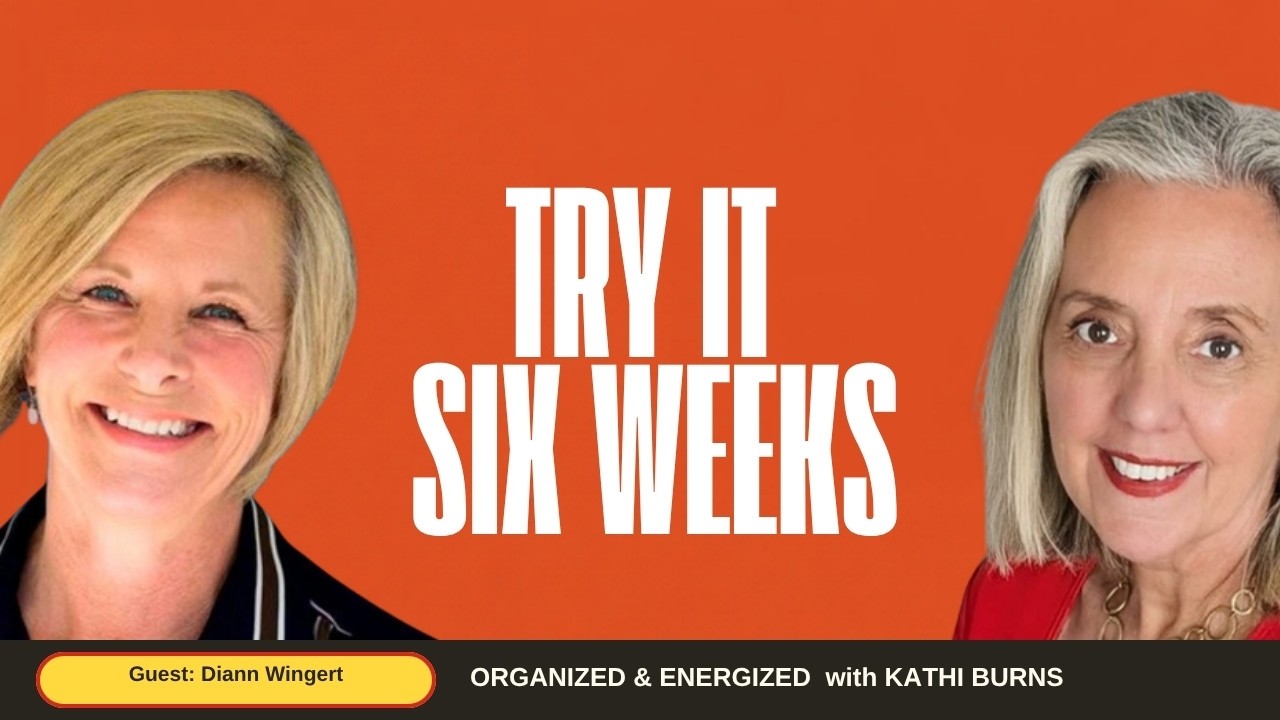
with Diann Wingert, former psychotherapist, business mindset coach and host of the ADHD-ish podcast · August 3, 2022 · 24 min
Diann Wingert spent about seven years in private practice as a psychotherapist before becoming a business mindset coach for women entrepreneurs.
She says coaching was not just a new title: therapy goes one session at a time and focuses on insight, while coaching maps the steps and deliverables between where a client is and where they want to be.
Diann no longer calls anything she has stopped doing a failure; she treats it as complete.
She tries new interests in renewable six-week experiments, such as cello, fencing or improv, instead of overcommitting money and time.
She plans her business by looking at the whole year and working in 90-day sprints, which she says is how she reached 100 podcast episodes.
Published · Updated
What is this episode about?
How do you think like an entrepreneur when your training taught you to think like a therapist? Kathi Burns, CPO®, Business FLOW Strategist, talks with Diann Wingert, who worked in medical sales, became a clinical social worker through UCLA, became clinical director of a large nonprofit agency and then opened her own therapy practice. After about seven years she realized she'd rather talk about possibilities than problems, and became a business mindset coach for women entrepreneurs. You'll hear what her very first coaching client taught her, why she says letting go is a muscle, why she calls the things she has left behind complete rather than failed, how six-week experiments let her try new things without overcommitting, the free inbox app she uses to tame subscriptions, and how she plans the year in 90-day sprints.
When it no longer is aligned with the person you are becoming, it's going to hold you back.Diann Wingert
Jump to links and resources · Part of How do I grow my business without burning out? · All episodes · Every guest
What are the key takeaways?
- Diann thought moving from therapy to coaching meant a new title, new pricing and moving online; her first client showed her it was a new professional identity.
- In her view, therapy is usually insight- and process-oriented, while coaching focuses on where a person wants to get, how long it will take and the deliverables at each step.
- Diann says that when something no longer fits the person you are becoming, you owe it to yourself to become complete with it and release it, and nobody else can give you that permission.
- Kathi Burns calls letting go a muscle and starts clients with physical clutter because it is the easiest thing to let go of.
- The best advice Diann was given was to change her relationship with failure; she used to try only things she knew she'd be good at, which kept her skills narrow.
- She now signs up for renewable six-week experiments and either renews them or calls them complete.
- Diann uses Unroll.me to combine email subscriptions into one daily digest, and plans with a year calendar on the wall plus 90-day sprints.
This episode is brought to you by the Business Logjam Session
A private 75-minute online session with Kathi Burns to find the one thing holding your business back and leave with your next steps. It is the same F.L.O.W. process Kathi uses with her own clients: Focus on your goals, Locate your logjams, Outline your solutions, Walk away knowing your next steps.
Find What's Holding Me BackInterested in sponsoring the show? Get in touch.Can a therapist become a business coach?
Yes. Diann Wingert did it after about seven years in her own therapy practice, once she realized she was more interested in talking about possibilities than problems. She had worked in medical sales, trained as a clinical social worker at UCLA and been clinical director of a large nonprofit before she started calling herself a coach.
How is coaching different from therapy?
Diann says therapy goes one session at a time and is usually insight- and process-oriented, while coaching is goal-oriented. She expected to keep doing what she knew with a new title, new pricing and an online setup. Her first client, who had already worked with another coach, showed her she needed to map where the person is, where they want to be and the deliverables in between. She then invested in coach training and certification.
How do you let go of things that no longer serve you?
Give yourself permission, because nobody else can. Diann says that once something no longer fits the person you are becoming, whether it is a career, a business, a hobby or a relationship, you owe it to yourself to become complete with it and release it. Kathi calls letting go a muscle that gets easier the more you use it.
Is quitting a business a failure?
Diann doesn't think so. She no longer calls a business she has closed, or anything she no longer does, a fail. To her, the real fail is holding on to things that are out of alignment and resenting them because letting go feels like it says something bad about you. She says the same mindset made it easier to leave Los Angeles and to move again.
How do you start thinking like an entrepreneur?
For Diann, thinking like an entrepreneur started with changing her relationship with failure. She used to try only things she knew she'd be good at, which kept her skills narrow. Now she runs renewable six-week experiments, like cello or fencing lessons. If she likes one she renews; if not, she calls it complete.
What holds women entrepreneurs back?
Diann's quiz, What's Holding You Back?, looks at six common behavior traits among female entrepreneurs; usually one of them is the key culprit, and addressing it helps the others fall into place. Takers learn which trait is theirs and get a short series of four emails with tips and strategies. She compares that trait to a pebble in your shoe: you still get places, but it hurts more than it needs to.
How do you get your email inbox under control?
Diann's favorite organizing hack is Unroll.me, an app that rolls your email subscriptions into one daily digest instead of having each one arrive on its own. You can unsubscribe from any of them inside the app and send the important ones back to your inbox. She says it saves her a lot of time and that it's free.
How do you plan your business year in 90-day sprints?
Diann looks at the entire year to plan the big picture, then works in 90-day sprints. She used to look only at her to-do list and daily calendar and was always running late. Launches, books and conferences need more than 30 days' notice, so she keeps a year calendar on the wall and looks at it every day. She credits this longer view with reaching her 100th podcast episode.
Where does each part of the conversation start?
- 0:00 Meet Diann Wingert
- 0:37 From therapist to business coach
- 2:37 Her first coaching client
- 4:41 No regrets, no mistakes
- 6:58 Letting go is a muscle
- 8:19 Complete, not failed
- 11:04 Change your relationship with failure
- 13:31 Six-week experiments
- 15:55 What's holding you back
- 17:19 A pebble in your shoe
- 17:58 Her inbox hack
- 19:10 Plan the year in 90-day sprints
- 22:16 Wrap-up
What resources were mentioned?
These episodes continue the same thread as this one: Lia Dunlap, Carly Church, Ginny Priem, Stephanie Wall Morrow also answer the question "How do I grow my business without burning out?", and the rest are the most recent conversations on the show.

 MotherhoodEpisode 147
How To Build a Village That Supports Your Business and Your Life with Carly Church


See every episode on the podcast archive or filter by topic on the How do I grow my business without burning out? hub.
How can I support the show?
- Subscribe on Apple Podcasts, Spotify or YouTube, or add the RSS feed to any app.
- Rate and review. A rating on Apple Podcasts helps new listeners find the show, and Kathi reads every review.
- Share the episode with one business owner who needs it; the share buttons are at the top of the page.
- Grab a free eBook: 6 Steps to Organize & Energize Your Home, 6 Steps to Organize Your Home Office or 6 Steps to Organize & Energize Your Life.
- Work with Kathi. The Business Logjam Session is a private 75-minute session to find what is holding your business back.
- Be a guest. Apply here if you have a story about clearing the obstacles in your business.
What did they say, word for word?
The transcript below is edited for readability: filler words and false starts are removed and speaker names are added. Nothing was added or summarized.
Read the full transcript +
Kathi: Hi everyone. I am back and I am with my girl pal Diann Wingert, and we are here to talk about business, getting down to business. How to get business done from a psychotherapist's perspective. So welcome, Diann. Don't be scared.
Diann: And I will say that I am a former therapist, now business mindset coach, but it really does come in handy, because wherever you go, there you are. And most of us are still dealing with stuff that we learned in childhood, in our lives and in our business.
Kathi: Yep, you got it. There we are. So, tell us about your story. How did you become this business mindset coach, and why did you shift over to the dark side of online coaching?
Diann: Oh, it's so funny that you use that term, because I think a lot of my former therapist colleagues really felt like I'd sold my soul to the devil when I started calling myself a coach. So, yeah, I just joke about that now. To tell you the truth, I had a previous career in medical sales, and then I had an early midlife crisis. Went back to grad school at UCLA and became a clinical social worker. I did that for a long time. I loved it. I was good at it. But as I crawled up the food chain, I eventually was the clinical director of a large nonprofit agency and found myself in a harassment situation, because the CEO I reported to was incompetent and unethical, and I am an outspoken, smart female. So that was a little bit problematic, and I decided at that point in time I needed to work for myself. I opened a therapy practice, and after about seven years, Kathi, I realized I am much more interested in talking about possibilities than problems. I think I've done my time as a therapist. If what you really need is someone to help you reach your goals, you are much better suited to a coach, and that really suits the person I've become over time.
I realized I am much more interested in talking about possibilities than problems.
Kathi: I totally agree. Don't talk about what doesn't work. Let's talk about what can work and what the possibilities are. I'm with you on that, big time. Moving forward, instead of rehashing the past, I think is a good thing. So that's a leap in a way. I mean, it makes total sense, and I'm sure you were really clear about it. Talk about the first client that you got when you decided to make that shift and go into actual coaching of possibilities for your clients.
Diann: I really underestimated what a big change it was, to be quite frank. I thought, I have all this education, all this training, all these years of experience helping people deal with problems. I literally thought I was going to change my title and change my pricing structure and go from face to face in a beautiful office to online, and I'm just going to keep right on. I was very wrong about that. Because with therapy, you go one session at a time. It's usually not goal-oriented. It's usually insight- and process-oriented. So in order to become a successful coach, I really needed to think differently about: this is where the person is, this is where they want to be. What are the steps and pivots and landmarks along the way that we need to reach? And to be focusing on deliverables and not just insight. So I really was not prepared for that very first client, who had already worked with a previous coach. I wouldn't say it was an epic fail or anything, but it really helped me understand: no, this is a total transformation of my professional identity and way of helping. This is not just a pivot. So I actually went and invested in a lot of coach training and certification after that, because helping a person one hour at a time is very different than recognizing where they want to get, how long it's going to take to get there, and all the things you need to accomplish and the deliverables that you need to create at each step along the way. It's much more like a curriculum than a journey. And that was a big change for me, and it took a little bit of getting used to.
Kathi: Yeah, I can see that totally. So if you had to do it over again, would you still go through the processes that you went through, through all of your career iterations? Would you have skipped one? Would you have jumped right into something else? How do you feel about the journey of your progression?
Diann: It's a really good question. I don't think anyone's ever asked me that in an interview before. I have just made it a promise to myself at this stage of my life to have no regrets and to consider nothing a mistake. Everything that I have done has served me in some way. If you offered me a magic wand and said, based on where you are now and what you've learned along the way, is there anything you would have skipped or done differently? I think I would have done all the same things. I would have done them for less time. And there was a very important transformation inside of me that needed to take place. And it's one of the things I help my clients with now: by the time you realize that something you're doing doesn't fit the person you are becoming, you owe it to yourself to become complete with that thing and release it. Whether it's a relationship, a career, a business, a hobby, a friendship, a lifestyle, whatever it is, it could be anything. But when it no longer is aligned with the person you are becoming, it's going to hold you back. And I was not so good about giving myself permission to let something go and to move on, because frankly I got pushback from people who told me that was selfish. And who are you to think that you deserve something different, something better, something more? Now, I fully honor that I am a person who is on a path of continuous personal evolution, and that I actually owe it to myself, my loved ones, and the people I hope to serve to honor that. But it took some getting used to, and I ultimately had to empower myself with that belief. It wasn't like anyone else was going to give me permission to go there.
When it no longer is aligned with the person you are becoming, it's going to hold you back.
Kathi: No, you just get the naysayers. But I always say letting go is a muscle. And for most of us, the letting go muscle is atrophied. And letting go is scary. But the more versed and the more experienced you are at letting go, the easier it is to let things fall off that no longer serve you. That's why I actually start on the surface level of clutter, because that's an easy thing to let go of, compared to other things. But letting go is a hugely important thing. And I think so too because it's change. We're all going to change anyhow, so why not let go and move into the change that's coming your direction, instead of holding tight against the wind?
Diann: You know, Kathi, it's so much easier. As a matter of fact, I started doing this once I realized, oh, it's not that you didn't know you were ready to move on. It's that you weren't giving yourself permission to let go. It was like I was waiting for other people to acknowledge that it was okay. They can't do that.
Kathi: Yeah. They don't know it's okay for you. You're the only one that knows it's okay, and they don't know it's okay for them in most cases.
Diann: So I needed to understand. I no longer think of a business that I've closed as a fail. I never think of anything that I've done and I no longer do as a fail. What I think is a fail is when we hold on to things that are no longer in alignment and no longer serve us, and we actually resent them, and we don't give ourselves permission to release them because we think it means something bad about us that we want to. I've let go of that belief.
Kathi: Amen and hallelujah to that. Yeah, that is the fail. I agree. Things change and move all the time, and there's no failure. So we shift. And right now, look at a great majority of us, especially as women, who have shifted completely out of what we were doing into something completely new, because guess what? We had the space and time to do it. And if life happens and you've got this unexpected space or time that you never had before, that's the time to shed off all that other stuff.
Diann: You and I are absolutely like-minded. I'm very grateful that I let go of my previous career, that I gave myself permission to leave Los Angeles, which had been my home all of my life, and moved three years ago to a city where neither my husband nor I knew anyone. Now we're about to move again. If I had not cultivated this muscle of letting go, which became the muscle of resiliency, I wouldn't be able to do this with grace and ease. Oh, it's inconvenient. I hate packing and turning off the utilities and all that as much as anybody. But it's so much easier on me because I have cultivated this letting go in other areas of my life.
Kathi: And to be able to let go of these, it makes you excited about what's to come. It builds that excitement, because it's no longer a dread or a fear thing. It's like, I wonder what that's going to be like. What's the next chapter going to look like?
Diann: Right. That's where I'm coming from. I'm not afraid. I'm not worried. People are like, well, it didn't work out in Portland. Aren't you worried it's not going to work out where you're going? I said, to be honest with you, that never crossed my mind.
Kathi: It did work out. You just realized that it wasn't what you wanted. So, thank goodness you found that out, instead of 20 years later when you did have friends and then you're like, "No, I wasn't really liking it the whole entire time, but I stuck to it."
Diann: Not for me. No, not at all.
Kathi: Okay. So what do you think is the best piece of advice that anybody's ever given you? Could be business or personal.
Diann: The best piece, and this actually goes really in line with everything that we're talking about, Kathi. The best piece of advice I have ever been given is to change my relationship with failure. Because even though I'm speaking in a very impassioned way about my resiliency and my willingness to let things go, and how everything's an adventure, and I refuse to see anything as a fail, and I have no regrets, all of that is a very intentionally cultivated mindset that has taken me a number of years. The previous Diann, Diann 1.0, would stick with things much too long, and would actually only attempt something that she knew she would be good at. I just was not on to myself. Previously in my life, I thought, well, I'm going to do things that I already know I'm good at, because that's the fast track to being successful. I mean, why not go with your gifts, right?
Kathi: Right.
Diann: And that was true up to a point, but the subtle side of it was I was also skillfully avoiding whole entire areas of living and learning that I might have come to enjoy, that would have developed different aspects of myself, and I avoided them. I steered real clear of them because I wasn't going to be good at them, at least not right away. And I interpreted that in the past as meaning that I had weaknesses or limitations, that it meant I was no good at something, and that was intolerable. So I just avoided those things. Well, as you can imagine, that kept my range of developed skills and abilities pretty narrow. I have swapped that for this belief: okay, change your relationship with failure. What does that mean? Instead of thinking if I do something and I don't stick with it, it's a fail, it was an experiment. It was an adventure. So instead of going headfirst into whatever my new obsession was, spending a ton of money, a ton of time, and alienating everybody else because it was all I talked about obsessively, now I do six-week experiments. I will sign up for six weeks of cello lessons, six weeks of fencing lessons. I'll take six weeks of improv or six weeks of whatever, instead of doing the deep dive and then burning out on it and later going, awkward. Now I consider everything I do an experiment, and it's a renewable six weeks. So if I like it for six weeks, I'll sign up for another six weeks. If I don't, I'm complete with it, and then I go try something else. That allowed me to not have to limit myself to only doing things that I would be good at automatically, because you really aren't going to get good at anything in six weeks, but you could at least get a feel for whether you'd like to stick with it long enough to get good at it.
Now I consider everything I do an experiment, and it's a renewable six weeks.
Kathi: I love that six-week idea. That's very cool. I might have to make it into a program, huh? My next program is six weeks.
Diann: Perfect.
Kathi: We're going to get it gone in six weeks, kids.
Diann: Perfect. Perfect. Perfect.
Kathi: But that's funny. I like that idea, though. I'll take painting for six weeks. I'll take fencing for two six weeks. I love that. I'm going to carry that one through.
Diann: Yeah. And it's not just clever, Kathi. There's also solid neuroscience behind it, because you and I know that it takes the brain about six weeks to actually start to form the neural pathways of new habits, whether it's getting rid of one or starting a new one. So with six weeks, you've given yourself a shot at something, and you're not being grossly unrealistic either way.
Kathi: Thanks for validating that.
Diann: Oh, you're so welcome.
Kathi: All the time, it's four to six weeks to change your ways. I'm always saying that you're not going to change your ways in four weeks. They think even four weeks, and that's even cutting it pretty close. Six weeks is the thing. Okay. Thank you. Love a little science. Love a little science.
Diann: It's just science.
Kathi: Okay. So tell me about the valuable free resource. You have something that you're going to offer the listeners here that they're going to grab on to quickly and benefit from.
Diann: Absolutely. Well, if you like the sound of my voice and what I have to say with it, you should absolutely come follow the Driven Woman podcast and listen to me over there. But the free resource I have to share right now is I just put together an updated version of my quiz called What's Holding You Back? There are six common behavior traits among female entrepreneurs, and there's usually one of them that is the key culprit, and if they address that one, the others start to fall into place. So I'll give you a link to the quiz, What's Holding You Back. They get identified which of the six is them, and then they'll get a short series of four emails that give resources, tips and strategies for how to get ahead of it so they can start moving forward.
Kathi: That's awesome. That's completely customizable for everybody. So I'm going to jump into that, too. I think everybody needs it, because we all have something that's holding us back. So we might as well get to the bottom of it, baby.
Diann: Everybody. Yeah. Everybody. And that's because we are growing and expanding. If we were not growing and expanding, there'd be a whole other set of things.
Kathi: But for us female entrepreneurs who are out there rocking the world, it's really good to pinpoint what the potential road bump is. Not roadblock, but what's the bump in the road, right?
Diann: You know what I think? You and I both like using analogies and metaphors, so I'll tell you mine. When you have one of these things holding you back, it's not like you're not going places, because you are. It's not like your car is out of gas and you're broken down by the side of the road and you don't have AAA, and oh, woe is me. It's more like you have a pebble in your shoe. You will still get places, but it'll be more painful than it needs to be. I say get the pain out faster.
It's more like you have a pebble in your shoe. You will still get places, but it'll be more painful than it needs to be.
Kathi: Yeah. Get that rock out of your shoe. Get that rock out of your shoe. I love that. Okay, that's great. So, we have to talk about an organizing hack. I'm sure there's something that you use that you absolutely love that would be your favorite hack for staying organized.
Diann: You know what? I have so many, so it's really unfair to pick one, but I'm going to tell you about one that maybe not everybody already knows about, and that is an app called Unroll.me. Unroll.me is a really nice hack for getting on top of your email inbox. It puts your subscriptions into a digest where you get one a day, instead of every single thing that you subscribe to coming individually. So instead of having 150 emails, you have one digest. You can also unsubscribe from any of those right in the app. And you can choose to put any of them that are really important and singular back in your inbox. It saves me so much time, and it's free.
Kathi: Love it. Love it. Unroll.me. We will definitely put that in the show notes below, gang, so you can just click-ity click and make it part of your regime. I like that. That's awesome. Okay. So what else should we talk about? Anything that I've missed asking you that we should be discussing on this brilliant podcast? Because I love our conversations. I mean, we could sit and talk forever, but what shall we talk about?
Diann: I'd say something that I have definitely changed, Kathi, in the last year is I was always just looking at the dirt under my feet. Meaning, I was winging it. I'm very passionate. I'm very energetic. I have lots of ideas. And I always just felt like I could make things up, literally one day at a time. It took me a long time to realize that's not the best strategy when you have big goals, big dreams and big plans. For example, I just released the 100th episode of my podcast. I would never have been able to do that if I hadn't started thinking bigger picture and more organized. So even though this is probably not necessarily new to you or maybe your listeners, I only work in two ways now: either looking at an entire year to plan out the big picture, and then I look at 90-day sprints. I used to just look at what I've got to do today. I didn't even look at the whole week at a glance. That was too much for me. It was just my to-do list and my daily calendar. I was always running late and missing the boat. So I trained myself over time to do 90-day sprints and to actually look at the entire year at a glance, because for the big things, the programs we want to launch, the book we want to write, the conferences we want to go to, 30 days ahead of time isn't enough. If you want to get the best, most affordable flights, the best price for the conference registration, all that, you really do need to train your time horizon to be further in the future. And I have ADHD, so my time horizon was just like today. But I've learned that you can stretch it by having visual aids, like a year calendar on the wall that you go and look at every day. Just to look: okay, here's where I am, and here's where I'm going. And then my plan is 90 days at a time. I did not invent this. I didn't create it. There's lots of people way smarter than me who teach this in detail, but I don't think I realized until just a couple of years ago how important and transformational it really is to look at your life in a bigger chunk of time.
Kathi: Absolutely. And a year is definitely the minimum that you would forecast out, really looking at, okay, what's that year going to lead me to? What's going to happen the next year? But that's really good. A lot of people love the visual with the board on the side that actually just has everything. It's very helpful for people to have that visual cognition on a daily basis to see what's up.
Diann: Yeah. And if it's a whole year, it's kind of hard to ignore, because it takes up a lot of wall space.
Kathi: Exactly. It's a giant Sharpie write-up, right? A giant whiteboard. Well, I think that's really good advice. And for all of you women out there who are struggling or just saying, why are things not working? Just use a few of the tips that we've talked about today. There's even the basic Unroll.me. Whatever you're going to do, just implement something, and as our very smart, savvy guest Diann says, keep at it for six weeks before you ditch it. Make sure that it's something that does or does not work. If it does not work, feel free to flip it out the door. But if you don't try it for six weeks, you won't really know.
Diann: So yeah, six weeks is magic. Don't overcommit and then feel embarrassed because you spent too much money, too much time, and you ignored the rest of your life. Commit for six weeks and then reassess it. It's a game changer.
Kathi: Yeah, absolutely. Well, this has been eye-opening as usual, and I really appreciate you being on the show. And everybody, check out Diann's podcast as well. It is called The Driven Woman.
Diann: And you will soon be a guest, so they can come and listen to you over there.
Kathi: The Driven Woman, because I am driven, as are all of us listening. You wouldn't be listening to this if you weren't also a driven woman. So check out that podcast as well. Anyhow, signing off for now. Love you all. Thank you, Diann.
Diann: Love you, too.
Kathi: And we will see you next week. Bye for now.
Diann: Bye for now.
Where can I find the links and resources from this episode?
Connect with Diann
Organizations and companies
Inspired? Here Are Your Action Steps:
- List one thing in your life or business that no longer fits the person you are becoming.
- Give yourself permission to let it go instead of waiting for someone else to say it's okay.
- Practice letting go on physical clutter first, since it is the easiest place to start.
- Call the things you've stopped doing complete, not failed.
- Pick a new interest and sign up for six weeks only, then decide whether to renew.
- Roll your email subscriptions into one daily digest and unsubscribe from the ones you don't read.
- Put a full-year calendar on your wall and look at it every day.
- Plan your big launches, events and projects in 90-day sprints.
- Take Diann's What's Holding You Back? quiz to find the trait that slows you down.
Frequently asked questions
Can a therapist become a coach?
+
Diann Wingert did. After about seven years in her own therapy practice she became a business mindset coach for women entrepreneurs. She says it was a bigger change than she expected, and she invested in coach training and certification after her first client.
Isn't coaching just therapy with a different name?
+
Diann thought so at first and found out she was wrong with her very first client. In her experience, therapy goes one session at a time and focuses on insight. Coaching starts with where someone is and where they want to be, then maps the steps and deliverables in between.
How to start thinking like an entrepreneur?
+
Diann's answer in this episode is to change your relationship with failure. Instead of only doing things you already know you're good at, treat new things as experiments. She signs up for six weeks at a time and either renews or calls the experiment complete.
What does Diann mean when she says you have to give yourself permission to let go?
+
She says that when something no longer fits the person you're becoming, whether it's a job, a business, a hobby or a relationship, you owe it to yourself to become complete with it and release it. She used to wait for other people to say it was okay, and learned they can't do that for you.
How does Diann plan her business?
+
She used to look only at her daily to-do list. Now she looks at the whole year, keeps a year calendar on the wall, and works in 90-day sprints. She says that longer view is what let her reach 100 podcast episodes.
Who is talking in this episode?

About the Host, Kathi Burns
Kathi Burns, CPO®, is a Business FLOW Strategist based in San Diego. For the last 20+ years, Kathi has helped clients create systems they can stick to. She is the author of How to Master Your Muck, Organizing With Tetris and Home Organization, The Smart Guide, and co-author of four more titles; all are in Kathi's shop. Kathi's business has been featured on Good Morning America, and her advice has been featured in Oprah Magazine, Martha Stewart Living, Better Homes and Gardens and Entrepreneur Magazine.
More about Kathi · Shop Kathi's books · Business Logjam Session · Apply to be a guest

About Diann Wingert
Diann Wingert, MSW, is a business strategist and former psychotherapist who coaches entrepreneurs, and the creator of the ADHD-ish Method. She worked in medical sales before going back to graduate school at UCLA to become a clinical social worker. She rose to clinical director of a large nonprofit agency, then opened her own therapy practice. After about seven years she realized she was more interested in talking about possibilities than problems, and she became a business mindset coach for women entrepreneurs, investing in coach training and certification after her first coaching client. Her podcast, first called The Driven Woman Entrepreneur, is now called ADHD-ish, and she had just released its 100th episode when she recorded this conversation.
Want help putting this into practice?
Book a Business Logjam Session with Kathi
A private 75-minute online session to find the one thing holding your business back and leave with your next steps, using the same F.L.O.W. process Kathi uses with her own clients: Focus on your goals, Locate your logjams, Outline your solutions, Walk away knowing your next steps.
Prefer to start small? Download Kathi's free eBook 6 Steps to Organize & Energize Your Life.
Published · Updated
This episode page is for general information. Guests speak for themselves, and their opinions, statistics and examples are their own. Nothing here is legal, financial, medical or mental-health advice; talk to a qualified professional about your own situation. Some links go to the guest's own products or free offers; addSpace does not earn a commission from them unless stated.